Among the letters of the New Testament, 1 Corinthians 13 stands out as a compact, piercing meditation on what it means to live a life shaped by divine virtues. Often titled the Love Chapter in many English translations, this short but dense passage moves beyond clever rhetoric or ecstatic displays of power to ask a basic question: what is left when all gifts, abilities, and achievements are weighed against the measuring rod of love? In this sense, the chapter offers a condensed theology of faith, hope, and love that has guided countless believers and readers across centuries.
The phrase that many know by heart—“now these three remain: faith, hope, and love; and the greatest of these is love”—is more than a collection of ethical maxims. It is a theological claim about the ordering and purpose of the Christian life. The article you are reading seeks to explain the meaning of 1 Cor 13, tracing its language, historical setting, literary shape, and practical implications. We will explore how faith, hope, and love relate to one another, why love is described as the strongest force, and how readers can apply these truths in personal character, church life, and social action.
Historical context: Paul, Corinth, and the early church
To appreciate the message of 1 Corinthians 13, it helps to situate it within the letter’s larger concerns. Paul writes to a diverse church in a cosmopolitan city known for its philosophical debates, religious pluralism, and internal tensions. The Corinthians grapple with disagreements about spiritual gifts, leadership, morality, and how the gospel should translate into everyday living. In that setting, the apostle’s aim is not merely to correct doctrinal error but to redirect the moral imagination toward what holds lasting value.
In the opening chapters of 1 Corinthians, Paul emphasizes the supremacy of the gospel over flashy displays—whether in tongues, prophecy, or knowledge. By the time he reaches the famous poem about love, he shifts from argument to exhortation, from a debate about signs to a vision of character. This transition reveals his conviction that the true mark of maturity in the church is not possession of extraordinary gifts alone but the cultivation of virtuous dispositions that reflect God’s own character.
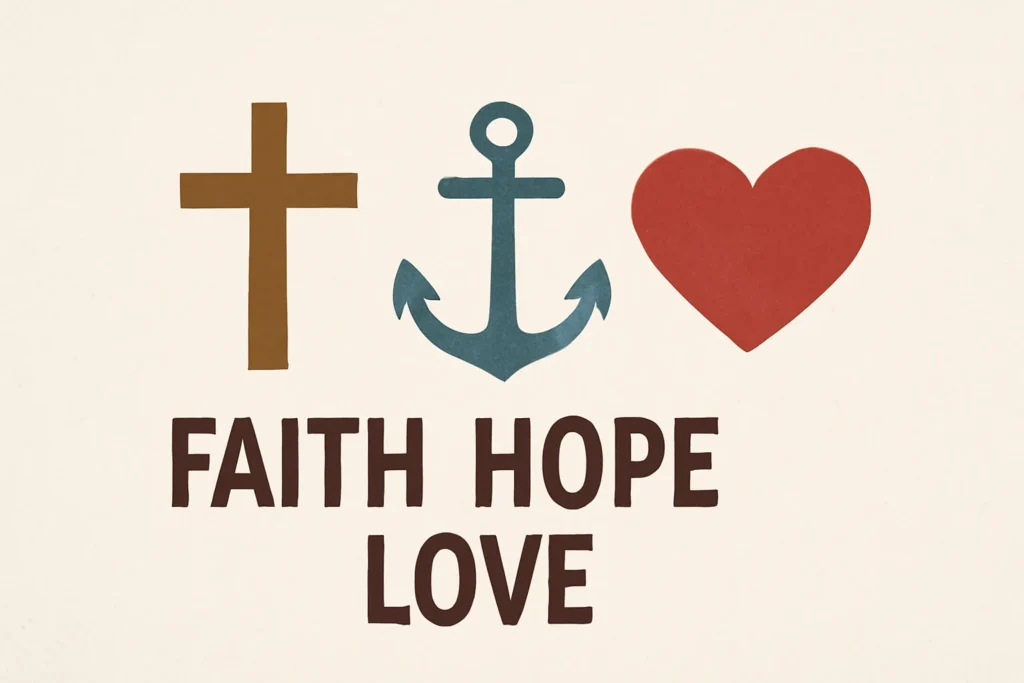
The core triad: faith, hope, and love
Faith (Pistis): Trusting the God who creates and sustains
In biblical terms, faith is more than mental assent; it is trust in the reliable character of God revealed in Jesus Christ. In the context of 1 Corinthians, Paul treats pistis as the foundation of the believer’s relationship with God, shaping how a person behaves toward others, especially in moments of trial or uncertainty. Faith is the posture that says, even when circumstances are unclear, the God who promised is faithful. This trust becomes concrete when it translates into patience, perseverance, and a willingness to persevere in love when outcomes are not guaranteed.
Hope (Elpis): Expectation rooted in God’s promises
Hope in the New Testament sense is not a vague wish but a confident expectation grounded in God’s promises and the coming fullness of God’s kingdom. In 1 Corinthians 13, hope keeps the believer oriented toward what God will accomplish—transformation, restoration, and the ultimate defeat of all that destroys human flourishing. This hope does not erase present pain, but it reframes present reality by anchoring it in the certainty of God’s redemptive plan. The virtue of elpis encourages patience, endurance, and faithful witness in difficult times.
Love (Agape): The governing force in ethical life
The term here is agape, a self-giving, others-centered love that seeks the good of others without calculating the cost or benefit to oneself. In the Pauline corpus, agape is not merely an emotion or a sentiment; it is a transformative force that shapes decisions, speech, and actions. For Paul, love is the supreme virtue because it embodies the charity God shows toward humanity. In practical terms, love translates into acts of kindness, refusals to retaliate, and a willingness to bear with others even when it is hard. The passage argues that love is not passive or merely sentimental; it is active, discerning, and resilient.
Love as the greatest virtue: why this sequence matters
A striking claim in 1 Cor 13 is that love transcends even the most spectacular gifts. A person may speak with the eloquence of angels or have prophetic insight and yet be described as hollow if love is absent. This is the core argument: gifts and abilities, while valuable, are temporary and easily misused without the shaping force of love. The sequence—faith, hope, and love—does not diminish faith or hope; rather, it clarifies their end: they serve the person and community most fully when oriented by love.
What it means for practical Christian living
If faith is trust in God, and hope is confident expectation of God’s promises, then love is the energy that translates belief into tangible practice. Paul’s argument implies that communities should evaluate actions and priorities by their love quotient, not by the sheer display of spiritual sensations. In contemporary life, this means evaluating plans, policies, and priorities by how they contribute to the flourishing of others, especially the vulnerable.
Lexical and theological notes: Greek terms and translations
Greek terms: pistis, elpis, agape
The original Greek text uses three key words: pistis (faith), elpis (hope), and agape (love). Each term carries a depth that sometimes differs from English equivalents. Pistis can refer to trust, fidelity, and allegiance. Elpis embeds anticipation and confident expectation rooted in God’s faithfulness. Agape denotes a self-giving love that seeks the best for others, often at personal cost. In many English Bibles, the phrase is rendered as “faith, hope, and love,” but some older translations use “charity” for agape, which can illuminate the sense of active benevolence but may obscure the breadth of the term as the Greeks used it.
Across history, translators have chosen different words to render the same ideas. The old King James Version uses charity for agape, highlighting generosity but sometimes suggesting mere almsgiving rather than a comprehensive virtue. Modern translations typically render the trio as faith, hope, and love, with love capturing the expansive sense of agape in the Pauline corpus. Readers should note how the chosen translation shapes interpretation: agape as a lived ethic does not merely feel kindly toward others; it manifests in concrete actions, even when inconvenient.
Literary form, structure, and rhetorical shape
Poetic meditation and a liturgical cadence
The passage is often understood as a poetic meditation embedded in a longer exhortation. Its rhythm and cadence resemble a choric or liturgical piece: a sequence that builds from simple descriptions to increasingly demanding claims about the nature of love. The rhetorical intensity helps readers feel the weight of the claim that love, not mere skill or certainty, becomes the ground of lasting community and faithful witness.
Triadic structure and its implications
The triad of faith, hope, and love is not a random listing but a deliberately balanced framework. Each term contributes a distinct dimension to the life of a community. In Paul’s argument, these three are united yet distinguished: faith anchors trust in God, hope anchors expectation for God’s future, and love compels present ethical behavior toward neighbor. The famous line that the greatest of these is love places love at the apex of moral vision precisely because it incarnates the other two in visible, transformative ways.
Practical applications: how to cultivate faith, hope, and love
In personal life: cultivating character and resilience
Faith as daily trust: cultivate a rhythm of prayer, instruction, and reflection that reinforces trust in God’s character during ordinary days and storms alike.
Hope as forward-looking perseverance: maintain a posture of hopeful expectation, especially when the present experience seems contradictory to God’s promises.
Love as a disciplined practice: practice patience, kindness, humility, and forgiveness in relationships with family, friends, coworkers, and strangers.
In community life: shaping churches and organizations
Lead with love in decisions about governance, discipline, and outreach, so that power and privilege do not eclipse care for the vulnerable.
Teach and model faith as trust in God that yields reliability and integrity in leadership and mission.
Encourage hope by articulate future-oriented vision—what God intends for the world and for the church—while remaining present and faithful in the meantime.
In public life: social virtue and communal flourishing
Let love drive public ethics: implement policies and practices that protect the dignity of every person and promote justice, mercy, and peace.
Balance faith and hope with humility: recognize the limits of human planning and the need for God’s ongoing action in history.
Encourage communities to celebrate differences while embodying love that binds, forgives, and reconciles.
Contemporary relevance: lessons for today
The lessons of 1 Corinthians 13 are not confined to abstract ethics or ecclesial seminars. They speak to the heart of how communities endure, how leadership is measured, and how individuals find meaning in the face of suffering. In a world with rapid change, the triad of faith, hope, and love offers a framework for navigating moral complexity. Love remains not merely a feeling but an active orientation toward others that can bridge divides, heal wounds, and create spaces of trust. In personal journeys, readers may notice that genuine hope grows as a hopeful trust in God’s future is tethered to generous, patient, and courageous acts in the present.
Common questions and misunderstandings
Is love more important than faith?
The phrase “the greatest of these is love” does not minimize faith or hope. Rather, it clarifies that faith and hope reach their full and visible significance when transmuted into love. In other words, faith that does not express itself in love becomes inert, and hope that does not translate into acts of care loses its moral force.
Paul’s broader argument in the surrounding chapters is that spiritual gifts, while meaningful for building up the church, must be measured by love. Gifts without love do not accomplish God’s purposes; love is the calibration by which gifts gain their true value. Thus, the instruction on faith, hope, and love sits within a larger critique of superiority complexes within the church—an appeal to prioritize communal flourishing over personal prestige.
How does this passage apply to non-Christians?
Even for readers outside the Christian faith, the triad of faith (as trust in a trustworthy reality), hope (as a forward-looking orientation toward a good future), and love (as a robust practice of benevolence) can serve as a universal ethical framework. While the content of faith may differ across traditions, the emphasis on love as the most transformative virtue often aligns with many moral intuitions about human flourishing.
Frequently discussed themes and cross-references
Charity and virtue ethics in the broader Pauline corpus
In Paul’s letters, agape appears as the defining virtue that grounds all other ethical actions. Across the epistles, love is the motive, the fruit, and the end of the Christian life. This resonates with other biblical writers who speak of love as the fulfillment of the law and the sign of genuine discipleship.
Love in liturgy and wedding culture
The resonance of 1 Corinthians 13 in weddings and devotional readings demonstrates how its theological content translates into daily life practices. The passage’s emphasis on patience, kindness, and endurance translates into vows and commitments that couples and communities cherish even when romance yields to routine. The cultural reception of this text demonstrates its enduring appeal as a guide for relational ethics.
Conclusion: living out the meaning of 1 Cor 13
The message of 1 Corinthians 13 invites readers to reframe success, achievement, and spiritual experience through the lens of love. It is a call to cultivate a life where faith anchors trust in God, hope sustains perseverance, and love compels generous, merciful, and just action toward others. Far from reducing faith to sentimentality or hope to passive expectation, Paul’s poem elevates love as the dynamic force that makes all other virtues transformative. In practice, this means nurturing communal life that embodies patience, kindness, humility, and endurance; pursuing personal holiness that is visible in acts of service; and engaging with the world in a way that reflects God’s gracious, seeking love for every neighbor.






Leave a Reply