3 Point Sermon on Faith: A Practical Guide to Strengthening Your Trust
3 Point Sermon on Faith: A Practical Guide to Strengthening Your Trust
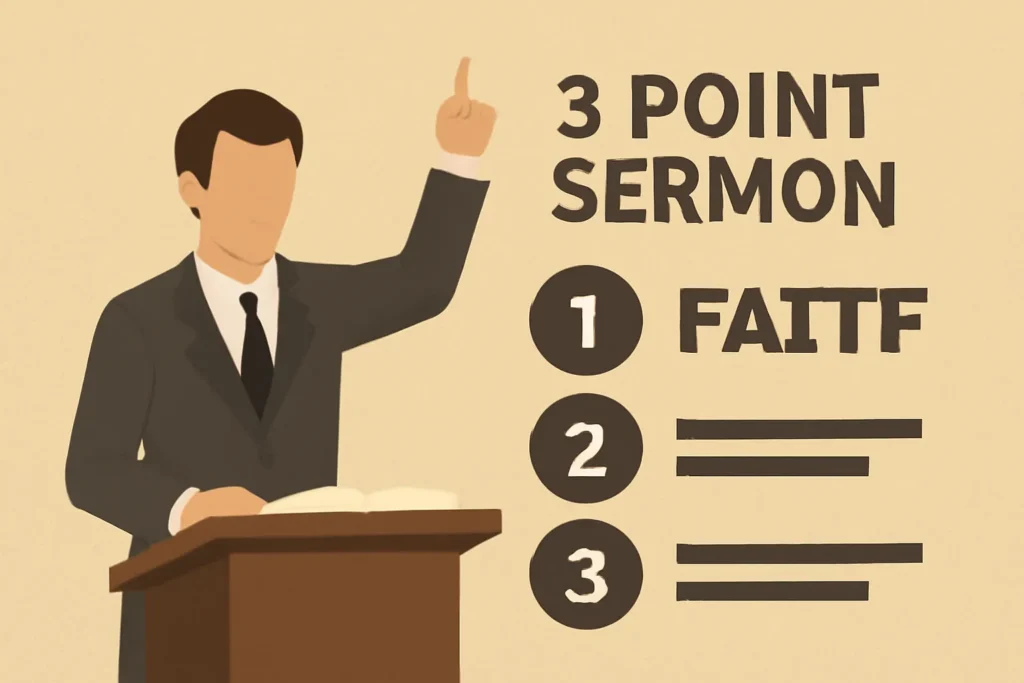
Three-Point Sermon on Faith: A Practical Guide to Strengthening Your Trust is a primer for readers who want a clear, repeatable method for growing in trust. This article presents a structured, three-point approach that can be used in personal study, small groups, or public teaching. By focusing on three core dimensions—trust, practice, and action—you can build a durable framework for faith that remains relevant in daily life, even when circumstances are challenging.
Understanding the Concept: What a Three-Point Sermon on Faith Tries to Do
At its heart, a three-point sermon on faith aims to distill the complexity of faith into three coherent, consumable steps. This approach is valuable for readers who crave clarity, a reproducible path, and concrete outcomes. Much of Christian preaching and teaching has used triads or threefold frameworks because they align with how people remember and apply information. In this guide, we explore three central components that together form a practical pathway for strengthening trust: trust in what cannot be seen, the integration of belief with everyday living, and courageous faith that translates into action.
Point One: Faith as Trust in the Unseen
In a three-point sermon on faith, the first point anchors faith in the essential act of trusting what is unseen. This is not a denial of evidence or reason, but a recognition that much of life rests on realities beyond what we can measure or immediately prove. The biblical record repeatedly invites believers to place confidence in God’s character, promises, and presence, even when circumstances are opaque.
Definition and Biblical Foundation
Faith as trust in the unseen is the conviction that reality is more than what the eyes can detect. It is a posture of reliance on God’s faithfulness, grounded in Scripture and personal experience. The classic definition in faith literature highlights confidence in what we hope for and assurance about what we do not see. While this description appears in Hebrews 11, its echo runs throughout the biblical narrative—from Abraham leaving Ur to the Israelites crossing the Red Sea—and into modern testimonies of trust under pressure.
Practical Steps for Point One
Name the unseen realities. Make a daily habit of noting at least one unseen truth you choose to trust—God’s presence, His promises, or His love—despite visible uncertainty.
Journal your doubts and promises. Maintain a faith journal where you record doubts alongside scriptural or experiential reminders of God’s faithfulness.
Practice guided reflection. Use a short daily rhythm (5–10 minutes) of silence, a verse, and a prayer that expresses trust in what you cannot yet see.
Cultivate consistency of trust. Build a routine in which moments of fear or confusion become triggers to reaffirm your confidence in God’s character rather than surrender to fear.
Seek corroboration through community. Share your faith journey with a trusted friend or mentor who can remind you of God’s faithfulness when you feel uncertain.
Examples and Practical Applications
When a health diagnosis is uncertain, a Three-Point Sermon on Faith might encourage you to affirm God’s goodness, even while you seek medical clarity.
In financial strain, you practice trust by budgeting with integrity and trusting God to provide beyond your projection.
In relationships strained by conflict, you choose to trust God’s work in the other person and in your own response, rather than insisting on your way.
Point Two: Faith in Practice—Lived Belief in Daily Life
The second point of a three-point framework for faith emphasizes that genuine faith becomes evident in daily choices. It is easy to talk about faith in theory; the real test is how beliefs shape decisions, actions, and relationships when no one is watching. A practical sermon on faith invites readers to translate belief into behavior, aligning their routines with the promises they claim to trust.
Definition and Biblical Foundation
Faith in practice is belief translated into action. It is not passive; it is proactive. The Bible presents faith as obedience informed by trust—yielding to God’s guidance, even when the route is unclear. This is reflected in callings to forgive, to serve, to give, to pursue righteousness, and to seek justice. The narrative arc of faith in Scripture shows people moving from inner conviction to outward demonstrations of trust.
Identify everyday actions that reflect trust. List three daily habits—such as prayer, generosity, and integrity—that visibly show your faith to others.
Align routines with promises. If you claim God’s provision or guidance, adapt your schedule and choices to reflect reliance on those promises.
Practice delayed obedience. When God nudges you toward a difficult but right action, choose obedience even if it costs you something in the short term.
Engage in acts of service. Serve others with the understanding that service reinforces dependence on God’s strength, not your own cleverness.
Study practical Scripture for living. Focus on verses that address everyday decisions—finances, time management, family, and work—and write notes about how to apply them.
Examples and Practical Applications
Choosing to forgive someone who has harmed you, even when bitterness feels justified, demonstrates faith in the transforming power of grace.
Showing generosity toward those in need, when you have limited resources, is a test of trust in God’s provision.
Speaking truth with kindness in a difficult conversation reflects faith in God’s justice and mercy more than the comfort of maintaining appearances.
Point Three: Faith That Moves—Courage, Courageous Action, and Perseverance
The third element of a robust threefold faith framework involves action that demonstrates courage and perseverance. Faith is not merely interior conviction; it is a dynamic force that propels you forward into difficult assignments, risky ventures, and ongoing endurance. This is where faith becomes transformative not only for the believer but also for the communities around them.
Definition and Biblical Foundation
Faith that moves refers to the kind of trust that leads to bold steps—stepping into the unknown, choosing courage over fear, and continuing to trust God during hardship. The biblical witness is filled with stories of giants of faith who faced obstacles and chose action rooted in belief—often in the face of fear, uncertainty, and opposition.
Practical Steps for Point Three
Set courageous goals. Identify one area—personal, relational, or vocational—where you will take a bold step this week or month, trusting God for the outcome.
Develop perseverance routines. Create a plan for staying the course during slow or painful seasons, including accountability, rest, and spiritual nourishment.
Lean into community for encouragement. Build a support network that will pray with you, challenge you, and remind you of God’s faithfulness when you falter.
Practice resilience through small, meaningful choices. Even minor commitments to faithfulness compound over time, producing significant outcomes.
Celebrate progress and learn from setbacks. Document lessons learned and milestones reached to fuel ongoing motivation.
Examples and Practical Applications
Taking a risk in a new service project or ministry, and trusting the process even if the results are uncertain.
Advocating for a moral or ethical stance in a difficult environment, driven by the conviction that truth and justice are worth pursuing.
Enduring a season of hardship with hope, using the time to deepen character and strengthen relationships with others.
Variations on a Three-Point Sermon on Faith: Expanding Semantic Breadth
To make faith teaching more accessible or adaptable for different audiences, you can rephrase the same three-point structure using a variety of terms. Here are several variations that preserve the core logic while improving semantic breadth for sermons, studies, or articles:
Threefold Faith Model: Trust, Practice, Move. A compact way to describe the same journey in faith using different language.
Triadic Faith Approach: Belief, Behavior, Boldness. Emphasizing the progression from conviction to conduct to courageous action.
Three-Step Faith Plan: Hold, Heal,Help. Each step captures a stage in growing trust that leads to communal impact.
Three-Component Faith Framework: Assurance, Alignment, Action. Focused on inner assurance, alignment with God’s will, and outward action.
Three-Phase Faith Pathway: Perception, Participation, Perseverance. A pathway that begins with how you perceive God and ends with steadfast endurance.
In practice, you can adapt titles, slide deck headings, or teaching handouts to use these variations while preserving the core ideas. For example, a workshop might present “Threefold Faith Model: Trust, Practice, Move” as the core curriculum, then branch into the same subpoints under each term. This flexibility is especially valuable for adult education, youth ministries, or interfaith dialogues where different audiences respond to different vocabularies.
Practical Application in Daily Life: Turning Theory into Habit
A robust three-point sermon on faith is not merely theoretical; it invites ongoing transformation. The following practical applications help transform the sermon into daily life and personal growth.
Morning reflection: Start your day with a brief prayer or affirmation focused on trust in God’s presence and care.
Midday check-in: Take a short pause to assess how your actions align with your stated beliefs and promises from Scripture.
Evening gratitude: End the day by naming at least one thing you observed that reminded you of God’s faithfulness, no matter how small.
Weekly Practices to Support the Three Points
Sabbath-style rest to reflect on seven days of trust and to re-commit to the three-point path for the coming week.
Group accountability sessions where peers share testimonies of trust, practical steps taken, and the outcomes of courageous actions.
Journaling prompts that focus on unseen realities, lived belief, and bold steps—prompting you to articulate how faith informs every domain of life.
Journaling Prompts and Memory Work
Copy out a promise you want to trust and write a short paragraph describing how you would live if that promise were fully true in your life today.
Choose a life area where you feel fear or hesitation. Write three ways your faith could guide you to act, even if results are uncertain.
Memorize a verse or passage that speaks to trust in God, especially one that your community commonly refers to during trials.
Common Challenges and How to Overcome Them
A three-point sermon on faith is a noble aim, but real paths of trust encounter obstacles. Here are some frequent challenges and practical responses to keep your journey robust and resilient.
Challenge 1: Doubt and Uncertainty
There is a difference between doubt and unbelief—doubt can be a temporary pause that leads to growth, while unbelief is a settled stance. Respond with curiosity, questions, and a commitment to continue acting on what you understand to be true, even while you seek further clarity.
Challenge 2: Fear When Acting on Faith
Fear often masquerades as prudence. Learn to differentiate between prudent caution and fear-driven paralysis. In practice, you can move forward with small steps, accumulating evidence of God’s faithfulness to encourage bigger steps later.
Challenge 3: Burnout or Weariness
Perseverance requires sustainable rhythms. Build rest, community accountability, and spiritual nourishment into your routine so that endurance becomes a learned habit rather than a heroic exception.
Challenge 4: External Pressure and Opposition
When culture or peers push against your faith, stay grounded in your three-point framework. Remember that the aim is not to win every argument but to live consistently in a way that honors God and serves others.
Advanced Applications: Teaching, Preaching, and Group Studies
People learn in different ways. The three-point sermon on faith can be adapted for lecture formats, small groups, or interactive Bible studies. Here are some approaches to maximize impact:
Sermonized talks: Deliver the material with clear transitions between points, using stories and analogies to illuminate each dimension—trust, practice, and movement.
Small-group discussions: Break into triads to discuss each point, share personal experiences, and pray for one another to live out the three points in practical ways.
Workshop sessions: Use exercises and role-plays to practice the behaviors associated with each point, such as bold decision-making, conflict resolution, and acts of service.
Curriculum design: Create a multi-week program that introduces the three points gradually, with assignments, reflections, and community challenges between sessions.
Conclusion: Embracing a Practically Strengthened Trust
In sum, a three-point sermon on faith—whether framed as “Trust in the unseen,” “Faith in practice,” or “Faith that moves”—offers a durable, practical navigation for living with greater trust. By grounding belief in unseen realities, translating faith into consistent daily practice, and cultivating courageous, persevering action, you create a virtuous circle: trust leads to living, living reinforces trust, and ongoing acts of trust produce lasting transformation. The variations on this theme—threefold faith model, triadic faith approach, and three-step plan—are not competing theories; they are complementary expressions of the same essential truth: faith is a journey from inward conviction to outward change, guided by God’s promises and sustained by community.
Whether you are preparing a sermon, leading a study group, or seeking to strengthen your own inner life, this practical guide to a three-point approach on faith can help you articulate a clear path and walk it with integrity. Remember that faith does not need perfect conditions to begin. It requires a decision to begin, a willingness to be honest about your doubts, and a commitment to take the next faithful step—one day at a time.











Leave a Reply