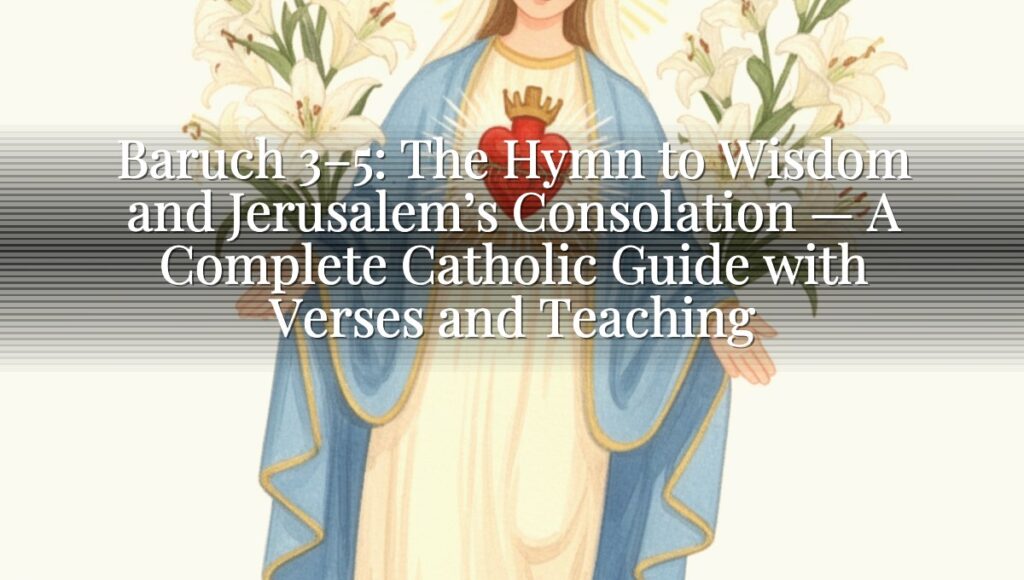
Baruch 3–5: The Hymn to Wisdom and Jerusalem’s Consolation — A Catholic Guide to The Book of Baruch
Introduction
The Book of Baruch, though often overlooked in casual study, holds a vital place in Catholic spirituality and redemptive history. Chapters 3–5 are especially cherished in Catholic tradition for presenting a luminous hymn to Wisdom and a poignant consolation of Jerusalem after the exile. In the New American Bible Revised Edition NABRE, these chapters invite readers to trust in divine wisdom amid suffering and to recognize God’s fidelity to the covenant people. For Catholics, Baruch provides a bridge between the wisdom literature of the Hebrew Scriptures and the lived experience of exile and return, reminding us that wisdom is not only a concept but a personal encounter with the living God. Reading Baruch 3–5 fosters prayer, repentance, hope, and a deeper sense of God’s provident care in history and in our own lives.
What is The Book of Baruch?
Historical context: The Book of Baruch is a deuterocanonical writing in the Catholic Bible, positioned among the writings after the prophets and before Ezekiel in most canonical orders. It is not part of the Hebrew Bible and is not included in Protestant canons. The work is generally understood to reflect themes from the post-exilic period, addressing the destruction of Jerusalem and the long road to restoration. The central voice in the text is traditionally associated with Baruch ben Neriah, the scribe of the prophet Jeremiah, though modern scholarship often treats Baruch as a composite work whose final form likely emerged in the 2nd century BCE.
Authorship and canon: While the name Baruch anchors the tradition, the exact authorship is debated. The Catholic Church, however, holds the work as canonical and inspired, while acknowledging that its precise historical authorship may be complex. In the Catholic canon, Baruch is considered one of the deuterocanonical books, accompanying others such as Tobit, Judith, Wisdom, Sirach, and 1–2 Maccabees. This status is affirmed by the long-standing teaching of the Church and the formal declarations of the Councils, notably Trent, and subsequently reflected in the universal usage codified in NABRE and liturgical practice during the life of the Church.
Catholic canon: The Catholic Church cardinally recognizes Baruch as part of Sacred Scripture in the Old Testament. Its inclusion is reinforced by the Church’s magisterial teaching, including the Council of Trent (16th century) which defined the canon, and Vatican II’s Dei Verbum, which confirms the inspiration and canonical status of the deuterocanonical books. For apologetics, one may explain that canonical status rests on authentic apostolic tradition, early Church usage, and the teaching authority of the Church, not merely on historical authorship alone.
Most Important Verses from The Book of Baruch
Baruch 3:9–14 — The wisdom hymn invites all who seek wisdom to turn toward God, highlighting the accessibility of wisdom to those whose hearts are humble and contrite. Catholic interpretation emphasizes wisdom as a divine gift that leads to true understanding and conversion.
Baruch 3:16–20 — The reader is urged to seek Wisdom with reverence, noting that true knowledge comes from the fear of the Lord. This aligns with Catholic teaching on prudence and moral discernment rooted in reverence for God.
Baruch 3:24–29 — Wisdom is depicted as present and near to those who call on God. Catholics see this as a manifestation of divine providence inviting human agents into a living relationship with the Word of God.
Baruch 3:30–37 — The text underscores the universality of God’s call and the personal appropriation of divine wisdom, a theme echoed in Catholic anthropology: humanity’s deepest longings find their fulfillment in God who speaks through wisdom.
Baruch 4:1–4 — Jerusalem is exhorted to cling to the law and to recognize that the path of wisdom leads to restored identity, echoing Catholic teaching about the law’s enduring relevance for the people of God.
Baruch 4:21–22 — The exile has an end, and the exiled community is invited to return with joy. This ties into Catholic eschatological hope rooted in God’s faithfulness and restoration.
Baruch 4:23–30 — Theme of repentance and conversion as the pathway to consolation; Catholics interpret this as a call to fidelity to God and to the covenant, with trust in divine mercy.
Baruch 4:31–37 — The promise that God’s saving act transcends present difficulties; the Church sees this as a sign of spiritual and national restoration in light of God’s promises.
Baruch 5:1–4 — Jerusalem’s radiance and the sign that nations will witness the light of God’s people; Catholics view this as a prophetic vision of the Church’s mission to illuminate the world with divine wisdom.
Baruch 5:5–9 — A final exhortation of hope and trust in the God who gathers the dispersed and leads His people home; this aligns with Catholic teaching on God’s providence and the eschatological consolation of Jerusalem and God’s people.
Across these verses, Baruch 3–5 presents a consistent pattern: the appeal to seek Wisdom, the consolation of those who suffer, and the hopeful restoration of God’s people under His providence. The NABRE translation preserves the nuances of the original language and the ecclesial use of these texts in Catholic liturgy and catechesis.
What the Catholic Church Teaches
The Catholic Church holds that Baruch is a canonical and inspired book within Sacred Scripture. This position is grounded in the broader Catholic teaching on Sacred Scripture as inspired and as the Church’s rule of faith and life. The Council of Trent affirmed the canon, including Baruch, as part of the Sacred Scriptures. Vatican II’s Dei Verbum reinforces that all that the Catholic Church regards as revealed truth is contained in the canonical books of Scripture, including the deuterocanonical books. The Catechism of the Catholic Church explains the nature of Scripture and the place of the Old Testament within salvation history, acknowledging the deuterocanonical books as part of the canon (for example in sections addressing the formation of Scripture and the church’s use of these writings in teaching, prayer, and worship).
For apologetics: how to respond to those who deny this point — emphasize that canonical status rests on apostolic witness, early Church usage, and the magisterial teaching of the Church, not merely on human authorship or historical critical debate alone. Point to the Church’s define-and-preserve role in distinguishing canonical books (including Baruch) and the continuity of their reception in liturgy, patristic writings, and Catholic doctrine. Distinguish between scholarly debates about authorship and the Magisterium’s teaching about inspiration and canonicity, which Catholics hold as authoritative for faith and morals.
This Book in Church History
Saints and theologians who engaged with Baruch contributed to its patristic and medieval reception. The Latin Church’s formulation of the canon in the Council of Trent relied on long-standing usage and authoritative tradition that embraced Baruch as canonical. Jerome, who produced the Vulgate, included Baruch in the Latin canon, reinforcing its place in Catholic worship and study. Augustine and Origen, among the early Fathers, referenced Baruch’s themes in their exegesis and moral teaching, helping to shape a Catholic understanding of exile, repentance, and wisdom as God’s gift. In the modern era, Vatican II reaffirmed the Church’s approach to Scripture, and the NABRE edition remains a primary Catholic Bible used for study, catechesis, and liturgy, including Baruch 3–5 as part of the Old Testament readings and the prayer life of the Church.
Is Baruch part of the Catholic Bible but not in the Protestant Bible? Yes. Baruch is deuterocanonical and is included in the Catholic Old Testament; it is not part of the Protestant canon.
Who wrote Baruch? Traditionally Baruch son of Neriah is linked to the scribe of Jeremiah, but modern scholarship often sees the book as a composite work likely finalized in the 2nd century BCE.
When was Baruch written? The exact date is uncertain; most scholars place its final form in the period after the exile, around the 2nd century BCE, with older material in Baruch 1–2 and 3–5 shaping the present text.
What is the significance of the Hymn to Wisdom in Baruch 3–4? It presents Wisdom as a divine gift and companion for those who seek God, illustrating a Catholic emphasis on wisdom as a gift that leads to truth, conversion, and fidelity to the covenant.
How should Baruch 3–5 be read in Catholic life? As a text that invites conversion, trust in God’s fidelity, and hope for God’s restoration, especially in times of suffering, exile, or uncertainty. It is read in light of Christ and the Church’s interpretation of Wisdom as God’s Word made known to the people.
Closing Prayer
Prayer to Wisdom and Consolation
Lord God, you are the source of all wisdom. Open our hearts to the gift of your divine wisdom as Baruch invites us to seek you, repent, and hope in your faithfulness. Help us to live as your light-bearing people, to trust in your promises, and to comfort those who endure exile of spirit or circumstance. May the example of Jerusalem’s restoration in your mercy strengthen our faith and our call to mercy toward all who suffer. Through Christ our Lord, who is the Wisdom made flesh. Amen.








Leave a Reply