You may be looking for a Bible verse with reflection because a familiar situation has left you worried, tired, grateful, or unsure what to do next. The right verse can give you more than a comforting sentence: it can help you pause, understand your response, and consider how faith shapes your next step.
A useful reflection does not force a verse to say whatever you want. It begins with the verse’s main idea, connects that idea with your circumstances, and ends with a practical response or prayer. Read slowly, ask an honest question, and give yourself enough quiet to notice what the passage brings to mind.
A Bible verse becomes more meaningful when you consider its context, message, and application together. Context asks what is happening around the verse. The message asks what the passage reveals about God, people, wisdom, suffering, hope, or faithful action. Application asks how that truth may shape your attitude or behavior today.
Reflection is different from simply searching for a sentence that confirms your first reaction. If you feel angry, for example, a verse about justice may matter, but it should not be used to justify cruelty or revenge. A careful reflection allows Scripture to comfort, challenge, correct, and guide you.
The best passage for reflection is not always the one that sounds most familiar. A short verse may be memorable, while a nearby paragraph explains its meaning more clearly. Reading a few verses before and after your chosen reference can prevent misunderstandings and reveal details you might otherwise miss.
Use the verse as an invitation, not a shortcut. A Bible verse with reflection should help you listen carefully and respond wisely; it should not be treated as a guarantee that every difficult situation will resolve immediately.
A strong reflection usually includes four elements:
The setting: What situation, speaker, audience, or problem surrounds the passage?
The central truth: What does the verse emphasize about God, faith, character, or human responsibility?
The personal connection: Where does this truth meet your present thoughts, choices, or relationships?
The response: What prayer, action, conversation, or change in perspective follows?
These elements keep reflection grounded. They also make a passage useful for private prayer, a church group, a journal entry, a pastoral conversation, or a short devotional shared with someone who needs encouragement.
How to choose the right Bible verse for your situation
Start by naming what you are actually carrying. “I need a Bible verse” is a broad request; “I am afraid of a decision,” “I am grieving a family member,” or “I need patience with someone at work” gives you a clearer direction. Specific emotions and circumstances make it easier to find a passage that speaks honestly without pretending every problem is the same.
Consider the kind of help you need. A passage about God’s presence may serve someone facing loneliness, while wisdom literature may be better for a decision involving speech, money, or relationships. The Gospels can direct your attention to Jesus’ compassion and teaching, and the letters often address community life, endurance, forgiveness, and spiritual maturity.
It also helps to distinguish between comfort and instruction. You may need comfort first when you are grieving or overwhelmed. At another time, a verse that asks you to examine your conduct may be more helpful than one that simply reassures you. Both kinds of passages have a place, and mature faith makes room for both consolation and correction.
Before settling on a verse, ask these questions:
What am I feeling, and what event or thought is underneath that feeling?
Do I need reassurance, wisdom, repentance, courage, patience, or hope?
What does the full passage say, rather than the isolated line alone?
Does my interpretation fit the broader teaching of Scripture?
What response would reflect love of God and love of neighbor?
These questions protect you from using a verse as a slogan. They also help when you are choosing a passage for someone else. A person facing loss may not need a quick explanation of why suffering happened. They may need a verse that acknowledges sorrow and a reflection that offers steady presence rather than easy answers.
When possible, read the passage in a translation you understand well and compare it with another reliable translation if a phrase seems unclear. Bible translations use different wording, so a reflection should focus on the passage’s meaning rather than on one English expression alone. A study Bible, trusted commentary, or mature faith leader can provide helpful background when the context is difficult.
How to write a thoughtful reflection from Scripture
Writing your own reflection can feel intimidating, but it does not require academic language. Begin with the reference and a brief statement of the passage’s main idea. Then describe what the verse reveals and how it meets a real part of your life. Keep the focus narrow enough that your reflection has a clear direction.
Begin with observation before interpretation
Read the passage more than once and notice its repeated words, contrasts, commands, promises, questions, and descriptions of God or people. Ask who is speaking, who is listening, and what problem or hope appears in the surrounding verses. Observation slows down assumption and gives the text room to speak on its own terms.
For example, if you reflect on Philippians 4:6-7, do not reduce the passage to the idea that faithful people should never feel anxious. The passage addresses bringing concerns to God through prayer and thanksgiving, while describing peace as God’s gracious response. That allows a more honest reflection: anxiety may still be present, but it need not be carried alone or allowed to control every decision.
Connect the passage with your actual life
After observing the text, identify one place where it meets your circumstances. You might connect a passage about speech with a tense family conversation, a passage about generosity with your spending habits, or a passage about endurance with a long period of caregiving. Concrete connections make reflection more than a general statement about being a better person.
Try writing one sentence that begins, “This passage meets me when…” You could complete it with “I want immediate answers,” “I am tempted to withdraw,” or “I am judging someone before hearing the full story.” The goal is not to expose yourself publicly. It is to name the point where Scripture can shape your response.
End with a response that is possible today
A response may be a prayer, a change in language, a conversation, a boundary, an act of service, or a decision to wait before acting. Keep it realistic. If you reflect on James 1:19, which emphasizes being quick to listen and slow to speak and anger, your response might be to pause before replying to a hurtful message and ask one clarifying question.
A practical response does not earn God’s favor. It gives your reflection a direction. You are moving from understanding to faithful practice, trusting that small choices can express what you have learned from the passage.
A simple writing pattern can help:
Read: Take in the passage slowly, including its surrounding verses.
Notice: Identify the main truth, tension, promise, warning, or invitation.
Relate: Name one situation where that truth meets your life.
Respond: Write a prayer or choose one faithful action.
Return: Revisit the passage later and notice what has changed in your understanding.
A reflection may be only a paragraph. A concise reflection can be more sincere and useful than a long explanation that never reaches the heart of the matter. Aim for clarity, honesty, and a response that you can remember after you close the Bible.
Bible verse reflections for common emotional and practical needs
Different situations call for different kinds of reflection. The examples below paraphrase the main ideas of the cited passages rather than reproducing a Bible translation. Read each reference in full, then consider how its message relates to your particular circumstances.
When you feel anxious about what comes next
Matthew 6:25-34 turns attention away from anxious preoccupation with food, clothing, and tomorrow. Jesus points to God’s care and calls his followers to seek God’s kingdom and faithful priorities in the present day. This does not dismiss legitimate planning or responsibility. It challenges the belief that constant worry can secure the future.
A reflection might say: “I have been rehearsing every possible problem as if worry could protect me. This passage invites me to handle today’s responsibilities without trying to control every future outcome. I can make the next wise decision, ask for help, and place the rest in God’s care.” A fitting response could be writing down one concern, one practical step, and one prayer.
When you need strength during suffering
Psalm 46 presents God as a dependable refuge and source of strength amid upheaval. Its imagery describes a world that feels unstable, yet it directs attention toward God’s presence rather than toward the illusion of human control. The passage can support a reflection for illness, conflict, disaster, or prolonged uncertainty.
You might write: “My circumstances are not calm, and pretending otherwise would be dishonest. Still, I am not required to create my own safety through constant fear. I can seek shelter in God, accept support from trustworthy people, and take the next necessary step without assuming I must solve everything alone.” This kind of reflection joins spiritual trust with practical support.
When you need forgiveness or a new beginning
Psalm 51 is a prayer of repentance that asks God for mercy, cleansing, and a renewed heart. It does not treat wrongdoing as insignificant or hide behind excuses. Its honesty can guide someone who needs to confess, repair harm, accept accountability, or return to a faithful way of living.
A reflection could focus on the difference between shame and repentance. Shame says your failure is your entire identity; repentance tells the truth about what happened and turns toward restoration. A thoughtful response may include a direct confession, an apology without conditions, and a practical plan to avoid repeating the harm. Forgiveness does not always remove the consequences of a choice, but it can begin a truthful new direction.
When you need patience with another person
Colossians 3:12-14 describes qualities such as compassion, kindness, humility, gentleness, patience, forgiveness, and love. The passage does not suggest that healthy relationships require silence about abuse or unlimited access to someone who causes harm. Instead, it presents a pattern for ordinary relationships in which people must bear with one another and address conflict with grace.
Your reflection might ask: “Am I responding to this person as a whole human being, or have I reduced them to the mistake that upset me?” You can choose patience without abandoning wise boundaries. A practical response may be waiting until you are calm, describing the behavior specifically, listening to the other person’s account, and deciding what repair or boundary is appropriate.
When you need wisdom for a decision
Proverbs 3:5-6 encourages trust in God rather than relying entirely on personal understanding, and it points toward acknowledging God in every part of life. This does not tell you to ignore evidence, advice, or consequences. It challenges self-confidence that refuses correction and invites you to place your plans within a larger moral and spiritual framework.
Reflect on the decision by asking: “What am I assuming? Whose counsel have I sought? Which option reflects honesty, responsibility, and love for others?” You may need to gather facts, pray, consult wise people, and give yourself time. Trust is not passive confusion. It is a willingness to follow truth even when the outcome is not completely visible.
Pair spiritual reflection with appropriate help. Prayer and Scripture can support you through grief, anxiety, addiction, abuse, illness, or crisis, but they do not replace medical care, counseling, emergency services, or protection from danger.
How to use a Bible verse with reflection in daily practice
A verse becomes easier to remember when you attach it to a regular moment. You might read it before work, during a lunch break, after putting your phone away at night, or while preparing for a difficult conversation. Consistency matters more than length; five attentive minutes can be more fruitful than an ambitious routine that quickly becomes burdensome.
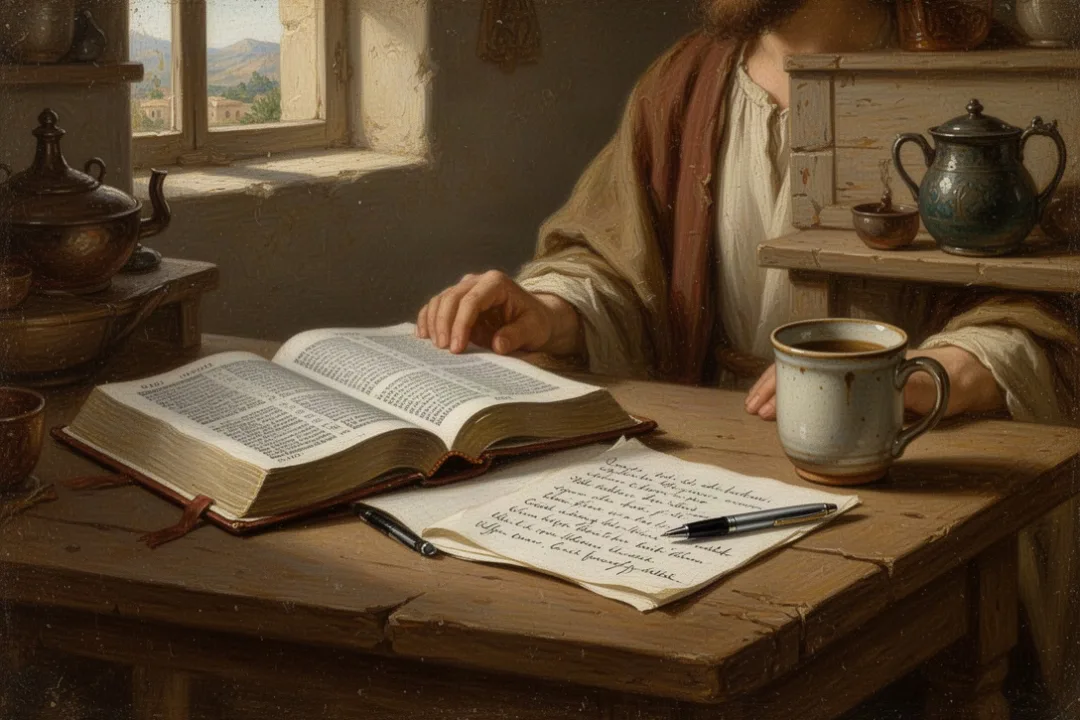
Keep a small journal with four prompts: “What does the passage say?” “What does it reveal?” “Where does it meet me?” and “What will I do?” Writing by hand can slow your thinking, while a digital note can help you search previous reflections. Either method works if it encourages honesty rather than performance.
You can also practice reflection with another person. Read the same passage, allow silence, and let each person share one observation and one response. Avoid rushing to fix another person’s pain or turning the discussion into a competition about knowledge. Listening is part of spiritual care, especially when the passage touches grief, conflict, or personal failure.
When sharing a verse with someone who is struggling, consider the timing and relationship. Ask permission before offering advice, and do not assume that a verse will answer a question the person has not asked. A gentle statement such as “This passage has helped me think about God’s presence; would you like to hear it?” respects the other person’s emotional space.
Some common mistakes can weaken a reflection:
Taking a verse out of context: A memorable line may have a particular audience, purpose, or literary setting.
Promising a guaranteed outcome: Faith does not allow you to predict that a specific job, relationship, healing, or financial result will occur.
Using Scripture to silence pain: A quick verse should not replace compassion, lament, listening, or practical assistance.
Confusing guilt with growth: Conviction can lead toward repair, while destructive shame often produces hiding and hopelessness.
Applying a passage to control others: Reflection should first examine your own response, not provide a tool for forcing someone else to comply.
Return to the same passage after a week or month. Your first reflection may focus on fear, while a later reading reveals a question about trust, service, or forgiveness. Scripture can meet you differently as your circumstances change, not because the text has become whatever you want, but because your attention and understanding have developed.
A helpful daily rhythm is simple: read a short passage, sit with one phrase or idea, name the feeling it brings up, and choose a response. You do not need to manufacture a dramatic experience. Quiet faithfulness often looks like telling the truth, apologizing, asking for help, resisting a harmful impulse, or offering patience in an ordinary moment.
Let your reflection remain connected to the character of God and the central direction of Christian faith: love God, love your neighbor, practice truth, seek justice, receive mercy, and walk humbly. A Bible verse with reflection is most useful when it moves beyond a temporary feeling and helps you live with greater wisdom, compassion, courage, and trust.
Frequently asked questions
How long should a Bible verse reflection be?
A reflection can be as short as a few sentences or as long as a journal page. Include the passage’s main idea, one honest connection to your life, and a practical response or prayer. Length matters less than clarity and sincerity. If the reflection becomes repetitive, return to the central question: What is this passage inviting me to understand or do?
Can I use one Bible verse for several different situations?
Yes, a passage may speak to different seasons of life, although its meaning should remain grounded in context. Your circumstances may change what you notice, but they should not turn the verse into a promise it does not make. Read the surrounding passage and explain how its central message applies in the particular situation you are facing.
What should I do if a Bible verse seems confusing or troubling?
Read the wider section, compare a few trustworthy translations, and look for historical or literary context. You can also discuss the passage with a knowledgeable pastor, teacher, or study group. Do not force yourself to reach an immediate answer. Honest questions can be part of faithful reflection, especially when a passage involves suffering, judgment, or difficult human behavior.
Is a Bible reflection appropriate for someone who is grieving?
It can be, if it is offered gently and at the right time. Choose passages that acknowledge sorrow, God’s presence, comfort, or hope rather than using Scripture to explain away the loss. Ask whether the person would like to hear the passage, listen without correcting their feelings, and offer practical support alongside prayer.






Leave a Reply