Blessing Cards: Creative Ideas and Meaningful Messages
Blessing Cards: Creative Ideas and Meaningful Messages
Blessing Cards are small vessels of grace that carry good wishes, encouragement, and spiritual or heartfelt sentiments from one person to another. In a world saturated with quick text messages and emojis, a thoughtfully crafted blessing card offers a tangible, lasting gesture that can be reread, rerelived, and cherished. This article dives into Blessing Cards: Creative Ideas and Meaningful Messages, exploring the many variations of blessing cards, practical ideas for designing them, and tips for writing messages that resonate across cultures, occasions, and personalities. Whether you want to celebrate, console, or simply remind someone they are seen, blessing cards provide a versatile, intimate way to communicate care.
A blessing card is a compact card—often blank inside or printed with a short message—that conveys goodwill, encouragement, or spiritual blessing. These cards can be religious or secular, formal or casual, but they share one essential purpose: to acknowledge another person with warmth and intention. Over time, the genre has grown to include many variations, such as handwritten blessing cards, inspirational blessing notes, newborn blessing cards, and sympathy blessing cards. Each variation serves a different moment in a person’s life while maintaining the core idea: to bless, honor, or uplift.
In addition to their emotional impact, blessing cards often function as keepsakes. A card tucked into a wallet, a scrapbook, or a memory box can become a quiet anchor during moments of doubt or transition. For communities, groups, and organizations, blessing cards can foster connection, shared care, and a sense of belonging. The practice can be creative, personalized, and deeply meaningful, especially when the messages reflect the recipient’s unique journey and values.
Creative Ideas for Blessing Cards
Creativity makes blessing cards memorable. Here are creative ideas for the design, format, and production of blessing cards that stand out while remaining thoughtful and accessible.
Physical Design Approaches
Handmade cards with textured cardstock, pressed flowers, or decorative stitching that adds tactile appeal.
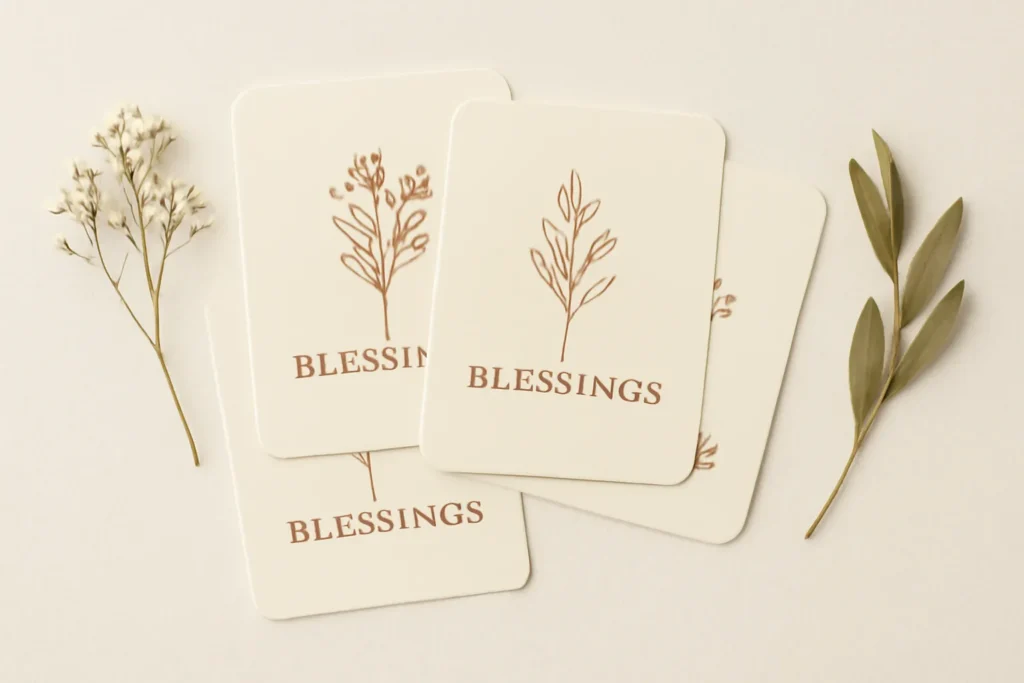
Watercolor or illustrated cards featuring gentle scenes (sunrise, blooming branches, a quiet landscape) that mirror the tone of the blessing.
Seed-embedded cards that can be planted after reading, turning blessing into growth.
Minimalist design using ample white space and a single, meaningful symbol (a dove, a heart, an anchor).
Calligraphy and typography—handwritten lettering or elegant fonts that convey care and craftsmanship.
Texture and layers—cutouts, vellum overlays, or embossed patterns that create depth without overwhelming the message.
Eco-friendly materials—recycled paper, soy-based inks, and sustainable inks for a gentle environmental footprint.
Formats That Broadly Expand the Concept
Blank inside cards to invite a personal message and unique blessing from the sender.
Printed blessing messages on the card’s inner spread, leaving space for a personal note.
Accordion or fold-out cards that reveal a sequence of blessings or a short blessing poem as you unfold each panel.
Interactive blessing cards with small pockets for a keepsake, a micro-note, or a tiny charm.
Digital-physical hybrids that include a QR code linking to a video blessing or a guided meditation associated with the message.
Variations by Occasion
Wedding blessing cards with vows-inspired sentiments or blessings for the couple’s life together.
Newborn blessing cards offering wishes for health, growth, and a life filled with wonder.
Graduation blessing cards cheering for transition, resilience, and future adventures.
Recovery blessing cards providing comfort, patience, and gentle encouragement to heal.
Sympathy blessing cards offering solace, remembrance, and a sense of ongoing care.
Housewarming blessing cards blessing a home with safety, warmth, and welcome.
Meaningful Messages: Crafting the Text
Words carry power. In blessing cards, crafting meaningful messages means balancing warmth, clarity, and authenticity. The following guidance helps ensure your messages feel sincere and impactful while respecting the recipient’s beliefs and sensibilities.
Elements of a Strong Blessing Message
Acknowledgement of the recipient’s situation or moment, show you see them.
Specificity—a detail that makes the blessing feel personal and not generic.
Actionable encouragement or a gentle invitation for the recipient to lean on support, hope, or community.
Hopeful tone without pressure, conveying warmth and kindness.
Inclusive language that respects diverse beliefs and backgrounds.
Conciseness so the message remains readable and memorable, while the card’s space is respectful of the receiver.
When writing, consider the relationship to the recipient: the tone can be formal for a professional colleague, intimate for a close friend, or gentle for a mentor or elder. The voice you choose will shape how the blessing lands and endures in memory. You can vary the style from traditional and reverent to light-hearted and contemporary, depending on the occasion and the recipient’s sensibilities.
Sample Messages by Occasion
Below are some starter lines you can adapt. They illustrate how to blend specificity with a broad, lasting blessing.
Wedding Blessings — "May your life together be filled with shared laughter, patient listening, and a love that grows through every season. May your home be a sanctuary of safety and joy, where kindness guides your steps and respect anchors your days."
New Baby Blessings — "Wishing your family gentle sleep, bright curiosity, and hearts that find wonder in every small moment. May your little one know the warmth of family, the courage to dream, and the blessing of unconditional love."
Graduation Blessings — "May your courage lead you toward new horizons, your curiosity illuminate the path ahead, and your values ground you as you build a life that is true to who you are."
Sympathy or Bereavement Blessings — "In this season of sorrow, may you feel the steady presence of love around you. May memories bring comfort, and may gentle days ahead remind you that you are not alone."
Recovery Blessings — "Wishing you patience in healing, daily sparks of hope, and the strength to rest when you need to. May every new day bring a little more ease and a little more light."
Moving or New Home Blessings — "May this new space become a place of peace, a canvas for your dreams, and a home where friends gather and memories bloom."
Personalizing Your Message
To deepen resonance, consider these personalization techniques:
Refer to a shared memory or moment that highlights the recipient’s strengths.
Include a short blessing for a future dream or goal.
Ask for something meaningful to the recipient: a hope, a wish, or a prayer.
Close with an affirmation of your ongoing support or presence in their life.
When you personalize a blessing, you transform a generic sentiment into a tangible connection. The recipient feels seen, heard, and valued, which is often the deepest purpose of a blessing card.
Design and Materials: How Aesthetics Meet Meaning
The look and feel of a blessing card can amplify its message. A well-chosen design communicates care before the recipient even reads the words. Here are practical considerations for the physical and printable form of blessing cards.
Choice of Materials
Quality cardstock with a smooth or lightly textured finish improves legibility and tactile appeal.
Recycled or FSC-certified paper for an eco-friendly option that aligns with gentle, compassionate values.
Envelope pairing with a color that complements the card’s mood—soft pastels for tenderness, deeper tones for solemnity, or bright hues for celebration.
Inserts or inner panels that can hold a personal handwritten message or a small keepsake.
Typography and Color Psychology
Serif fonts tend to read as traditional or timeless, suitable for formal blessings.
Sans-serif fonts read as modern and approachable, good for casual encouragement.
Soft color palettes (pale blues, lavender, sage, peach) convey calm and comfort.
Warm accents (gold foil, rose gold, copper) can elevate the card and feel celebratory.
Accessibility matters: ensure high contrast between text and background, keep font sizes readable, and provide alt text for any decorative motifs that carry meaning (e.g., a dove as a symbol of peace). Inclusive design also means avoiding imagery or wording that might inadvertently exclude someone on the basis of religion, culture, or personal belief.
Incorporating Symbols and Imagery
Images and symbols can carry universal resonance, such as:
Roots or a tree motif to symbolize growth and stability.
Stars or a sunrise for new beginnings and possibilities.
Hands clasped or open to represent support and connection.
When using symbols, ensure they align with the message's tone and the recipient’s context. A blessing card for a non-religious audience might emphasize universal values like kindness, resilience, and community rather than prayer-related imagery.
DIY Techniques and Craft Tips
If you enjoy hands-on projects, these tips help you create blessing cards that feel lovingly crafted and professional. The following steps blend creativity with practicality, making the process accessible for beginners and satisfying for seasoned crafters.
Step-by-Step Craft Guide
Plan the concept—Choose the occasion, mood, and audience. Decide whether the card will be blank inside or printed with a blessing and a personal note space.
Choose materials—Select sturdy cardstock, complementary envelopes, and any decorative elements (ribbons, pressed flowers, stamps).
Prepare the layout—Sketch a light pencil layout on the card to plan text placement and imagery.
Print or write the message—If printing, use high-quality printer settings; if handwriting, practice the script to ensure legibility and elegance.
Add decorative elements—Apply stamps, embossing powder, or watercolor washes with care to avoid overpowering the message.
Finish and seal—Seal the card with a light coat of fixative or a wax seal for a tactile, ceremonial feel.
Tip: If you are making a batch, create a template for the inner message to keep the tone consistent while still allowing personal notes to be added by hand.
Smart Production Ideas
Batch writing—Write several blessing cards, then personalize them with the recipient’s name and a quick line tailored to that person.
Pre-printed messages with blank spaces for a personal line create a balanced mix of consistency and intimacy.
Printable templates—Offer a few design templates that friends or community members can download and print at home.
Gift ensembles—Pair blessing cards with a related small gift (tea, a candle, a plant) to enhance the sentiment.
Digital Blessing Cards and E-Cards
In the digital age, blessing cards extend beyond paper. E-cards and digital blessings can reach people across distances instantly, while still delivering warmth and care. Here are some ways to use digital blessings effectively.
Video blessings—Record a short video message that accompanies a printable card, offering a personal moment of blessing.
Animated e-cards—Use soft animations and gentle music to create a sense of ceremony without feeling overproduced.
PDF printables—Provide high-quality printable blessings that recipients can print, fold, and mail or gift in person.
QR-coded blessings—Include a QR code linking to a guided meditation, a poem, or a voice recording of the sender’s blessing.
Digital blessings should preserve the same intention as printed cards: clarity, warmth, and accessibility. Be mindful of file sizes, readability on mobile devices, and the recipient’s access to devices when choosing a format.
Cultural and Religious Perspectives
Blessing cards traverse many belief systems and cultural traditions. They can be adapted to honor diverse identities and practices while maintaining universal values such as care, hope, and support. When creating blessing messages for an interfaith or multi-cultural audience, consider:
Neutral language that avoids exclusive religious terminology unless you know the recipient’s preferences.
Inclusive imagery that speaks to shared human experiences rather than specific dogmas.
Respect for traditions—if you know a recipient’s faith or culture, you can tailor blessings to align with those rhythms (e.g., celebratory milestones, rites of passage) without presuming beliefs.
Examples of inclusive phrasing might include phrases like “May you be surrounded by love and light,” or “Wishing you peace, strength, and joy in the days ahead.” The goal is to offer a universal blessing that honors the recipient’s dignity and journey.
Ethical and Inclusive Language in Blessing Cards
As you craft messages, be mindful of the language you choose. A blessing card should empower and uplift without alienating or presuming—a practice of care that respects autonomy and diverse experiences. Here are some guidelines:
Avoid prescriptive language that implies how someone should feel or respond to their circumstances.
Favor hopeful realism over platitudes; acknowledge pain or difficulty when appropriate, while still offering light and support.
Use person-centered language—address the person directly, and tailor the message to their situation, not a stereotype.
Avoid religious terminology unless you know the recipient’s preferences; when in doubt, opt for universal blessings.
Inclusive blessing cards celebrate the diversity of human experience. They honor differences while focusing on shared human needs: connection, courage, health, and a sense of purpose.
Using Blessing Cards for Community and Service
Beyond personal exchanges, blessing cards can be powerful tools in communities, workplaces, schools, and care settings. They can:
Support caregivers and healthcare workers by acknowledging their efforts and reminding them of their impact.
Encourage students or colleagues during transitions, exams, or changes in teams.
Strengthen congregational or club life by offering shared blessings that reflect the group’s values.
Offer solace in hospices or community centers, providing a gentle, respectful way to express care.
Promote charitable acts—blessing cards can accompany care packages and volunteer initiatives to remind recipients that they are valued.
In these contexts, the blessing card becomes a bridge: a small, tangible message that connects people, builds trust, and fosters a culture of care. It also offers a low-cost, scalable way to inject meaning into everyday interactions.
To capture the breadth of this practice, it helps to think of blessing cards through multiple, overlapping lenses. Here are some variations and related concepts that expand semantic reach without losing the heart of the practice:
Blessing notes as compact, conversational messages tucked into notebooks or lunch bags.
Encouragement cards placed in jackets, backpacks, or desks to offer a quick boost.
Prayer cards for communities that include spiritual blessings tied to faith traditions.
Gratitude cards that acknowledge a person’s impact with blessings framed as thanks.
Affirmation cards containing positive statements and values that reinforce resilience and self-belief.
Wellness cards focusing on mental and emotional health, stress relief, and self-compassion.
Pet blessing cards offering blessings for animals and their humans, reflecting the bond between pets and families.
By naming these variations, you acknowledge that blessing can take many forms while sharing a single through-line: intentional care expressed through words and design.
Whether you’re a stationery designer, a writer, a teacher, or simply someone who loves to give blessings, these practical guidelines can help you craft cards that endure and delight.
Start with the recipient’s essence—their values, hopes, and current life stage. Let that essence guide tone and content.
Limit the scope—focus on a single intention per card (e.g., resilience, joy, peace), which makes the blessing easier to carry forward.
Use concrete imagery—names, places, or moments that evoke senses and memory, rather than abstract abstractions alone.
Balance form and warmth—a formal blessing can be beautiful; a warm, intimate blessing can be deeply touching. A blend often works well.
Leave space for personalization—even a small blank space invites the recipient to reflect and respond in their own way.
Proofread for tone—read the blessing aloud to check rhythm and emotional impact. Remove phrasing that could feel judgmental or prescriptive.
Remember, the value of a blessing card lies not just in the words but in the care with which they are delivered. The act of choosing materials, handwriting, and presentation signals that you took time and effort to honor the recipient.
In contemporary life, blessing cards can play multiple roles, from a personal ritual to a social practice. They can:
Provide continuity in relationships where communication might be sporadic or digital-only.
Serve as a tangible reminder of support during difficult times, helping recipients feel less isolated.
Strengthen community bonds by creating shared rituals—such as exchanging monthly blessings among friends or colleagues.
Encourage mindfulness—choosing a blessing can be a brief, reflective practice that centers the giver and receiver.
Support inclusivity—with careful language, blessing cards can be universal and welcoming across diverse backgrounds.
As digital communication grows, the physical blessing card can be a counterbalance: a pause, a tactile reminder in a fast-paced world. The best blessing cards combine thoughtful content with careful presentation, turning a small card into a lasting memory.
A blessing card is more than a piece of paper. It is a deliberate, generous act that communicates care, presence, and possibility. By combining creative ideas, meaningful messages, thoughtful design choices, and inclusive language, you can craft blessing cards that endure across time and circumstance. Whether you are giving a wedding blessing card, a newborn blessing card, a graduation blessing card, or a sympathy blessing card, your effort becomes a gift of significance. It offers not just words, but a sense of connection—the belief that someone holds you in their heart and wants the best for your life.
In the end, the best blessing cards are those that feel authentic, personal, and timely. They acknowledge a moment, honor a person, and invite ongoing care. With a little creativity, careful language, and thoughtful presentation, you can expand the reach of every blessing you share and help others carry forward the light of your good wishes.










Leave a Reply