A historical Bible study examines a biblical passage in the world where it was written, copied, heard, and first understood. You study the passage’s historical setting, literary form, original audience, cultural assumptions, and relationship to other ancient evidence before applying its message today.
A dependable study usually follows this order: observe the text, identify its genre, investigate the setting, compare relevant evidence, consider major interpretations, and then draw careful conclusions. Historical research does not replace faith or theological reflection; it helps you avoid reading ancient words as though they were written in modern circumstances.
The Bible is a collection of writings produced across many centuries, regions, communities, and literary forms. A historical approach therefore asks questions about a specific passage rather than treating every verse as though it came from the same setting. The historical world behind Amos is not identical to the world behind Luke, and a letter such as Philemon raises different questions from a creation narrative or a wisdom poem.
The first concern is historical context. This includes the political powers, social customs, religious practices, economic conditions, geography, and conflicts that shaped the passage. A command, image, argument, or warning may sound different when you know what problems the first hearers faced.
The second concern is the text’s formation and transmission. Many biblical books have a complex history. A book may preserve older traditions, use earlier written sources, reflect a long period of community memory, or have been edited into its present form. That possibility should not be treated automatically as an attack on the text. It is a question about how the writing reached its readers.
The third concern is the original audience. Ask who likely heard or read the passage, what they already knew, and what response the writer sought. Paul’s letters, for example, address particular communities and disputes. The Gospel narratives present Jesus to readers with specific religious and cultural backgrounds. A passage can have continuing significance while still addressing an immediate first-century situation.
Historical study also distinguishes between what the text claims and what modern researchers can independently establish. A biblical writer may interpret an event theologically, while archaeology, inscriptions, and other ancient writings may provide partial information about the surrounding circumstances. These sources can illuminate one another, but they do not always answer the same questions.
Guiding principle: Begin with the passage’s own world before asking how it applies to yours. Historical context should clarify the text, not be used to make it say whatever a reader already believes.
How to establish the passage’s setting
Choose a manageable unit before researching. A paragraph, story, oracle, hymn, or short section of a letter usually works better than an entire biblical book for a single study session. Read the surrounding chapters first, then write down the passage’s main movement in your own words.
Record observations without explaining them too quickly. Look for repeated words, contrasts, commands, characters, locations, changes in speaker, references to time, and connections with earlier events. Mark details that seem strange or unnecessary to a modern reader. Those details often point toward the ancient setting.
Use the passage to identify historical questions
A good question is specific enough to investigate. Instead of asking, “What was life like in Bible times?” ask, “Why does this passage mention a city gate?” or “What did hospitality require in this social setting?” Focus on evidence that can actually help interpret the selected text.
People: Who speaks, acts, rules, suffers, teaches, or receives the message?
Places: Where does the scene occur, and what was that location known for?
Institutions: What roles do kings, priests, elders, judges, households, assemblies, or Roman officials play?
Customs: What assumptions about marriage, inheritance, purity, meals, clothing, work, or hospitality appear?
Conflicts: What dispute, threat, injustice, theological question, or social tension gives the passage urgency?
Political setting: Which empire, local ruler, or authority shaped the audience’s daily life?
Next, establish the passage’s broad historical location. For the Old Testament, relevant settings may include the kingdoms of Israel and Judah, Assyrian or Babylonian domination, Persian rule, or the Hellenistic and Roman periods. For the New Testament, consider Jewish life under Roman authority, the influence of Greek language and culture, local leadership, and the movement of people through cities and trade routes.
Do not assume that a passage’s setting can be reduced to a single date. Scholars often debate when a book was written, and some texts may contain materials from more than one period. Use language such as “during the period associated with” or “against the background of” when the evidence does not justify greater precision.
Geography can be just as significant as chronology. A journey through Galilee, Judea, Samaria, or the Decapolis carries social and political associations. Jerusalem’s temple was not merely a religious building; it was also connected with pilgrimage, authority, sacrifice, identity, and imperial power. A map can reveal distances, terrain, and travel patterns that are easy to miss in a flat reading of the text.
Separate background information from interpretation
Background material should answer a question raised by the passage. If a commentary gives a long description of ancient clothing but the passage’s meaning does not depend on clothing, that information may be interesting without being useful. Effective research is selective: it gathers details that explain the author’s vocabulary, argument, images, actions, or assumptions.
Keep two notes for each finding: the evidence and the interpretive effect. For example, evidence about ancient patronage may clarify why a person publicly honors a benefactor. The interpretive effect might be that the passage presents gratitude within a network of social obligation, rather than describing a private feeling alone.
Identify genre before drawing conclusions
Genre tells you what kind of communication you are reading and what expectations should guide interpretation. A psalm uses poetic compression and imagery; a law collection presents commands within a covenantal framework; a Gospel combines narrative and theological presentation; an epistle addresses real communities through argument and exhortation. The same phrase may function differently in each form.
Start by asking what the passage is doing. Is it praising, lamenting, warning, narrating, legislating, instructing, satirizing, disputing, blessing, or reporting a vision? The answer helps you decide whether a statement should be read as direct historical reporting, poetic description, symbolic communication, legal instruction, or rhetorical exaggeration.
Narrative: Examine plot, characters, repetition, speeches, point of view, and the narrator’s presentation of events.
Poetry: Pay attention to parallel lines, metaphors, sound, imagery, emotional movement, and deliberate overstatement.
Prophecy: Study the historical crisis, covenant language, accusations, promises, and symbolic actions addressed to a particular audience.
Wisdom literature: Ask whether a saying presents a general pattern, a challenge to conventional thinking, a prayer, or a reflection on life’s uncertainty.
Law: Consider the social problem being addressed, the covenant setting, and how the law relates to surrounding instructions.
Letters: Reconstruct the issue, recipients, relationship between writer and audience, and sequence of the argument.
Apocalyptic writing: Investigate symbols, visions, scriptural echoes, persecution, and the hopes offered to the original community.
Genre prevents two common errors. One is flattening poetry into technical prose, as when a metaphor is treated as a literal description. The other is treating historical narrative as though every detail were arranged like a modern report. Ancient writers could communicate truth through selective narration, speeches, symbolism, and literary design.
Genre does not answer every question by itself. A Gospel can contain historical claims and theological interpretation at the same time. A prophetic oracle can address an immediate political situation while using imagery that reaches beyond that moment. The goal is not to place texts into rigid boxes but to read them according to their communicative form.
Research language, manuscripts, and parallel evidence
Translations are valuable, but historical study benefits from comparing several careful translations. Notice where they differ in a significant phrase, verb, title, measurement, or place name. Differences do not automatically mean that one translation is dishonest. Translators must sometimes choose between several reasonable ways to represent an ancient word or sentence.
If you do not know Hebrew, Aramaic, or Greek, you can still study language responsibly. Use a reputable lexicon or study Bible, compare the word’s use elsewhere, and avoid building an argument on a dictionary’s first definition. A word’s meaning comes from context and usage, not from every possible meaning listed in a reference work.
Be cautious with claims about “the original word.” Biblical words often have a range of meanings, and a translated term may represent different underlying words in different passages. A word study should examine grammar, neighboring words, literary context, and the way the term functions in the book—not just an appealing definition.
Manuscript study asks how the biblical text was copied and preserved. Ancient manuscripts sometimes contain spelling differences, omitted or repeated words, harmonized phrases, or other variants. Most variations do not alter the passage’s central message, but some affect how a sentence should be translated or whether a line was present in an early form of the text.
When comparing textual notes, distinguish among manuscript evidence, translation choices, and interpretive explanations. A footnote may tell you that ancient witnesses differ; a commentary may then explain which reading scholars consider earlier and why. Those are related but separate claims.
Other ancient sources can provide context. These may include inscriptions, coins, legal documents, letters, buildings, burial remains, literary works, and records from neighboring cultures. Each source has limits. An inscription may confirm a ruler’s name but say little about ordinary family life. Archaeology can show settlement patterns or material practices but rarely proves the meaning of a theological statement.
Evidence warning: Archaeology usually illuminates historical possibilities rather than “proving the Bible” in a simple way. Evaluate what a discovery actually shows, how securely it is dated, and whether it relates directly to your passage.
Use parallel biblical passages with care. A later writer may quote, adapt, or reinterpret an earlier text for a new audience. That relationship is meaningful, but the later use should not erase the original passage’s setting. Study the earlier text in its own context, then examine what the later writer does with it.
Test interpretations against historical and literary evidence
Historical Bible study is strongest when it considers more than one plausible explanation. List the main interpretive options, then ask what each one explains well and where it encounters difficulty. Do not treat every scholarly view as equally persuasive, but do distinguish between a minority position supported by evidence and a claim based mainly on speculation.
Pay attention to the difference between certainty, probability, and possibility. We may be confident about a passage’s broad setting while remaining uncertain about its exact date or the identity of a person mentioned indirectly. Good interpretation allows those levels of confidence to remain visible.
Read the passage in three expanding circles:
Immediate context: Examine the sentences, scene, argument, or poem directly around the selected words.
Book-level context: Ask how the theme, vocabulary, and structure function throughout the biblical book.
Historical and canonical context: Consider the period, audience, related writings, and later biblical use without confusing those layers.
For example, a study of Amos should consider the prophet’s accusations against wealthy and powerful people, the worship practices criticized in the surrounding material, and the social conditions implied by the language of courts, trade, land, and debt. The point is not merely to collect facts about the eighth-century setting. It is to see how that setting gives force to the book’s demand for justice and genuine devotion.
A study of Philemon should examine household relationships, patronage, slavery in the Roman world, travel, imprisonment, and the social cost of receiving a person as a brother. Historical knowledge does not settle every ethical question, but it prevents the letter from being reduced to a vague lesson about kindness. It also helps you see why Paul’s wording could create pressure within the social relationship he addressed.
A study of Mark 7 should consider Jewish purity concerns, table fellowship, debates about tradition, and the narrative setting of the dispute. Rather than assuming that the passage dismisses all religious practice, ask what controversy the scene presents and how the surrounding Gospel develops the themes of inner allegiance, food, outsiders, and the kingdom of God.
Keep historical reconstruction separate from personal application. First state what the passage most likely meant within its ancient setting. Then ask how its principles, warnings, promises, or vision might address a present community. Application should grow from interpretation; it should not be used to force a convenient conclusion onto the ancient text.
Build a repeatable historical Bible study process
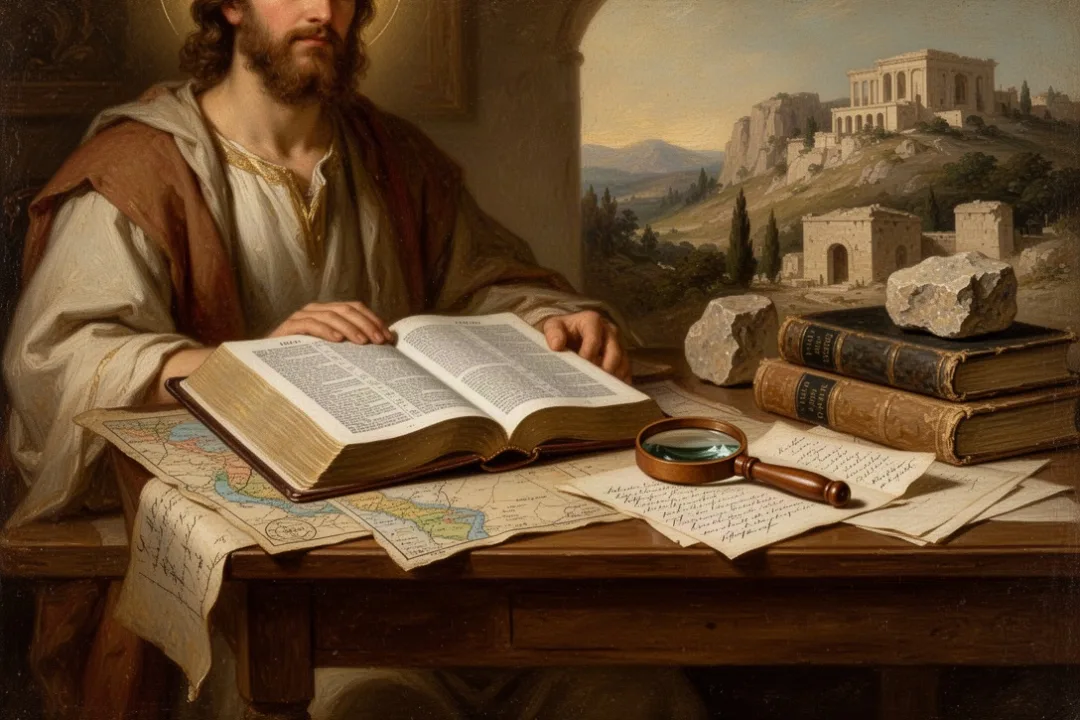
You can complete a useful study with ordinary tools if your questions remain focused. Start with the biblical text in several translations, a map, a Bible dictionary or encyclopedia, a study Bible with transparent notes, and at least one commentary that explains its sources and reasoning. For difficult passages, consult more than one scholarly perspective.
Work through the following sequence and write down your findings rather than relying on memory:
Choose the passage. Select a complete unit with a recognizable beginning and ending.
Read it repeatedly. Read the surrounding chapter and record observations before consulting outside sources.
Describe the genre. Identify whether the passage is narrative, poetry, prophecy, law, wisdom, letter, Gospel material, or apocalyptic writing.
Ask historical questions. Identify people, places, institutions, customs, conflicts, political pressures, and economic conditions that need explanation.
Research the setting. Use maps, reference works, historical sources, and archaeological background that directly relate to those questions.
Compare translations and textual notes. Investigate meaningful differences without assuming that every variation changes the interpretation.
Trace the argument or movement. Explain what the speaker or writer wants the audience to understand, reject, trust, or do.
Compare interpretations. Note the strongest explanations and the evidence supporting or challenging each one.
State your conclusion carefully. Separate firm observations from likely reconstructions and unresolved questions.
Apply the passage responsibly. Connect its message to present life without pretending that ancient customs and modern institutions are identical.
A written worksheet can keep the process balanced. Include headings such as What the text says, What the setting explains, What remains uncertain, and What the passage calls for. This format makes it harder to confuse a historical fact with an interpretation or a personal reaction.
Watch for several recurring mistakes. Anachronism projects modern political categories, family structures, or individual assumptions into an ancient society. Proof-texting removes a verse from its argument to support a position formed elsewhere. Presentism judges an ancient text without first asking what its original audience could have understood. The opposite mistake is romanticizing the past as though ancient societies were simple, unified, or morally uncomplicated.
Good historical study also remains alert to the Bible’s internal diversity. Different writers may emphasize different aspects of a person, event, institution, or theological question. Do not smooth away every difference before you have examined it. A careful reading can respect each book’s voice while considering how readers have understood the collection as a whole.
The result should be more than a list of background facts. A successful study explains how history affects meaning: why a word mattered, why a command addressed a real situation, why an image carried emotional force, why an argument persuaded or challenged its audience, and how the passage’s first hearers might have responded. That kind of reading gives you a more disciplined basis for interpretation, teaching, discussion, and personal reflection.
Frequently asked questions
Do I need to know Hebrew or Greek for a historical Bible study?
No. You can make substantial progress with several reliable translations, a Bible dictionary, maps, historical reference works, and careful comparison of context. Original-language tools can help with difficult passages, but they require grammar and contextual judgment. Treat simple word-study claims cautiously, and consult resources that explain how they reached their conclusions rather than relying on isolated definitions.
Is historical Bible study the same as historical-critical scholarship?
They overlap, but they are not identical. Historical-critical scholarship uses methods that investigate authorship, dating, sources, composition, and transmission. A church-based historical study may use some of those questions while also emphasizing canonical shape, theological meaning, and faith-informed application. Both approaches benefit from clear evidence, honest uncertainty, and attention to the passage’s ancient setting.
How can I tell whether a Bible background source is trustworthy?
Look for named authors with relevant expertise, clear citations, engagement with primary evidence, and a distinction between established facts and debated proposals. Be cautious with sources that claim one archaeological discovery settles a major question, assign precise meanings to every ancient custom, or present complex scholarly debates as simple conspiracies. Comparing several reputable resources is safer than depending on one voice.
How long should a historical Bible study take?
A focused study of a short passage may take an hour or two, while a complex text can require several sessions. Spend enough time to understand the literary context before researching background details. The goal is not to collect every fact about the ancient world; it is to answer the historical questions that genuinely affect the passage’s meaning and application.




Leave a Reply