One blood, one race: What human unity really means
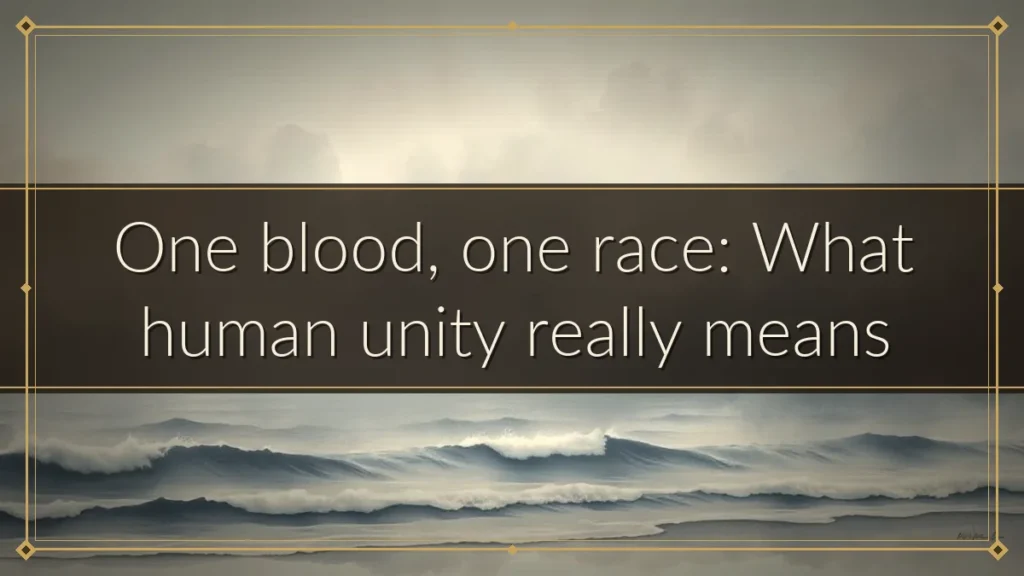
One blood, one race: What human unity really means
All human beings belong to one human family. The phrase “one blood, one race” is often used to express that shared origin, shared dignity, and shared responsibility. It can point to a Christian belief that God made humanity from one source, while also fitting the scientific understanding that every living person belongs to the same species.
The phrase becomes most useful when it opposes racism without pretending that racial categories have no social effects. People may share a common humanity and still have different ancestries, appearances, cultures, languages, histories, and experiences. Human unity is real, but it does not require erasing human particularity.
The wording is closely associated with Acts 17:26, where Paul speaks in Athens about God making the nations of humanity from one source. Bible translations differ in how they render the passage. Some use language about one person, one ancestor, or one human family rather than the exact phrase “one blood.” The central idea is that no nation possesses a separate origin that makes it more human than another.
That biblical claim addresses both human equality and human dependence on God. It does not say that every community has the same customs or historical experience. Instead, it challenges the belief that differences in skin color, ethnicity, nationality, or social status create different levels of human worth.
In ordinary conversation, the phrase can carry several related meanings:
Shared human origin: all people belong to one species and one human family.
Equal dignity: no racial or ethnic group is naturally superior or inferior.
Shared moral responsibility: people should treat one another as neighbors rather than as strangers or threats.
Rejection of racial hierarchy: ancestry and appearance cannot justify domination, exclusion, or unequal worth.
Hope for reconciliation: communities divided by racism can pursue justice and restored relationships.
Important distinction: Saying that humanity is one does not mean that racism is imaginary or that cultural differences should disappear. It means those differences cannot be used to deny anyone’s equal humanity.
How science explains one human family
Modern humans are one species: Homo sapiens. People around the world can have striking visible differences, but those differences developed within a single interconnected human population over many generations. Human beings share the overwhelming majority of their genetic material, and no simple biological boundary divides humanity into a fixed set of races.
Traits commonly linked with race, such as skin pigmentation, hair form, and certain facial features, are influenced by ancestry and adaptation. Skin color, for example, is strongly connected to patterns of ultraviolet exposure over long periods. These visible traits are real, but they do not form a complete biological map of a person’s identity, abilities, behavior, or value.
Genetic variation is often greater within broadly defined racial groups than between them. A person classified under one racial label may share more genetic similarities with someone assigned to another label than with a person placed in the same broad category. That is one reason scientists generally treat race as a social category with biological consequences, rather than as a set of naturally separate human subspecies.
This point should not be oversimplified. Ancestry can matter in medicine because inherited variants may be more common in particular populations. Family history, geographic ancestry, environment, nutrition, discrimination, and access to care can all affect health. Good medical practice considers the individual rather than assuming that a racial label tells the whole story.
A step-by-step way to understand the phrase
The phrase can be understood clearly by moving from biology to ethics and then to practical action. Each step corrects a common misunderstanding.
Start with shared humanity. Every person is human, regardless of race, ethnicity, citizenship, religion, language, or social position.
Separate ancestry from hierarchy. Different ancestry can explain some physical traits or cultural traditions, but it does not create a ranking of human worth.
Recognize race as socially powerful. Even when racial categories are not fixed biological divisions, institutions and individuals can use them to distribute opportunity, danger, respect, and resources.
Listen to lived experience. A claim of unity should not silence people who have experienced discrimination or inherited the effects of earlier injustice.
Practice equal treatment and repair. Shared humanity should lead to fair policies, honest relationships, accountability, and protection for people who are vulnerable to racial harm.
Preserve legitimate differences. Unity does not demand one culture, one language, one worship style, or one way of remembering history.
This sequence prevents two opposite errors. One error treats racial categories as proof that humanity is divided into separate kinds of people. The other says that because humanity is one, racial discrimination no longer deserves attention. The better approach holds both truths together: people are one human family, and social systems can still treat them unequally.
What the Bible teaches about shared human dignity
Several major biblical themes support the idea behind “one blood, one race.” Genesis describes humanity as made in the image of God, which grounds human dignity in creation rather than achievement, wealth, nationality, or appearance. The image of God is not presented as a privilege reserved for one ethnicity.
Acts 17:26 connects the peoples of the earth to a common human origin. The point of Paul’s speech is not to provide a modern scientific account of population genetics. It is a theological claim against human pride: nations exist within God’s providence, and no group can claim independent superiority before the Creator.
The biblical story also describes God’s concern for foreigners, migrants, widows, orphans, and other people at risk of exclusion. Commands in the Hebrew Scriptures repeatedly call Israel to remember its own experience as a vulnerable people and to treat outsiders fairly. These teachings make care for the stranger part of moral faithfulness, not an optional gesture of kindness.
In the New Testament, Jesus crosses social boundaries involving ethnicity, religion, gender, illness, and status. His conversation with the Samaritan woman in John 4 and the parable of the compassionate Samaritan in Luke 10 challenge contempt between neighboring communities. These passages do not erase the historical identities of Jews and Samaritans; they confront the assumption that group identity determines who deserves mercy.
Paul’s letters use the language of a single body to describe a community made up of people with different backgrounds and gifts. Galatians 3:28 is often cited in discussions of equality, although its immediate context concerns status in relation to Christ. It should not be used to claim that social differences do not exist. Rather, it declares that those differences do not decide who may belong to God’s people or who has greater spiritual worth.
“Love your neighbor as yourself” — Mark 12:31
This command is broader than politeness. It calls for a form of regard that takes another person’s well-being seriously. Applied to race, it asks whether your assumptions, institutions, and habits protect the dignity of people outside your own group.
Why “race is a social construct” needs careful explanation
When scholars call race a social construct, they do not mean that race is fictional or that people simply imagine its effects. They mean that societies create categories, attach meanings to them, and use them to organize power and belonging. The boundaries of racial labels have changed across time and place, which shows that they are not fixed in the same way as species classifications.
Race can be socially constructed and still be socially real. A racial label may influence where someone can live, which schools they attend, whether employers trust them, how police perceive them, or how strangers treat them. The category is not a biological destiny, but racialization can produce measurable consequences.
The history of the United States illustrates this complexity. Laws and customs have assigned different rights and restrictions to groups described as White, Black, Native, Asian, Hispanic, or by other terms. The categories have shifted over time, and people within each category have never been identical. Yet the effects of segregation, forced removal, exclusion, enslavement, immigration restrictions, and discrimination have shaped families and institutions across generations.
For that reason, “we are all one race” can be heard in two ways. It may be a sincere statement of equality. It may also sound dismissive if used to avoid discussing a person’s racial identity or a community’s experience. A more complete statement is that humanity is one species and one moral family, while racial categories have been used to organize unequal treatment.
How one blood, one race challenges racism
Racism depends on a false conclusion: that a visible or inherited difference gives one group greater value, authority, intelligence, purity, or entitlement. The shared-humanity principle rejects that conclusion at its foundation. No person becomes less human because of skin color, and no group becomes more human because it controls institutions or resources.
Racism is not limited to openly hateful language. It can appear in stereotyping, exclusion, unequal enforcement of rules, discriminatory hiring, housing barriers, unequal schooling, and indifference to racial harm. A person may reject explicit prejudice while still benefiting from assumptions that disadvantage others. Understanding one human family should therefore lead to self-examination as well as criticism of obvious bigotry.
Practical resistance to racism includes several kinds of action:
Examine language: avoid generalizing about a racial or ethnic group, even when the statement appears complimentary.
Question unequal patterns: ask why a workplace, school, congregation, or neighborhood produces sharply different outcomes for different groups.
Learn specific history: replace vague ideas about prejudice with knowledge of local policies and events.
Listen without demanding proof: take reports of racial mistreatment seriously and avoid making the harmed person educate everyone before receiving concern.
Share access and influence: support fair hiring, leadership opportunities, participation, and decision-making.
Correct harm: apologize clearly, change the behavior, and accept reasonable accountability rather than defending intention alone.
These steps do not require pretending that every person has the same life. They require recognizing that fairness may involve addressing unequal conditions, not merely applying identical words or rules to everyone.
How churches and faith communities can apply the principle
A church that teaches one human family should reflect that teaching in its worship, leadership, fellowship, and public conduct. A statement about unity has little credibility if one racial group makes all decisions while other groups are welcomed only as attendees or symbols of diversity.
Faith communities can begin with honest observation. Who preaches, teaches, leads music, serves on governing boards, manages finances, and shapes the congregation’s priorities? Who feels comfortable raising concerns? Who is expected to adapt, and whose customs are treated as the normal standard?
Healthy racial unity does not require a congregation to flatten every tradition into one style. A multiracial church may include different musical forms, testimonies, foods, holidays, and ways of expressing grief or celebration. Shared worship can make room for difference rather than treating one group’s preferences as universal Christianity.
Church leaders can also create practical habits that support trust:
Teach biblical passages about creation, neighbor love, justice, hospitality, and reconciliation in their full context.
Invite members to discuss local racial history without turning the conversation into a contest over who has suffered most.
Respond promptly to racial insults, exclusion, and unequal treatment.
Build leadership teams with genuine authority for people from different racial and ethnic backgrounds.
Support partnerships that address concrete needs rather than limiting unity to occasional multicultural events.
Measure progress by relationships, shared power, and changed practices, not only by attendance at special programs.
Reconciliation also requires truth. A community cannot heal by demanding quick harmony while avoiding memories of discrimination or asking injured people to forgive without accountability. Christian reconciliation includes repentance, changed behavior, and a willingness to bear the cost of restored trust.
For difficult conversations: begin with the shared conviction that every person bears equal dignity, then make room for specific accounts of harm. Unity grows through truth and responsibility, not through pressure to sound agreeable.
What the phrase does not mean
“One blood, one race” should not be used to deny a person’s ethnic identity. People may rightly take pride in family history, language, music, food, faith traditions, and community memory. Rejecting racial supremacy is different from rejecting cultural belonging.
It also does not mean that racism disappears when people use inclusive language. A person can sincerely believe in human equality and still repeat stereotypes or support practices that exclude others. Good intentions matter, but impact, patterns, and accountability matter too.
The phrase does not mean that every population has identical health risks, histories, or social conditions. Broad racial labels are often too imprecise for medical or demographic analysis, yet ancestry and environment can still provide useful information. The responsible approach is to gather relevant details without turning group averages into assumptions about an individual.
Nor does shared humanity mean that all cultures are interchangeable. Human beings have common needs, but communities develop different ways to meet those needs. The goal is not to erase difference; it is to prevent difference from becoming a reason for contempt, exclusion, or domination.
How to speak about race with accuracy and respect
Clear language helps keep the principle from becoming a slogan. Instead of saying that race does not exist, you can say that race is not a set of separate human types, while recognizing that racial classification affects people’s lives. Instead of saying that everyone is exactly the same, you can say that everyone has equal dignity and deserves equal protection.
It is also useful to distinguish among race, ethnicity, ancestry, and nationality. Race usually refers to socially assigned categories based partly on perceived physical traits. Ethnicity often includes shared culture, language, traditions, and historical identity. Ancestry concerns family and population origins, while nationality refers to legal or political membership in a country. These concepts overlap, but they are not interchangeable.
When discussing a person or community, use the terms they use for themselves when possible. Avoid treating one individual as a spokesperson for millions of people. Ask respectful questions when context matters, and do not assume that a person’s appearance reveals their complete heritage, beliefs, citizenship, or experience.
Language alone cannot solve racial injustice, but careless language can reinforce it. Precision protects dignity because it allows people to be seen as individuals while still naming the systems and histories that shape their lives.
What one human family requires from you
The deepest meaning of “one blood, one race” is not merely that people share distant origins. It is that your obligations extend beyond your immediate circle. A neighbor is not less worthy because their accent, skin color, family history, religion, or national origin differs from yours.
That principle begins in personal relationships but reaches into public life. It affects how you vote, hire, teach, lead, worship, enforce rules, spend money, and respond when someone is treated unfairly. Shared humanity is not a claim to repeat only during ceremonies; it is a standard for decisions that affect other people’s safety and opportunity.
A faithful and responsible use of the phrase therefore holds together three commitments: common human origin, equal human dignity, and serious attention to racial injustice. Denying any one of these creates distortion. Together, they provide a stronger basis for truth, justice, humility, and genuine fellowship across racial and ethnic lines.
Frequently asked questions
Is “one blood, one race” a direct Bible verse?
No. The wording is commonly connected with Acts 17:26, but Bible translations render that verse differently. The passage teaches that humanity shares a common origin under God’s authority. “One blood” is a theological expression of that idea rather than a quotation that appears identically in every translation.
Does believing in one human race mean race does not matter?
No. Race is not a division into separate biological human types, but racial categories have powerful social effects. They can influence treatment, opportunity, health outcomes, and exposure to discrimination. Human unity should help oppose racial hierarchy while leaving room to acknowledge identity, history, culture, and unequal experiences.
How should Christians respond when someone says race is irrelevant?
Christians can affirm equal dignity while explaining that racial injustice remains relevant because people and institutions can treat groups differently. Listening to experiences of discrimination, learning local history, challenging prejudice, and supporting fair practices are consistent with loving one’s neighbor. Ignoring racial harm does not create genuine unity.
Are racial differences completely biological?
Some traits associated with racial categories have genetic and environmental influences, and ancestry can affect certain health risks. However, racial labels do not divide humanity into clear biological subspecies or predict a person’s worth, intelligence, or character. Individual family history and medical information are more precise than broad racial assumptions.






Leave a Reply