Religious poems: meaning, types, and ways to read them
Religious poems: meaning, types, and ways to read them
Religious poems turn belief into language shaped by emotion, imagination, memory, and prayer.
They can praise God, question suffering, remember a sacred story, express repentance, celebrate creation, or search for meaning in ordinary life. Some are written for worship, while others are private reflections that happen to use religious ideas. A religious poem may be calm and reverent, but it may also be angry, uncertain, intimate, or full of wonder.
A poem is generally religious when it engages seriously with faith, the sacred, spiritual practice, or ultimate questions. It does not have to mention a deity or belong to a formal worship service. A poem about forgiveness, mortality, compassion, creation, or the struggle to trust may carry religious meaning even when its language is indirect.
Religious poems often work on more than one level. A river may be a physical landscape, a symbol of renewal, and an image of spiritual change. Night may describe darkness, grief, contemplation, or the feeling of being separated from God. The strongest poems allow these meanings to remain together rather than reducing every image to a single explanation.
Religious poetry also differs from religious prose because form carries part of the meaning. Repetition can resemble a litany. A regular rhythm can create the feeling of communal prayer. A broken line may suggest doubt, interruption, or a mind struggling to speak. Sound, silence, and pacing are not decorations; they help shape the reader’s experience.
A useful starting point: Ask what the speaker is seeking, praising, fearing, or surrendering before trying to identify every symbol.
A brief history of religious poems across traditions
Religious poetry is found in nearly every literary and spiritual tradition. Sacred songs and poetic prayers were preserved orally before many were written down. Their rhythm, repetition, and memorable images helped communities remember them and use them in worship.
Within Judaism, the Psalms include praise, lament, thanksgiving, confession, trust, and appeals for justice. Other Jewish poetic forms, including piyyutim, developed for liturgical use. These works show that devotion is not limited to one emotional register: a faithful speaker may celebrate God in one poem and complain to God in another.
Christian poetry draws on biblical imagery, the life of Jesus, saints’ lives, personal prayer, and the calendar of worship. Hymns are one familiar form, but Christian religious poems also include sonnets, meditations, mystical lyrics, narrative poems, and poems of doubt. Writers such as George Herbert, John Donne, Gerard Manley Hopkins, and Christina Rossetti used distinct forms to explore sin, grace, nature, death, and divine presence.
Islamic literary traditions include devotional poetry praising God, expressing love for the Prophet Muhammad, and exploring spiritual discipline. Persian poets such as Rumi and Hafez are frequently read in English as spiritual writers, although their religious, cultural, and literary contexts are richer than many simplified modern quotations suggest. Poetry connected with Sufi practice often uses longing, wine, the beloved, music, and travel as layered images of spiritual desire.
Hindu devotional poetry includes bhakti traditions devoted to a particular deity or expression of the divine. Poets such as Mirabai wrote from a deeply personal relationship with Krishna, while other devotional traditions use song, storytelling, praise, and surrender. Sikh scripture includes highly poetic compositions, and Buddhist traditions use verses, gathas, and contemplative poetry to express impermanence, compassion, ethical attention, and awakening.
These traditions should not be treated as interchangeable. A familiar image such as light, love, or the path can have different meanings depending on the theology, language, ritual setting, and history behind it. Respectful reading begins with context, especially when a poem comes from a tradition other than your own.
Major kinds of religious poems
Religious poems can be grouped by purpose, although a single poem may belong to several categories. The following breakdown helps you recognize what a poem is doing as you read it.
Praise poems celebrate God, a deity, creation, holiness, or the beauty of existence.
Prayer poems address the divine directly through requests, confession, gratitude, or surrender.
Lament poems give language to grief, injustice, illness, abandonment, or unanswered prayer.
Devotional love poems use the language of desire, intimacy, fidelity, and belovedness to express spiritual commitment.
Wisdom poems reflect on mortality, moral choices, suffering, humility, and the shape of a good life.
Narrative religious poems retell sacred stories, the lives of holy figures, or moments of conversion and revelation.
Nature poems connect landscapes, animals, seasons, and the human body with creation or divine meaning.
Contemplative poems slow down attention and invite stillness, awareness, compassion, or inward examination.
Liturgical poems are created for communal worship, festivals, rites, processions, or repeated recitation.
This classification can clarify the poem’s central movement. A praise poem tends to move toward celebration, while a lament may move from pain toward trust, protest, acceptance, or simply honest speech. A mystical poem may resist a clear conclusion because the experience it describes cannot be fully contained in ordinary concepts.
How to read a religious poem step by step
Religious poems sometimes feel difficult because they combine unfamiliar references with compressed language. You do not need to solve every image immediately. Read first for the speaker’s emotional and spiritual movement, then return for closer interpretation.
Read the poem aloud. Listen for repeated sounds, pauses, changes in pace, and words that receive unusual emphasis. Religious poetry often depends on the ear because it has roots in song, prayer, and public recitation.
Identify the speaker and audience. The speaker may address God, a saint, a community, the self, nature, death, or another person. A poem that sounds like a statement may actually be a plea or a confession.
Describe the immediate situation. Ask what has happened before the poem begins. Is the speaker grieving, celebrating, waiting, repenting, remembering, or responding to a sacred story?
Mark repeated words and images. Repetition may reveal the central concern. If the poem returns to water, fire, breath, bread, darkness, or a road, consider how the image changes each time.
Notice movement and contrast. Look for shifts such as silence to speech, fear to trust, distance to closeness, winter to spring, or pride to humility.
Check important references. A brief reference to a biblical figure, Hindu deity, Buddhist teaching, Islamic story, Jewish festival, or Christian sacrament may carry substantial meaning. Use reliable background information rather than guessing.
Separate the poem’s voice from your own beliefs. You can understand a poem’s spiritual claim without adopting it. Interpretation begins by asking what the poem means within its own world.
Return to the ending. The last lines may resolve the poem, complicate it, or deliberately leave the speaker waiting. Do not assume that a quiet ending means certainty.
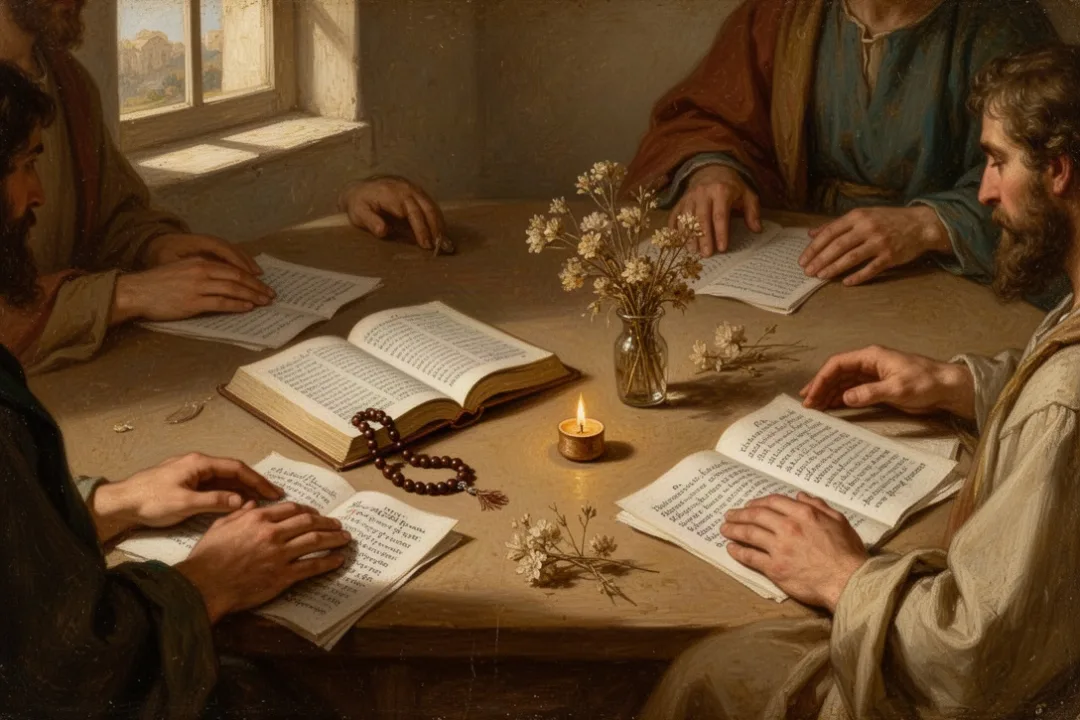
It also helps to distinguish the literal image from its possible symbolic force. A candle may really be burning in a room, but it may also suggest hope, vigilance, divine presence, memory, or a fragile human life. Let the surrounding words determine which meanings are strongest.
How religious poems use imagery and symbolism
Religious poetry often relies on images that have accumulated meaning through scripture, ritual, art, and community memory. Water can suggest birth, cleansing, baptism, danger, chaos, or passage. Fire can represent judgment, passion, purification, revelation, or the presence of the holy. The same symbol can change meaning within a single poem.
Light and darkness are especially common. Light may indicate knowledge, goodness, life, or divine nearness, while darkness may suggest ignorance or despair. Yet darkness can also be protective, fertile, mysterious, or spiritually rich. A poem may challenge the assumption that the sacred appears only in brightness.
Gardens, mountains, deserts, roads, doors, houses, bread, wine, clothing, breath, and the human body all carry possible religious associations. Their effect depends on the poem’s details. A desert can mean spiritual emptiness, but it can also be a place of revelation and freedom from distraction.
Pay attention to pronouns and forms of address. The difference between “I,” “we,” “you,” and “they” can reveal whether the poem is private, communal, confrontational, or instructional. A speaker who begins by saying “I” may move toward “we,” suggesting that a personal experience has become a shared act of worship.
“The heavens declare the glory of God” — Psalm 19:1, expressed here as an idea rather than a full quotation.
The opening of Psalm 19 illustrates a recurring feature of religious poetry: the natural world is treated not merely as scenery but as a form of testimony. The sky, day, and night become part of a larger conversation about divine order. Similar patterns appear in many traditions, though the specific theology and symbolism differ.
Why religious poems include doubt, anger, and silence
A common misconception is that religious poetry should sound confident from beginning to end. Many influential devotional poems do the opposite. They ask why suffering exists, accuse the heavens of silence, confess spiritual numbness, or describe the fear of losing faith.
Lament is not necessarily disbelief. In many traditions, direct complaint can be a form of relationship because the speaker continues to address the sacred even while feeling abandoned. The poem may preserve a conversation that ordinary polite language would avoid.
Silence can also have several meanings. It may represent unanswered prayer, contemplative attention, divine mystery, grief, or the limits of language. A poet who cannot name an experience may use pauses, unfinished syntax, or negative statements to show that difficulty honestly.
When you read a poem of doubt, resist the urge to correct the speaker. Instead, ask what kind of faith the poem makes possible. It may present faith as certainty, endurance, trust without proof, protest, fidelity, or the courage to keep asking.
Reading tip: Do not judge a poem’s spiritual depth by how positive it sounds. Grief, anger, and uncertainty can be central forms of religious expression.
Religious poems for worship, comfort, and personal reflection
People use religious poems in many settings, and the setting changes how the words are heard. A poem read during a worship service becomes part of a communal act. The same poem read alone before sleep may feel more private, especially if its language reflects fear, grief, or longing.
For worship, choose poems that fit the community’s beliefs, season, and purpose. A poem about praise may suit a celebration, while a poem of lament may be more appropriate during mourning or a service focused on justice. Consider whether the language can be understood when heard once and whether its imagery respects the people who will receive it.
For funerals and memorial services, religious poems often help name what ordinary conversation cannot. Strong choices may acknowledge loss without pretending that grief has ended. A poem can offer hope, but it should not pressure mourners to feel peaceful before they are ready.
For personal reflection, choose a poem that gives you room to respond. You might read it slowly, write down the line or image that stays with you, and record your own answer. Some readers use a religious poem as a starting point for prayer; others use it for meditation, journaling, or quiet attention.
Read the poem once for its overall feeling.
Read it again and underline a repeated image or phrase.
Write one sentence describing what the speaker wants.
Notice one place where the poem surprises or unsettles you.
End with a question, prayer, or observation in your own words.
How to choose religious poems for children and young readers
Children respond well to religious poems with strong images, clear rhythm, and a subject they can approach through experience. Poems about gratitude, kindness, animals, seasons, family, wonder, and caring for the earth may offer an accessible beginning. Short poems are not automatically simple, so read them aloud and consider whether the emotional content is suitable.
Older children and teenagers may appreciate poems that do not hide difficult questions. They can discuss why a speaker feels angry, how a symbol changes, or whether the ending provides an answer. Avoid presenting one interpretation as the only possible response when the poem deliberately leaves room for thought.
When sharing poetry from a tradition different from the audience’s own, provide basic context without turning the reading into a lecture. Explain the relevant festival, figure, practice, or belief, and make clear that a single poem cannot represent an entire religion.
How to write a religious poem with honesty and care
You do not need specialized vocabulary to write a meaningful religious poem. Start with a real moment: washing a cup after a funeral, hearing birds before dawn, sitting in a hospital room, lighting a candle, walking through a place of worship, or admitting that you do not know what to pray.
Specific details usually create stronger spiritual writing than abstract declarations. Instead of saying that the world is beautiful, describe rain collecting in a window frame or a child placing flowers in a bowl. The concrete image gives the reader something to see, hear, and feel.
Choose one spiritual question. Examples include “Where is God in suffering?” or “What does forgiveness require?”
Begin with a physical scene. Let the question emerge from an object, place, action, or memory.
Use one central image. Develop it gradually rather than adding many unrelated symbols.
Let the speaker change. The change may be small: greater honesty, a new question, a moment of attention, or willingness to wait.
Keep some mystery. You can end with recognition without explaining everything.
Read the draft aloud. Remove phrases that sound borrowed or overly general, and keep the language that feels precise and true.
Respect matters when writing about sacred figures, ceremonies, or traditions that are not your own. Learn how the tradition understands the subject, avoid treating sacred practices as decorative symbols, and acknowledge when you are writing from an outsider’s perspective. Humility strengthens religious poetry because it prevents the poem from claiming more authority than the writer possesses.
How form supports spiritual meaning
Form can mirror the action of prayer. A repeated refrain may create steadiness, while a sonnet can hold an argument within a controlled structure. Free verse may reflect spontaneous speech, uncertainty, or contemplative wandering. There is no single correct form for religious poetry.
Consider what repetition does in your poem. Repeating a name can express praise or longing. Repeating a request can suggest persistence. Repeating a line that changes slightly each time can show a mind moving toward a new understanding.
Line breaks deserve attention. A line ending after “wait,” for example, can create suspense, while placing “alone” on its own line can give the word emotional weight. Short lines may resemble breath or prayer; longer lines may convey abundance, argument, or a rush of feeling.
Sound also contributes to meaning. Gentle consonants can create intimacy, while hard sounds may reinforce conflict or urgency. Read the poem aloud enough times to hear whether its music supports its subject. A poem about stillness does not have to be silent, but its rhythm should make room for stillness.
Questions to ask when discussing religious poems
Good discussion does not require everyone to share the poet’s beliefs. It requires careful attention to the language and respect for different responses. These questions can guide a classroom, book group, worship gathering, or private reading.
What does the speaker believe at the beginning, and does that belief change?
Which image carries the greatest emotional weight?
Is the poem speaking to a community, an individual, or the divine?
How does the poem portray suffering, responsibility, hope, or forgiveness?
What does the poem leave unsaid?
Does the form create a prayerful, argumentative, musical, or contemplative effect?
What cultural or religious context would help a reader understand the poem more accurately?
How might a reader from another tradition respond differently?
The best discussion often allows two readings to remain in conversation. A river may represent spiritual cleansing for one reader and danger or loss for another. Ask what in the poem supports each interpretation rather than treating personal reaction as sufficient evidence on its own.
Finding religious poems that fit your purpose
If you want poems for prayer, begin with devotional anthologies, the poetry associated with your own tradition, or texts recommended by a trusted religious leader or librarian. For academic study, use editions that include introductions and notes explaining historical references, translation choices, and ritual settings.
Search by theme, tradition, form, and occasion. Useful searches might combine terms such as “poems of lament,” “poetry for a memorial service,” “Jewish liturgical poetry,” “Sufi devotional poetry,” “Hindu bhakti poems,” or “Buddhist poems on compassion.” Searching only for “religious poems” may produce a mixture of unrelated styles and varying quality.
Pay attention to translation. A translated poem may preserve the general meaning while changing its rhythm, imagery, or tone. If a poem comes from a sacred text, check whether the wording is drawn from a particular translation and avoid assuming that one English version represents the original language or every community’s interpretation.
Finally, choose poems that meet the actual need. A poem for private contemplation does not have to work aloud at a public ceremony. A poem for a classroom may need more context than a poem selected for a familiar worship setting. The right choice is one whose language, emotional weight, and spiritual assumptions fit the people who will hear it.
Frequently asked questions
Are religious poems always about God?
No. Many religious poems address God or a deity directly, but others explore sacred stories, moral responsibility, mortality, compassion, ritual, creation, or spiritual longing without naming a divine being. A poem can also be religious because of the questions it raises and the way it treats human life as connected to something sacred or ultimate.
What is the difference between a religious poem and a prayer?
A prayer is usually an act of communication directed toward the divine, whether spoken privately or publicly. A religious poem may function as a prayer, but it can also narrate a story, portray doubt, describe a spiritual experience, or invite reflection. Some poems are meant for worship; others are literary works intended mainly for reading.
Can a religious poem include humor or ordinary daily life?
Yes. Religious poetry does not have to use formal or solemn language. Meals, work, family conversations, weather, illness, and household tasks can all become settings for gratitude, questioning, humility, or recognition. What matters is how the poem connects ordinary experience with its spiritual concerns, not whether the subject sounds traditionally sacred.
How can I tell whether a religious poem is appropriate for a ceremony?
Read it aloud and consider its tone, beliefs, emotional intensity, length, and cultural context. Make sure its language suits the occasion and the people present. A poem for a funeral should acknowledge grief responsibly, while a poem for worship should fit the community’s tradition. When uncertain, ask the ceremony’s leader or organizers.





Leave a Reply