1 Maccabees 1: Antiochus and the crisis in Jerusalem
1 Maccabees 1: Antiochus and the crisis in Jerusalem
When you read 1 Maccabees 1, you may wonder why the chapter moves so quickly from Alexander the Great to temple worship, religious persecution, and martyrdom. The answer is that the chapter sets the entire Maccabean struggle in its historical and spiritual context: foreign rulers compete for power, some Jewish leaders adopt outside customs, and Antiochus IV Epiphanes eventually attacks the worship of Israel’s God.
The chapter is not only a record of military events. It presents a crisis over identity, worship, and loyalty. Jerusalem is conquered, the temple is profaned, Jewish practices are outlawed, and people who remain faithful face severe punishment. By the end, the reader understands why armed resistance becomes possible and why later chapters focus on Judas Maccabeus and his family.
The opening verses begin with Alexander the Great, who conquers a vast territory and establishes a powerful empire. The chapter emphasizes his military success, but it also stresses that his kingdom does not remain united. After his death, his generals take control, and their rival kingdoms become the political setting for the events that follow.
This opening is brief, yet it serves an important purpose. The writer connects the persecution of Judea to the larger conflicts created by the breakup of Alexander’s empire. Jerusalem is not isolated from international politics; it lies between competing powers and becomes vulnerable whenever those powers fight for influence.
The narrative then turns to Antiochus IV Epiphanes, a Seleucid ruler. He is presented as ambitious, aggressive, and determined to strengthen his authority. His actions in Judea are not described as a simple change of government. They become an assault on the religious practices that had shaped Jewish communal life.
Antiochus enters Jerusalem and takes valuable objects from the temple. The chapter describes the city as suffering great loss, with homes and possessions seized and many people taken captive. The temple, which represented the center of Jewish worship, is stripped of its treasures and treated as though it were merely another source of royal wealth.
After this first attack, Antiochus sends forces back to Jerusalem. The city is fortified, and a foreign garrison is established there. The text describes the city’s inhabitants as being pressured and surrounded, while those who resist are left in a dangerous position.
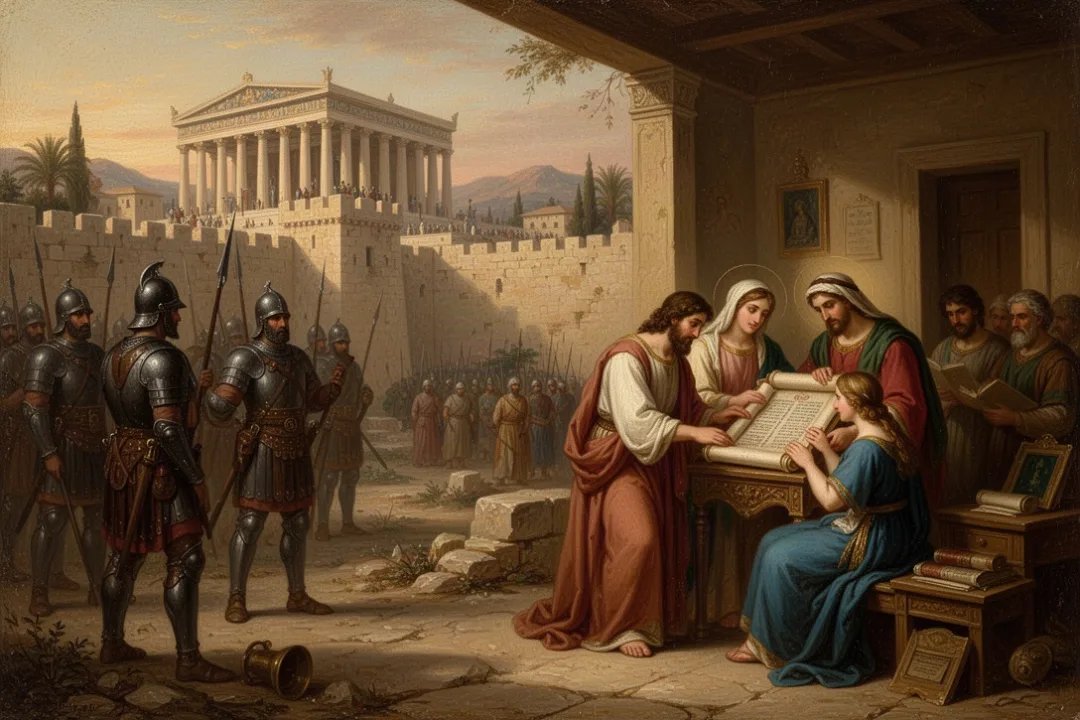
The chapter then describes royal decrees that reach throughout the kingdom. Jewish people are ordered to abandon distinctive practices, including circumcision, Sabbath observance, festival observance, and temple sacrifice. Copies of the Law are destroyed, and possessing or following them can bring a death sentence.
These commands go beyond ordinary political administration. They aim to erase the practices that distinguish Jewish worship and communal life. The issue is not simply whether Judea must pay taxes or obey a foreign king. The issue is whether people may continue to live according to the covenant traditions they believe define their relationship with God.
How Alexander’s successors create the setting for persecution
Alexander’s empire spread Greek political and cultural influence across the eastern Mediterranean and much of the Near East. After his death, his empire divided among rival rulers. 1 Maccabees 1 does not give a full history of the Hellenistic world, but it shows how those rivalries eventually affect Judea.
The Seleucid kingdom controlled the region that included Jerusalem for much of the period described in the book. Seleucid rulers governed a diverse population, and Greek language, institutions, education, and public customs were widespread. Some Jewish people welcomed aspects of this culture, while others feared that adopting it would weaken their religious commitments.
The chapter presents this conflict through the actions of Jewish leaders who seek permission to establish a gymnasium in Jerusalem and to adopt customs associated with other nations. A gymnasium was not simply a place for modern-style exercise. In the ancient Greek world, it was connected with education, civic identity, athletics, and public culture.
For some people, participation in Greek customs may have seemed practical or sophisticated. It could offer social access, political influence, or a way to fit into the dominant culture. The writer of 1 Maccabees, however, views these developments as a serious turning away from the Law and from the traditions that organize Jewish life.
The chapter describes Jewish men who attempt to conceal the sign of circumcision after entering the gymnasium. This detail shows the pressure created by assimilation. Circumcision was a physical sign of the covenant, but in a public environment shaped by Greek ideals, some people tried to hide that identity rather than face embarrassment or exclusion.
The central conflict: 1 Maccabees 1 treats cultural assimilation as dangerous when it requires abandoning practices that define faithfulness to God. The concern is not learning from another culture; it is surrendering worship and covenant identity under pressure.
The book’s perspective is deliberately clear. It does not present every contact with Greek culture as equally sinful or every person who speaks Greek as unfaithful. Instead, it focuses on choices that directly replace Jewish worship and practice with foreign religious customs.
This distinction helps modern readers avoid a simplistic reading. The chapter is not merely saying that every foreign influence is bad. It is asking what happens when political power, social ambition, and religious compromise combine to make faithfulness appear backward or dangerous.
Why Antiochus attacks the temple and Jewish practices
Antiochus’s actions have both political and religious dimensions. A ruler could seek loyalty by imposing a common culture across a diverse empire, but the decrees in this chapter are unusually severe because they target the central practices of Jewish life. The destruction of sacred books and the prohibition of worship show an effort to control not only public behavior but also the community’s memory and identity.
The temple’s desecration is one of the chapter’s most significant events. Antiochus’s forces place a pagan altar on the temple altar and offer sacrifices there. The writer describes this act as the “abomination of desolation”, a phrase that later becomes important in Jewish and Christian biblical interpretation.
Because the temple was the center of sacrifice and national worship, its defilement carries meaning far beyond the damage to a building. The act declares that the king’s authority stands above the commands of God. It also turns the sacred center of Jerusalem into a visible symbol of foreign domination.
The chapter associates the new worship with a deity identified as Zeus Olympios. It also describes pagan altars being erected throughout Judea. In this way, the decree reaches beyond Jerusalem and attempts to reshape everyday religious life across the region.
The authorities require people to offer sacrifices according to the royal command and to abandon the customs handed down through the Law. The chapter mentions forbidden foods and other practices that would have marked Jewish faithfulness in daily life. These details show that persecution affects kitchens, homes, festivals, family ceremonies, and public gatherings—not only formal worship.
Antiochus also orders the destruction of copies of the Law. Anyone found keeping a scroll, or continuing to observe the covenant, can be condemned. Burning sacred writings is especially significant because it attacks the community’s ability to teach, remember, and transmit its faith.
The persecution therefore operates on several levels:
Political control: The empire uses royal orders, soldiers, and fortified positions to impose obedience.
Religious replacement: Pagan worship is installed where Jewish worship had been practiced.
Cultural pressure: Greek customs are promoted as the path to social acceptance and advancement.
Erasure of memory: Sacred books and inherited practices are targeted so that the next generation will have less access to its tradition.
This combination explains why the chapter feels so urgent. The crisis is not limited to a single battle or a change of king. The survival of a community’s religious identity is at stake.
What the chapter teaches about resistance and faithfulness
After describing the decrees, 1 Maccabees 1 gives examples of people who refuse to obey. Their stories show that resistance begins in ordinary acts of faithfulness: continuing to observe the Law, refusing forbidden sacrifices, protecting children, or choosing death rather than public apostasy.
One of the most striking examples is the account of a woman who circumcises her infant son. Because circumcision has been prohibited, this act becomes an open rejection of the king’s decree. The authorities discover what she has done, and the chapter portrays her punishment as an attempt to terrorize the community into obedience.
The narrative also describes a mother and her seven sons who are killed because they refuse to eat forbidden food. The writer does not treat their deaths as meaningless victims of political violence. Their willingness to suffer becomes a witness that the king’s power has limits.
The account of the mother and her sons highlights several themes. Family faithfulness becomes a form of resistance, physical suffering is connected to hope in God, and obedience is measured by loyalty to the Law rather than by survival at any cost.
Different translations and traditions may number or phrase some details differently, so it is best to consult the verse references in the edition you are using. The basic message remains consistent: the family refuses to abandon the practices that identify them as faithful Jews, even when the state makes obedience to those practices punishable by death.
The chapter’s martyrs do not win a military victory. Their witness works differently. They reveal that coercion can control public actions for a time, but it cannot automatically create genuine religious loyalty.
For the writer, martyrdom also exposes the moral weakness of Antiochus’s power. The king can destroy books, seize property, and kill people, but his ability to command does not make his demands righteous. The faithfulness of the persecuted becomes a judgment on the ruler who claims absolute authority.
Readers should also recognize that the chapter reflects the values and language of an ancient Jewish resistance account. It is not a modern legal or political essay. Its purpose is to preserve the memory of persecution and to encourage loyalty to God in a time when compromise may seem safer.
How 1 Maccabees 1 fits within the Bible
First Maccabees is included in the Catholic and Orthodox biblical traditions, while it is generally treated as part of the Apocrypha by Protestants and is not included in the Jewish Tanakh. Its status differs by tradition, so readers may encounter it in some Bibles and not others.
The book was written after the events it describes and presents a historical account shaped by religious conviction. It is valuable for understanding the Maccabean revolt and the political world of the second century BCE, although it should be read as an ancient work with a particular viewpoint rather than as a modern neutral chronicle.
First Maccabees is distinct from Second Maccabees. Both cover parts of the same general period, but they have different structures, emphases, and styles. First Maccabees gives substantial attention to political developments, military leadership, diplomacy, and the rise of the Hasmonean family.
First Maccabees 1 also connects with themes found elsewhere in Scripture. The destruction of Jerusalem and the profanation of the temple recall earlier biblical accounts of foreign invasion. The prohibition of worship and the testing of faithful people also prepare readers for later Jewish and Christian discussions of persecution.
Daniel is especially relevant as a companion text for many readers. Daniel’s visions describe oppressive rulers, desecration, and the endurance of faithful people. First Maccabees does not simply repeat Daniel, but the two books illuminate the same broad historical crisis from different literary and theological perspectives.
The New Testament does not quote 1 Maccabees as part of its text in the same way it quotes books accepted across Christian traditions. Still, the Maccabean period forms an important background for understanding Jewish groups, hopes, conflicts, and expectations in the centuries before Jesus.
The story also helps explain the significance of Hanukkah. Later chapters of 1 Maccabees describe the purification and rededication of the temple after the revolt. Chapter 1 provides the necessary background: the temple has been profaned, Jewish worship has been suppressed, and restoration will eventually become a central goal.
How to read the major themes in 1 Maccabees 1
The chapter can be read as a warning about the relationship between political power and religious identity. A government may claim that uniformity will create peace, but uniformity imposed through force can become an attack on conscience. The people in this chapter are not merely resisting a foreign accent or style of dress; they are resisting commands that require them to abandon worship.
Another major theme is the danger of compromise by influential insiders. The persecution does not begin only with soldiers from outside Judea. The chapter first describes Jewish leaders who seek to adopt foreign customs and encourage a broader cultural transformation from within.
That does not mean every change introduced by an outside culture is automatically wrong. The sharper question is what a community gives up in exchange for acceptance, security, status, or political access. The chapter asks readers to examine whether adaptation has crossed into surrender.
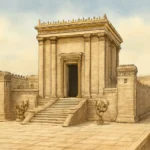
The temple represents more than a religious building. It stands for the center of communal worship, memory, and covenant life. When it is desecrated, the community experiences the attack as an assault on its relationship with God and on the meaning of Jerusalem itself.
The chapter also gives serious attention to written tradition. Destroying the Law is an attempt to make obedience impossible for future generations. Preserving texts, teaching children, and continuing inherited practices therefore become acts of resistance.
Several questions can guide a careful reading:
Which parts of the chapter describe political conquest, and which describe religious persecution?
How do the actions of assimilating Jewish leaders prepare the way for later decrees?
Why does the writer treat the temple and the Law as central symbols of communal identity?
What do the martyrs reveal about the limits of royal power?
How does the chapter prepare for the temple’s later purification and rededication?
For personal or group study, read the chapter in stages rather than treating it as one uninterrupted narrative. First follow the political history, then identify the decrees, and finally compare the responses of those who comply with those who resist.
A useful study process is:
Mark the rulers and places: Identify Alexander, the Seleucid succession, Antiochus, Jerusalem, and the wider region.
List the forbidden practices: Notice how the decrees affect worship, sacred writings, food, circumcision, festivals, and the Sabbath.
Track the symbols: Pay special attention to the temple, the altar, the Law, and the fortified city.
Compare responses: Examine assimilation, passive suffering, active resistance, and martyrdom.
Read forward: Continue into the next chapter to see how Mattathias and his sons respond to the crisis.
Reading tip: Do not reduce 1 Maccabees 1 to a story about conflict between Greek and Jewish people. The chapter describes a struggle within Judea as well as imperial persecution, and it focuses on whether Jewish worship will survive political and social pressure.
The chapter ends without resolving the crisis. Antiochus’s decrees remain in force, the temple has been defiled, and faithful people have been killed. That unfinished ending directs the reader toward the next stage of the story, where resistance becomes organized under Mattathias and his sons.
Its final effect is therefore both historical and moral. Historically, it explains the conditions that lead to the Maccabean revolt. Morally, it asks whether faithfulness can survive when obedience is costly, public identity is mocked or prohibited, and powerful leaders insist that political security requires religious surrender.
Frequently asked questions
Who is Antiochus IV in 1 Maccabees 1?
Antiochus IV Epiphanes was a Seleucid king who ruled during the second century BCE. In 1 Maccabees 1, he invades Jerusalem, plunders the temple, imposes pagan worship, and bans important Jewish practices. His policies provoke resistance and become the immediate background for the Maccabean revolt.
What is the “abomination of desolation” in this chapter?
In 1 Maccabees 1, the phrase refers to the pagan altar placed on the temple altar in Jerusalem. The act represents the replacement and desecration of Jewish worship. Later biblical writings use related language in different settings, so each passage should be interpreted within its own historical and literary context.
Why is circumcision important in 1 Maccabees 1?
Circumcision is presented as a covenant practice and a visible sign of Jewish identity. Antiochus’s decree forbids it, making the practice a direct test of loyalty. The story of the mother who circumcises her infant son shows how even a private family act becomes an act of public resistance under persecution.
How does 1 Maccabees 1 relate to Hanukkah?
Chapter 1 describes the events that make Hanukkah necessary: the temple is looted, pagan worship is installed, and Jewish sacrifices are stopped. Later chapters recount the revolt, the recovery of Jerusalem, and the temple’s purification and rededication, which are remembered in the Hanukkah festival.




Leave a Reply