The Book of Daniel tells how Jewish exiles remained faithful to God while living under powerful foreign empires. Its first six chapters focus on Daniel and his friends in Babylon, while chapters 7–12 describe symbolic visions about kingdoms, persecution, judgment, and God’s lasting rule.
Daniel presents faithfulness as both daily obedience and courageous resistance. The book also emphasizes that human rulers are temporary, God knows the future, and his kingdom will ultimately outlast every earthly power.
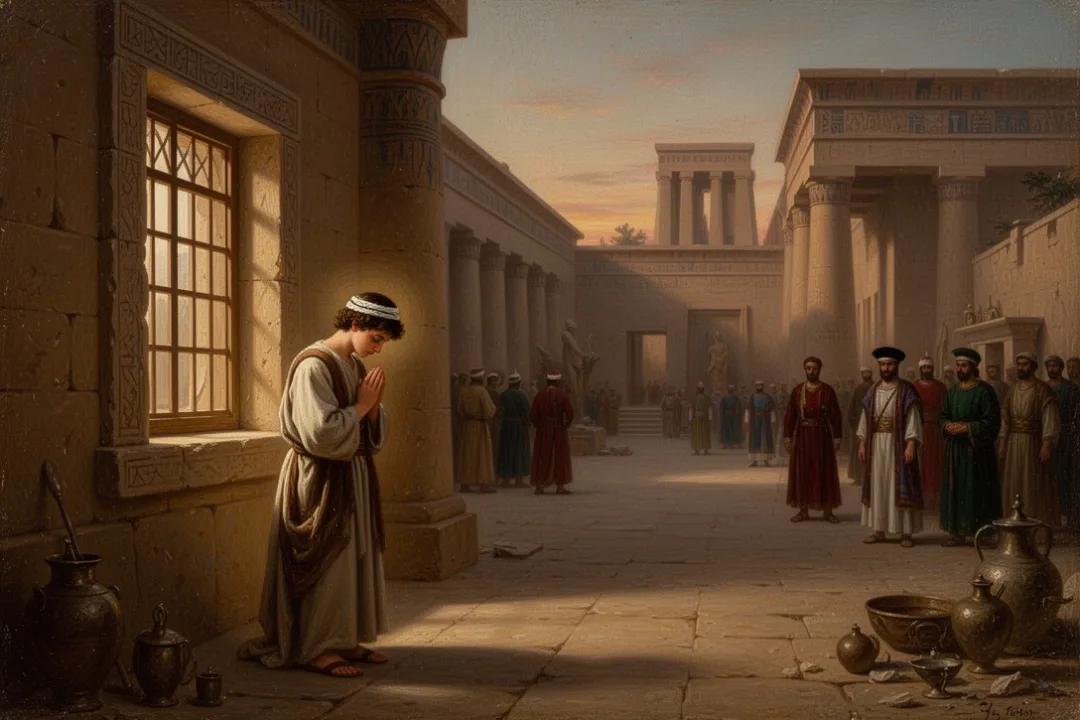
Daniel begins after Jerusalem has been captured by Babylon. King Nebuchadnezzar takes young Judeans to Babylon, including Daniel, Hananiah, Mishael, and Azariah. The four receive Babylonian names—Shadrach, Meshach, Abednego, and Belteshazzar—and are trained for service in the royal court.
Although they live in a foreign culture, the young men do not abandon their religious convictions. Daniel asks for a different diet rather than eating the king’s food, and God gives the four knowledge, wisdom, and understanding. Daniel also receives the ability to understand visions and dreams, a gift that becomes central to the rest of the book.
In chapter 2, Nebuchadnezzar has a disturbing dream and demands that his advisers tell him both the dream and its meaning. When they cannot, the king threatens their lives. Daniel prays with his friends, and God reveals the mystery to him.
The dream concerns a large statue made of several materials. Daniel explains that its parts represent a succession of kingdoms. A stone strikes the statue, destroys it, and grows into a mountain that fills the earth. The image communicates that human empires rise and fall, while God’s kingdom will endure.
Daniel does not claim credit for the revelation. He tells the king that the answer comes from God, who reveals hidden things and makes known what will happen. Nebuchadnezzar responds by honoring Daniel, but the king’s recognition does not mean that he has learned lasting humility.
Chapter 3 centers on Daniel’s three friends. Nebuchadnezzar builds a large golden image and orders officials to bow before it. Shadrach, Meshach, and Abednego refuse because worship belongs to God alone.
The king throws them into a blazing furnace, yet they survive. A fourth figure appears with them, and the king later orders their release. The chapter stresses faithfulness under pressure: the three men trust God’s power, but they also refuse to make their obedience depend on whether God rescues them from danger.
Chapter 4 contains another dream of Nebuchadnezzar. He sees a great tree that provides shelter and food, but a heavenly messenger orders it to be cut down. Daniel interprets the tree as the king himself and warns that his pride will bring him low.
Nebuchadnezzar boasts about his power and achievements. He then loses his sanity and lives like a wild animal for a period of time. When his understanding returns, he acknowledges that God rules over human kingdoms and can humble those who live proudly.
In chapter 5, King Belshazzar holds a feast using vessels taken from the Jerusalem temple. During the celebration, a mysterious hand writes on the wall. The king’s advisers cannot interpret the message, so Daniel is summoned.
Daniel explains that the writing announces the end of Belshazzar’s reign. The king has been weighed and found deficient because he knew what happened to Nebuchadnezzar yet failed to humble himself. That same night, Babylon falls to the Medes and Persians. The story connects arrogance, misuse of power, and sudden judgment.
Chapter 6 is the familiar account of Daniel in the lions’ den. Under the new Persian ruler Darius, Daniel becomes one of the kingdom’s leading officials. Other administrators become jealous and try to find a legal reason to accuse him.
They persuade Darius to prohibit prayer to anyone except the king for thirty days. Daniel continues his regular practice of praying toward Jerusalem. He is arrested and placed in a den of lions, but God protects him. Daniel’s enemies are punished, and Darius publicly acknowledges God’s power.
The chapter does not present prayer as a way to avoid every difficulty. Daniel still faces arrest, a royal decree, and the threat of death. Instead, it shows that consistent devotion matters more to him than personal safety or public approval.
Central idea: Daniel and his friends serve foreign rulers without treating those rulers as ultimate. Their loyalty to God shapes their decisions, even when obedience brings real personal risk.
What the visions in chapters 7–12 mean
The second half of Daniel changes from court stories to symbolic visions. These chapters use beasts, horns, heavenly beings, judgment scenes, and symbolic time periods. Their images can be difficult to interpret, but their broad message is consistent: oppressive kingdoms are temporary, God judges evil, and faithful people can trust his final authority.
Chapter 7 describes four beasts rising from the sea. The creatures represent kingdoms, but they are portrayed as violent and unnatural. A small horn emerges from the fourth beast and speaks arrogantly against God’s people.
Then Daniel sees the Ancient of Days seated in judgment. The arrogant ruler is condemned, and one like a son of man receives authority and an everlasting kingdom. The vision contrasts beastly political power with a kingdom marked by rightful rule and lasting dominion.
The phrase “son of man” has a particular meaning within Daniel’s vision, where the figure comes before God and receives authority. Later Christian interpretation connects this figure with Jesus, but the passage should first be understood in its own setting: God grants enduring rule to a figure associated with humanity and the faithful people of God.
Chapter 8 presents a ram and a goat. The ram represents the Medo-Persian power, while the goat represents Greece. The goat’s prominent horn breaks, and several horns replace it. A further ruler rises and attacks the holy place and the people who worship God.
The vision reflects the speed of conquest, the division of an empire, and the damage caused by a ruler who opposes God. Daniel becomes distressed and seeks understanding. The chapter reinforces the book’s concern with political violence and religious persecution.
In chapter 9, Daniel reads the prophecy of Jeremiah concerning Jerusalem’s desolation. He responds with one of Scripture’s major prayers of confession. Daniel identifies himself with his people rather than treating their suffering as someone else’s fault.
He acknowledges national sin, disobedience, and failure to heed God’s warnings. Daniel asks for mercy and restoration because Jerusalem and the sanctuary bear God’s name. The angel Gabriel then gives him a revelation involving “seventy sevens,” a symbolic period connected with sin, atonement, Jerusalem, and future events.
Interpretations of the seventy sevens differ significantly. Some readers understand the passage as a timetable of historical events, while others emphasize its symbolic structure and theological message. The safest shared point is that the vision presents history as under God’s direction, even when its details are difficult to map precisely.
Chapters 10–12 form one extended vision. Daniel mourns and fasts before receiving a message from a heavenly messenger. The messenger describes conflict involving the kings of the north and south, referring to struggles between rival powers that affect the Jewish people and the land.
The vision includes a ruler who desecrates the temple and stops regular worship. This figure is commonly associated with Antiochus IV Epiphanes, a second-century B.C. ruler who persecuted Jews and interfered with worship in Jerusalem. The passage also looks beyond immediate events toward resurrection, judgment, and the vindication of the faithful.
Chapter 12 speaks of a time of distress followed by deliverance. It includes one of the clearest Old Testament references to resurrection and final judgment: some awaken to everlasting life, while others face shame. The wise are compared to lights, and those who lead others toward righteousness are honored.
Daniel is told to seal the words until the appointed time. That command suggests that the revelation is not given to satisfy every curiosity about dates and schedules. It calls readers to endurance, wisdom, and trust while history remains unresolved.
Who are the main people and powers in Daniel
Daniel and his three friends
Daniel is a Judean exile who serves in several imperial administrations. He is consistently portrayed as wise, prayerful, disciplined, and trustworthy. His strength is not political control but the ability to remain faithful while exercising responsibility within a foreign government.
Hananiah, Mishael, and Azariah are Daniel’s closest companions. Their Hebrew names emphasize their connection to Israel’s God, while their Babylonian names reflect the pressure to adopt the identity of the empire. The furnace story gives them a shared role as witnesses against idolatry.
Nebuchadnezzar, Belshazzar, and Darius
Nebuchadnezzar represents imperial power at its height. He can reward servants, threaten them, build monuments, and command entire populations, yet Daniel repeatedly shows that his authority is limited. The king’s personal movement from pride to acknowledgment of God’s sovereignty shapes several early chapters.
Belshazzar appears as a ruler who knows the past but refuses to learn from it. His feast and the writing on the wall show how quickly a powerful kingdom can reach its end. Darius, by contrast, is portrayed as a ruler who respects Daniel but is trapped by a law created through political manipulation.
The book’s rulers are not all identical, but they share a basic limitation: no king controls the future completely. Their decrees can endanger God’s servants, yet none can overturn God’s purposes.
The kingdoms and symbolic rulers
Daniel uses different images to describe successive empires. The statue in chapter 2, the beasts in chapter 7, and the animals in chapter 8 communicate related ideas through different symbols. Readers should be cautious about forcing every image into a single modern political prediction.
The visions were meaningful to communities facing imperial domination. They reveal the moral character of kingdoms, not merely their names. Governments become “beastly” when they depend on violence, pride, exploitation, and opposition to worship.
Babylon appears as a power that conquers Jerusalem and takes its people into exile.
Medo-Persia follows Babylon in the book’s sequence of empires.
Greece is associated with rapid conquest and the division of power after a great ruler’s fall.
Later persecuting rulers embody the threat posed by leaders who attack Jewish worship and the faithful community.
What are the main themes in Daniel
God’s sovereignty over political history
Daniel does not deny the reality of military power, government policy, or persecution. Instead, it places every empire within a larger framework. Kings may appear dominant, but they remain accountable to the God who gives and removes authority.
This theme appears in both the stories and the visions. In the court narratives, rulers are humbled or replaced. In the visions, terrifying beasts are judged and their dominion is removed. The message is not that political events are unimportant; it is that political power is never ultimate.
Faithfulness in an unfamiliar culture
Daniel and his friends do not withdraw from public life. They learn the language and literature of Babylon, serve in government, and advise kings. At the same time, they draw a clear boundary around worship, prayer, and practices that would violate their convictions.
The book therefore presents a careful pattern for life in a pluralistic society. Faithful people can contribute their skills to public institutions without allowing those institutions to define their deepest loyalties. Daniel’s example combines competence, integrity, and spiritual courage.
Wisdom comes from God
Daniel’s ability to interpret dreams and visions is repeatedly linked to God rather than personal brilliance. He studies, listens, prays, and speaks carefully, but the source of hidden knowledge is divine.
That emphasis protects Daniel from becoming a celebrity interpreter. He does not use revelation to promote himself. His wisdom serves frightened people, exposes injustice, warns rulers, and encourages the faithful.
Pride brings judgment
Nebuchadnezzar’s downfall, Belshazzar’s feast, and the arrogant horn in the visions all illustrate the same principle. Rulers who treat themselves as gods and people as tools eventually face judgment.
Daniel’s treatment of pride is more than a warning to kings. Individuals and communities can also confuse success with absolute authority. The book calls for humility because every human achievement remains subject to God’s evaluation.
Endurance and hope under persecution
The visions do not promise that faithful people will avoid suffering. Daniel is imprisoned, his friends face execution, and later visions describe severe oppression. Hope comes from the certainty that suffering does not have the final word.
Resurrection, judgment, and the everlasting kingdom answer the question of whether faithfulness is worthwhile when evil appears to win. Daniel’s answer is yes, because God remembers his people and will set right what earthly rulers have distorted.
How to read Daniel’s prophecy responsibly
Daniel has inspired many interpretations, especially concerning the identity of the four kingdoms, the timing of the seventy sevens, and the meaning of the final visions. Some readers connect the symbols primarily to ancient history, while others see patterns that continue into later events.
A responsible reading begins with the book’s original concerns. Its first audience knew exile, imperial rule, threats to worship, and the temptation to abandon their identity. The visions speak into those pressures before readers apply them to later circumstances.
Symbolic numbers should also be handled carefully. Daniel uses numbers to organize visions and communicate completeness, duration, or divine timing. Treating every number as a modern calendar calculation can produce confident predictions that the book itself does not authorize.
Reading caution: Daniel’s visions are meant to encourage faithfulness and confidence in God’s judgment, not to support date-setting or speculation about particular modern leaders.
Several practices help keep interpretation grounded:
Read each vision within the chapters immediately around it.
Compare repeated images, such as beasts, horns, kingdoms, and judgment scenes.
Distinguish what the text explains directly from what interpreters infer.
Consider the experience of Jewish communities living under foreign empires.
Allow room for disagreement about details while holding onto the book’s central message.
Why Daniel still matters to readers
Daniel speaks to people who must make ethical decisions inside systems they do not control. Its characters work for governments that do not share their faith, yet they refuse corruption and idolatry. That combination is relevant to anyone trying to preserve integrity in a workplace, institution, or culture with competing values.
The book also gives language for examining power. It asks what happens when leaders demand loyalty that belongs to God, when public success becomes an excuse for pride, and when laws are used to punish conscience. Daniel does not treat these questions as abstract; it presents them through costly choices.
Prayer is another practical theme. Daniel prays before interpreting the king’s dream, confesses his people’s sin, and maintains his routine even when prayer becomes illegal. His prayer life is not limited to emergencies. It forms the character that allows him to act wisely during emergencies.
Finally, Daniel offers hope that does not depend on immediate political outcomes. The faithful may lose status, safety, or influence for a time, but God’s judgment is more lasting than any empire’s victory. The book directs attention beyond present appearances to justice, resurrection, and an everlasting kingdom.
Read as a whole, Daniel joins court narratives with apocalyptic visions to make one sustained claim: God remains sovereign when his people are displaced, threatened, or overlooked. Faithfulness may require courage, patience, and resistance, but the future belongs not to arrogant empires but to God and those who remain loyal to him.
Frequently asked questions
Is Daniel a historical book or a book of prophecy?
Daniel contains both court narratives and prophetic visions. Chapters 1–6 tell stories about Daniel and his companions in foreign royal courts, while chapters 7–12 present symbolic revelations about kingdoms and future judgment. Readers differ on questions of composition and historical detail, but the book consistently presents its message as a call to faithfulness under imperial pressure.
What is the main message of the Book of Daniel?
Its central message is that God rules over human kingdoms and will ultimately judge arrogant and oppressive powers. Daniel also teaches that believers can serve responsibly in a foreign culture without surrendering their worship or moral convictions. The book joins present faithfulness with future hope, including the expectation of final justice and resurrection.
What does the statue in Daniel 2 represent?
The statue represents a succession of earthly kingdoms. Its different materials signify changing empires, while the stone that destroys it represents God’s enduring kingdom. Interpretations vary about the exact identity of every kingdom, but the image clearly contrasts temporary political power with a rule that does not depend on conquest, human pride, or military strength.
Why was Daniel thrown into the lions’ den?
Rival officials persuaded King Darius to sign a law restricting prayer to the king for thirty days. They knew Daniel regularly prayed to God, so they used his religious devotion to trap him. Daniel continued praying, was sentenced to the lions’ den, and was protected by God. The story emphasizes integrity under unjust pressure.








Leave a Reply