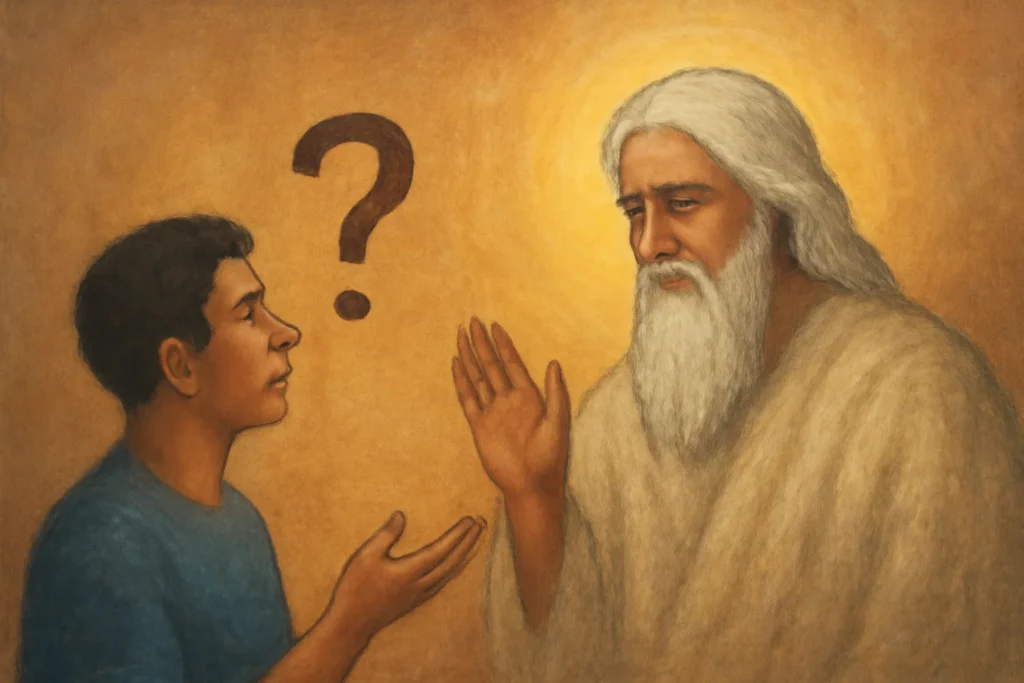
Ask God a Question: An Introduction to Seeking Guidance
Throughout human history, people have turned to a higher Power in moments of uncertainty, seeking
insight beyond ordinary perception. When we say Ask God a Question, we are
describing a deliberate act of reaching for clarity, purpose, and direction in the face of
life’s ambiguous turns. This article explores the idea of posing questions to the divine, the
practices that accompany such inquiries, and the ways in which perceived answers can shape
behavior, choices, and character. It is not a guarantee of instant certainty, but a pathway for
cultivating discernment, patience, and trust in something larger than ourselves.
To seek guidance through prayer, contemplation, or quiet reflection is to engage in
an ongoing conversation with the sacred. The phrasing may vary—some speak of asking God a
question, others of inquiring of the Divine, and still others of turning toward spiritual wisdom.
What remains constant is the intention to open the heart, to reduce noise, and to invite
illumination that can inform actions and shape one’s inner life. This article presents a practical
guide to deliberate questioning, common methods across traditions, and the mindset that helps
translate a question into meaningful, responsible answers.
Before we go deeper, it is helpful to understand a few principles that recur across many paths:
Humility is essential. A genuine question invites humility, acknowledging limits and opening space for revelation that may come in unexpected forms.
Clarity matters. A well-formed question is more likely to yield a useful response than a vague wish for certainty.
Patience is often part of the process. Answers may arrive gradually, through quiet insight, changes in circumstance, or shifts in perspective.
Action follows discernment. The value of a divine or spiritual answer lies not only in knowing, but in living that knowledge with integrity.
Historical and Cultural Varieties of Asking for Divine Guidance
People across cultures have developed varied rituals and language for asking God a question.
While the vocabulary differs, the underlying impulse is remarkably similar: to seek truth, to find
direction for a difficult decision, and to align one’s life with a perceived order beyond personal
preference. The following sections sketch some of the broad traditions and approaches that illuminate
how individuals have engaged the divine in different epochs.
Ancient and Scriptural Traditions
In many ancient contexts, inquiring of the divine involved sacrifice, ritual, or oracular voices.
The sense that the sacred speaks through signs—omens, visions, or holy texts—permeates
civilizations. In the Judeo-Christian tradition, for example, people have asked God a question through
prayer, prophetic counsel, and the study of Scripture, seeking guidance that harmonizes personal
desire with divine purposes. In other pathways, sages and mystics have used contemplative silence to
listen for truth that transcends ordinary thought.
Eastern and Global Perspectives
Across the world, many spiritual lineages invite a direct encounter with the sacred through meditation,
mindfulness, and non-dual awareness. In these contexts, a question may emerge from a posture of
curiosity rather than demand, recognizing that clarity often unfolds gradually as the mind settles.
The practice of asking the Divine in a quiet mind can resemble a dialogue with the inner sense of
truth—sometimes described as stillness, awareness, or the witness within.
Modern Approaches: Personal Reflection and Community Insight
In contemporary life, people blend traditional forms with personal practice. You might ask God a question during a morning routine, in a moment of crisis, or while journaling about
a dilemma. Others seek guidance within a community—a faith group, a mentor, or a trusted friend—who
can offer perspective, accountability, and prayers that accompany the process of seeking
spiritual answers.
If you want to explore how to pose a question to God, several practical paths can
support your intention. The following methods are versatile, flexible, and adaptable to diverse
spiritual backgrounds. You may combine them or emphasize one that resonates most deeply with you.
Prayer with Intent: Begin with sincerity. State the question in simple, concrete
terms, naming the outcome you hope for and any constraints or values involved. Acknowledge your
own limitations and invite guidance beyond personal preferences.
Quiet Contemplation: Sit in silence or a comfortable stillness, allowing thoughts to
settle. You might repeat a brief phrase, such as a personal invocation, and observe what arises—a
sense of peace, a new detail in a situation, or a gentle shift in perspective.
Journaling: Write your question, then write without censorship for several minutes. Notice
any recurring themes, images, or phrases. Sometimes the act of externalizing the question clarifies
what you are really asking.
Scripture, Sacred Texts, or Readings: Read passages related to your question. Pay
attention to verses that resonate, even if they challenge your expectations. Reading with humility
often invites insights that are not immediately obvious.
Dream Reflection: Keep a dream journal. After waking, reflect on symbols or
messages that might connect to your question. Dreams can provide symbolic guidance rather than
direct instructions.
Rituals and Sacred Constraints: Some traditions use rituals, fasting, or specific
times (like a particular day or season) to deepen attention. These practices can shift
consciousness and open space for guidance to appear.
Dialogue with Trusted Guides: Talk with a mentor, a spiritual counselor, or a
trusted friend who shares your values. They can help you test the question, name assumptions,
and reflect on potential interpretations without pressuring you toward a predetermined answer.
Crafting Your Question: What to Ask and How to Ask
The quality of the question often determines the usefulness of the response. A well-crafted
inquiry invites clarity, integrity, and practical direction. Here are some guidelines to shape a
meaningful question.
Be specific, not vague. Instead of saying, "What should I do with my life?" try a more
focused prompt, such as, "In the next six months, what step would most align me with my core values in my career?"
Ground the question in values. Tie your request to enduring commitments like honesty, compassion,
justice, growth, or service. Questions anchored in virtue tend to yield steadier guidance.
Ask for guidance, not control. You may phrase the inquiry as an invitation for insight rather than a demand
for a specific outcome. For example, "What wisdom can help me respond well in this situation?" instead of "Tell me exactly what to do."
Allow for multiple possibilities. Divine guidance may come as a nuanced suggestion, a timing cue, or a shift in perception—be open to various forms of response.
Invite accountability. Include a request for the strength or resources to act on the answer, and a way to test its
wisdom against real-life experience.
Listening for Answers: How to Recognize Guidance
Receiving a response to a question you’ve asked is often less about dramatic voices and more
about subtler forms of perception. Here are common ways people experience spiritual answers.
Inner clarity: A moment of quiet certainty or a simple sense that a particular option is right, even if it’s not the easiest path.
New perspectives: A shift in how you view a problem, seeing aspects you hadn’t noticed before.
Consistent signs: Repeated cues—an idea that keeps returning, a recurring theme in conversations, or a pattern in events—that highlight a certain direction.
Affirmations in scripture or sacred texts: A passage or verse that seems to illuminate the question in a way that aligns with your situation.
Dreams and creative insight: Dreams may offer symbolic guidance, while music, art, or writing can reveal a path you hadn’t considered.
Peace over agitation: A sense of peace or calm at the thought of following a particular course, even if others fear it.
Impact on behavior: Observing your actions changing in tangible ways that reflect the direction you’ve sensed.
It is important to distinguish genuine spiritual guidance from wishful thinking or cognitive biases. A healthy
approach involves reflection, testing, and time. People often find it helpful to check the response
against reality: Does the guidance promote compassion? Does it withstand ethical scrutiny? Does it respect the welfare
of others? Is it consistent with longstanding values that you hold dear?
Discerning the Quality of the Response
Not every impression labeled as guidance is equally reliable. The practice of discernment helps ensure that the
response you receive is anchored in wisdom rather than impulse. Here are criteria you can use to evaluate
a perceived answer.
Alignment with core values. Does the guidance promote justice, mercy, humility, and the dignity of all beings?
Self-transcendence. Does it push you toward restraint, service, or the greater good rather than exploitation, ego-boosting, or harm?
Community and accountability. Have you tested the sense of guidance with a trusted adviser or community that shares your values?
Practical feasibility. Is there a feasible way to act on the guidance, or is it only a conceptual or miraculous moment?
Timeliness. Does the timing fit your current life circumstances? Is there a discernible rhythm to when guidance arrives?
Consistency across sources. Do related texts, teachings, or practices converge on a similar direction?
When you inquire of God, you may not always receive a single, definitive answer. Instead, you might
uncover a tapestry of insights that guide you to act with greater wisdom. The discernment process often requires
patience and ongoing attention to how your life unfolds in response to the guidance you’ve sensed.
Engaging in spiritual inquiry carries responsibilities. It is possible to misuse the process or misinterpret signs,
particularly when emotions run high or fear is dominant. Consider the following cautions as you continue your
practice of asking questions to the divine.
Avoid manipulation. Be wary of attempts to bend the outcome to fit personal desires or to control others.
Guard against idolatry of certainty. An unwavering belief in a single answer can block growth and humility. Remaining open to revision is a strength, not a weakness.
Respect boundaries. Respect the autonomy and dignity of others who may be affected by your decisions that arise from spiritual guidance.
Test the results in the world. Real-world outcomes—ethics, compassion, and responsibility—should be part of your evaluation.
Seek ongoing discernment. Revisit questions as circumstances change, because what was useful at one time may require adaptation later.
Ask God a Question in Daily Life: Practical Scenarios
The ability to transform a question into lived wisdom appears most clearly in ordinary moments—when a
decision, relationship, or project needs direction. Here are practical scenarios that illustrate the process:
Career and vocation: You might ask, “What step can I take this season that aligns my work with my deepest values?” The guidance could point toward skill development, a shift in role, or a choice to mentor others.
Relationships and community: In relationships, a question such as, “How can I show up with more honesty and compassion in this conflict?” may yield practices like active listening, setting healthy boundaries, or scheduling time for repair.
Health and well-being: A question like, “What small, sustainable habit can I adopt to care for my body and mind?” might result in a routine that emphasizes rest, nutrition, and stress management.
Ethical decisions: When faced with a moral dilemma, you could ask, “Which choice honors the dignity of all affected parties and minimizes harm?” This helps you weigh outcomes with compassion and responsibility.
Service and generosity: A question such as, “Where is my contribution most needed right now?” can lead you to volunteer, donate, or support someone in a way that makes a tangible difference.
Guided Practice: A Simple Daily Routine
If you want a practical, repeatable habit for asking God a question each day, try this simple routine:
Begin with a moment of stillness—three to five minutes of breath awareness.
State your question clearly in one or two sentences, focusing on a specific situation, value, or outcome.
Pause and listen. If useful, write down any impressions, phrases, or images that come to mind.
Check your response against your lived experience over the next 24–72 hours. Note what changes, patterns, or insights emerge.
Close with a brief prayer, gratitude, or affirmation of responsibility to act with integrity.
This routine is adaptable. Some days you may receive a direct sense of clarity; other days you may gain a
subtle shift in perspective or a practical instruction that becomes visible only later. The point is to
maintain an ongoing conversation, rather than a one-off petition.
Supplements: Tools That Support Our Practice
Various tools can support asking God a question in meaningful ways. The following
options are common across diverse communities and can be tailored to fit your practices.
Prayer beads, mantras, or breath counting: Repeating a short phrase or using rhythmic breathing can create a
rhythm of attention that opens space for insight.
Journaling prompts: Questions like, “What am I really afraid of?” and “What would love require in this moment?” help
surface authentic concerns and values.
Scriptural study aids: Commentaries, concordances, or study guides can illuminate passages that illuminate
the question from multiple angles.
Community dialogue: Dialogue with others who share your spiritual orientation can deepen discernment and
keep you accountable to your stated intentions.
Silence and consecration: Time set apart for solitude or fasting can sharpen perception and invite deeper noticing.
Common Misconceptions and Clarifications
As with any deeply personal practice, there are myths and misunderstandings about asking God a question.
Clarifying these can help you keep a healthy perspective.
Myth: Answers arrive as literal commands. Clarification: Guidance often comes as insight, a change in attitude, or a practical option—not a direct mandate.
Myth: Only certain people can hear the divine. Clarification: People from many backgrounds report meaningful
experiences of guidance; the form may differ, but the impulse to seek truth is universal.
Myth: If you don’t receive a response, you’ve failed. Clarification: Silence can be a valid answer, inviting patience, reflection, or a different approach.
Myth: Guidance must be perfect. Clarification: Spiritual guidance often requires interpretation, humility, and ongoing testing.
Integrating Guidance into Life and Relationships
The real test of spiritual guidance is how it informs action and relationship. When you
respond to a sensed answer, you contribute to a life characterized by integrity, care, and courage. Consider how to
translate insight into concrete steps:
Communicate clearly with others who are affected by your decisions. Explain your reasoning, share the values guiding you, and invite feedback.
Act with kindness, even when the path is difficult. Compassion for others helps ensure that decisions bolster the common good.
Revisit and revise your approach as new information arrives. Spiritual guidance is often iterative, not final.
Document outcomes to learn what kinds of questions yield the most helpful responses in your context.
Celebrate discernment—recognize moments when you avoided harm, made a wise choice, or learned from a misstep.
Below are some commonly asked questions about the practice of asking God a question and seeking spiritual answers. If you have additional questions, feel free to adapt these ideas to your own
tradition and experience.
Most people find it meaningful to ask questions about intention, purpose, decision-making, relationships, and
service. You can also seek comfort in times of distress, guidance in moments of uncertainty, or clarity when facing
conflicting options. The most helpful inquiries focus on ethical alignment, personal growth, and ways to contribute
to the welfare of others.
How do I know if the answer is real guidance rather than wishful thinking?
Real guidance often resonates with your deepest values, leads to compassionate action, and withstands ethical
scrutiny. It tends to unfold gradually and requires time, reflection, and testing. If you consistently find that
the direction you sense aligns with truth-telling, empathy, and responsible behavior, it is more likely to be genuine
guidance than a projection of ego.
Is it possible to hear God’s voice directly?
Across traditions, people describe a spectrum of experiences—from inner stillness and a sense of peace to more explicit
directional guidance. Some traditions emphasize inner discernment; others highlight communal confirmation, sacred texts,
or prophetic voices. Regardless of the form, the practice involves humility, integrity, and a willingness to live
according to what is perceived as truth.
Conclusion: The Ongoing Conversation with the Divine
Asking God a question is not a one-time event but an ongoing practice that nurtures a lifelong
relationship with the sacred. It invites you to slow down in a fast-paced world, to listen more deeply to
the inner life, and to act with responsibility toward others. The process can be deeply formative: it
helps cultivate a posture of humility, a commitment to truth, and a
readiness to live with integrity, even when the path is uncertain.
Whether you describe it as asking God a question, inquiring of the Divine, or seeking spiritual answers, the essence remains the same: you open a space for wisdom beyond mere
opinion. By combining clear questions with disciplined listening, you foster discernment that can guide
daily decisions, shape character, and sustain hope. In this way, the practice becomes less about a single
moment of declaration and more about a continuous, evolving relationship with the sources of meaning in life.
If you are starting today, consider choosing one practice unique to you—perhaps a short daily question, a quiet
moment of listening, or a brief journaling exercise. Over time, you may discover that the act of asking
questions itself becomes transformative, teaching you patience, compassion, and courage. That is the heart of
seeking guidance and spiritual answers—a path that honors the mystery while inviting
you to live with intention, empathy, and faith.










Leave a Reply