Babylonian captivity in the Bible: What happened and why
Babylonian captivity in the Bible: What happened and why
The Babylonian captivity was the period when Babylon conquered the kingdom of Judah, destroyed Jerusalem and its temple, and deported many of its people to Babylon. The crisis unfolded through several stages, especially in 597 BCE and 586 BCE, and ended after Persia conquered Babylon and permitted exiles to return.
The Bible presents the exile as both a historical disaster and a spiritual turning point. Books such as 2 Kings, 2 Chronicles, Jeremiah, Ezekiel, Daniel, Ezra, Nehemiah, and Lamentations describe its causes, suffering, meaning, and aftermath. The captivity forced Judah to consider its covenant with God while also preserving a strong hope that Jerusalem and its worship would be restored.
Where the Babylonian captivity fits in biblical history
After the reign of Solomon, the united kingdom of Israel divided into two kingdoms. The northern kingdom kept the name Israel, while the southern kingdom was called Judah and included Jerusalem. These kingdoms faced different conquerors: Assyria destroyed the northern kingdom in the eighth century BCE, while Babylon later conquered Judah.
The Babylonian captivity therefore does not mean that every Israelite was taken to Babylon. It refers specifically to the exile of many people from Judah, particularly its political, religious, and skilled populations. Others remained in the land, and some fled to neighboring regions, including Egypt.
Babylon rose under King Nebuchadnezzar II and became the dominant power in the ancient Near East. Judah had been caught between larger empires and eventually rebelled against Babylonian control. Babylon responded with military campaigns that reduced Judah to a devastated vassal state and finally ended its independence.
Central point: The Babylonian captivity was not one single event. It was a sequence of Babylonian invasions, deportations, the destruction of Jerusalem, decades of exile, and a gradual return under Persian rule.
The main events of the Babylonian exile in order
Babylon defeats Egypt and gains control of Judah. Babylon’s victory over Egypt at Carchemish established its regional power. Judah came under Babylonian authority during the reign of Jehoiakim.
The first deportation takes place. In 597 BCE, Babylon captures Jerusalem after King Jehoiachin, also called Jeconiah or Coniah, surrenders. The king, royal officials, soldiers, craftsmen, and other leaders are taken to Babylon.
Zedekiah rules as Babylon’s appointed king. Babylon places Zedekiah, a relative of Jehoiachin, on Judah’s throne. He later rebels, despite warnings from the prophet Jeremiah.
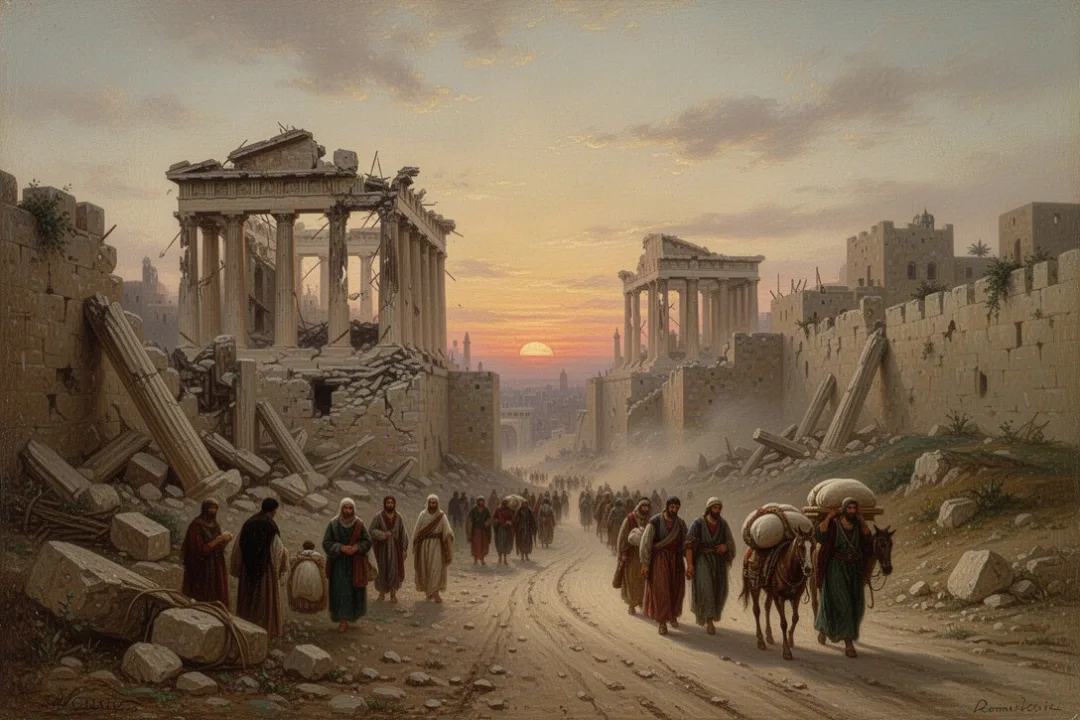
Jerusalem falls after a long siege. Babylon attacks again, and the city falls in 586 BCE. The temple is burned, the city walls are damaged, and another large group is deported.
Judah loses its political independence. Babylon governs the remaining population through appointed officials. The biblical account also records violence, famine, and the killing or exile of important leaders.
The exiles build lives in Babylon. They live in communities, preserve their identity, and continue seeking God while separated from Jerusalem and the temple.
Persia defeats Babylon. In 539 BCE, Cyrus the Great conquers Babylon. His imperial policy allows displaced peoples, including Judean exiles, to return and restore local sanctuaries.
Return and rebuilding begin. The biblical books of Ezra and Nehemiah describe groups returning to Judah, rebuilding the temple, restoring Jerusalem’s defenses, and renewing communal religious life.
Why Babylon conquered Judah according to the Bible
The historical explanation includes rebellion, imperial power, military strategy, and the political weakness of Judah. The biblical explanation goes further: the prophets interpret the conquest as divine judgment for persistent injustice, idolatry, covenant disobedience, and refusal to listen to correction.
That explanation appears throughout the historical books and prophetic writings. Kings and Chronicles describe rulers who tolerated or promoted worship practices that the biblical writers regarded as unfaithful to Israel’s God. They also condemn the exploitation of vulnerable people and the failure to practice justice.
Jeremiah repeatedly warns Jerusalem that Babylon will come. His message is not that Babylon’s gods are stronger than Israel’s God. Instead, Babylon is portrayed as an instrument permitted to carry out judgment, while Babylon itself will later face judgment for its pride and cruelty.
The prophets do not treat national catastrophe as proof that God has abandoned his people. They place judgment and faithfulness side by side. Judah’s defeat is real, but so are God’s promises of preservation, repentance, and restoration.
What happened during the first deportation in 597 BCE
Babylon’s first major capture of Jerusalem occurred after Jehoiakim’s rebellion and the beginning of Jehoiachin’s reign. Jehoiachin surrendered after a short reign, and the Babylonian army deported him along with members of the royal household, military leaders, officials, and skilled workers.
The account in 2 Kings 24 emphasizes that the exile included people who could strengthen a rebellion or help build Babylon’s economy. The deportation was therefore both a punishment and an imperial strategy. Babylon removed Judah’s leadership class and installed Zedekiah as a dependent ruler.
The prophet Ezekiel was among those taken in this earlier deportation. He later received prophetic visions among the exiles by the Kebar River. His ministry shows that biblical prophecy did not stop when Jerusalem was lost. God’s word, in Ezekiel’s presentation, reached the displaced community outside the land.
Jehoiachin remained in Babylon for many years. Near the end of the exile, a Babylonian king treated him favorably and allowed him to eat at the royal table, as recorded in 2 Kings 25. This small detail matters because it preserves a sign of hope for the Davidic royal line even after Judah’s monarchy had collapsed.
Why Jerusalem and the temple fell in 586 BCE
Zedekiah eventually rebelled against Babylon, likely expecting support from Egypt. Babylon responded by besieging Jerusalem. A siege cut off food and supplies, creating extreme hunger and suffering within the city. Jeremiah urged submission to Babylon, but his counsel was rejected by the king and other leaders.
When the city fell, Zedekiah attempted to escape but was captured. The biblical narrative describes the punishment inflicted on him and the destruction that followed. Babylon’s forces burned the temple, the royal palace, and major buildings, then broke down sections of Jerusalem’s wall.
The temple’s destruction was especially devastating. It had been the central place of sacrifice and public worship, and its loss raised a painful theological question: How could God’s dwelling place be destroyed? The biblical answer does not deny the catastrophe. Instead, it explains that the temple was never meant to protect a people committed to injustice while they rejected God’s commands.
2 Kings 25 and 2 Chronicles 36 connect the fall of Jerusalem with the warnings of earlier prophets. Lamentations gives the event an emotional voice, describing grief, hunger, shame, loneliness, and mourning without minimizing the city’s pain.
Do not confuse the dates: The first major deportation occurred in 597 BCE, while the destruction of Jerusalem and the temple is generally dated to 586 BCE. Some chronological systems use slightly different dates, but the two events should not be treated as identical.
How the Bible describes life in Babylon
The exiles did not spend every day in prison cells. Babylon deported them from their homeland, but many lived in organized communities and worked, raised families, and conducted ordinary affairs. The experience was still forced displacement, marked by loss of land, political freedom, temple worship, and connection to Jerusalem.
Jeremiah 29 contains a letter to the exiles in Babylon. In it, Jeremiah tells them to build houses, settle down, plant gardens, marry, have children, and seek the welfare of the city where they live. He also warns them not to trust prophets who promise an immediate return.
This instruction gives the exile a distinctive shape. The community is called to remain faithful without pretending that Babylon is its permanent spiritual home. It must live responsibly in a foreign society while waiting for God’s appointed time of restoration.
Psalm 137 expresses the emotional conflict of exile through memories of Jerusalem and grief beside Babylon’s waterways. The psalm’s opening images are among the Bible’s clearest portrayals of displacement and homesickness. Its later language is harsh, showing how trauma and anger can appear in prayers of lament.
The exiles also faced pressure to assimilate. New names, languages, customs, and political loyalties surrounded them. Yet the biblical stories show people maintaining distinctive practices, praying toward God, remembering Jerusalem, and refusing to let imperial power define the limits of their faith.
What Daniel contributes to the story
The book of Daniel begins with young Judeans taken to Babylon during the early period of conquest. Daniel and his companions are trained for service in the royal court. Their situation involves education, cultural pressure, and opportunities for advancement, but also demands that could conflict with loyalty to God.
Daniel’s refusal to abandon his religious identity appears in several episodes. He and his companions decline certain royal provisions, interpret dreams by relying on God rather than Babylonian wisdom, and continue praying despite official restrictions. The famous account of Daniel in the lions’ den emphasizes faithfulness under imperial pressure.
Daniel also presents visions of kingdoms rising and falling. Babylon is powerful, but it is not ultimate. The book places earthly empires within a larger view of history in which God remains sovereign and human kingdoms are temporary.
The book’s symbolism can be difficult to interpret, and faithful readers disagree about some details. Its central message is clearer: exile does not cancel God’s authority, and political power cannot demand the worship that belongs to God alone.
How Ezekiel interprets God’s presence outside Jerusalem
Ezekiel served among the exiles and addressed a community that had lost its land and temple. His visions use striking imagery to show God’s glory moving and acting beyond Jerusalem. This directly challenges the assumption that God could be confined to one building or territory.
At the same time, Ezekiel does not dismiss the importance of Jerusalem. He explains the city’s judgment, condemns its corruption, and later describes visions of renewal. The book moves from accusations against leaders and false prophets toward promises of a new heart, a new spirit, restored land, and renewed worship.
Ezekiel 37’s vision of dry bones uses a valley filled with bones to portray a people who believe their hope is gone. God brings life to the bones in the vision, representing the restoration of Israel. The image first addresses national renewal, although later readers have also applied it to individual resurrection and spiritual renewal.
For exiles, Ezekiel’s message was especially significant: their physical distance from Jerusalem did not put them outside God’s reach. Judgment had displaced them, but it had not erased their identity or eliminated the possibility of restoration.
What Jeremiah says about the seventy years
Jeremiah refers to a period of seventy years connected with Babylon’s dominance and Judah’s restoration. Jeremiah 25 presents the years as a period during which the nations will serve the king of Babylon. Jeremiah 29 applies the same number to the exiles’ expectation of return.
Readers calculate the seventy years in different ways because the exile involved several deportations and because ancient writers can describe a period from different starting and ending points. Some count from Babylon’s rise over Assyria or the first Babylonian control of Judah to Babylon’s fall. Others connect it more specifically with the temple’s destruction and its later rebuilding.
The main point is not that every biblical passage uses a modern chronological formula. The number communicates that the exile has a limited, appointed duration. It will be long enough to transform a generation, but it will not last forever.
Daniel 9 reflects on Jeremiah’s seventy years and responds with confession and prayer. Daniel does not treat the prophecy as a reason for passivity. He seeks mercy, acknowledges communal sin, and asks God to restore Jerusalem.
How the exile changed Jewish faith and Scripture
The captivity produced profound changes in the way the community practiced and expressed faith. With the temple destroyed, sacrifice could not continue in Jerusalem as before. The exiles had to preserve their identity through prayer, teaching, memory, communal practices, and obedience.
The period strengthened the importance of reading and preserving sacred traditions. The exact process by which biblical books reached their final forms is complex, and it developed over time. Still, the exile and restoration period clearly became a major setting for collecting, interpreting, and transmitting Israel’s history and prophetic messages.
The community also learned to live with a more portable expression of faith. Worship and instruction could take place among people far from Jerusalem. This did not make the temple irrelevant, but it showed that covenant faith could survive political defeat and geographical separation.
The exile also sharpened questions about identity. Who belongs to the covenant community? How should people relate to foreign rulers? Can a displaced people remain faithful in a dominant culture? The books of Ezra and Nehemiah address these questions through debates about marriage, worship, leadership, Torah observance, and the rebuilding of Jerusalem.
How Babylon’s fall made the return possible
Babylon’s empire ended when Cyrus of Persia conquered Babylon in 539 BCE. The Persian Empire generally used a more flexible policy toward subject peoples than the Babylonians had used in their deportation program. Cyrus permitted displaced communities to return and restore their religious centers.
Ezra 1 presents Cyrus as authorizing the Judeans to return to Jerusalem and rebuild the temple. The text also describes the return of temple vessels that Nebuchadnezzar had taken. This detail symbolizes the reversal of Babylon’s earlier victory: what had been removed from the sanctuary is brought back.
The return was not one simple mass migration. Groups went back at different times, and rebuilding faced opposition, administrative difficulties, economic hardship, and internal disagreements. The people had to reconstruct not only walls and buildings but also a functioning community.
The second temple was eventually completed, though the restored community’s circumstances differed greatly from those of Solomon’s kingdom. The restored temple became the center of worship, but Judah remained under imperial authority rather than becoming a fully independent kingdom.
What Ezra and Nehemiah reveal about restoration
Ezra focuses strongly on the temple, priesthood, Torah, and the community’s religious identity. Nehemiah emphasizes the rebuilding of Jerusalem’s walls and the organization of public life. Together, the books show that returning home did not instantly remove every consequence of exile.
The restored community struggled with poverty, foreign opposition, weak infrastructure, and disagreements over faithfulness. Leaders called the people to renew their covenant commitments, observe religious practices, and address social problems among their own members.
Nehemiah’s reforms include concerns about economic exploitation. Wealthier Judeans had taken advantage of poorer neighbors, and Nehemiah confronted them. This continues the prophetic theme that genuine restoration must involve justice within the community, not merely restored buildings or public ceremonies.
Ezra and Nehemiah also show that restoration can be incomplete in human terms. Jerusalem exists again, but the community still waits for the fuller promises associated with God’s kingdom, the Davidic line, and lasting peace.
How the Babylonian captivity connects to later biblical themes
The exile becomes a pattern that later biblical writers use to discuss sin, judgment, repentance, and redemption. The destruction of Jerusalem is remembered as the deepest national catastrophe, while the return becomes evidence that God can bring life out of apparent failure.
The prophets often describe restoration with images of a new exodus, a renewed covenant, a rebuilt city, and a purified people. These promises are not always identical or equally specific. Some concern the historical return from Babylon; others point beyond that return toward a more complete future restoration.
In the New Testament, Jesus and the apostles inherit this world of exile imagery and restoration hope. They read Israel’s Scriptures in light of Jesus’ ministry, death, and resurrection. Christians differ over how particular restoration promises relate to the church, Israel, and the future, but the Babylonian exile remains an important background for understanding those discussions.
The captivity also helps explain why biblical faith does not equate prosperity with righteousness or national power with divine approval. Judah possessed a temple and a royal tradition, yet it still faced judgment. Babylon ruled a vast empire, yet it too was temporary and accountable.
Important Bible passages about the Babylonian captivity
2 Kings 24–25: Describes the deportations, the fall of Jerusalem, the destruction of the temple, and events after the city’s collapse.
2 Chronicles 36: Interprets Judah’s defeat in light of prophetic warnings and records Cyrus’s authorization for the return.
Jeremiah 25 and 29: Explains Babylon’s role in judgment and gives the exiles guidance about living during the long period of displacement.
Lamentations: Gives poetic expression to Jerusalem’s devastation, grief, shame, and appeal for mercy.
Ezekiel 1–3: Introduces Ezekiel’s prophetic ministry among the exiles and shows that God’s glory is not limited to Jerusalem.
Ezekiel 36–37: Presents promises of inner renewal, restored identity, and national revival through the imagery of dry bones.
Daniel 1–6: Shows Judeans maintaining loyalty to God while serving within Babylonian political structures.
Daniel 9: Reflects on Jeremiah’s seventy years through confession, prayer, and a plea for Jerusalem’s restoration.
Ezra 1–6: Describes the first return and the rebuilding of the temple.
Nehemiah 1–13: Covers the rebuilding of Jerusalem’s walls and efforts to renew community life.
Psalm 137: Expresses the sorrow and anger of people separated from Jerusalem and living under Babylonian domination.
Common misunderstandings about the Babylonian captivity
It was not the same as the Egyptian slavery. The Babylonian captivity happened centuries after the exodus from Egypt. Both involved oppression and eventual deliverance, but they were different historical events with different political settings.
It was not the Assyrian exile of the northern kingdom. Assyria conquered Israel, the northern kingdom, before Babylon conquered Judah. Biblical writers sometimes speak of all Israel as one people, but the political events should be distinguished.
Every Judean was not deported. Babylon removed many important groups, but some people remained in Judah. Others were scattered elsewhere. The biblical accounts describe both the exiles and the poor population left behind.
The return did not happen immediately after Babylon’s fall. Cyrus’s conquest created the opportunity for return, but the rebuilding of the temple and city developed over years. Political permission and practical restoration were separate stages.
The seventy years do not erase the complexity of the timeline. The Bible uses the number as a meaningful prophetic period, but readers should allow for different starting points and interpretations rather than forcing every event into one simplistic calculation.
What the Babylonian captivity means for readers today
The story speaks to people who have experienced displacement, cultural pressure, institutional failure, or the loss of familiar religious structures. It does not offer a quick explanation for every disaster. Instead, it preserves prayers, warnings, questions, and promises within the same account.
One lesson is that faith can continue in unfamiliar surroundings. Jeremiah’s message to settle, work, raise families, and seek the welfare of the city challenges both despair and isolation. Faithfulness does not require pretending that exile is easy or permanent.
Another lesson is that restoration involves more than returning to a place. The biblical prophets connect renewal with changed hearts, justice, humility, and renewed commitment to God. Rebuilding walls or institutions without addressing exploitation and idolatry would not fulfill the deeper purpose of restoration.
The captivity also encourages careful reading of suffering. The Bible includes historical explanation, prophetic interpretation, poetry, personal stories, and unresolved grief. No single passage captures the entire experience. Reading these voices together gives a more accurate picture of a community living through judgment while holding onto hope.
For Christians, the exile provides essential background for themes such as kingdom, redemption, covenant, temple, and restoration. For Jewish readers, it remains one of the central events in the long history of loss, survival, return, and religious continuity. For anyone studying the Bible, it marks the moment when a defeated people learned to preserve identity and hope far from home.
Frequently asked questions
How long were the Jews in Babylon?
The exile is commonly described as lasting about seventy years, based on Jeremiah’s prophecies. The exact calculation depends on whether someone begins with Babylon’s first control of Judah, the first deportation in 597 BCE, or Jerusalem’s destruction in 586 BCE. Groups returned at different times after Persia conquered Babylon in 539 BCE.
Who was the king of Babylon during the captivity?
Nebuchadnezzar II was the principal Babylonian ruler associated with Judah’s conquest, the deportations, and Jerusalem’s destruction. Biblical books also mention later rulers, including Belshazzar, in the final period before Babylon fell to the Persian Empire. The captivity therefore covered more than one king’s reign.
Did Daniel live during the Babylonian captivity?
Yes. The book of Daniel places him among Judeans taken to Babylon during the early phase of the conquest. He served in the royal court while maintaining loyalty to God. Daniel’s stories and visions present Babylonian power as real but temporary, and they emphasize faithful living under foreign rule.
Did all the Jews return from Babylon?
No. Some Judeans returned in stages, while many remained in Babylon or settled elsewhere. The books of Ezra and Nehemiah describe important return movements and the rebuilding of Jerusalem, but they do not portray every exile as coming back. Jewish communities outside Judah continued to exist after the restoration began.









Leave a Reply