If you are trying to understand the kings, prophets, and events of the Old Testament, one question quickly becomes unavoidable: what was Judah, the southern kingdom, and how was it different from Israel? Judah was the smaller kingdom formed after the united monarchy of Saul, David, and Solomon divided. Its capital was Jerusalem, its royal family came from David, and it remained in existence for more than three centuries after the northern kingdom of Israel was conquered by Assyria.
Judah’s history is the story of a kingdom balancing political danger, religious responsibility, and dynastic continuity. It survived pressure from Egypt, Aram, Assyria, and Babylon for generations, but was eventually conquered by Babylon. The destruction of Jerusalem and the exile of many Judeans became a defining crisis, while the later return under Persian rule helped shape the religious community known through the rest of the Bible.
The word Judah can refer to several related things. It was first the name of one of the twelve tribes of Israel, then the territory associated with that tribe, and later the kingdom centered in the southern hill country. After Solomon’s reign, the larger kingdom ruled from Jerusalem divided into two states.
The division is traditionally connected with the reign of Rehoboam, Solomon’s son, in the late tenth century BCE. According to the biblical account, northern tribes rejected Rehoboam after he refused to ease the burdens imposed during Solomon’s reign. They established a separate kingdom under Jeroboam, while Judah remained under the house of David.
The northern kingdom is usually called Israel, although both kingdoms claimed the heritage of Israel. The southern kingdom is called Judah because its territory was dominated by the tribe of Judah and because Jerusalem stood within its political and religious center. Benjamin, including areas near Jerusalem, was also closely connected with Judah.
Keep the names distinct: “Israel” may mean the whole people descended from Jacob, the northern kingdom, or the modern nation. “Judah” may mean a tribe, a kingdom, a region, or the people of that region. The surrounding context determines the meaning.
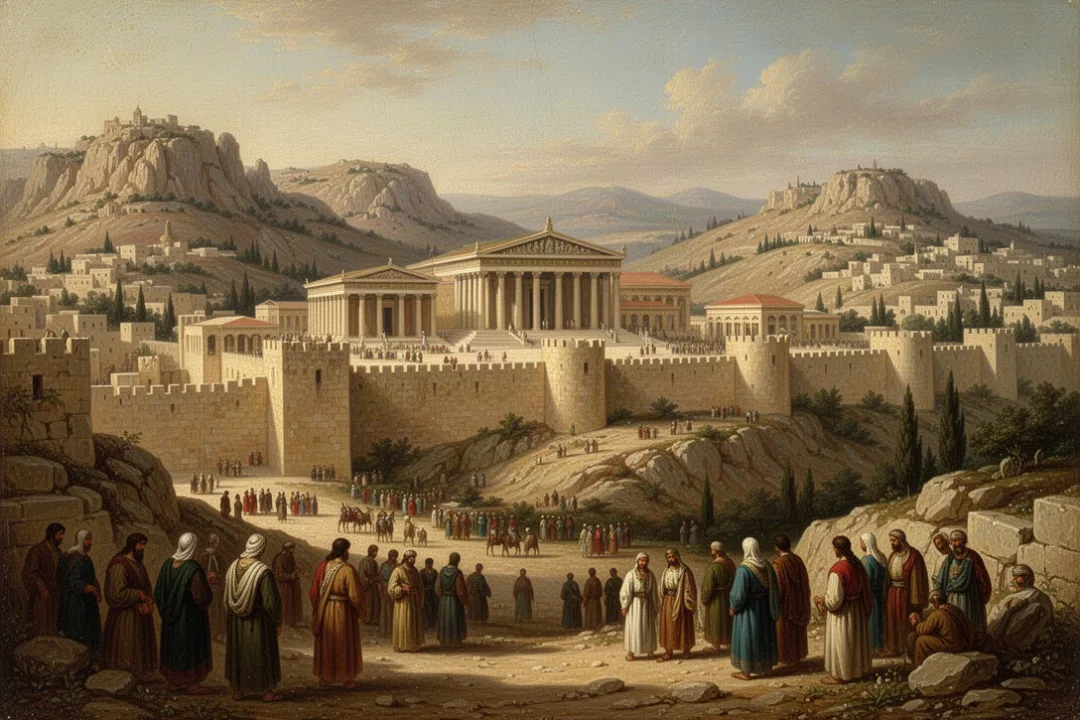
Judah was generally smaller and less wealthy than Israel. Its landscape included the rugged central highlands, the Judean wilderness, and fertile areas in the foothills. Jerusalem’s position gave Judah an enormous religious advantage, because the temple and the Davidic palace were located there, even when the kingdom had fewer people and resources than its northern neighbor.
Where Judah was located and why Jerusalem mattered
Judah occupied the southern portion of the land associated with the Israelite kingdoms. Its core territory stretched around Jerusalem, Bethlehem, Hebron, and the Judean hill country. The kingdom’s eastern edge descended toward the Dead Sea and the wilderness, while its western areas reached toward the coastal plain, though Judah did not always control that region securely.
The terrain shaped Judah’s political life. Mountain roads could be defended more easily than open plains, and Jerusalem’s elevated position offered strategic protection. At the same time, the kingdom depended on trade routes and had to watch powerful states controlling the plains and international corridors to the north and south.
Jerusalem was more than a capital. It was the location of the temple, the seat of the Davidic monarchy, and the main symbol of Judah’s covenant identity. The city’s importance meant that threats against Jerusalem were never merely military threats. They also raised questions about whether God would preserve the Davidic line and the temple-centered community.
The temple provided a central place for sacrifice and pilgrimage, but Judah’s religious life was not limited to Jerusalem. Local shrines, high places, family practices, and rural sanctuaries existed throughout the land. Biblical writers often criticized these sites, especially when they were associated with worship practices they considered improper or with devotion to other deities.
How Judah’s kings ruled after the division
Judah’s royal line was more stable than the succession patterns of the northern kingdom. The Davidic dynasty continued from Rehoboam until the Babylonian conquest. This did not mean that every reign was peaceful or that succession was always simple, but Judah did not experience the repeated series of coups and short-lived dynasties that marked much of Israel’s history.
The early relationship between Judah and Israel varied. At times the two kingdoms fought over territory and influence. At other times they cooperated through alliances and marriages, especially when facing a shared enemy. These political connections could produce temporary security, but prophets often condemned alliances that seemed to place military strategy above faithfulness to God.
Several Judean kings receive particular attention in the biblical record:
Asa is remembered for strengthening Judah and opposing forms of religious practice judged unacceptable by the biblical writers, although his reign also included political and military compromises.
Jehoshaphat expanded Judah’s administrative strength and cooperated with Israel at times, but those relationships brought both advantages and criticism.
Uzziah, also called Azariah, presided over a period of strength and development before later problems weakened the kingdom’s position.
Hezekiah is associated with religious centralization, resistance to Assyria, and the defense of Jerusalem during the Assyrian crisis.
Manasseh ruled for a long time and is portrayed as encouraging practices that biblical authors considered deeply harmful, though a later tradition describes his repentance.
Josiah led a major religious reform and tried to restore covenant practices during a brief period when Assyria’s power was declining.
These reigns show why Judah cannot be described simply as either a faithful kingdom or an unfaithful one. Its history included sincere reform, political calculation, social injustice, temple devotion, idolatry, and resistance to foreign powers. Biblical accounts evaluate kings not only by military success, but by how they treated worship, justice, and covenant obligations.
What Judah’s prophets said about worship and justice
The prophets associated with Judah addressed both religious practice and public life. They did not treat temple rituals as a substitute for ethical conduct. Their messages repeatedly challenged exploitation of the poor, dishonest courts, violence, political arrogance, and the assumption that Jerusalem could never fall simply because the temple stood there.
Isaiah ministered during a period of major Assyrian pressure and spoke to kings, officials, and the people of Jerusalem. His messages included warnings about pride and injustice, criticism of unreliable political alliances, and hope for God’s future work through Jerusalem and the Davidic line.
Micah, who came from a rural town in Judah, sharply criticized powerful leaders who seized land and took advantage of vulnerable people. His prophecy connected genuine devotion to the practice of justice, humility, and faithful obedience rather than to ceremony alone.
Jeremiah lived during Judah’s final decades and warned that Babylon would defeat Jerusalem because of persistent rebellion and injustice. His message was unpopular because many listeners believed the temple guaranteed protection. Jeremiah also spoke of restoration and a renewed covenant after judgment.
Other prophets, including Zephaniah, Nahum, and Habakkuk, addressed Judah’s moral failures and the upheaval caused by empires. Their writings show that Judah’s crisis was interpreted not merely as a contest between armies. Military disasters were examined as moments of theological and moral reckoning.
“What does the Lord require of you?” — Micah 6:8
That reference is often remembered because it summarizes a central prophetic concern: a relationship with God should produce justice, mercy, and humility. The verse is not a complete description of every prophetic message, but it captures why the prophets criticized religious confidence detached from responsible conduct.
Why Judah survived Assyria when Israel did not
The northern kingdom of Israel fell to the Assyrian Empire after a series of conflicts. Samaria, its capital, was captured in 722 BCE, and the kingdom was incorporated into the Assyrian imperial system. Some inhabitants were deported, and other populations were moved into the region as part of Assyrian policy.
Judah survived this catastrophe, but only under severe pressure. Assyria invaded Judah during the reign of Hezekiah, capturing many fortified towns and threatening Jerusalem. The biblical account in 2 Kings, Isaiah, and 2 Chronicles describes the confrontation between the Assyrian forces and Jerusalem. Assyrian records also mention the campaign and Hezekiah’s position.
Jerusalem was not captured during that campaign, but Judah did not simply defeat Assyria in a straightforward battle. The kingdom paid tribute and suffered extensive damage. Jerusalem’s survival became a powerful part of Judah’s identity, reinforcing the belief that the city had been delivered even though the countryside had been devastated.
Assyria’s withdrawal from Jerusalem remains a subject discussed through biblical, Assyrian, and historical evidence. The biblical texts emphasize divine deliverance, while the Assyrian account emphasizes imperial dominance and Hezekiah’s submission. These sources reflect different perspectives on the same regional conflict.
After Assyria’s power declined, Judah regained some freedom of action. Josiah used the changing political situation to expand influence into areas formerly controlled by the northern kingdom. That opportunity was brief. Egypt and Babylon soon became the principal powers competing for control of the region.
What Josiah’s reform changed in Judah
Josiah’s reign, usually placed in the late seventh century BCE, is remembered for a major reform centered on the temple in Jerusalem. The biblical account describes the discovery or renewed recognition of a scroll of instruction during temple repairs. This led to public covenant ceremonies, the removal of religious objects linked to other worship, and an effort to centralize sacrifice in Jerusalem.
The reform also affected sites associated with the former northern kingdom. Josiah’s actions suggest that he viewed religious centralization as part of a broader attempt to reunite Israelite identity around Jerusalem and the Davidic kingdom. The reform was therefore religious, political, and national at the same time.
Yet the reform did not erase every problem. Later biblical writers still describe Judah’s long pattern of disobedience, and the kingdom’s political situation deteriorated quickly after Josiah died. His death at Megiddo while confronting Pharaoh Neco of Egypt left Judah vulnerable to competing empires and led to rapid changes among his successors.
Josiah’s reign is significant because it demonstrates how kingship, temple worship, written instruction, and national identity were connected. It also shows the limits of reform when political conditions are unstable and when earlier habits have become embedded in society.
How Babylon conquered Judah and Jerusalem
Babylon defeated the declining Assyrian Empire and became the dominant power in the region. Judah tried to navigate the rivalry between Babylon and Egypt, but its position was increasingly difficult. Several Judean kings either resisted Babylon or were placed under Babylonian influence before rebelling.
Babylonian forces captured Jerusalem, destroyed the temple, and ended the kingdom’s independence in the early sixth century BCE. The destruction is commonly dated to 586 BCE, although some chronological systems give 587 BCE. The event was not a single isolated loss. It involved siege, famine, political collapse, destruction, and deportation.
King Zedekiah attempted to resist Babylon but was defeated. Jerusalem’s walls and temple were destroyed, and many members of the royal court, military leadership, skilled professions, and other groups were taken into exile. The population left in Judah faced economic hardship and political uncertainty.
The exile did not mean every Judean left the land. Babylon deported significant groups, but a population remained in Judah. The biblical and archaeological evidence points to both an exiled community and a local community experiencing the consequences of conquest.
The fall of Jerusalem created a profound theological crisis. The temple had been the center of worship, and the Davidic monarchy had seemed central to God’s promises. If the city and temple could be destroyed, people had to reconsider what covenant faithfulness meant and how worship could continue away from Jerusalem.
What the Babylonian exile meant for Judah
The exile involved more than geographic displacement. It disrupted royal government, land ownership, temple worship, family networks, and inherited assumptions about national security. Judeans in Babylon had to preserve their identity without an independent kingdom and without regular access to the Jerusalem temple.
Prophetic and historical writings from this period wrestled with questions of guilt, suffering, memory, and hope. Some texts explain the catastrophe as the consequence of long-term covenant violations. Others emphasize that judgment would not be the last word. The exile became a period in which the community developed new ways to maintain identity through prayer, instruction, Sabbath observance, family traditions, and shared stories.
The book of Lamentations gives voice to grief over Jerusalem’s destruction. Ezekiel, who was among the exiles, addressed a displaced community and emphasized God’s presence beyond the ruined temple. Jeremiah wrote to exiles about building lives in Babylon while awaiting a future restoration. These perspectives helped the community face the tension between judgment and hope.
The exile also influenced the preservation and shaping of Israelite traditions. Stories about creation, ancestors, the exodus, kingship, covenant, and Jerusalem were remembered with new urgency. The community’s identity was no longer dependent solely on political independence. Scripture, communal practice, and faithfulness in foreign surroundings became increasingly important.
How Judah returned under Persian rule
Babylon’s empire fell to the Persian ruler Cyrus the Great in 539 BCE. Persian policy allowed displaced peoples to return and restore certain local sanctuaries, although the details differed from one community to another. Judeans began returning to Jerusalem and Judah, and work eventually began on rebuilding the temple.
The return did not recreate the old kingdom. Judah became a Persian province often called Yehud, governed within the Persian imperial system. There was no restored independent Davidic monarchy comparable to the pre-exilic kingdom. Leaders such as Zerubbabel, Ezra, and Nehemiah played important roles in rebuilding the community, its temple, its walls, and its religious life, but they did so under imperial authority.
The Second Temple was completed in the Persian period, though the restored community faced opposition, poverty, internal disputes, and questions about who belonged within the community. The books of Haggai and Zechariah encouraged the rebuilding effort, while Ezra and Nehemiah describe efforts to organize religious practice and strengthen Jerusalem.
The post-exilic community preserved the memory of Judah while also developing a wider identity. People connected to Judah came to be known as Judeans, a term that later developed into the word “Jew.” The Persian-period community therefore stands at an important transition between the ancient kingdom of Judah and later Jewish religious history.
Common mistakes when studying Judah’s history
Judah’s story is easier to follow when several common confusions are avoided. The biblical books were written for theological and communal purposes, while imperial records and archaeology provide different kinds of evidence. Careful study holds these sources together without assuming that every source uses the same language or emphasizes the same details.
Do not treat Judah and Israel as interchangeable after the division. Both belonged to the broader Israelite heritage, but Israel usually names the northern kingdom and Judah the southern kingdom in this period.
Do not assume Judah was always the more faithful kingdom. Judah had important reforms, but its prophets also condemned serious injustice and religious unfaithfulness.
Do not describe the Assyrian conquest as the end of all Israelites. The northern kingdom ended as an independent state, but its people did not simply disappear.
Do not say the Babylonian exile removed every Judean. Deportation affected substantial groups, while many people remained in the land.
Do not confuse the return from exile with restored independence. Post-exilic Judah existed under Persian rule rather than as a fully sovereign Davidic kingdom.
Do not read the prophets as only predicting future events. They also addressed immediate political decisions, economic injustice, worship, and the behavior of rulers.
Do not assume every date is universally presented in exactly the same way. Ancient chronology can be reconstructed differently, especially around the dates of Jerusalem’s final fall.
How to study Judah’s story in the Bible
A useful approach is to read Judah’s history across several books instead of relying on one continuous modern-style narrative. Kings and Chronicles overlap but have different emphases. The prophets often speak within the same historical periods, while books such as Ezra and Nehemiah describe the community after the exile.
Begin with the division of the monarchy in 1 Kings 12 to understand why Israel and Judah became separate kingdoms.
Read selected royal accounts in 1 and 2 Kings, especially the reigns of Hezekiah, Manasseh, Josiah, and the final kings.
Pair historical sections with prophets. Isaiah helps illuminate the Assyrian period, while Jeremiah addresses Judah’s final years and exile.
Read the destruction narratives in 2 Kings 24–25 and compare them with the grief expressed in Lamentations.
Follow the return through Ezra, Nehemiah, Haggai, and Zechariah to see how the post-exilic community rebuilt its life.
Pay attention to repeated themes: the responsibility of kings, the treatment of the poor, the danger of trusting foreign alliances, the significance of Jerusalem, and the relationship between worship and justice. Those themes explain why biblical writers evaluate Judah’s history morally rather than presenting only a list of battles and rulers.
Why Judah remains important to biblical history
Judah’s importance extends beyond its political lifespan. It preserved the Jerusalem temple tradition, maintained the Davidic royal line for centuries, and became the setting for many of the Bible’s most influential prophetic voices. Its collapse forced religious thinkers to address how faith could survive the loss of land, monarchy, and sanctuary.
The kingdom’s history also shaped later ideas about covenant, repentance, restoration, and faithful life under foreign rule. The exile became a central reference point for understanding both judgment and hope. The return created a community that was no longer an independent kingdom but continued to identify with the promises, scriptures, and traditions associated with Judah.
When you read about Jerusalem, the Davidic line, the temple, Hezekiah, Josiah, Babylon, or the exile, you are often reading part of Judah’s story. The southern kingdom was small compared with the empires around it, yet its political crises and religious traditions became foundational for Jewish history and for the biblical worldview that influenced Christianity and other later traditions.
Frequently asked questions
When did Judah become the southern kingdom?
Judah became the southern kingdom after the united monarchy divided following Solomon’s reign, traditionally during the reign of Rehoboam in the late tenth century BCE. The northern tribes formed the kingdom usually called Israel under Jeroboam. Judah remained centered on Jerusalem and continued under the Davidic dynasty until Babylon conquered it in the early sixth century BCE.
What was the capital of Judah?
Jerusalem was the capital of Judah throughout the kingdom’s history. It housed the royal palace and temple, making it the political and religious center of the southern kingdom. Jerusalem’s importance also made its survival during the Assyrian crisis and its destruction by Babylon especially significant in biblical history and theology.
Who destroyed the kingdom of Judah?
The Babylonian Empire destroyed Judah as an independent kingdom. Babylon conquered Jerusalem, destroyed the temple, removed King Zedekiah, and deported many Judeans. The final destruction is commonly dated to 586 BCE, although some chronologies use 587 BCE. Judah later returned as a Persian province, not as an independent kingdom.
Is Judah the same as the modern country of Israel?
No. Ancient Judah was a kingdom in the southern Levant, centered on Jerusalem, and existed long before the modern State of Israel. The name “Israel” also has several historical meanings, including the biblical people and the ancient northern kingdom. Modern political geography and ancient biblical geography should be kept distinct.










Leave a Reply