Baptism Remembrance Cards: Ideas, Designs, and Templates
Baptism Remembrance Cards: Ideas, Designs, and Templates
Baptism Remembrance Cards: Ideas, Designs, and Templates are more than just small keepsakes. They capture the moment of a sacred rite, carry personal prayers, and become treasured mementos for families and churches alike. This article explores the purpose, design considerations, wording options, and practical steps to create thoughtful baptism remembrance cards that endure beyond the ceremony.
A baptism remembrance card is a compact, often decorative card distributed at or after a baptism ceremony. Its primary purpose is to commemorate the event and provide recipients with a tangible keepsake that honors the moment. While some families give these cards at the church door, others mail them to loved ones after the service. In many communities, the cards function as invitation-like reminders to celebrate faith milestones with the child’s family, and they may accompany a program booklet, a photo, or a small baptism keepsake such as a pin or cross charm.
Different terms are used across regions and traditions. You might encounter christening cards, baptism keepsake cards, memorial baptism cards, or water baptism remembrance cards. Though wording and imagery vary, the core aim remains the same: to honor the sacred event and offer a personal message of blessing, love, and support.
Key elements of a baptism remembrance card
Names of the child being baptized and the date of the ceremony.
Church or parish information (optional) to anchor the card in the liturgical context.
A meaningful verse, prayer, or blessing that reflects the family’s faith tradition.
Personal message from parents, godparents, or relatives.
Imagery such as crosses, doves, water motifs, lilies, angels, or scenes that symbolize new life.
Contact or social media details (optional) for sharing future updates or photographs.
Printable vs. physical card—the format influences wording length and layout.
Design ideas and motifs for baptism remembrance cards
Designing a baptism remembrance card involves balancing solemnity, joy, and timeless appeal. Here are design directions to consider:
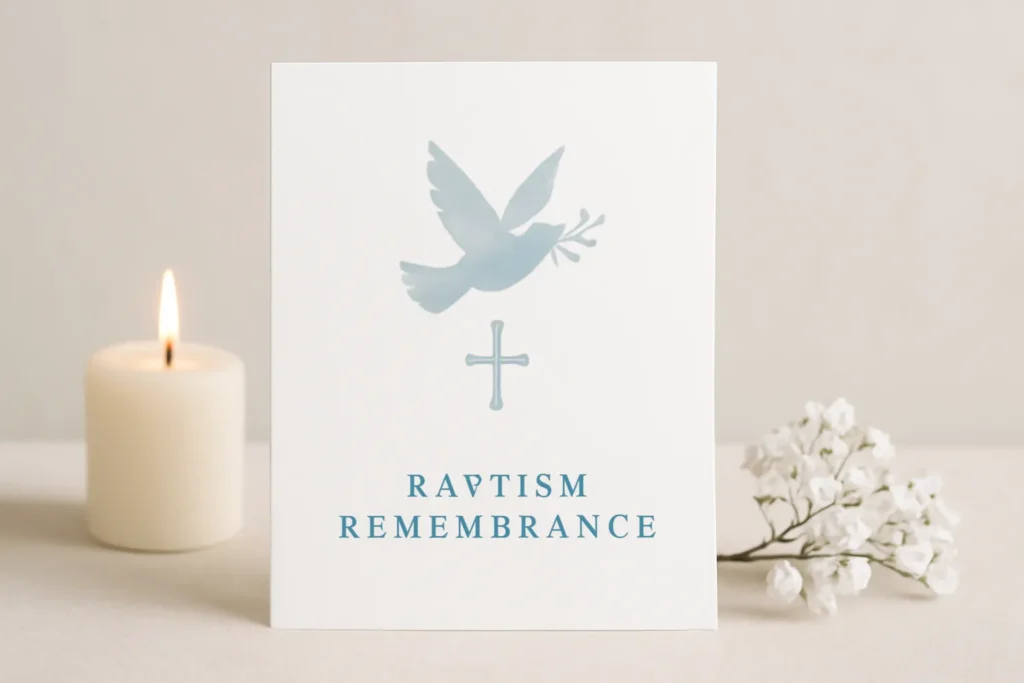
Classic elegance—A refined palette (soft ivory, pale blue, blush pink, or lavender), understated typography, and minimal ornamentation. Use a single upright image such as a cross or a simple dove.
Soft pastel rustic—Textured cardstock, hand-drawn motifs, and gentle watercolor washes create a warm, intimate tone that feels handmade.
Modern minimalism—Bold typography, ample white space, and a single symbolic icon (a small cross, water ripple, or seedling) provide a contemporary look.
Vintage scripture cards—Decorative borders, vintage fonts, and scriptural quotes evoke a timeless, ceremonial mood.
Nature-inspired themes—Leaf silhouettes, water imagery, and botanical accents connect baptism with new life and creation.
Photographic keepsakes—A portrait or baptism photo paired with a clean layout that foregrounds the image and a short blessing.
Family-centered designs—Incorporate family crests, names, or a lineage motif to emphasize the person's place within a faith community.
Cross-cultural blends—Infuse regional or cultural symbols alongside universal Christian imagery to reflect heritage and inclusivity.
Color palettes and typography considerations
Color and typeface choices shape the card’s tone. For baptism remembrance cards, consider the following guidelines:
Color psychology—Soft blues and whites convey serenity and purity; rose and lavender suggest tenderness; greens evoke new life; gold or silver accents imply celebration and sacredness.
Contrast and readability—Choose high-contrast combinations to ensure the text is legible on various screens (for digital templates) and in print.
Typography pairing—A serif font for a classic, ceremonial feel pairs well with a clean sans-serif for readability. For a modern look, a geometric sans with a delicate script can strike a balance.
Font size and hierarchy—Keep the child’s name prominent, date slightly smaller, and body text readable at 8–12 points depending on the format.
Consistency—Limit to two or three typefaces to maintain a cohesive design across multiple cards in a set.
When selecting colors and typography, also reflect the faith tradition. Some denominations favor more conservative palettes, while others welcome brighter hues and contemporary fonts. The key is to maintain reverence while ensuring the card remains legible and durable as a keepsake.
Wording and verses for baptism remembrance cards
The wording you choose should honor the ceremony, reflect the family’s beliefs, and feel personal. You can use verses from scriptures, short blessings, or original messages. Here are categories and examples to inspire your own text.
Short blessings
May God bless you and keep you in His grace. Today you are welcomed into the Christian family and into God’s light. May your life be filled with faith, hope, and love.
With grateful hearts we celebrate this baptism, and we pray that your days be filled with the joy of faith and the peace of Christ.
Scripture-inspired lines
“Jesus said, Let the little children come to me, and do not hinder them” (Matthew 19:14). May this day mark the beginning of a journey in faith, guided by His love.
“For I know the plans I have for you,” declares the Lord (Jeremiah 29:11). May your life be guided by grace and grounded in His promises.
Message from parents or godparents
From the parents or godparents: “We prayed for this moment, and we thank God for you. May you grow in grace, courage, and compassion.”
From a grandparent: “Welcome to the church family, dear child. May your days be blessed with wonder and your nights with peace.”
Personalized notes
Include a brief, heartfelt note that reflects your hopes for the child. For example: “May your life be a light in the world and your heart be full of wonder for God’s great kindness.”
Templates and how to customize
Templates offer a practical way to produce professional-looking baptism remembrance cards without starting from scratch. They come in a variety of formats, including printable PDFs, editable InDesign or Illustrator files, Microsoft Word templates, and online designer templates. Here’s how to make the most of them:
Choose a template that fits your aesthetic—Look for a design whose margins, font sizes, and image area align with your printing method.
Replace placeholders with real data—Child’s full name, parents’ names, date, church, and location.
Insert a meaningful image—A baptism photo, a symbolic icon, or a simple illustration that complements the design.
Adjust text length—Ensure the final card isn’t crowded. If needed, trim the verse or keep the message concise.
Preview and proofread—Check for spelling errors, date accuracy, and printer alignment before printing.
Export for print or share digitally—Save as a high-resolution PDF for print, and as a shareable image or PDF for email or social media if appropriate.
When selecting a template, consider the printing method you’ll use. If you plan to print at home, you may prefer a template designed for standard cardstock and common envelope sizes. If you’re using a professional printer, you can opt for templates with bleed, crop marks, and color profiles suitable for offset or digital printing.
Editable templates let you modify text, fonts, and colors directly in a compatible program or online editor. They are ideal if you want to tailor each card for different recipients or reflect multiple family members' blessings. Non-editable templates are ready-to-use designs that you can fill in by hand or with a paste-and-print method. They’re great for quick projects or for versions that require a consistent, formal tone.
DIY vs professional design services
Choosing between a DIY approach and hiring a professional designer depends on budget, time, and desired finish. Here are the considerations to guide your decision:
DIY advantages—Lower cost per card, full creative control, and the ability to print on your own schedule. Great for family projects or small, intimate ceremonies.
DIY limitations—Print quality may vary, and it can be time-consuming if you’re new to design software. You may need to source materials separately.
Professional design advantages—Polished, print-ready files, expert typography and layout, and often access to premium templates and finishes. Ideal for churches, photographers, or families seeking a high-end look.
Professional services—Graphic designers, calligraphers for handwriting on envelopes, or printing houses that provide bundled services (design, print, and assembly).
If you’re coordinating a church event or a church-related photographer project, you may want to commission a designer who understands liturgical motifs and church registry details. For personal milestones, a DIY approach with a printable template can yield meaningful results while staying within budget.
Printing tips and materials
Your choice of printing method and materials affects durability, appearance, and the overall impact of the baptism remembrance card. Consider the following practical guidance:
Cardstock weight—Choose a sturdy paper in the range of 80–110 lb cover (210–300 g/m²) for physical cards. Heavier stock feels more premium and stands up well to handling.
Finish—Matte finishes reduce glare and offer a sophisticated look; satin finishes are a balance between muted shine and readability; and soft-gloss can enhance color vibrancy in photos.
Envelopes—Pair cards with matching or complementary envelopes. Include a plain or liner envelope for extra elegance. Consider seal examples or wax seals for a traditional touch.
Color management—If you print at home, ensure your printer’s color profile matches your template’s design (often CMYK). If sending to a printer, request a proof to verify color accuracy.
Print orientation and bleed—Account for bleed (extra image area beyond the trim line) on templates that require edge-to-edge printing. Verify that all important text stays inside the safe margin.
Proofing and test prints—Print a single test card to check alignment, font size, and image clarity before committing to a full run.
Accessibility and inclusivity in baptism remembrance cards
Design and wording should be accessible and inclusive. Consider these practices:
Plain-language wording—Avoid overly dense phrasing that may obscure the message. Clarity is a form of care.
Inclusive language—If the child has a non-binary or blended family, or if you want to honor different family members, use language that respects diverse identities and backgrounds.
Readable typography—Choose larger font sizes and high-contrast color combinations to improve readability for guests with visual impairments.
Alternative formats—Offer digital versions or large-print options for guests who require accessible formats.
Variations by tradition and region
Across cultures and denominations, baptism cards may reflect the local liturgical language, symbols, and aesthetics. Some variations to consider:
Eastern traditions—Icons, Cyrillic script for some regions, and solemn color palettes aligned with liturgical seasons.
Catholic and Anglican contexts—More formal language, sacramental imagery, and options for including the parish name or sponsor details.
Protestant and evangelical circles—May emphasize personal testimony, verses about new life in Christ, and contemporary design sensibilities.
Multifaith or interfaith contexts—Incorporate inclusive language and symbols that respect diverse beliefs while marking the baptism as a significant life event.
Examples and sample wording for card text
To help you get started, here are varied text blocks you can adapt. Each example includes a distinct tone, from formal to personal to poetic.
Formal: In celebration of the baptism of Child’s Full Name, on this day, Date, at Church Name. May God grant you grace, strength, and unwavering faith as you grow in His love.
Warm and personal: We welcomed Child’s Name into the Christian family through baptism on Date at Church. With grateful hearts, we share our joy and prayer that you may always know God’s peace.
Verse-driven: “Let the little children come to me” (Matthew 19:14). May this sacred day be the seed of lifelong faith, love, and mercy in Child’s Name.
Caption-style for photos:Child’s Name — Baptized on Date. A blessing for today, and a promise for tomorrow.
Short blessing: May God’s grace guide you, may His love surround you, and may your life be a beacon of hope for others.
Practical steps for issuing baptism remembrance cards
Whether you’re planning a single card or a small batch for a church event, these steps help ensure a smooth process:
Define the purpose—Are cards for guests, for distribution at church, or for a small family circle?
Choose the format—Print-at-home cards, professional print, or digital cards to email or share online.
Set a budget—Consider design, printing, and envelopes; digital templates reduce costs but may require printing later.
Gather content—Collect child’s name, birth date, baptism date, church, location, and a blessing or verse.
Coordinate with others—If godparents or grandparents are contributing messages, establish a deadline to collect text.
Proof and test print—Review spelling, dates, and alignment; print a sample before final runs.
Plan the distribution—Decide whether cards will be handed out in church, mailed, or sent with a thank-you note.
Design templates you can adapt
Templates come in many formats and can be adapted for different styles and faith traditions. Here are common template types and how to use them:
Printable templates—PDF or image-based templates you print at home or with a local print shop. Great for DIY projects and small runs.
Editable digital templates—Files in InDesign, Illustrator, or Word that let you modify text, font, and color before printing or sending digitally.
Online designer templates—Web-based editors that guide you through layout and typography, often with integrated printing options.
Photo templates—Designed to feature a baptism photo prominently, paired with a minimal blessing and date.
Budget-friendly strategies for baptism remembrance cards
Creating meaningful cards does not have to be expensive. Consider these strategies to keep costs reasonable while maintaining quality:
Print in bulk—Even modest bulk printing reduces per-card cost and allows you to standardize design elements.
Use simple templates—A clean, elegant template with a single decorative element often looks more premium than a busy layout.
Combine with other keepsakes—Pair cards with a small photo magnet, a bookmark featuring a blessing, or a QR code linking to a memory page.
Choose cost-effective finishes—Opt for matte or satin finishes instead of high-gloss to balance cost and quality.
Ask for favors—If you know a designer or a print shop, you may receive a discount or a commissioned project rate.
Common mistakes to avoid
While designing and distributing baptism remembrance cards, watch for these pitfalls to ensure the final product is appropriate and well-received:
Overcrowded layouts—Too much text or imagery can overwhelm the recipient and reduce readability.
Inconsistent branding—Mixing multiple fonts or styles within a single card can appear chaotic.
Ambiguous dates—Verify the baptism date and time to prevent confusion among guests.
Unclear tone—Match the card’s tone to the ceremony: solemn and respectful for formal churches; warm and intimate for family gatherings.
Neglecting accessibility—Ensure the text is legible, and consider alt text or large-print options for digital versions.
Conclusion: creating meaningful keepsakes
Whether you call them baptism remembrance cards, christening keepsake cards, or baptism memorial cards, the essence remains the same: to honor a sacred moment, to bless the child, and to connect family and friends in a shared expression of faith. With thoughtful design, carefully chosen wording, and practical printing choices, these cards become lasting memory aids that families can treasure for generations. By exploring ideas, templates, and templates customization options, you can craft cards that are as unique as the child being baptized while still aligning with the reverence of the ceremony.
As you embark on your project, remember that simplicity and sincerity often yield the most enduring impact. A card that pairs a single, meaningful verse with a clean layout can speak volumes, creating a keepsake that families proudly display, share, and reminisce about long after the day of baptism has passed.






Leave a Reply