Beautiful Gate: meaning, location, and biblical importance
Beautiful Gate: meaning, location, and biblical importance
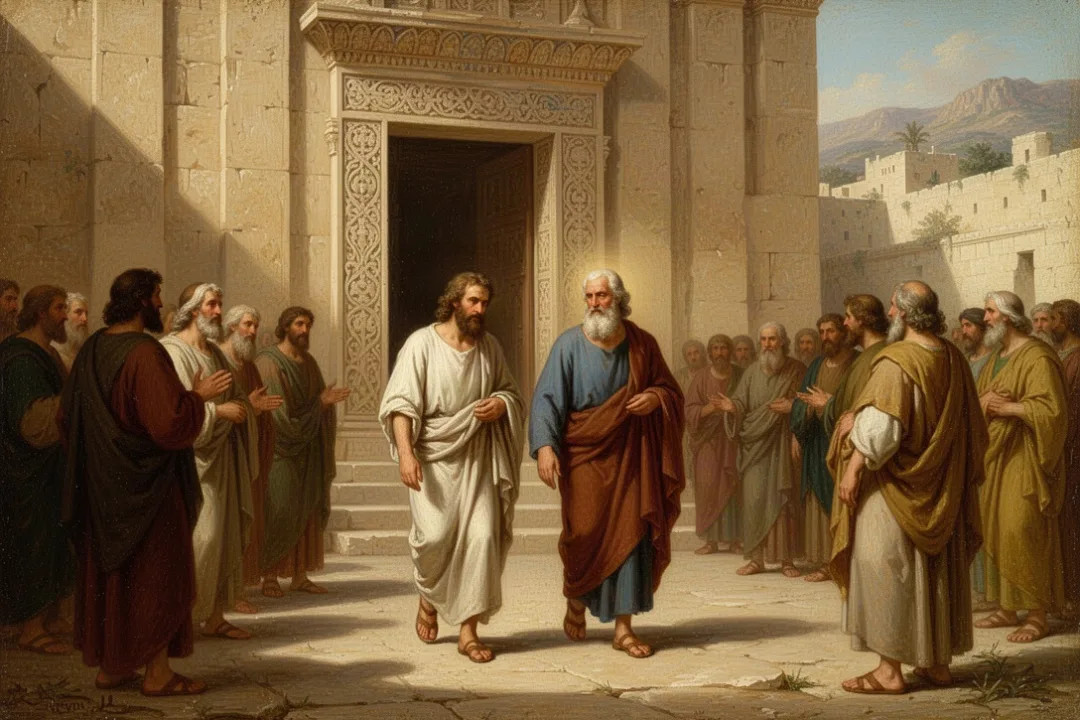
The Beautiful Gate was a Jerusalem temple entrance where Peter and John encountered a man who had never been able to walk.
The account appears in Acts 3:1-10, when the apostles went to the temple for prayer. The man was carried there each day and placed near the gate so he could ask worshipers for money. Peter offered something more lasting than a donation: healing in the name of Jesus Christ of Nazareth.
The story begins with Peter and John going up to the temple at the afternoon hour of prayer. A man with a lifelong mobility disability was being brought to the temple entrance, where he depended on the generosity of people entering the sacred courts. His position made him visible to many worshipers, but it also showed how dependent he was on others for basic support.
When the man saw Peter and John, he asked them for money. Peter told him to look at them, creating a moment of personal attention rather than allowing the encounter to remain a routine request for alms. The man expected to receive something, but Peter explained that he had no silver or gold to give.
Peter then declared that, through the authority of Jesus Christ, the man should rise and walk. Acts describes Peter taking him by the right hand and helping him up. The man’s feet and ankles became strong, and he entered the temple with the apostles, walking, leaping, and praising God.
The people recognized him as the man who had regularly sat at the Beautiful Gate asking for help. That recognition matters because the event was not presented as an anonymous or unverifiable healing. Worshipers had seen his condition repeatedly, and his sudden ability to walk caused them to respond with amazement.
The man expected financial assistance, but received physical restoration.
Peter directed attention to Jesus, not to his own power or religious status.
The healed man entered the temple, joining worship with a body that had been transformed.
The crowd knew his identity, which made the change publicly evident.
The healing also changed the man’s relationship to the temple space. He had previously been placed outside or near the entrance as someone seeking support. Afterward, he went inside with Peter and John, praising God. The gate therefore became the setting for a movement from dependence and exclusion toward participation, worship, and public testimony.
Central point: In Acts 3, the Beautiful Gate is not presented as magical architecture. The power of the event is attributed to the risen Jesus, whose name Peter proclaimed as the source of the healing.
Why the Beautiful Gate mattered in the Jerusalem temple
The temple was the central place of Jewish worship in Jerusalem, and its entrances connected ordinary streets with sacred courts. A gate could be both a practical passageway and a highly visible public setting. The Beautiful Gate placed the healing at the boundary between the city and the temple, where worshipers gathered and where the event could not easily remain private.
Luke, the writer of Acts, identifies the entrance by its Greek name, commonly translated Beautiful Gate. The name may refer to the gate’s appearance, craftsmanship, decoration, or general impressiveness. The text does not provide enough detail to establish exactly what feature made it beautiful.
That uncertainty should not obscure the narrative purpose. Luke gives the gate a specific name because the location helps readers picture the scene and because the healing became a recognizable public event. The man was not healed in an unknown room or away from witnesses. He was restored where people regularly saw him and where religious discussion naturally followed.
The temple setting also explains why Peter’s words quickly led to a larger audience. The man remained close to Peter and John, and the astonished crowd gathered around them in the area associated with Solomon’s Colonnade. Peter used the opportunity to explain that the God of Abraham, Isaac, and Jacob had glorified Jesus, whom the leaders had rejected.
Peter’s speech in Acts 3 connects the healing with several biblical themes:
God’s faithfulness to Israel: Peter speaks of the God of the patriarchs rather than presenting the event as a departure from Israel’s Scriptures.
Jesus’ suffering and glorification: The healing is linked to the one whom God raised and honored after his death.
Faith in Jesus’ name: Peter attributes the man’s restored strength to Jesus, not to human skill.
Repentance and restoration: Peter calls his listeners to turn back to God and receive the blessings associated with repentance.
Prophetic fulfillment: He presents Jesus as the one anticipated by Moses and the prophets.
The gate’s beauty, then, is not the main theological subject of the chapter. Its importance comes from the contrast between an impressive entrance and a man who had been left powerless beside it. The scene asks readers to look beyond visible wealth, status, and architecture toward the restoring work of God.
Where the Beautiful Gate may have been located
The exact location of the Beautiful Gate is uncertain. Acts says that it led into the temple area, but it does not give measurements, a direction, or a detailed architectural description. As a result, later interpreters and historians have proposed different identifications based on descriptions of the Second Temple and the layout of the Herodian temple complex.
One common identification is the Nicanor Gate, a large and prominent entrance associated with the inner temple courts. This gate stood between areas with different levels of access and was known in later descriptions for its impressive appearance. Some readers connect its prominence with Luke’s reference to a beautiful gate.
That identification remains a possibility rather than a proven fact. The New Testament does not call the gate the Nicanor Gate, and the surviving evidence does not allow every entrance in the temple complex to be matched with certainty to Luke’s wording. The name may have referred to another gate, or the ancient designation may have been understood differently from modern reconstructions.
Another proposal has connected the Beautiful Gate with an eastern entrance to the temple precincts. This view takes the wording and approach to the temple into account, though it also faces difficulties involving the precise arrangement of the courts and gates. Ancient descriptions, archaeological remains, and later traditions do not produce a single universally accepted answer.
Several cautions help keep the discussion accurate:
The Bible identifies the gate by name but does not describe its materials or appearance in detail.
Modern diagrams are reconstructions, not photographs of the first-century temple.
Later names and traditions may preserve useful memories, but they are not automatically identical to the wording in Acts.
The event can be understood without solving the architectural question, because the narrative’s main focus is the healing and Peter’s explanation.
The Jerusalem temple itself was a vast and carefully ordered complex, with areas assigned for different activities and groups. The gate would therefore have been more than a doorway in a narrow modern sense. It likely formed part of a series of entrances and courts through which worshipers moved toward the central sanctuary.
This setting makes the man’s daily position especially significant. He was near one of the most important religious centers in Jerusalem, surrounded by worshipers, yet still dependent on their individual generosity. His healing did not merely improve his ability to move; it brought him visibly into the worshiping community.
What Peter’s healing teaches about Jesus’ name
Peter’s response to the man’s request is sometimes misunderstood as a promise that material help is unimportant. The text does not condemn giving money to people in need. Instead, it emphasizes that Peter and John were not treating the man’s deepest need as something they could solve with their limited resources. They offered what they had received authority to give: healing in the name of Jesus.
In the Bible, a person’s name often represents identity, authority, character, and reputation. To act in Jesus’ name does not mean repeating a formula that forces a result. Peter was declaring that the authority behind the healing belonged to Jesus, the one whom God had raised from the dead.
Acts makes this point again when Peter addresses the crowd. He refuses to let the people conclude that the apostles’ own religious devotion or ability produced the miracle. The healing becomes evidence of Jesus’ continuing activity after his resurrection.
This distinction is central to the chapter’s message. Peter is not presented as a wonder-worker who has independent power. He is a witness who points from the visible event to the identity of Jesus. The restored man is evidence of divine action, while Peter’s speech interprets what the crowd has seen.
The passage also holds together two ideas that should not be separated. The first is compassion for a suffering person; the second is proclamation about Christ. Peter does not use theology to ignore the man’s immediate condition, and he does not treat the healing as an end in itself. The physical restoration becomes an occasion to speak about God’s promises and the call to repentance.
Peter’s language about Jesus includes both rejection and honor. The crowd is told that Jesus was rejected by human authorities but glorified by God. He is described as God’s servant and as the source of life, while his resurrection confirms that death did not have the final word.
The chapter also presents healing as part of God’s larger work of restoration. Peter speaks of a future period when God will restore all things, linking the individual miracle with the hope of renewal promised through the prophets. The healed man’s body offers a small but visible sign of that wider hope.
Read the passage in context: Acts 3 is not only a story about receiving a miracle. It is also a sermon about Jesus’ resurrection, God’s faithfulness, repentance, and the promised restoration of creation.
How the Beautiful Gate connects with the rest of Acts
The healing at the Beautiful Gate leads directly to conflict as well as wonder. While Peter and John are speaking to the people, priests, the captain of the temple guard, and Sadducees become concerned because the apostles are teaching the resurrection of the dead in connection with Jesus. The apostles are arrested and held until the next day.
That sequence shows how public the event was. The authorities could not simply dismiss the healing as a private religious experience because the man was present and the crowd had witnessed his changed condition. Acts 4 reports that the healed man stood with Peter and John when they were questioned.
Peter again attributes the healing to Jesus and explains that the man stands well because of the name of Jesus Christ, whom the leaders rejected and whom God raised from the dead. The official questioning therefore becomes another opportunity for the apostles to testify.
The authorities recognize that Peter and John are unschooled or ordinary men, yet they are impressed by their boldness. They also know that the apostles have been associated with Jesus. The healed man’s presence makes the matter difficult to deny, and the leaders warn the apostles not to speak or teach in Jesus’ name.
The apostles answer that they cannot stop speaking about what they have seen and heard. Their courage does not come from personal prestige. It grows from their conviction that Jesus is alive and that the healing at the gate confirms his authority.
The story has another important outcome: the community responds by praising God. Acts reports that many who heard the message believed, bringing the number of believers to about five thousand men. The passage does not reduce the event to a spectacle. It shows a chain of effects:
A vulnerable man receives attention and healing.
The crowd asks how the change happened.
Peter explains the role of Jesus.
Religious authorities challenge the apostles.
The apostles continue to witness despite the warning.
The growing community gives glory to God.
Acts later returns to the apostles’ public ministry in the temple area. The focus remains on teaching, prayer, fellowship, and signs that point beyond the apostles themselves. The Beautiful Gate is therefore part of a larger pattern in which public acts of mercy and public proclamation reinforce one another.
How Christians commonly understand the Beautiful Gate today
Many Christian readers see the man at the Beautiful Gate as an example of someone who was visible but overlooked. People carried him to a place where help might be available, yet his condition had become part of the daily background of temple life. The passage encourages communities to notice people whose needs have become familiar enough to ignore.
The story also challenges a narrow definition of generosity. Money can meet genuine needs, and responsible care for the poor remains a serious obligation. At the same time, the apostles show that faithful service may involve presence, conversation, advocacy, practical assistance, prayer, or connection with appropriate care—not only a financial transaction.
Another lesson concerns the dignity of the person receiving help. Peter tells the man to look at him, and John remains part of the encounter. The man is not treated as an obstacle, a statistic, or a source of guilt. He is addressed directly and becomes an active participant in what follows.
Christians should also handle the healing account with care. The passage does not authorize blaming people who remain sick or disabled, as if a lack of faith explains every unmet need. Nor does it promise that every physical condition will be healed immediately. Acts presents a particular sign in a particular setting, while the New Testament elsewhere describes suffering, illness, prayer, medical care, and patient endurance in varied ways.
The strongest application is therefore not a formula for obtaining a miracle. It is a call to combine compassionate attention, humble dependence on Jesus, and courageous witness. The Beautiful Gate reminds readers that a person can be overlooked by a crowd and still be fully seen by God.
When reading Acts 3, it can help to ask:
Who is present at the edge of the community but not fully included?
Do your responses address only an immediate request, or do they respect the person’s deeper dignity?
Are you giving credit to God rather than claiming spiritual power for yourself?
Can practical care and clear Christian witness exist together without either being neglected?
How does the hope of future restoration shape your response to present suffering?
The Beautiful Gate remains memorable because the place, the person, and the message meet in one scene. A man once carried to the temple becomes a walking witness. Peter and John become witnesses not to their own greatness, but to Jesus’ authority. And an impressive gate becomes the backdrop for a reminder that God’s restoring work can begin where human beings have learned to expect only routine.
Frequently asked questions
Is the Beautiful Gate the same as the Nicanor Gate?
Many interpreters identify it with the Nicanor Gate because that entrance was prominent and associated with the inner temple courts. However, Acts does not use the name Nicanor Gate, and the surviving evidence does not prove the identification. It is best described as a widely discussed possibility rather than a certain archaeological conclusion.
Who was healed at the Beautiful Gate?
Acts does not give the man a personal name. It says that he had been unable to walk from birth and was carried to the temple each day to ask for alms. After Peter invoked the name of Jesus Christ, the man’s feet and ankles became strong, and he entered the temple walking and praising God.
What does “Beautiful Gate” mean spiritually?
The gate can symbolize the meeting point between human need and God’s restoring grace. The passage also emphasizes that spiritual power does not come from architecture, ritual location, or the apostles themselves. Peter directs the crowd to Jesus, while the healed man’s response shows gratitude, worship, and public testimony.
Where should I read the story of the Beautiful Gate?
Read Acts 3:1-10 for the encounter and healing, then continue through Acts 3:11-26 for Peter’s explanation. Acts 4:1-22 shows the apostles being questioned by authorities and gives the healing’s public consequences. Reading these passages together keeps the miracle connected to the resurrection message and the apostles’ witness.










Leave a Reply