Solomon’s Portico was a covered walkway on the eastern side of Jerusalem’s temple complex, associated in the New Testament with Jesus’ teaching and the public life of the early church.
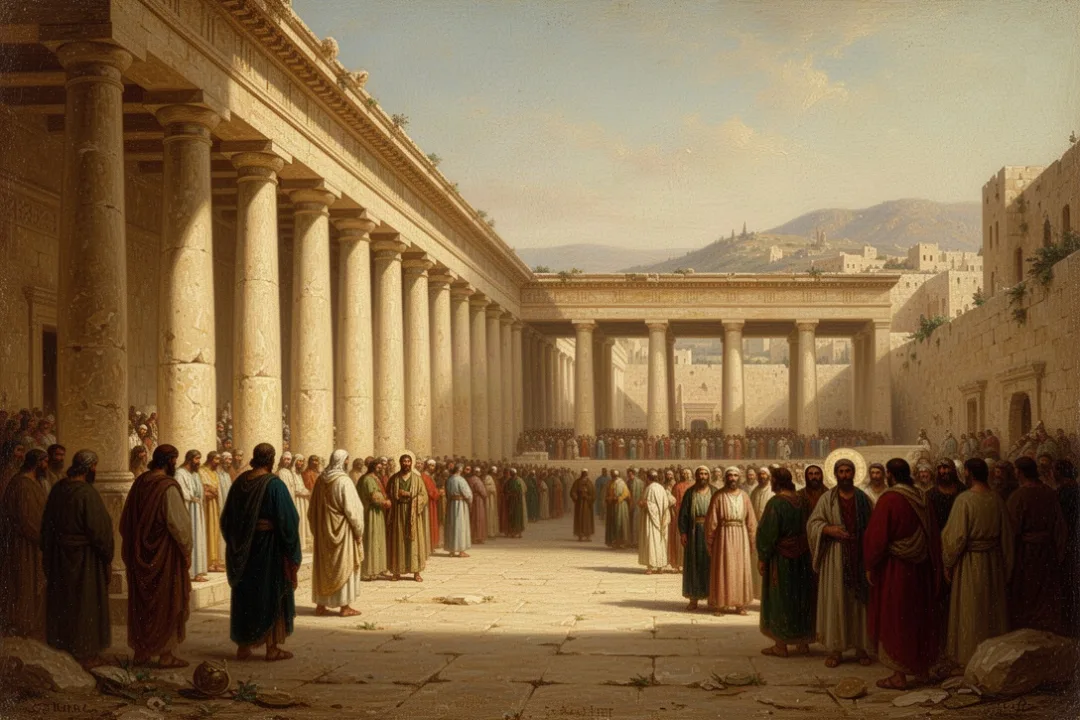
A portico is a roofed passage or gallery supported by columns. Solomon’s Portico, also called Solomon’s Porch, was therefore not a separate temple or an enclosed room. It was a spacious, sheltered colonnade where people could walk, meet, listen to teachers, and gather out of the sun or rain.
The name appears in the New Testament as “Solomon’s Portico” or “Solomon’s Porch”. The wording comes from the Greek term Stoa of Solomon. It identified a particular section of the temple precincts, most likely along the eastern side of the outer court.
The setting matters because the temple was the religious and social center of Jerusalem. Visitors came there to pray, offer sacrifices, teach, debate, conduct business connected with worship, and meet fellow Israelites. A covered walkway beside the courts provided a natural public setting for conversations and speeches.
Key idea: Solomon’s Portico was a public colonnade within the temple precincts, not a surviving building from Solomon’s original temple.
Where Solomon’s Portico appears in the Bible
The New Testament mentions Solomon’s Portico in three main passages. Each reference gives the location a slightly different role: a place where Jesus walked and taught, a gathering point after a healing, and a meeting place for the first believers in Jerusalem.
John 10:23: Jesus walks in Solomon’s Portico during the Festival of Dedication, commonly called Hanukkah.
Acts 3:11: Peter, John, and the healed man are together in Solomon’s Portico, where astonished people gather around them.
Acts 5:12: The apostles and believers meet in Solomon’s Portico, while signs and wonders are reported among the people.
These passages present the portico as a visible and accessible public location. The events were not hidden in a private house. They took place near the temple, among pilgrims, worshipers, religious leaders, and other people moving through Jerusalem’s busiest sacred space.
How to understand Solomon’s Portico step by step
Place it within the temple complex. It belonged to the larger precinct surrounding the sanctuary, not to a modern church building.
Picture a covered colonnade. Rows of columns supported a roof, creating shade and shelter beside an open court.
Read the passages in their immediate settings. John connects the portico with Jesus’ dispute during Hanukkah, while Acts connects it with healing, preaching, and communal worship.
Separate the name from the building’s exact origin. The title refers to Solomon, but the New Testament setting was the later temple complex associated with Herod’s major rebuilding work.
Notice the public character of the events. The portico allowed teaching and signs to attract large groups of people.
Consider its symbolic force carefully. The location linked the early Christian proclamation with Jerusalem’s temple without proving that the portico itself had survived unchanged from Solomon’s time.
Why it was called Solomon’s Portico
The name connects the colonnade with King Solomon, the ruler traditionally associated with the first temple in Jerusalem. Yet the exact reason for the name remains uncertain. Ancient writers and later interpreters did not leave enough evidence to establish every detail of the structure’s history.
One possibility is that the portico stood beside, or incorporated, an older section of the temple platform. The eastern side of the temple area may have preserved very ancient construction or retaining work. Another possibility is that the name reflected a long-standing tradition connecting the location with Solomon, even if the visible columns and roof belonged to a later period.
The name should not be treated as proof that visitors in the first century were standing inside Solomon’s original temple. That first temple had been destroyed centuries earlier. The portico mentioned in the New Testament belonged to the temple environment of the Second Temple period, after the Jewish people had rebuilt the sanctuary and its surrounding courts.
Some ancient descriptions distinguish the eastern colonnade from other parts of the temple complex and associate it with Solomon. The evidence is useful, but it does not remove every historical question. The safest description is that Solomon’s Portico was a later temple colonnade whose name preserved a connection with Solomon or with an older part of the site.
How the temple setting helps identify the portico
Jerusalem’s temple was not simply one building surrounded by empty ground. It was a large architectural complex arranged around courts, gates, walls, stairways, and covered walkways. The sanctuary stood within a broader sacred precinct that could hold many people.
The porticoes helped organize this space. They created a transition between the open courts and the outer boundaries of the complex. A person could stand beneath the roof while still remaining in a public area. Teachers could address listeners without needing access to the inner sanctuary.
Solomon’s Portico is commonly located on the eastern side of the temple platform. This identification fits its description as a substantial covered walkway and helps explain why it could serve as a gathering place. The exact layout cannot be reconstructed with complete certainty because the temple was destroyed in the first century, and later construction changed the site.
Modern diagrams often show the portico running along the east side of the outer court. These reconstructions are helpful for visualization, but they should be viewed as informed proposals rather than photographs of a building whose complete plan is known.
Jesus at Solomon’s Portico during Hanukkah
John 10:22-39 places Jesus in Solomon’s Portico during the Festival of Dedication. This festival commemorated the rededication of the Jerusalem temple after its earlier desecration in the second century BC. In Jewish tradition, the festival is known as Hanukkah.
The passage says that it was winter and that Jesus was walking in the portico. A group of Jewish people gathered around him and pressed him to state plainly whether he was the Messiah. Jesus’ response centers on his works, his relationship with the Father, and the identity of those who belong to him.
The portico provides more than a location marker. A sheltered eastern walkway would have been a practical place to walk and speak during colder weather. It also placed Jesus in a prominent temple setting, where his words could be heard by people already gathered for a major festival.
The discussion becomes confrontational. Some listeners accuse Jesus of blasphemy and prepare to stone him, while Jesus answers by appealing to his works and to Scripture. The location therefore frames a public debate about Jesus’ identity and authority, not a quiet private conversation.
John 10 presents Jesus’ works as evidence of his mission and describes his followers as those who hear his voice and belong to him.
Readers should avoid turning the portico into a hidden code. Its main contribution to the scene is historical and dramatic: Jesus is walking in a recognizable part of the temple complex during a festival, speaking openly while religious questions are already at the center of public attention.
Peter and John at Solomon’s Portico after the temple healing
Acts 3 tells of a man unable to walk who is placed near the temple entrance to ask for assistance. Peter, speaking in the name of Jesus Christ, tells him to rise and walk. The man is then described as walking, leaping, and praising God in the temple area.
Afterward, people gather around Peter, John, and the healed man in Solomon’s Portico. The crowd is astonished because many people knew the man’s condition and recognized him as the person who had regularly asked for help. The portico becomes the setting for Peter’s explanation of what has happened.
Peter does not present the healing as a reason to praise the apostles themselves. He directs attention to the God of Israel and to Jesus, whom he describes as the source of the restoration. His speech interprets the event within Israel’s Scriptures and calls the listeners to turn back to God.
This scene shows how the portico functioned as a place where an observable event could lead to public proclamation. The healing drew attention, and the covered walkway gave the apostles a natural place to address the crowd. The physical setting supported the movement from wonder to explanation.
The account also keeps the apostles connected with the temple. They are not portrayed as abandoning Jerusalem’s sacred space immediately after Pentecost. Instead, they continue to appear there, proclaiming Jesus in a location familiar to the city’s worshipers and visitors.
The community gathers there in Acts 5
Acts 5:12 describes the apostles performing signs and wonders among the people, with the believers gathering together in Solomon’s Portico. This reference gives the strongest picture of the portico as a regular meeting place for the early Christian community.
The passage distinguishes between the believers’ public gathering and the reactions of others in Jerusalem. The group has a recognizable presence near the temple, while people who are cautious or fearful do not necessarily join them. At the same time, the account says that the people held them in high regard and that more men and women came to faith.
Solomon’s Portico therefore represents a community that is public but not yet institutionally separate from Jewish life in Jerusalem. The first believers meet near the temple, share a visible identity, and proclaim Jesus in a setting that carries deep religious significance.
The portico may also have offered practical advantages. It was large enough for a group, open enough to remain accessible, and sheltered enough for extended conversation. Its association with teaching made it a suitable location for the apostles to speak to believers and passersby alike.
What Solomon’s Portico reveals about the early church
The biblical references suggest several features of the earliest Christian movement in Jerusalem. First, its members were deeply rooted in Jewish Scripture and worship. The temple remained a meaningful place for prayer, preaching, and public witness.
Second, the movement was visible. The apostles did not limit their activity to private homes or secluded meetings. The portico placed them where large numbers of people could see them, hear them, question them, or challenge their message.
Third, the early believers connected words with actions. In Acts, healing and other signs attract attention, but the apostles then interpret those events through their message about Jesus. The portico is a setting where public deeds and public teaching meet.
Fourth, the community’s presence there created both opportunity and tension. A public gathering could reach more people, but it could also draw scrutiny from authorities and opponents. The same visibility that helped spread the message made conflict more likely.
Reading tip: The New Testament uses Solomon’s Portico to show that the first believers proclaimed Jesus in the heart of Jerusalem’s public religious life, not in isolation from it.
Was Solomon’s Portico part of Solomon’s original temple?
Probably not in the simple sense suggested by the name. Solomon’s first temple was destroyed by the Babylonians in the sixth century BC. The temple standing in Jerusalem during the ministry of Jesus belonged to the later Second Temple period and had undergone extensive rebuilding and enlargement.
The later complex was associated especially with the building program of Herod the Great, who expanded and beautified the temple precincts. Herod’s work began before Jesus’ public ministry and continued over a long period. The structure seen by Jesus and the apostles was therefore the product of multiple historical stages.
That does not mean the name Solomon’s Portico was meaningless. Ancient buildings often retained names tied to earlier rulers, traditions, or surviving foundations. The eastern side of the temple platform may have included older material, and the name may have preserved memory of Solomon’s association with the site.
Still, the evidence does not allow a confident claim that the columns and roof visible in the first century were built by Solomon. A careful explanation distinguishes the traditional name from the uncertain architectural history.
What happened to Solomon’s Portico?
The Roman destruction of Jerusalem in AD 70 brought the Second Temple and its surrounding structures to an end. The temple complex was heavily damaged or destroyed, so Solomon’s Portico did not continue as an intact New Testament-era meeting place.
The surviving and rebuilt features of the Temple Mount area belong to later periods and cannot simply be identified with the portico described in Acts. Archaeological remains can illuminate the size, construction methods, and history of the temple platform, but they do not provide a universally accepted, fully preserved structure labeled Solomon’s Portico.
Some parts of the eastern retaining area may preserve ancient foundations or materials from earlier stages of the site. Yet connecting specific visible stones to the exact portico mentioned in the New Testament requires caution. The building history of Jerusalem is complex, with destruction, rebuilding, repairs, and changes in use across many centuries.
For that reason, the most reliable way to understand Solomon’s Portico is through the biblical passages and their historical setting, supported by general knowledge of Second Temple architecture rather than by claiming that the original portico can be visited today.
Solomon’s Portico and the meaning of public space
The portico’s significance comes partly from its position between sacred architecture and ordinary public movement. It was close to the temple but not the inner sanctuary. People could gather there without entering the most restricted areas of worship.
That in-between character made it useful for teaching. A speaker could address people already interested in religious questions, while the openness of the space allowed others to stop and listen. The portico was sacred in its setting but public in its function.
In John, Jesus’ presence there places a major theological dispute in a prominent temple location. In Acts, the apostles use the same kind of public space to interpret healing and announce the significance of Jesus. The setting reinforces the New Testament picture of a message presented openly before Israel and Jerusalem.
The portico also shows why location matters when reading biblical narratives. A reference to a particular walkway can indicate who might have been present, how large a crowd could form, and why an event became widely known. It can also show how early Christian activity related to existing Jewish institutions and spaces.
Common mistakes about Solomon’s Portico
Calling it Solomon’s original temple: The New Testament setting belongs to the later Second Temple period.
Assuming it was an enclosed hall: A portico was generally a roofed, columned walkway or gallery, open along at least one side.
Treating every reconstruction as certain: The broad location is clearer than the exact plan and surviving architectural details.
Separating it from the temple: Solomon’s Portico was part of the temple precinct, not an independent Christian meetinghouse.
Overlooking its public character: The passages emphasize crowds, teaching, healing, and visible community life.
Reading the name as a complete construction history: The association with Solomon may reflect tradition or older elements, but it does not prove that Solomon built the first-century colonnade.
Why Solomon’s Portico still matters for readers today
For biblical readers, Solomon’s Portico connects architecture, history, and theology. It helps locate Jesus’ teaching within Jerusalem’s temple precinct and places the earliest Christian preaching in a setting known to the city’s population.
It also encourages careful reading. The name carries an ancient association, but the structure belonged to a complicated later history. The biblical text gives enough information to understand the portico’s role without requiring certainty about every stone, column, or phase of construction.
Most of all, the portico is remembered as a place of open teaching, public witness, communal gathering, and response. Jesus walked and spoke there. Peter and John addressed a crowd there after a healing. The believers gathered there as the message about Jesus spread through Jerusalem.
Frequently asked questions
Is Solomon’s Portico the same as Solomon’s Porch?
Yes. “Solomon’s Portico” and “Solomon’s Porch” are different English renderings of the same biblical location. Both refer to a roofed, column-supported walkway in the Jerusalem temple precinct. The wording varies by Bible translation, but the passages are John 10:23, Acts 3:11, and Acts 5:12.
Where was Solomon’s Portico located?
It is generally understood to have stood along the eastern side of the temple complex in Jerusalem. The exact dimensions and architectural arrangement are uncertain because the Second Temple was destroyed and the site underwent later changes. Its broad identification as an eastern colonnade is more secure than a detailed reconstruction.
Did Solomon build Solomon’s Portico?
The name connects the location with Solomon, but the New Testament portico should not be assumed to be a structure built by Solomon. The temple complex standing in Jesus’ time belonged to the Second Temple period and had been extensively rebuilt. The name may preserve an older tradition or association with earlier construction.
Why did the early Christians meet there?
Solomon’s Portico was a large, public, sheltered area near the temple courts. It allowed the apostles and other believers to gather where people could see and hear them. Acts presents it as a place for communal meetings, public preaching, and discussion after the healing of the man who had been unable to walk.










Leave a Reply