If you have searched for “cheribuim”, the standard English spelling is cherubim. The word names a class of heavenly beings described in the Bible as attendants of God’s presence, guardians of sacred space, and bearers of divine glory. They are not presented in Scripture as the small, winged children often shown in paintings or greeting cards.
The biblical picture is more serious and more varied. Cherubim appear at Eden, above the ark of the covenant, in the temple, and in the visions of Ezekiel. Their exact appearance changes from passage to passage, but the recurring ideas are holiness, protection, movement, and God’s throne.
Cherubim is the plural form of cherub in English. In the Hebrew Bible, the related Hebrew term is commonly transliterated as keruv for one being and keruvim for more than one. English Bible translations use “cherub” and “cherubim,” while the spelling “cheribuim” is a misspelling.
The word’s deeper origin is not completely certain. Scholars have compared it with terms from other ancient Near Eastern languages, but those comparisons do not produce one universally accepted definition. The biblical passages themselves provide the clearest guide: cherubim are heavenly creatures associated with God’s presence, not ordinary human beings or independent gods.
The Bible does not give one short description that applies to every appearance. In some passages, cherubim are represented in sacred artwork. In others, they appear as living beings in a prophet’s vision. These forms should be read together without assuming that every passage is describing the creatures in exactly the same way.
Spelling note: The correct spelling is cherubim, not “cheribuim.” “Cherubim” is already plural; “cherubs” is also used in English as a plural form, especially in ordinary conversation.
Several biblical terms are sometimes grouped together in popular discussions, but they are not interchangeable. Cherubim are distinct from seraphim, who appear in Isaiah’s temple vision, and from angels described as messengers. Scripture presents different heavenly beings with different roles, even though English readers may use “angel” broadly for supernatural servants of God.
Where cherubim appear in the Bible
The first biblical reference occurs after Adam and Eve are sent from the garden of Eden. According to Genesis 3:24, God places cherubim and a flashing sword at the garden’s eastern entrance to guard the way to the tree of life. The scene connects cherubim with restricted access to sacred life and with the boundary between ordinary human existence and God’s holy provision.
This passage does not describe the cherubim’s bodies in detail. Its emphasis is on their assignment: they guard a way that human beings can no longer enter. The cherubim therefore function as protectors of holy space, not as decorative figures or comforting household spirits.
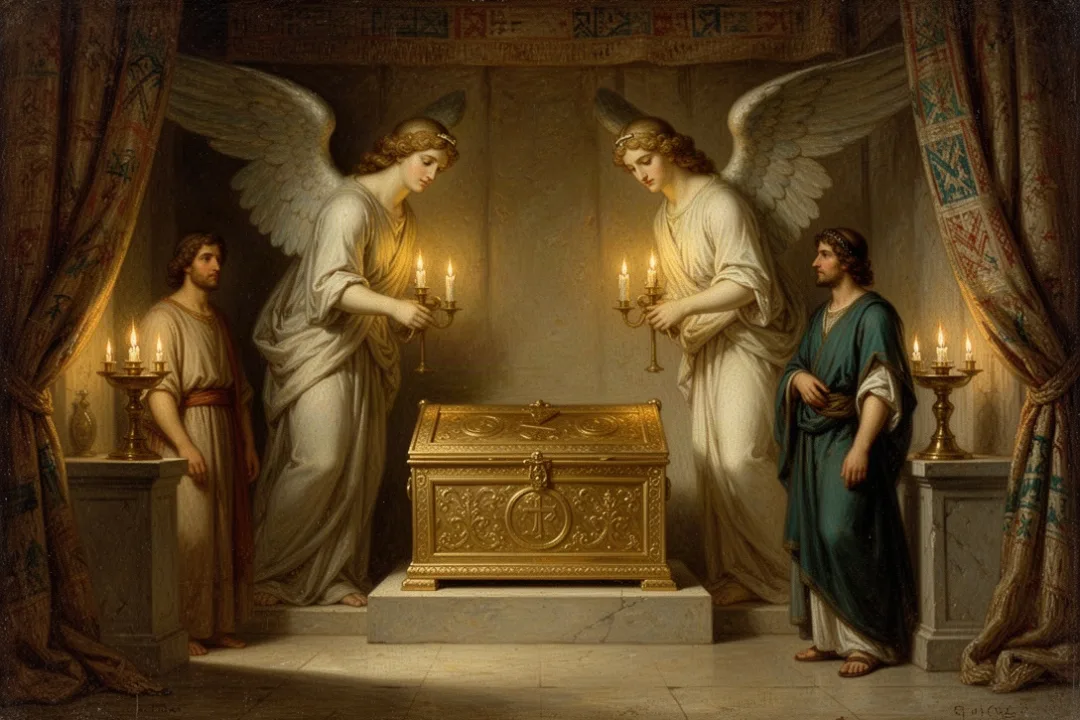
The next major setting is the tabernacle, the portable sanctuary used by Israel during its wilderness years. God instructs Moses to place two cherubim above the cover of the ark of the covenant, with their wings spread over it. Exodus 25:18–22 connects this space with God’s meeting and speaking with Moses.
The ark’s cherubim were not idols. They did not represent rival deities, and Israel was not told to worship them. Their position expressed the idea that the invisible God was enthroned above or between heavenly attendants. The artwork pointed toward God’s presence and kingship while preserving the command against making images of God himself.
Cherubim also appear in the design of the tabernacle curtains and the inner curtain that separated the holy place from the Most Holy Place. Exodus 26 describes cherubim woven into the fabric. Later, the temple built by Solomon includes carved cherubim, palm trees, and flowers on its walls and doors, as well as large cherub figures in the inner sanctuary, according to 1 Kings 6–7 and 2 Chronicles 3–5.
These repeated images show that cherubim were closely connected with Israel’s worship space. They marked a place as belonging to God’s heavenly court. Their presence in the sanctuary did not make the building magical; it communicated that worship took place before the holy King.
The Psalms use poetic language that places God above or upon cherubim. Psalm 18:10 portrays God coming with a cherub as part of a powerful storm-like manifestation, while Psalm 80:1 addresses the God enthroned above the cherubim. Psalm 99:1 uses similar royal imagery. These poems emphasize divine power and majesty rather than offering a complete physical description.
Ezekiel provides the most detailed and startling vision. In Ezekiel 1 and 10, the prophet sees living beings associated with wheels, fire, brightness, and the divine glory. In Ezekiel 10, these beings are explicitly identified as cherubim. The vision’s purpose is not to satisfy curiosity about heavenly anatomy; it presents God’s mobile throne and shows that divine glory is not confined to one building.
After the temple’s destruction, Ezekiel’s vision would have carried particular force. The imagery portrays God as sovereign even amid judgment and exile. The cherubim move with the divine presence, suggesting that God is not trapped in Jerusalem or dependent on a particular structure.
What cherubim look like in biblical descriptions
The Bible gives more than one visual description of cherubim. The carved and woven cherubim used in the sanctuary are not described with the same level of detail as Ezekiel’s visionary beings. A reader should therefore avoid combining every feature into one fixed portrait as though Scripture supplies a single photographic image.
Ezekiel 1 describes living beings with a human-like general form but with unusual features. Each has four faces, four wings, and legs that appear straight, with feet resembling those of a calf and shining like polished bronze. Their faces include human, lion, ox, and eagle features in the first vision. Ezekiel 10 uses cherubim language and gives related details, though the vision also includes distinctions in how the creatures and their faces are described.
The vision also includes wheels beside the living beings. The wheels are described as extraordinarily complex and covered with eyes. They move in coordination with the creatures and are associated with the divine throne. This imagery communicates awareness, order, and freedom of movement, not a mechanical diagram intended to be reconstructed literally.
Each cherub in Ezekiel’s vision has four wings. Two wings extend upward or outward, while the other two cover the body. The wings contribute to the vision’s sense of speed, reverence, and supernatural mobility. The cherubim are not portrayed as soft, childlike figures with small decorative wings.
The cherubim above the ark are presented differently. Exodus 25 describes two figures made of gold, facing one another and extending their wings over the ark’s cover. The text does not provide enough information to establish exactly what their faces or bodies looked like. Artistic depictions therefore involve interpretation rather than a fully specified biblical design.
The large temple cherubim described in 1 Kings 6 have wings that extend across the width of the inner sanctuary. Each figure is ten cubits high in the temple account, and their combined wings fill the room. These dimensions emphasize the grandeur of the Most Holy Place and the symbolic scale of the heavenly guardians within it.
Some readers ask whether cherubim have four faces and four wings all the time. The careful answer is that Ezekiel’s visions describe them that way, while other biblical passages focus on artistic representations without listing the same characteristics. Scripture gives a rich symbolic picture, not a biological classification.
Why cherubim guard holy places and accompany God’s glory
Cherubim’s main biblical significance comes from their relationship to God’s holiness. At Eden, they guard access to the tree of life. Above the ark, they stand in the symbolic throne area of the sanctuary. In Ezekiel, they accompany the divine presence. Across these settings, they signal that people cannot treat God’s holiness as ordinary or approach it on their own terms.
Guarding does not necessarily mean that cherubim are hostile warriors in every passage. Their role is broader than fighting. They mark boundaries, attend the divine King, and serve within the vision of God’s heavenly court. Their presence tells the reader that a sacred scene involves authority, judgment, and protection.
The ark of the covenant is especially important for understanding their role. The ark represented the covenant relationship between God and Israel and was kept in the Most Holy Place. Cherubim above it formed part of the sanctuary’s symbolic throne. God’s presence was associated with that space, but God was not reduced to the box, the room, or the sculpture.
This distinction separates biblical cherubim from idols in the ancient world. An idol was treated by worshipers as an image or manifestation of a deity. The cherubim in Israel’s sanctuary were created objects that represented the heavenly attendants of the true God. They were never the recipients of Israel’s worship.
Their imagery also expresses divine kingship. Ancient rulers were often pictured with attendants, throne guardians, or winged creatures. The Bible uses familiar royal symbolism but places it within Israel’s belief in one sovereign God. The cherubim are servants of the King, not gods who share his authority.
Ezekiel adds another dimension: the cherubim are connected with the movement of God’s glory. They are not merely stationed beside a throne. They move as the throne moves, and the prophet sees the glory depart from the temple in the context of judgment. This does not mean that God is limited by physical motion; it is a visionary way of showing the presence and withdrawal of divine favor.
The image also carries hope. If God’s glory can depart from the temple, it can also be understood as present beyond the temple. The heavenly throne is mobile, and God remains sovereign during exile. Cherubim therefore belong both to passages about restricted holiness and to passages about God’s freedom to be present with his people beyond a familiar sanctuary.
At Eden: cherubim guard the way to the tree of life.
In the tabernacle: they appear above the ark and in the sanctuary’s woven designs.
In Solomon’s temple: they fill the inner sanctuary with royal and heavenly imagery.
In the Psalms: they are connected with God’s throne and powerful appearance.
In Ezekiel: they accompany the divine throne and glory in a prophetic vision.
How cherubim differ from angels, seraphim, and popular art
In ordinary English, people often call any heavenly being an angel. The Bible, however, uses several kinds of heavenly imagery. Cherubim can serve God, but Scripture does not always describe them as messengers delivering announcements to people. Their recurring roles are more closely tied to God’s throne, sacred boundaries, and divine glory.
Seraphim appear most clearly in Isaiah 6. Isaiah sees them near God’s throne with six wings: two covering the face, two covering the feet, and two used for flying. They proclaim God’s holiness and participate in the prophet’s cleansing and calling. Their six-winged description differs from Ezekiel’s four-winged cherubim.
The New Testament refers to cherubim in connection with the curtain and sacred furnishings of the earthly sanctuary. Hebrews 9:5 mentions cherubim of glory above the mercy seat, using the tabernacle imagery to discuss worship, access, and the limitations of the former covenant arrangement. Revelation uses other heavenly creatures and throne imagery, but it does not simply reproduce Ezekiel’s terminology in every scene.
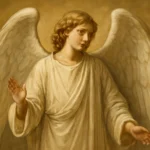
Later Christian art helped create the familiar image of the cherub as a chubby winged child. This tradition developed through artistic and cultural history rather than from the main biblical descriptions. Renaissance and later artists used childlike figures to symbolize innocence, heavenly presence, or the soul’s nearness to God.
That artistic tradition is not necessarily meant to claim that biblical cherubim literally looked like children. It is a symbolic convention. If you are reading Genesis, Exodus, 1 Kings, or Ezekiel, the text itself points toward imposing guardians and throne attendants rather than baby-like figures.
There is also a linguistic reason for some confusion. In modern English, cherub can mean either a biblical heavenly being or, figuratively, a sweet-looking child. The figurative meaning has become common enough that it can overshadow the older religious meaning. Context determines which sense is intended.
Read the passage before the picture: If a painting shows a cherub as a child, treat it as artistic symbolism. The Bible’s cherubim are associated with sacred boundaries, divine authority, wings, and visionary creatures—not with a single universal appearance.
How to read cherubim passages responsibly
Cherubim passages are easiest to misunderstand when every detail is treated as a literal description of ordinary physical creatures. Ezekiel’s vision uses fire, radiance, eyes, wheels, faces, wings, and sound to communicate something about God’s glory. The imagery is concrete, but its purpose is theological as well as visual.
Start by identifying the setting. Is the passage describing a garden, a sanctuary, a temple, a psalm, or a prophetic vision? The setting affects what the cherubim are doing. A carved figure above the ark should not be read in exactly the same way as a living being seen in a prophet’s vision.
Next, pay attention to the action. Ask what the cherubim guard, where they are placed, whom they serve, and what happens around them. These actions often reveal more than speculation about their appearance. The Bible repeatedly positions them near God’s presence or at a boundary involving holiness.
It also helps to distinguish description from interpretation. A passage may say that a cherub has wings, while a later reader may infer that all cherubim must always have the same number of wings or faces. That inference goes beyond what every passage states.
Several practical guidelines can keep your reading grounded:
Correct the spelling and identify the passage. Search for “cherubim” and read the surrounding verses rather than relying on an isolated image.
Separate biblical text from later artwork. A childlike figure, a single pair of wings, or a particular facial expression may come from artistic tradition.
Compare related passages carefully. Genesis, Exodus, Kings, Psalms, Ezekiel, and Hebrews emphasize different aspects of cherubim.
Look for the main theological function. Cherubim usually point to God’s holiness, kingship, presence, judgment, or protection.
Avoid forcing every vision into a modern scientific category. Prophetic imagery communicates divine realities through symbolic and dramatic forms.
For many readers, the most useful question is not “What species are cherubim?” but “What does their presence tell me about the scene?” In Genesis, they represent guarded access. In the sanctuary, they frame the place where God is understood to meet his people. In Ezekiel, they accompany a throne that displays God’s authority even outside the temple.
The Bible leaves some questions unanswered. It does not explain the complete origin of cherubim, give a full account of their number in heaven, or provide one universal physical profile. That restraint matters. A careful interpretation can say what the texts clearly communicate without pretending to know details they do not supply.
Across the biblical passages, cherubim are best understood as majestic heavenly attendants and guardians of sacred space. Their unusual forms reinforce the otherness of God’s heavenly court, while their service shows that they remain subordinate to God. The result is a picture of divine holiness that is both awe-inspiring and ordered: access is guarded, worship is structured, and God’s glory is not confined by human boundaries.
Frequently asked questions
Is “cheribuim” the correct spelling?
No. The standard English spelling is “cherubim.” It is the plural of “cherub,” although “cherubs” is also accepted in general English. The misspelling “cheribuim” may appear when people are searching for information, but it is not the usual form found in English Bible translations or theological writing.
Are cherubim angels?
Cherubim are heavenly beings who serve God, so they are often discussed broadly alongside angels. However, the Bible does not use the word “angel” as a complete label for every heavenly creature. Cherubim have distinctive associations with God’s throne, sacred boundaries, and divine glory, while angels are frequently portrayed as messengers.
Do cherubim have four faces?
Ezekiel’s visions describe cherubim with four faces, four wings, and other extraordinary features. Other passages mention cherubim in sanctuary artwork without providing the same details. For that reason, the four-faced appearance belongs specifically to Ezekiel’s visionary description rather than serving as a complete physical profile for every biblical reference.
Why are cherubs often shown as babies?
The baby-like cherub became popular through later European religious art. Artists used childlike winged figures as symbols of innocence, love, or heavenly presence. That convention is different from the biblical descriptions, which associate cherubim with guardianship, divine authority, wings, and God’s throne. It should be understood as artistic symbolism rather than a direct portrait from Scripture.






Leave a Reply