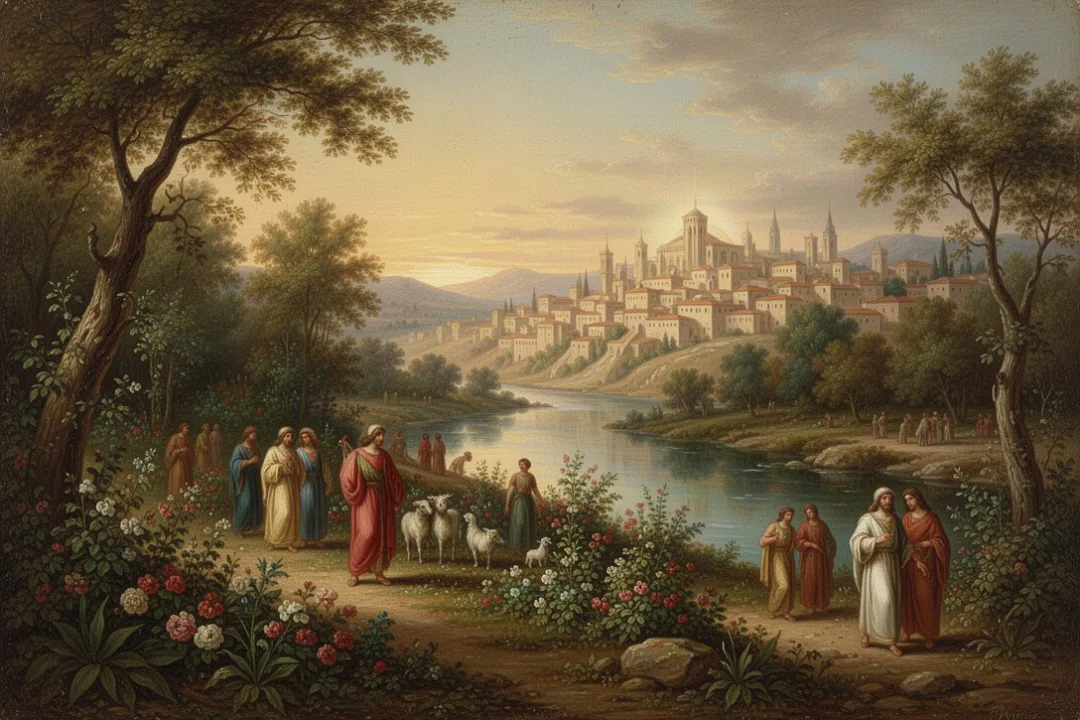
From Eden to the New Jerusalem, the Bible tells one connected story: God creates a good world, humanity loses communion with him through sin, and God works throughout history to restore his presence with his people. The story ends not with people escaping creation, but with creation renewed and God living openly among redeemed humanity.
Eden represents the beginning of human life with God in a flourishing garden. The New Jerusalem represents the goal of redemption: a holy city within a renewed creation, where death, mourning, pain, and the curse are gone (Revelation 21–22). Between these scenes, Scripture develops themes of presence, exile, covenant, temple, kingdom, sacrifice, and restoration.
The opening chapters of Genesis present creation as ordered, fruitful, and good. God gives light, land, living creatures, and human beings distinct places within his world. Humanity is made in God’s image, which means people are called to represent his character and exercise responsible care over creation (Genesis 1:26–28).
Eden is more than a beautiful garden. It is the first setting where humans live in direct fellowship with God and receive a calling that reaches beyond the garden itself. Adam and Eve are placed there to work and guard it, and they are commanded to fill the earth. The picture is of God’s presence spreading through the world as humanity faithfully reflects him.
The garden also establishes several themes that return at the end of the Bible. Eden contains a river, the tree of life, and unrestricted access to God’s presence. Revelation uses corresponding images when it describes the river of life and the tree of life in the New Jerusalem (Revelation 22:1–5).
The central direction of the biblical story: Scripture moves from a garden sanctuary where humanity is expelled to a worldwide, city-like dwelling where God’s presence is permanently shared with his people.
How sin turns fellowship into exile
Genesis 3 describes humanity’s rebellion through eating from the forbidden tree. The act is not merely a failure to follow an arbitrary rule. It represents distrust of God’s wisdom and an attempt to define good and evil independently of the Creator. The result is fractured relationship, shame, conflict, pain, and death.
Adam and Eve are sent out of Eden, and access to the tree of life is blocked. This exile matters because it shows that sin is both guilt before God and disorder within creation. The human problem affects worship, work, family life, community, and the ground itself.
Yet judgment is not the only message in Genesis 3. God gives a promise that the serpent’s power will ultimately be crushed through the offspring of the woman (Genesis 3:15). Christians traditionally understand this promise as an early sign of the victory later accomplished through Jesus Christ. The Bible’s rescue story begins immediately after humanity’s fall.
The chapters that follow show sin expanding beyond Eden. Cain kills Abel, violence spreads, and human pride reaches a symbolic height at Babel. These accounts show why restoration must address more than individual mistakes. God’s plan must heal human hearts, social relationships, nations, and the created order.
Why the flood and Abraham’s calling matter to restoration
The flood narrative presents God’s judgment on widespread violence while also preserving a future for creation through Noah and his family. After the flood, God makes a covenant with Noah and gives the rainbow as its sign (Genesis 8–9). The covenant concerns the earth as a whole, not only one ethnic group.
God’s call to Abraham then narrows the focus to one family for the sake of all families. Abraham is promised land, descendants, and blessing, with the stated purpose that all nations will be blessed through him (Genesis 12:1–3). The biblical story therefore does not move from Eden to one isolated spiritual community. It moves toward blessing for every people.
The promises to Abraham also connect people and place. His descendants will become a people, receive a land, and live under God’s covenant. These promises develop the larger question raised by Eden: how can human beings live with God’s presence in a world damaged by sin?
Abraham’s story includes waiting, failure, and testing, but it also shows God’s faithfulness. The covenant does not rest on human perfection. It depends on God’s commitment to create a people through whom his purposes will continue.
How the exodus creates a people who live near God
Israel’s deliverance from Egypt is a decisive stage in the movement toward restored fellowship. God rescues the Israelites from slavery, leads them through the sea, and brings them to Mount Sinai. The exodus is both liberation from oppression and formation into a covenant people.
At Sinai, God gives Israel laws that shape worship, justice, family life, economic conduct, and treatment of vulnerable people. These commands show that redemption is not merely release from danger. It creates a community whose life is meant to display God’s holiness and compassion.
The tabernacle becomes the portable center of Israel’s worship. Its purpose is for God to dwell among his people (Exodus 25:8). The tabernacle contains guarded sacred space, priests, sacrifices, and symbols associated with Eden. Cherubim appear again, and the sanctuary represents a controlled meeting place between holy God and sinful humanity.
Unlike Eden, however, access is limited. Only the high priest enters the innermost sanctuary, and only under prescribed conditions. Sacrifices address guilt and impurity, while the veil communicates that the relationship between God and humanity remains incomplete.
What the tabernacle and temple anticipate
When Israel settles in the land, the temple in Jerusalem becomes the permanent center of national worship. Solomon’s temple is decorated with garden-like imagery, including plant forms and cherubim. Its design echoes Eden and presents the temple as a kind of restored sanctuary.
Still, the temple is not the final answer. Israel’s history reveals repeated idolatry, injustice, and covenant breaking. The prophets warn that religious ceremony cannot substitute for loyalty to God and care for neighbors. The destruction of Jerusalem and the temple, followed by exile to Babylon, shows that the land and sanctuary do not guarantee security when the people persist in rebellion.
The exile reverses many blessings associated with Eden. The people lose their home, their political independence, and the visible center of worship. Yet the prophets speak of a future return, a new covenant, a cleansed people, a restored land, and God’s renewed presence.
Isaiah describes a future where the wilderness becomes fruitful, nations come to worship the Lord, and death is overcome. Ezekiel envisions a restored temple and a river flowing from it to bring life. Jeremiah promises a covenant in which God’s law is written on the hearts of his people. These visions prepare readers for the New Testament’s claim that restoration has begun through Jesus.
How Jesus brings God’s presence into human life
The Gospels present Jesus as the central person in the movement from Eden to the New Jerusalem. He announces God’s kingdom, heals the sick, forgives sins, confronts evil, and gathers a renewed people. His ministry shows that God’s restoration is not an abstract plan. It arrives through the life, death, resurrection, and reign of the Messiah.
John’s Gospel describes Jesus as the Word who became flesh and lived among humanity (John 1:1–18). This claim places Jesus at the center of the Bible’s presence theme. God’s presence is no longer represented only by a garden, tabernacle, or temple. It is revealed personally in Jesus Christ.
Jesus also presents himself as greater than the temple (Matthew 12:6; John 2:19–21). His body becomes the meeting place between God and humanity. Through him, people encounter God’s mercy, holiness, truth, and authority without needing to approach through the old temple system.
His miracles provide signs of restored creation. The blind see, the lame walk, storms are calmed, the hungry are fed, and the dead are raised. These acts do not remove every consequence of the fall during Jesus’ earthly ministry, but they reveal the character of the coming kingdom.
Jesus’ death addresses the problem of sin at its deepest level. The cross is presented in the New Testament as a sacrifice, a victory over hostile powers, a demonstration of God’s love, and the means of reconciliation. His resurrection then begins the renewal of embodied human life. Christianity does not treat the physical body as a disposable shell; Jesus rises bodily, anticipating the resurrection of his people.
Why Pentecost changes the meaning of God’s dwelling
After Jesus’ resurrection and ascension, the Holy Spirit comes upon his followers at Pentecost (Acts 2). The Spirit’s arrival fulfills prophetic expectations and changes how God’s presence is experienced. The church becomes a Spirit-filled people rather than a nation centered on one geographic sanctuary.
The New Testament calls individual believers temples of the Holy Spirit and describes the gathered church as God’s dwelling place (1 Corinthians 3:16–17; 6:19). These teachings do not make physical creation irrelevant. Instead, they show that the future restoration has entered the present through a community whose life is meant to reflect God’s holiness.
The Spirit also creates unity across ethnic and linguistic boundaries. At Pentecost, people from many regions hear the message in their own languages. The event answers the division associated with Babel and points toward the multinational worship seen in Revelation.
Christians therefore live between the beginning of renewal and its final completion. Forgiveness, reconciliation, spiritual gifts, and new life are present now, but death and suffering have not yet disappeared. The church is called to bear witness to the coming world while practicing its values in the current one.
How the New Testament describes the future renewal
The New Testament expects Jesus to return, the dead to be raised, evil to be judged, and creation to be renewed. Paul describes creation as longing for liberation from corruption and connects its future freedom with the revealing of God’s children (Romans 8:18–25). This language portrays redemption as cosmic, not merely private.
Second Peter speaks of a new heaven and a new earth characterized by righteousness (2 Peter 3:13). The phrase does not require readers to imagine a completely unrelated universe. In biblical context, it points to a transformed order in which sin, decay, and rebellion no longer dominate.
Revelation presents the climax through the descent of the New Jerusalem from heaven to the renewed earth (Revelation 21:1–5). The city comes down; redeemed humanity does not permanently travel away from creation. God’s dwelling is with people, and the separation represented by Eden’s expulsion is finally removed.
The city’s description includes walls, gates, precious materials, and perfect proportions. These details communicate security, beauty, holiness, and completeness. The New Jerusalem is a city, but it also functions as a sanctuary. God and the Lamb are its temple, and God’s glory supplies its light.
What returns from Eden in the New Jerusalem
Several Eden themes reappear in Revelation 21–22, but in expanded form. The Bible’s ending is not a simple return to the beginning. It is the completion of what Eden represented.
God’s presence: Eden offers fellowship with God, while the New Jerusalem provides permanent, unrestricted communion with him.
The tree of life: Access is blocked after the fall, but the tree appears again beside the river of life and serves the healing of the nations.
Water: Eden has a river, and Revelation describes a river flowing from God’s throne through the city.
Work and service: Humanity’s calling is not erased. God’s servants worship, reign, and serve him in the renewed creation.
Creation’s fruitfulness: The final vision includes abundant life, healing, light, and a world no longer ruled by the curse.
Human community: The ending includes nations and kings bringing their honor into the city, showing that redeemed cultural diversity has a place in God’s future.
The New Jerusalem is also more secure than Eden. Eden’s inhabitants could be deceived, rebel, and be expelled. In the final state, nothing unclean enters the city, evil has been judged, and God’s people are permanently established in life with him.
The final hope is not disembodied escape: Christian hope is resurrection life in a renewed creation, with God’s presence fully revealed and human beings restored to faithful service.
How the Bible’s major covenants fit the same story
The covenants in Scripture are not disconnected agreements. Each one develops God’s commitment to restore what sin damaged. The Noahic covenant preserves the world, the Abrahamic covenant promises blessing through one family, and the Mosaic covenant forms Israel as a holy people.
The Davidic covenant adds the promise of a lasting royal line (2 Samuel 7). Israel’s kings fail in different ways, but the prophets continue to expect a righteous ruler from David’s family. The New Testament identifies Jesus as that promised king, whose reign extends to the nations and ends in justice and peace.
The new covenant promised through the prophets brings forgiveness, inner transformation, and renewed knowledge of God (Jeremiah 31:31–34; Ezekiel 36:24–28). Jesus identifies his death with this covenant, and the Spirit applies its benefits to his people.
Taken together, the covenants show a consistent pattern: God remains faithful despite human unfaithfulness. His method includes judgment, mercy, promise, sacrifice, kingship, and transformation. The destination is a people who belong to him and a creation where his purposes are fully realized.
Practical ways to read the Eden-to-New-Jerusalem theme
This theme can shape Bible reading, theology, and daily faith without reducing every passage to a hidden symbol. Pay attention to how each text contributes to the larger story, while respecting its immediate setting and purpose.
Track God’s presence. Notice where God dwells, who may approach, and what barriers or invitations appear.
Track the land and creation. Ask whether a passage describes garden, wilderness, promised land, exile, restoration, or renewed creation.
Track the people. Observe how God forms a family, nation, church, and ultimately a redeemed multitude from every nation.
Track the problem of sin. Look for guilt, corruption, exile, death, idolatry, injustice, and the ways God addresses them.
Track the promise. Identify what God promises, how the promise develops, and how later Scripture refers back to it.
Read the ending alongside the beginning. Compare Genesis 1–3 with Revelation 21–22, while also noticing how the middle of Scripture connects the two.
Several common mistakes can weaken this reading. Avoid treating Eden as merely a lesson about personal temptation, because Genesis also addresses creation, vocation, authority, and human community. Avoid treating heaven as the complete final destination if you are discussing the vision of Revelation 21–22, where the holy city comes to the renewed earth.
Do not assume every garden or river in Scripture has exactly the same meaning.
Do not ignore Israel’s role in the story when moving directly from Genesis to Jesus.
Do not separate personal salvation from the Bible’s concern for justice, bodies, nations, and creation.
Do not claim that present Christian experience has already reached the full condition promised in Revelation.
Do not turn symbolic details in apocalyptic passages into predictions with unwarranted precision.
What this story means for Christian hope and practice
The movement from Eden to the New Jerusalem gives Christian hope a firm shape. God is not abandoning the world he made. He is confronting sin, gathering a people, defeating death, and preparing a creation where righteousness and life endure.
That hope affects how Christians understand ordinary faithfulness. Work, care for neighbors, protection of the vulnerable, truthful worship, and reconciliation are not attempts to build the New Jerusalem by human strength. They are responses to God’s coming kingdom and signs of allegiance to its king.
The theme also gives suffering a wider context. Pain is real and should not be dismissed as unimportant, but Revelation promises that God will remove death, mourning, crying, and pain from the renewed order (Revelation 21:4). Christian comfort rests not on pretending suffering is good, but on trusting that God will judge evil and heal what sin has damaged.
Finally, the biblical story ends with intimacy rather than distance. God’s servants see his face, bear his name, and reign with him (Revelation 22:3–5). What was lost through exile is restored in a greater form: humanity lives before God, serves him freely, and shares in the life of the renewed creation forever.
Frequently asked questions
Is the New Jerusalem the same place as heaven?
The New Jerusalem is described as coming down from heaven to the renewed earth in Revelation 21. This emphasizes that the final Christian hope includes a restored creation, not merely an eternal existence in a spiritual location. Heaven is associated with God’s realm, while the New Jerusalem represents God’s lasting dwelling with redeemed humanity in the world made new.
How does Jesus connect Eden and the New Jerusalem?
Jesus connects them by dealing with the sin that caused humanity’s exile and by bringing resurrection life. He is presented as the source of creation’s renewal, the meeting place between God and humanity, and the ruler who defeats evil. Revelation then shows the tree of life, God’s presence, and the removal of the curse restored through his victory.
Does the Bible teach that Christians should care about the physical world?
Yes. The Bible begins with God calling creation good and ends with creation renewed. Christian faith therefore includes care for people, bodies, communities, and the environment, while recognizing that human efforts cannot produce the final restoration promised by God. Responsible care is a response to creation’s value and a sign of hope in its future renewal.
Why is the temple theme important in this biblical storyline?
The tabernacle and temple represent places where God dwells among his people, but access remains limited because of sin. Jesus fulfills the temple’s meeting-place role, and the Holy Spirit makes God’s people his dwelling. In the New Jerusalem, no separate temple is needed because God and the Lamb are present throughout the city.






Leave a Reply