Goshen in the Bible: Meaning, Location, and Significance
Goshen in the Bible: Meaning, Location, and Significance
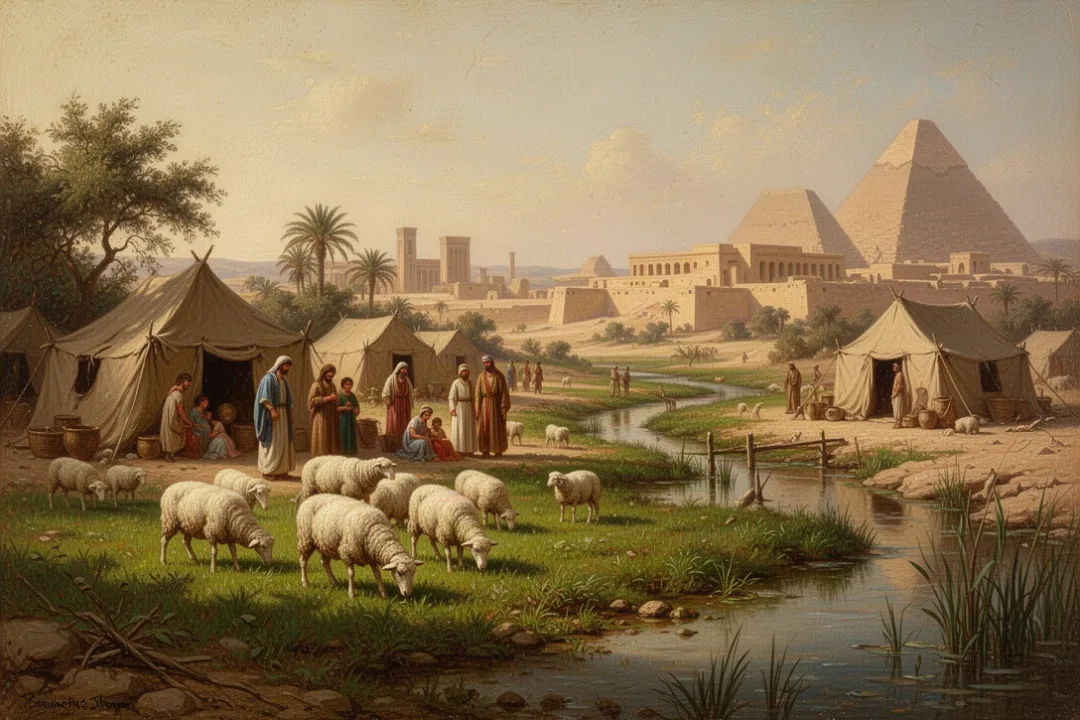
When you read about Jacob’s family moving to Egypt, you may wonder why the Bible keeps naming Goshen. Was it a city, a province, or simply a place where the Israelites lived? In Genesis and Exodus, Goshen is the Egyptian region assigned to Jacob’s descendants. It was a fertile area suitable for livestock, located in or near the eastern Nile Delta, where Israel’s family settled before becoming a large people.
Goshen first appears as a place of provision and refuge. Joseph arranged for his father Jacob, his brothers, and their households to live there during the famine. Later, Goshen became the setting where the Israelites grew in number, remained distinct from the Egyptians, and experienced God’s judgment on Egypt without being affected in the same way.
Goshen was not the name of a single house or village. It was a region of Egypt, probably in the eastern Nile Delta. The land supported animals and agriculture, which made it appropriate for Jacob’s family, whose livelihood centered heavily on raising livestock.
Joseph’s family came to Egypt because famine had spread through the region. Joseph, who had become a powerful administrator in Egypt, brought his father and brothers into the country so they could survive. He then directed them toward Goshen, where they could live separately while receiving food and protection.
Genesis presents Goshen as a real location with practical advantages. Pharaoh told Joseph’s family to settle in the best part of the land, and Joseph specifically identified Goshen as the place where they should live. The region therefore served both an economic purpose and a social one: it sustained the family while keeping them from being absorbed immediately into Egyptian society.
Quick answer: Goshen was the Egyptian region where Jacob’s family settled during the famine. It later became the main homeland of the Israelites in Egypt before the Exodus.
Where Goshen was located in Egypt
The Bible does not give modern coordinates for Goshen, so its exact boundaries cannot be established with certainty. Most discussions place it in the eastern Nile Delta, a productive area close to Egypt’s route toward Canaan. That location fits the biblical descriptions of pastureland, access to Egyptian centers, and movement toward the wilderness during the Exodus.
Genesis 46:28 says Judah was sent ahead to direct the family toward Goshen. Genesis 47 then describes Joseph meeting his father there and presenting some of his brothers to Pharaoh. The family’s settlement in Goshen was therefore connected with the royal court, yet it was distinct enough for them to maintain their own occupation and community.
Genesis 47:11 also uses the expression “land of Rameses” in connection with the place where Jacob’s family lived. Some readers treat this as another name for Goshen, while others understand it as a later geographical designation for the same general region. The reference should not be used to claim a precise modern location, since the biblical text does not provide enough information for that level of certainty.
The setting makes sense geographically. The eastern Delta contained water and pasture, while the nearby desert routes led toward Canaan. Goshen could support herds and families but also place the Israelites near the frontier they would eventually cross when they left Egypt.
How Goshen fits into the story step by step
The role of Goshen develops across several stages. Tracking those stages helps explain why the place matters beyond being a location on a map.
Joseph identifies Goshen as a safe settlement. He tells his brothers to report to Pharaoh that they are shepherds and to request Goshen as their home (Genesis 46:31–34).
Jacob’s household moves there. Jacob and his descendants leave Canaan and enter Egypt during the famine (Genesis 46:5–7, 28).
Pharaoh grants them the land. Joseph presents his brothers, and Pharaoh permits them to settle in the best part of the land and care for royal livestock (Genesis 47:1–6).
The family prospers and multiplies. The Israelites live in Goshen and acquire possessions there as their population increases (Genesis 47:27).
Goshen becomes distinct from Egypt during the plagues. Several judgments affect Egypt while Goshen is specifically spared or distinguished (Exodus 8:22; 9:26).
The Israelites leave Goshen for freedom. At the Exodus, Moses leads the people out of Egypt and toward the wilderness and the land promised to their ancestors.
This progression shows a movement from temporary refuge to established community and then to departure. Goshen was never presented as Israel’s final inheritance. It was a place where the family was preserved until the time came to leave.
Why Joseph chose Goshen for Jacob’s family
Joseph advised his brothers to emphasize that they were keepers of livestock. In Egyptian society, shepherding appears to have been viewed unfavorably by many Egyptians, as Genesis 46:34 indicates. That social difference made Goshen an appropriate place for Jacob’s family because it allowed them to continue their occupation away from the cultural center of Egypt.
The family’s identity also influenced the choice. Joseph did not simply ask Pharaoh to let his relatives live anywhere in Egypt. He sought a region where they could remain together, care for their animals, and avoid unnecessary assimilation. Goshen provided space for the family to grow as a distinct household.
Pharaoh’s response shows that the settlement was also useful to Egypt. Some of Joseph’s brothers were placed in charge of royal livestock, suggesting that their skills had practical value. Goshen was therefore not merely a hiding place. It was a productive region where the newcomers could contribute while preserving their own way of life.
Jacob’s family arrived as a relatively small household, but the biblical narrative emphasizes that the group became numerous. Goshen gave that household the room and resources needed to develop into the people later called Israel.
What the Bible says about life in Goshen
Several details in Genesis describe the character of life there. Jacob’s family received land, food, and an opportunity to maintain their herds. Genesis 47:12 says Joseph supplied food for his father, his brothers, and their households during the continuing famine.
Once the crisis had passed, the Israelites remained in Goshen and became very productive. Genesis 47:27 describes them as acquiring property and increasing greatly. The point is not simply that they survived. They established a durable community despite having entered Egypt as outsiders dependent on Joseph’s position.
Goshen also appears connected with family unity. Jacob’s household was not scattered among different Egyptian cities. The people lived together in one region, which helped preserve their shared ancestry, traditions, and relationship to the promises given to Abraham, Isaac, and Jacob.
At the same time, Goshen was not portrayed as a place without future tension. The book of Exodus begins by describing the Israelites as numerous and strong. A later Pharaoh, who did not regard Joseph’s contribution in the same way, viewed their growth as a threat and subjected them to forced labor. The same population growth that once signaled blessing eventually contributed to Egypt’s fear.
Goshen and the Israelites’ growth in Egypt
The Israelites’ multiplication in Goshen is central to the transition between Genesis and Exodus. Genesis ends with Jacob’s family established in Egypt, while Exodus opens with a later generation living under oppression. Goshen connects those two settings.
Exodus 1 explains that the descendants of Jacob increased significantly. Their growth created anxiety among Egyptian rulers, who feared that the Israelites might become too numerous or align with an enemy during war. The result was a system of forced labor and increasingly severe measures against the Hebrew population.
This development gives Goshen a complicated role. It was first a place of rescue from famine, then a place of population growth, and finally part of the setting from which oppression had to be escaped. The biblical story does not treat material security as the final goal. Goshen preserved the family for a season, but the people were ultimately called to move toward the land promised to them.
For that reason, Goshen can be misunderstood if it is treated only as a symbol of comfort. It was a genuine home for generations, but it was still Egypt. The Israelites’ identity and future were tied to God’s covenant promises, not permanently to the land where they had found temporary safety.
How God distinguished Goshen during the plagues
During the plagues, Goshen becomes a visible sign of separation between the Israelites and Egypt. The biblical text does not say that every plague affected the two populations in precisely the same way, but it clearly identifies several occasions when God protected or distinguished Goshen.
Flies: In Exodus 8:22–23, God says the swarms will not be present in Goshen, so Pharaoh can recognize a distinction between Egypt and Israel.
Death of livestock: Exodus 9:4 says the livestock belonging to Israel will be treated differently from the livestock of Egypt during the plague.
Hail: Exodus 9:26 states that hail did not fall in Goshen, where the Israelites were living.
Darkness: Exodus 10:22–23 describes darkness over Egypt while the Israelites had light where they lived.
The firstborn judgment: Exodus 11–12 presents protection for Israel through the Passover instructions, although the text frames this protection in terms of obedience and the blood of the Passover sacrifice rather than simply the geography of Goshen.
These passages show that Goshen was more than a convenient settlement. It became the place where God demonstrated that the Israelites were under his care while Egypt experienced judgment. The separation was theological as well as geographical.
Read the plague accounts carefully: Goshen is explicitly protected in some passages, especially those about flies and hail. It is better to distinguish what the text directly says from assumptions that every plague operated in exactly the same way.
What Goshen teaches about protection and responsibility
Goshen is often remembered as a picture of divine protection. That idea is grounded in the text: God marked out a difference between Egypt and Israel during several plagues, and the Israelites were preserved for the Exodus. Yet the protection was not presented as permission to remain passive forever.
The people were protected so they could be brought out. Goshen was a place of shelter, but it was also a staging ground for deliverance. When Moses announced God’s command to leave, the Israelites had to act: they prepared the Passover, gathered their belongings, and departed from Egypt.
This pattern matters when applying the story. A season of safety can be a gift without being a permanent destination. The biblical account holds together two truths: God provides a place of preservation, and God may later call his people beyond that place.
Goshen also illustrates protection within a larger community. The Israelites lived inside Egypt but were not identical to Egypt. Their distinct identity did not prevent them from engaging in the economy or interacting with the government. Instead, it meant that their ultimate allegiance and future were shaped by the God of their ancestors.
Was Goshen the Promised Land?
No. Goshen was in Egypt, while the Promised Land referred to the land associated with God’s covenant with Abraham, Isaac, and Jacob. The Israelites lived in Goshen for generations, but the Exodus was necessary because Egypt was not their final inheritance.
Jacob’s move to Egypt was authorized and even encouraged through Joseph’s position, but the family retained a connection to Canaan. Genesis 46 describes God speaking to Jacob before the journey, and Genesis 50 records Jacob’s request that his body eventually be taken back to the land of his ancestors.
The distinction becomes especially clear when Joseph dies. The family remains in Egypt, yet Joseph expresses confidence that God will eventually bring the Israelites out of the country and into the land promised to their ancestors. Goshen could be a genuine home without being the endpoint of the covenant story.
This distinction also prevents a common interpretive mistake. Goshen should not automatically be used as a label for every comfortable place in a believer’s life. In the biblical narrative, its value comes from its role in God’s particular work with Israel, not from a promise that people will always remain in a favored environment.
Goshen in Joshua and the other biblical reference
Goshen is mentioned again in the book of Joshua, but this reference concerns a different place. Joshua 10:41 says Joshua defeated enemies in the hill country, the Negev, the lowland, and the slopes, from Kadesh-barnea to Gaza, and in all the country of Goshen as far as Gibeon.
That Goshen was located in the southern part of the land of Canaan, not in Egypt. It is therefore essential to distinguish Egyptian Goshen in Genesis and Exodus from Judean Goshen in Joshua. The shared name does not mean they are the same region.
The Joshua passage shows that “Goshen” could function as a regional place-name outside Egypt. It also warns against reading every biblical reference as though it concerns the best-known Goshen. Context, neighboring locations, and the surrounding narrative determine which place is meant.
What the name Goshen may mean
The meaning of the name Goshen is uncertain. Various proposed explanations connect it with ideas such as drawing near, approaching, or a region’s geographical character, but the Bible itself does not provide a clear definition of the name.
Because the etymology is uncertain, the safest approach is to focus on how the Bible uses the place rather than building a doctrine on a proposed word meaning. Scripture gives Goshen significance through its role in the story: it was where Jacob’s family found food, where Israel grew, and where God distinguished his people during the plagues.
Readers sometimes hear that Goshen means “a place of drawing near” and then treat that translation as a direct spiritual promise. That interpretation may be meaningful as personal reflection, but it should not be presented as an established lexical fact. The location’s biblical importance does not depend on a certain etymology.
How to study Goshen in the Bible for yourself
A careful study can begin with the main passages in their narrative order. Reading the verses together is more useful than relying on a single definition or inspirational phrase.
Read Genesis 45:9–11. Notice Joseph’s plan to bring Jacob’s household to Egypt and settle them in Goshen.
Read Genesis 46:28–34. Observe Judah’s advance, Jacob’s arrival, and the family’s occupation as shepherds.
Read Genesis 47:1–12 and 27. Pay attention to Pharaoh’s permission, the land’s suitability, Joseph’s provision, and Israel’s growth.
Read Exodus 1. Trace how the Israelites’ increase led to fear and oppression under a later Pharaoh.
Read Exodus 8:20–24 and 9:1–7, 13–26. Compare the judgments on Egypt with the protection or distinction given to Israel.
Read Exodus 10:21–29 and 11–12. Consider how protection in Egypt led to the Passover and departure.
Read Joshua 10:40–43. Identify the separate Goshen in the land of Canaan and avoid combining the two locations.
As you read, ask three practical questions: What does Goshen provide?How does it preserve Israel’s identity?Why must Israel eventually leave? Those questions reveal the movement from provision to growth, from distinction to deliverance, and from temporary residence to covenant fulfillment.
Why Goshen still matters to Bible readers
Goshen matters because it brings together several major themes in Genesis and Exodus. It is a place of famine relief, family preservation, cultural distinction, divine protection, oppression, and eventual departure. Few locations in the biblical narrative carry so many connected parts of Israel’s early history.
The region also helps explain how a small family became a nation. Jacob’s descendants did not appear suddenly at the Exodus. They lived for generations in a real place, raised families, cared for livestock, acquired possessions, and increased in number before Pharaoh turned against them.
Goshen further shows that God’s care can operate through ordinary means. Joseph used political authority, food administration, land allocation, and family planning to preserve Jacob’s household. The biblical account presents those practical arrangements alongside God’s providence rather than treating them as opposites.
Most of all, Goshen is a reminder that a place of provision may be temporary. It was a gift to Jacob’s family and a genuine refuge during famine, but the story did not end there. The Israelites were preserved in Goshen so they could become a people and eventually follow God beyond Egypt.
Frequently asked questions
Is Goshen a city or a region in the Bible?
Goshen is best understood as a region rather than a single city. The Egyptian Goshen was probably in the eastern Nile Delta and included suitable pastureland for Jacob’s family and their livestock. The Bible also mentions a separate Goshen in southern Canaan during Joshua’s campaigns, so the name refers to more than one biblical location.
Did the Israelites live in Goshen for 400 years?
The Bible connects the Israelites’ Egyptian residence with a long period, but the exact calculation is interpreted in different ways. Scripture gives several chronological figures in different passages, and readers debate how they relate to one another. It is safest to say that Israel lived in Egypt for generations, with Goshen serving as their primary settlement before the Exodus.
Why were the Israelites protected in Goshen during the plagues?
The plague narratives use the distinction between Goshen and Egypt to show that God was judging Pharaoh’s land while preserving Israel. Exodus explicitly names protection during the plagues of flies and hail, and it describes light for the Israelites during the darkness. The Passover account adds specific instructions through which Israel’s firstborn were spared.
Is modern Goshen in Egypt known with certainty?
No. Many scholars place the biblical region in the eastern Nile Delta, but the Bible does not provide modern coordinates or fixed boundaries. Proposed identifications must remain approximate. The reference to the “land of Rameses” is relevant to the discussion, yet it does not settle the location with complete certainty.










Leave a Reply