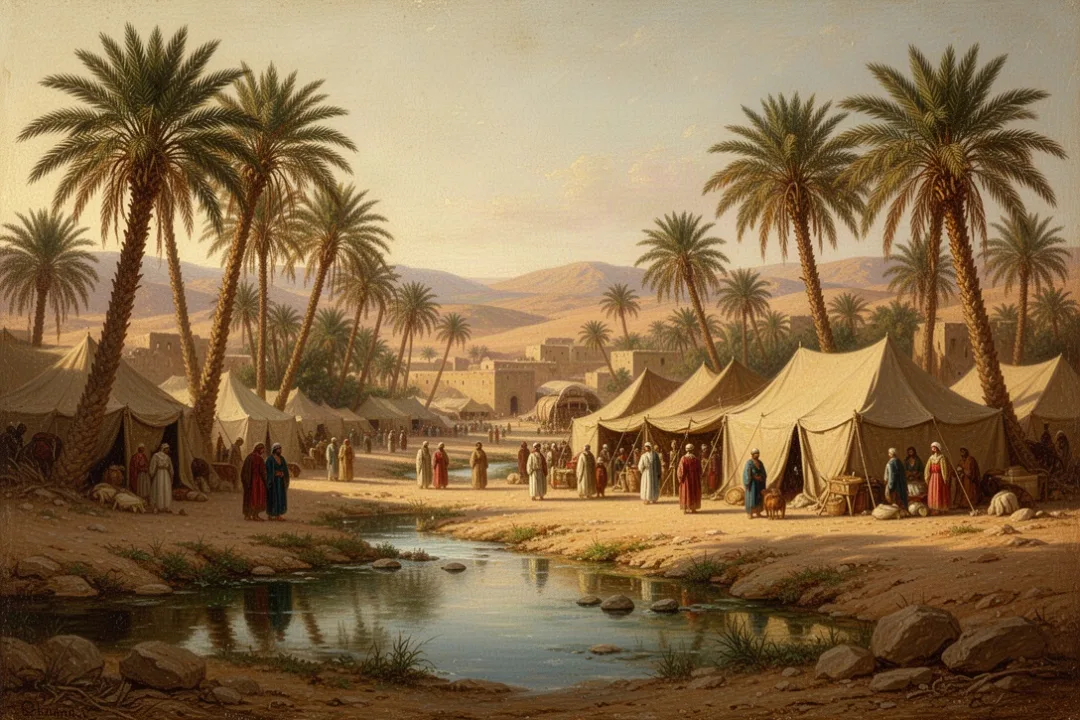
Elim was a desert oasis, not a person, where the Israelites stopped during their journey from Egypt to Mount Sinai. The Bible describes it as a place with twelve springs of water and seventy palm trees, making it a striking contrast to the dry wilderness around it.
Elim appears in the Israelites’ travels after they crossed the Red Sea and after Moses led them through the wilderness of Shur. The main references are Exodus 15:27 and Numbers 33:9. Both passages connect Elim with water, palm trees, and a temporary camp for the people.
After leaving Egypt, the Israelites traveled through unfamiliar and difficult terrain. They had escaped Pharaoh’s army, crossed the sea, and then entered a wilderness where reliable water was scarce. Their route brought them first to a place called Marah, where the water was too bitter to drink. After Moses cried out to God, the water became usable, according to Exodus 15.
From Marah, the people traveled to Elim. The biblical account presents Elim as a welcome change: instead of bitter water and hardship, the Israelites found abundant water and shade. They camped there before continuing toward the Wilderness of Sin.
Because the Bible gives no personal biography, family background, or actions for anyone named Elim in these passages, the question “Who was Elim?” is best answered by saying that Elim was a location. It was one of the named stations on Israel’s wilderness route.
Essential answer: Elim was an oasis where the Israelites camped after Marah and before entering the Wilderness of Sin. It was known for twelve springs and seventy palm trees.
Where Elim appears in the Bible
Elim is mentioned briefly, but its position in the story is clear. Exodus places it immediately after the account of Marah. The Israelites had traveled for three days into the wilderness without finding water, and when they reached Marah, the available water could not be consumed. Elim followed as the next named campsite.
The second major reference appears in Numbers 33, which records the stages of Israel’s journey from Egypt. This list names the places where the Israelites camped, including Succoth, Etham, Pi-hahiroth, Marah, Elim, and the Wilderness of Sin. In this travel record, Elim is one link in a much longer sequence.
These references serve slightly different purposes:
Exodus 15:27 emphasizes the physical features of Elim: its springs and palm trees.
Numbers 33:9 recalls Elim as one of the camps along Israel’s route after leaving Egypt.
The surrounding narrative places Elim between a difficult experience at Marah and further challenges in the wilderness.
Elim is therefore not a central character or a separate tribe. It is a geographical location remembered because it provided the travelers with the resources they needed to rest and continue.
What the Bible says was at Elim
The defining features of Elim were twelve springs and seventy palm trees. The text does not provide a detailed map or explain the exact size of the oasis. Still, these details show why Elim was suitable for a large traveling community and its animals.
Water was the most valuable resource in the desert. A group as large as the Israelites would have needed substantial supplies for drinking, cooking, washing, and caring for livestock. The presence of multiple springs made Elim more than a brief place to find a drink; it was a natural location for a camp.
The palm trees also mattered. In an arid environment, palms could indicate groundwater and offer shade from the sun. They would have made the camp more livable, especially for families who had already traveled through difficult country.
The numbers in the description have attracted considerable interpretation. Some readers see a possible connection between twelve springs and the twelve tribes of Israel, or between seventy palms and the seventy members of Jacob’s family who went to Egypt. Those connections may offer devotional meaning, but the biblical text does not explicitly say that the numbers symbolize the tribes or Jacob’s household.
A careful reading should begin with the plain description: Elim had many springs and palms, and this made it a desirable campsite. Symbolic interpretations can be considered afterward, but they should not replace what the passage directly states.
How Elim fits into the Israelites’ route
The sequence around Elim can be followed step by step. The exact geography remains debated, but the order of the biblical stations is more certain than the modern identification of every site.
Egypt: Moses led the Israelites out from slavery under Pharaoh.
Succoth and Etham: Numbers 33 names early camps after the departure.
The sea crossing: The people escaped Pharaoh’s pursuing forces.
The Wilderness of Shur: They traveled into a desert region with limited water.
Marah: The water was bitter and became drinkable after God’s intervention through Moses.
Elim: The Israelites found twelve springs and seventy palm trees and camped there.
The Wilderness of Sin: They moved onward and faced another shortage of food, followed by God’s provision of manna and quail in the Exodus account.
This order shows that Elim was not the final destination. It was a temporary place of relief along a demanding journey. The Israelites did not remain there permanently; the camp gave them water and rest before the next stage of travel.
That detail helps explain why Elim matters in the narrative. It is not presented as a city to conquer, a nation to confront, or a place where a major speech occurred. Its importance comes from its role in sustaining the people between more difficult stages.
Why Elim appears after the hardship at Marah
The contrast between Marah and Elim is one of the clearest features of the passage. At Marah, the Israelites encountered water that they could not drink. At Elim, they found an oasis with several springs. The two locations appear next to each other so that the journey moves from need and complaint to provision and rest.
Exodus describes the Israelites becoming fearful and dissatisfied when they could not find suitable water. Their reaction reflects a practical problem, not merely an abstract spiritual lesson. People traveling through the desert could become seriously endangered by a lack of water, and the community depended on Moses’ leadership during that crisis.
Elim does not erase the difficulty of the journey, but it shows that Marah was not the whole story. A disappointing location was followed by a place with abundant water. The narrative therefore gives readers a fuller picture of the wilderness: it includes danger and frustration, but also relief and provision.
Elim marks the point where the wilderness journey briefly becomes a place of water, shade, and rest.
The movement from Marah to Elim can also shape how readers understand the travel account without requiring them to force a symbolic meaning onto every detail. A wilderness route could contain both hardship and livable places. The biblical narrative preserves both realities.
Was Elim a person, a place, or a god?
For the passages in Exodus and Numbers, Elim is a place. It should not be confused with a person named Elim or with a deity. Some readers notice that the spelling resembles words used in other ancient Near Eastern contexts, but resemblance alone does not change the meaning of the biblical passage.
The text itself identifies Elim through its physical features and its position on the route. It says the Israelites went to Elim and camped there. That language is geographical and does not describe a human figure.
There are also other biblical names that sound similar to Elim. For example, the priest Eli appears in the books of Samuel, and Elim is not the same name or the same individual. The word “Elohim,” commonly translated in references to God, is also distinct from Elim. Similar-looking spellings can create confusion when names are read without their surrounding context.
The safest way to identify a biblical term is to examine how the passage uses it. In Exodus 15 and Numbers 33, Elim functions as a campsite with water and trees. Its grammatical and narrative role makes its identity clear.
Where was Elim located?
The exact location of Elim is uncertain. The Bible gives its place in the travel sequence, but it does not provide modern coordinates, distances, or a detailed geographical description. For that reason, proposed identifications remain possibilities rather than settled facts.
Many discussions place Elim somewhere in the Sinai Peninsula or nearby desert regions, based on the traditional route associated with the Exodus. Researchers have compared the biblical description with desert oases that contain springs and palm trees. Several locations have been suggested over time, but no identification has universal agreement.
Two cautions are useful when considering possible sites:
A modern oasis may resemble the description without being the exact biblical Elim.
The travel sequence does not by itself establish precise distances, because the biblical text does not record every turn or the duration of each camp.
The physical description does offer helpful clues. A likely candidate would need to be an oasis or water source in an arid region, capable of supporting a large group temporarily. It would also fit plausibly between Marah and the Wilderness of Sin in the sequence preserved by Exodus and Numbers.
Rather than presenting a disputed location as certain, it is more accurate to say that Elim was somewhere along the wilderness route traditionally associated with the Israelites’ movement from the Red Sea area toward Sinai. The Bible’s theological and narrative point does not depend on a modern map pin.
Reading the geography carefully: The Bible identifies Elim by its route and resources, but it does not give enough information to prove one modern location beyond dispute.
How Jewish and Christian readers understand Elim
Elim has often been read as a picture of refreshment after distress. After the bitter waters of Marah, the springs and palms at Elim suggest that God continued to care for the people during their journey. This interpretation stays closely connected to the narrative’s sequence.
Many teachers also use Elim to illustrate the value of temporary rest. The Israelites were not yet in the Promised Land, and Elim was not their permanent home. Even so, a temporary place can provide what travelers need: water, shade, recovery, and enough strength to continue.
That application should be handled with care. Elim was a real location within the biblical story, not merely an illustration invented to represent comfort. Its symbolic use is strongest when it grows out of the actual details: a wilderness, a thirsty people, springs, palms, and a temporary camp.
Some interpreters connect the twelve springs with the twelve tribes and the seventy palm trees with the seventy people from Jacob’s family mentioned earlier in Genesis and Exodus. These associations can be meaningful in sermons or devotional writing, but they are not explained by Moses in the passage itself. A reader should distinguish between what the text states and what later interpretation suggests.
What Elim teaches about the wilderness journey
Elim helps readers see that the Exodus journey was not described as a straight path from slavery to immediate comfort. The people moved through changing conditions. They experienced deliverance at the sea, thirst in the wilderness, bitter water at Marah, abundant water at Elim, hunger in the Wilderness of Sin, and further tests of trust.
The presence of Elim also corrects an overly simple picture of the wilderness as nothing but barren land. Desert regions can contain springs, palms, wadis, and seasonal resources. An oasis may be surrounded by dry country while still providing a livable environment for a time.
For the Israelites, Elim likely had practical significance as well as narrative significance. A large community could not travel indefinitely without reliable water. The camp at Elim allowed people and animals to recover, gather supplies, and prepare for another stage of the route.
The stop also highlights the importance of remembering places along a journey. Numbers 33 preserves a list of camps that might seem repetitive at first reading. Yet the list records the path by which the Israelites moved from Egypt toward the land promised to their ancestors. Elim remains memorable because it was a place of provision within that larger movement.
How to read the two main Elim passages
Exodus 15 should be read as part of a narrative about the Israelites learning to live after their escape from Egypt. The people have experienced a dramatic rescue, but they still face ordinary physical needs. Water is not a minor concern in the wilderness; it is essential to survival. Elim follows Marah as a concrete answer to that need.
Numbers 33 should be read as a travel record. Moses or the biblical narrator lists the camps where the Israelites stopped. In this setting, Elim is one stage among many, and its mention recalls the physical journey rather than retelling every event that happened there.
Reading both passages together gives a balanced understanding:
Exodus explains the experience: the people move from bitter water to an oasis.
Numbers preserves the itinerary: Elim is remembered as one of Israel’s camps.
Neither passage identifies Elim as a person: both use it as a geographical name.
The oasis is important because of its resources: twelve springs and seventy palm trees made it a place of rest.
This approach also prevents a common mistake: treating every biblical name as the name of an individual. Biblical narratives contain names for people, places, tribes, regions, mountains, cities, and other features. Context determines which kind of name a reader is seeing.
How Elim differs from Marah and the Wilderness of Sin
Elim is easiest to remember when compared with the locations immediately around it. Marah was associated with undrinkable or bitter water. Elim was associated with springs and palms. The Wilderness of Sin, which came afterward, became the setting for complaints about food and the provision of manna and quail in Exodus.
These places represent different stages of the same journey, but they should not be confused. Marah and Elim are both linked to water, while the Wilderness of Sin is linked more prominently to food. The narrative uses the changing needs of the people to show that each stage brought its own challenge.
The names also function as markers of memory. When later generations heard about Marah, they could recall bitter water and the crisis that followed. When they heard about Elim, they could recall the oasis. When they heard about the Wilderness of Sin, they could recall hunger and God’s provision.
What “who was Elim” should mean when searching the Bible
If you encounter the question “Who was Elim?” in a Bible study, the clearest response is: Elim was an oasis and campsite in the wilderness. It was not one of Moses’ companions, one of the twelve tribes, or a prophet.
A useful way to confirm the answer is to ask three questions:
What action is connected with the name? The Israelites went to Elim and camped there.
What features are associated with it? The passage mentions springs and palm trees.
Where does it appear in the sequence? It comes after Marah and before the Wilderness of Sin.
Those clues identify a location without requiring speculation. They also explain why Elim remains relevant to biblical readers: it is a small but memorable scene in the larger account of Israel’s exodus from Egypt.
Elim’s significance is found in its combination of geography and story. It was a real stop on the route as the biblical account presents it, a place where an exhausted and thirsty people found water and shade. The oasis did not end the journey, but it gave the travelers what they needed for the next stage.
Frequently asked questions
Is Elim a person in the Bible?
No. In Exodus 15:27 and Numbers 33:9, Elim is the name of a location. It was an oasis where the Israelites camped after leaving Marah. The Bible does not present Elim as an individual, leader, tribe, or deity.
What did the Israelites find at Elim?
They found twelve springs of water and seventy palm trees. These resources provided drinking water, shade, and a suitable place to camp during the wilderness journey. The account does not describe the oasis in greater detail or explain how large it was.
Where was Elim located?
Its exact modern location is uncertain. The Bible places it between Marah and the Wilderness of Sin on the Israelites’ route after leaving Egypt. Various desert oases in or near the Sinai region have been proposed, but none is universally accepted as the definite site.
Why is Elim important in the Exodus story?
Elim shows the Israelites receiving relief after the hardship at Marah. Its springs and palms made it a place of rest and provision before the journey continued. It also demonstrates that the wilderness route included both severe challenges and temporary places of refreshment.





Leave a Reply