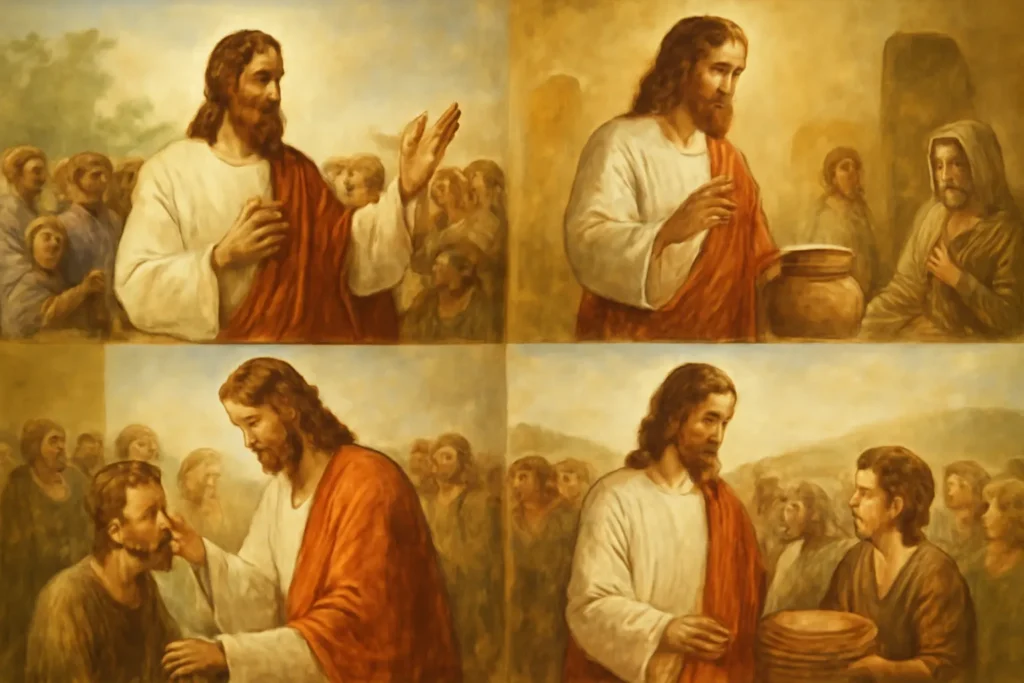
The life of Jesus is traditionally understood through a series of miracles that testify to his divine authority, compassionate action, and unique identity. For students, scholars, and curious readers, a coherent picture emerges when we attempt to arrange these events in roughly chronological order or, more precisely, in a timeline of Jesus' miracles. This article offers a careful, harmonized overview that blends the Gospel accounts into a practical sequence. It is important to note that the exact order of every miracle is debated among scholars because the four canonical Gospels present some events in different streams of narrative. Nevertheless, a commonly accepted harmony provides a helpful framework to study how Jesus moved from the Galilee to Jerusalem and how his miracles progressed in scale, scope, and significance.
What counts as a miracle and what does not
Before we dive into the chronology, it helps to clarify what is being counted as a miracle. Broadly, a miracle is a supernatural sign that reveals the presence and authority of the Kingdom of God, accompanied by an affective response—people respond with awe, faith, or opposition. In this article, we focus on events that:
Nature miracles (control over natural forces, such as water, wind, and food in abundance)
Healing miracles (cures of illness, infirmity, or disability)
Exorcisms (casting out demons from individuals or the possessed)
Raising the dead (restoration of life to a person who has died)
We exclude non-miraculous actions that are still profound—like teachings, parables, and acts of mercy—though those are deeply connected to the miracles as signs of Jesus’ mission. The chronology of miracles is closely tied to where and when Jesus performed them: in the towns and villages of Galilee, along the roads between Galilee and Judea, in and around Jerusalem, and finally in the dramatic events of the last week leading to the Passion and Resurrection.
Methodology: how scholars piece together the chronology
The Gospels present a complex tapestry. The Synoptic Gospels (Matthew, Mark, Luke) share many accounts and often arrange them in similar orders, while the Gospel of John preserves a different selection of signs and a different narrative rhythm. In order to assemble a practical timeline, scholars use a few guiding methods:
Cross-Gospel harmonization: comparing the three Synoptic accounts for consistent sequences and placing similar acts in a common order when the texts align.
Geographic markers: tracing Jesus’ movements among Galilee, Judea, Perea, Samaria, and Jerusalem to infer plausible progressions (e.g., Galilean miracles tend to precede Judean ones).
Thematic grouping: recognizing that some miracles are grouped by setting (home/hometown healings, Sabbath controversies, sea-crossing episodes) and arranging them within an approximate itinerary.
John’s distinctive sequence: acknowledging that John records several early signs in Galilee and Samaritan settings that differ from the Synoptic chronology, yet still reflects a coherent arc of public ministry.
The result is not an exact worksheet with dates, but a carefully reasoned timeline of Jesus' miracles that captures the growing reach of his ministry, the increasing conflict with opposition, and the deepening faith of those who encountered him.
The following sequence presents a harmonized order drawing on the Gospel records. It aims to balance the best-attested sequence with the reality that some events are difficult to pin down with precision. Each entry identifies the predominant setting and a brief note on why scholars place it here in this order of miracles. Where possible, I note when a miracle appears in multiple gospels and how that affects its placement.
Water into wine — Cana in Galilee (John 2:1-11). Often regarded as Jesus’ first public sign, it reveals his transforming power over nature and his concern to address social norms (the wedding celebration). This early sign in John kicks off the ministry with abundant symbolism about abundance and blessing.
Why here in the timeline? It sets the pattern for Jesus’ signs: accessible, meaningful to daily life, and unmistakably supernatural.
Healing the official’s son — Capernaum, near Galilee (John 4:46-54). A trusted Gentile-like official seeks Jesus from a distance and receives a word that his son is healed. This miracle expands the reach of Jesus’ miracles beyond the immediate circle of Jewish listeners.
Why here in the timeline? It marks a transition from private signs to public signs that cross social and geographic boundaries.
Healing the man at the pool of Bethesda — Jerusalem (John 5:1-9). A long-standing infirmity is removed with a spoken command. This is one of John’s early signs in a Judean setting, highlighting Jesus’ authority over illness and ritual purity concerns in the temple complex region.
Why here? It emphasizes Jesus’ authority in a major religious center and foreshadows debates over Sabbath and purity later in his ministry.
Healing Peter’s mother-in-law — Capernaum (Mark 1:29-31; Luke 4:38-39). Jesus immediately heals a household in his new base of operations, illustrating a pattern of compassion and swift response to need.
Healing many in Galilee (Mark 1:32-34; Matthew 8:16-17; Luke 4:38-41). In the early days, crowds bring the sick, demon-possessed, and those afflicted with various diseases to Jesus, and he heals them all.
Why here? It demonstrates the breadth of his ministry in his home region and sets the stage for more targeted signs in villages and synagogues.
Healing a leper — Galilee (Luke 5:12-15; Mark 1:40-45). The leper’s restoration is not only physical healing but social restoration, since leprosy carried stigma and separation.
Healing the centurion’s servant — Capernaum (Matthew 8:5-13; Luke 7:1-10). A Roman official asks for help, and Jesus heals the servant by a word of authority, praising the official’s faith.
Healing the paralytic, let down through the roof — Capernaum (Mark 2:1-12; Luke 5:17-26; Matthew 9:1-8). Jesus forgives sins and heals, demonstrating authority over both spiritual and physical ailments.
Healing a withered hand — in a synagogue (Mark 3:1-6; Luke 6:6-11). This event foregrounds a tension between mercy and Sabbath policing, revealing Jesus’ priority to heal on the Sabbath when compassion demands it.
Calming the sea and walking on water — Sea of Galilee (Matthew 8:23-27; Mark 4:35-41; Luke 8:22-25). Nature miracles here reveal Jesus’ power over elements and his disciples’ growing recognition of his identity.
Feeding of the 5,000 — Galilee (Matthew 14:13-21; Mark 6:30-44; Luke 9:10-17; John 6:1-14). A crowd is sustained with bread and fish, highlighting Jesus’ providential care and foreshadowing the “bread of life” imagery in John.
Walking on water (continued) and more healings in Gentile lands — crossing back toward the region of Galilee (Mark 6:45-56; John 6). The miracle sequence reinforces a pattern: signs that teach, test faith, and invite trust in Jesus’ provision.
Exorcisms and healings in the Gerasene territory — Gadara (Mark 5:1-20; Luke 8:26-39). Jesus casts out a legion of demons from a man, demonstrating authority over spiritual powers and the mission to the Gentiles beyond Israel’s borders.
The healing of the woman with the issue of blood and Jairus’ daughter — Galilean/Jerusalem corridor (Mark 5:21-43; Luke 8:40-56). A two-part healing narrative shows faith in action: a woman’s touch and a family’s plea, both answered by Jesus.
Blind Bartimaeus and other blind men — Jericho (Mark 10:46-52; Luke 18:35-43). Reversing sight loss is a powerful sign of restoring creation’s original order and Jesus’ shepherd-like care for those marginalized by society.
Feeding of the 4,000 — Decapolis/Gentile region (Mark 8:1-10; Matthew 15:32-39). A second feeding miracle demonstrates that Jesus’ compassion extends beyond Jewish communities and that his provision is abundant.
Lazarus raised — Bethany near Jerusalem (John 11:1-44). This climactic sign in John’s narrative moves readers toward the culminating week in Jerusalem, preparing the way for the Passion narratives.
Why here? It marks a decisive public indicator of Jesus’ power over death and serves as a turning point that accelerates opposition among religious leaders.
The anointing of Bethany and other Jerusalem-region signs — near the approach to the final week. Jesus’ miracles here intensify the conflict with authorities and set the stage for the events of Holy Week.
Final week in Jerusalem: signs and tensions — culminating in the Passion. While some of the last-week acts are not always labeled as standalone miracles, several notable acts—such as the cleansing of the temple and additional healings and revelations—function as climactic signs pointing to the Kingdom.
Resurrection appearances — Jerusalem and the surrounding regions (Matthew 28; Luke 24; John 20-21; Mark 16). The eventual post-resurrection encounters are signs of victory over death, confirming the divine mission.
Notable groupings within the chronology
Nature miracles (water to wine, wind and sea, bread multiplications, walking on water) repeatedly reveal authority over creation and invite trust in Jesus’ leadership.
Healings (leprosy, paralysis, fever, blindness, deafness, hemianopia, etc.) demonstrate Jesus’ compassion and include both physical and social restoration (for example, restoration to community for the untouchable or marginalized).
Exorcisms (demons cast out of individuals) illustrate a cosmic confrontation with evil and signal the in-breaking of God’s Kingdom into a broken world.
Raising the dead (Lazarus) stands as the most dramatic sign of life and anticipates the ultimate victory over mortality that Easter proclaims.
Cross-cutting themes in the ordering of miracles
Faith and response: in many accounts, Jesus notes or praises faith as a prerequisite for healing, while sometimes healing appears even where faith is minimal (or indirect).
Geography and mission: the sequence moves from Galilee to neighboring regions and toward Jerusalem, tracing a growing engagement with a broader audience, including Gentiles and sinners.
Authority and identity: each miracle reinforces who Jesus is—teacher, healer, rabbi, prophet, and Messiah—and how people should respond to him.
John’s distinctive signs and how they fit the timeline
The Gospel of John presents a curated set of signs that differ in order from the Synoptic Gospels. Rather than attempting to reproduce a single linear itinerary, John emphasizes seven classic signs with deeper theological implications, culminating in the raising of Lazarus and the climactic push toward the Passion. In a practical sense, you can view John’s miracles as a parallel timeline that runs alongside the Synoptic sequence. When harmonized, John’s signs reinforce the same arc: Jesus reveals himself, awakens faith (often in readers who are seeking or skeptical), encounters opposition, and presses toward a decisive confrontation with the religious authorities in Jerusalem.
Why the chronology matters for study and faith
Understanding the chronology of Jesus' miracles has several benefits:
Historical insight: it helps readers situate miracle stories within the broader arc of Jesus’ ministry and travels.
Thematic clarity: recognizing how nature, healing, exorcism, and life-restoration signs interact reveals overarching themes—compassion, authority, and the in-breaking of the Kingdom.
Liturgical and devotional relevance: many readers reflect on miracles in the context of seasons (e.g., Epiphany, Lent, Easter) and in the rhythm from public signs to Passion Week.
Biblical literacy: a well-ordered timeline helps students compare Gospel accounts, notice overlaps, and appreciate the distinct voices of the Evangelists.
Did Jesus perform the water-to-wine miracle before healing anyone else? In John, yes, it is presented as the first public sign, signaling his glory and authority.
Which miracle happened first—the calming of the sea or feeding the 5,000? The canonical accounts place these events in a sequence around the same period of intensified activity near the Sea of Galilee; the exact chronological order varies by Gospel, but both occur in the early phase of his Galilean ministry.
Is Lazarus’ raising part of the public miracles or later? Lazarus is a turning-point sign in the Gospel of John that foreshadows the Passion; in harmonized timelines, it is placed just before the final Jerusalem phase of Jesus’ ministry because it accelerates opposition from religious leaders.
Conclusion: the significance of a plausible miracle timeline
A thoughtful chronology of Jesus’ miracles offers more than a chronological toy. It helps readers see how Jesus’ acts were interconnected—each sign building on the previous ones, affirming his identity, inviting faith, and challenging readers to respond. The journey from Cana to Jerusalem is a journey through healing, provision, spiritual authority, and ultimate life through death and resurrection. While no single source can capture every nuance of every Gospel, a harmonized timeline provides a robust framework for study, teaching, preaching, and personal reflection.
Further resources for exploring the miracles in order
If you want to dive deeper into the chronology of Jesus' miracles, consider exploring:
Comparative gospel harmonies that place parallel accounts in a single sequence.
Commentaries on the miracles of Jesus that discuss the historical setting, Greek terms, and cultural context behind each sign.
Study guides that map each miracle onto the geographic and thematic arc of Jesus’ ministry.






Leave a Reply