When you read a Gospel passage and wonder what Jesus was really asking people to do, start with the setting and the central idea. Jesus’ sermons were not disconnected sayings; they addressed real people facing poverty, religious pressure, illness, conflict, fear, and questions about God’s kingdom. His teaching combined explanation with challenge, often calling listeners to change both their beliefs and their treatment of others.
The most extensive collection is the Sermon on the Mount in Matthew 5–7, with a closely related account in Luke 6 often called the Sermon on the Plain. Other major teaching sections include Jesus’ message in the synagogue at Nazareth, his parables about the kingdom, his warnings about Jerusalem and the future, and his final teaching to the disciples before his death.
Jesus taught with authority, but his authority was expressed in several different ways. He explained Scripture, told memorable stories, asked penetrating questions, confronted hypocrisy, welcomed outsiders, and used ordinary images such as seeds, lamps, vineyards, homes, debts, and meals. His sermons often moved from an outward rule to an inward transformation.
For example, in Matthew 5, Jesus discusses anger, sexual desire, truthfulness, retaliation, and love for enemies. He does not treat morality as a matter of appearances alone. His teaching reaches into motives, relationships, and the habits of the heart. The result is a demanding vision of faithful living that cannot be reduced to a list of religious performances.
His preaching also centers on the kingdom of God, or the reign of God. This kingdom is not presented merely as a place people enter after death. Jesus describes it as God’s active rule breaking into human life, changing how people see wealth, power, forgiveness, status, prayer, suffering, and hope.
Reading tip: Ask what each sermon reveals about God, what it exposes in human behavior, and what response Jesus expects from his listeners.
Where Jesus preached and who listened
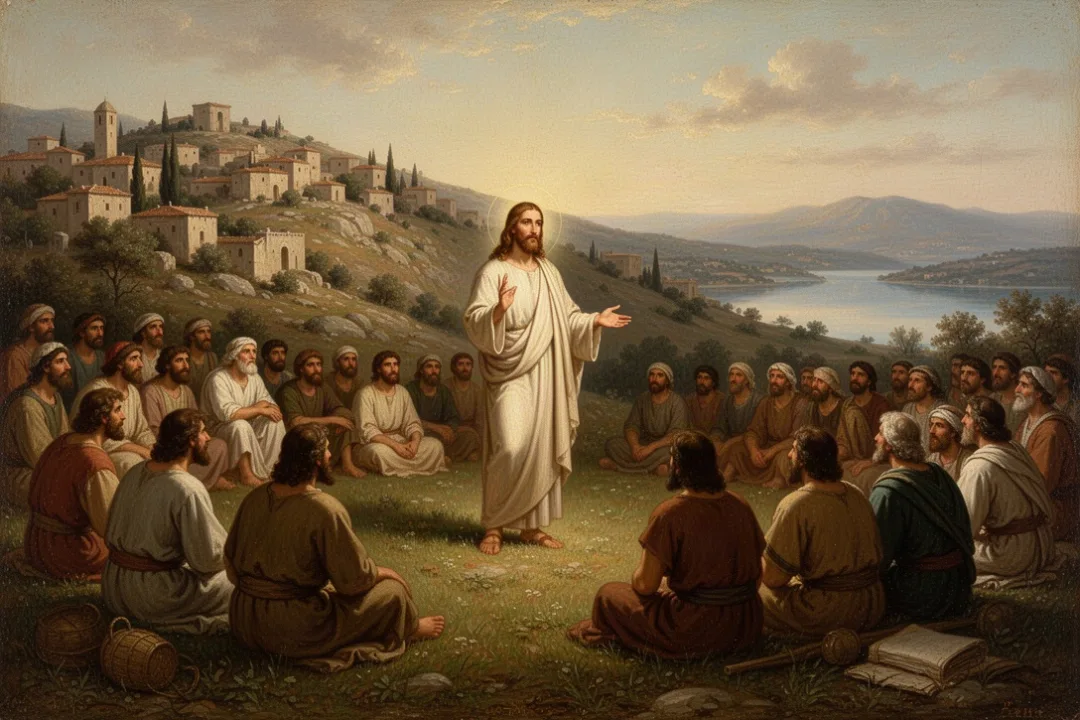
The Gospel accounts place Jesus’ teaching in many settings rather than in one formal religious service. He spoke on hillsides, beside the sea, in synagogues, in homes, at the Temple, along roads, and during meals. The location often helps explain the tone. A public sermon could address crowds, while a private conversation could clarify a teaching for close disciples.
His listeners included fishermen, farmers, religious teachers, wealthy people, tax collectors, women, children, the sick, and people viewed as morally or socially unclean. He did not speak to only one class of audience. Some came seeking healing, some wanted to test him, some were curious, and others were already committed followers.
The political and religious environment also shaped his sermons. Galilee and Judea lived under Roman rule, and many people longed for liberation. Religious leaders debated how to interpret the Law of Moses and how to live faithfully under foreign occupation. Jesus addressed those hopes but redirected them toward God’s rule, repentance, mercy, justice, and faithful obedience.
When the Gospels describe large crowds, they may summarize a longer period of teaching rather than preserve one uninterrupted speech. The Gospel writers arranged Jesus’ sayings for particular purposes, so similar ideas may appear in more than one setting. This does not make the teachings meaningless; it means readers should consider both the individual saying and the wider message of each Gospel.
How to study Jesus sermons step by step
A careful reading does not require advanced theological training. A simple process can help you move from a familiar quotation to a fuller understanding of what Jesus taught and why it mattered.
Read the complete passage. Do not isolate one sentence before reading the surrounding scene. Notice who is present, what question has been asked, and what happens afterward.
Identify the main subject. The passage may focus on prayer, forgiveness, wealth, the Sabbath, the kingdom, leadership, judgment, or discipleship.
Observe the teaching method. Determine whether Jesus is using a parable, comparison, question, warning, command, debate, prophecy, or explanation.
Notice the surprising element. Jesus frequently reverses ordinary assumptions about greatness, purity, success, power, and religious respectability.
Connect the passage to the wider Gospel. Compare related accounts in Matthew, Mark, Luke, and John without assuming they must use identical wording or arrangement.
Separate explanation from application. First ask what the original audience would have heard. Then consider how the principle should shape your decisions, relationships, and worship.
This approach guards against two common errors. One is treating every sentence as an isolated slogan. The other is turning a sermon into an abstract theological statement while ignoring its practical demands. Jesus’ teaching is meant to be understood, but it is also meant to be lived.
The Sermon on the Mount and its central message
Matthew 5–7 contains the best-known extended collection of Jesus’ teaching. It begins with blessings for people who appear weak, grieving, humble, hungry for justice, merciful, pure in heart, committed to peace, or persecuted for doing what is right. These blessings, often called the Beatitudes, describe people who belong to God’s kingdom even when their present circumstances do not look successful.
Jesus then describes his disciples as salt and light, using images of influence and visibility. His followers are not meant to hide their allegiance or live for private spiritual status. Their conduct should point others toward God, while avoiding the kind of public religion that exists mainly to attract praise.
In Matthew 5, Jesus speaks about the Law and the Prophets. He presents his mission not as permission to discard God’s prior revelation, but as its fulfillment and deeper interpretation. He then addresses several areas of life in which outward compliance can conceal inward damage:
Anger and reconciliation: damaged relationships matter, and worship cannot be separated from a willingness to seek peace.
Marriage and desire: faithfulness involves more than avoiding a visible act; it includes how a person regards another human being.
Truthfulness: reliable character should make elaborate promises unnecessary.
Retaliation: responding to harm without mirroring the aggressor requires strength, wisdom, and concern for justice.
Love of enemies: God’s generosity provides the pattern for treating even hostile people as human beings.
These teachings are not a call to tolerate abuse or abandon responsible protection of others. They challenge the instinct to answer every injury with revenge. Jesus directs attention toward reconciliation, integrity, mercy, and the refusal to let hatred control the person who has been harmed.
Prayer, generosity, and trust in the Sermon on the Mount
Matthew 6 turns from relationships to religious practice. Jesus discusses giving to the needy, prayer, and fasting, warning against performing devotion mainly to gain public approval. The issue is not whether these practices are valuable; it is whether they are directed toward God or toward an audience.
He teaches a model prayer that begins with God’s name, kingdom, and will, then asks for daily provision, forgiveness, and help in resisting evil. The prayer is concise but broad. It joins worship with dependence, personal need with moral responsibility, and forgiveness received with forgiveness extended to others.
Jesus also addresses material anxiety. He points listeners toward birds and wildflowers as reminders of God’s care, while still assuming that people must work, plan, and meet real responsibilities. The emphasis is on freedom from anxious obsession, not on passivity. Seeking God’s kingdom and righteousness should reorder priorities without denying ordinary needs.
His teaching about treasures in heaven contrasts temporary possessions with lasting spiritual value. He warns that wealth can become a master, and he uses the image of the eye and the image of serving two masters to show how inner focus affects the whole person. The question is not simply how much someone owns, but what controls their loyalty.
Practical question: When money, reputation, comfort, or control competes with faithfulness, which one usually receives your time and emotional energy?
Judgment, discernment, and the narrow way
Matthew 7 contains several sayings about judgment and discernment. Jesus warns against condemning others while ignoring one’s own serious faults. The image of removing a speck from another person’s eye while carrying a larger obstruction in one’s own eye makes the point vividly: self-examination must come before correction.
This does not prohibit moral discernment. The same chapter tells listeners to recognize destructive teachers by their results and warns against treating sacred things carelessly. Jesus holds together humility and clear judgment. His followers should not be quick to condemn, but neither should they call every teaching healthy simply because it sounds religious.
The sermon closes with images of two roads, two trees, two claims of discipleship, and two houses. Each contrast emphasizes that a decision must eventually become a way of life. Hearing Jesus without practicing his words is compared with building on an unstable foundation, while obedience provides a stronger basis for enduring trouble.
The closing scene in Matthew reports that the crowds were struck by the authority of Jesus’ teaching. He did not merely offer detached opinions or repeat the accepted language of religious teachers. The sermon placed the listener before a decision: receive God’s reign and practice its values, or continue relying on appearances and self-protection.
The Sermon on the Plain in Luke 6
Luke 6:17–49 presents a shorter but closely related teaching section. It includes blessings and corresponding warnings, instructions about loving enemies, the call to mercy, the danger of hypocrisy, and the picture of a house built on a solid foundation. Luke places stronger emphasis on social reversal and the danger of wealth that leaves a person indifferent to others.
The blessings address the poor, hungry, grieving, and rejected, while the warnings address people who are satisfied, wealthy, comfortable, and widely admired. These statements do not mean that poverty is automatically virtuous or that every comfortable person is condemned. They expose the danger of treating present circumstances as proof of spiritual success.
Luke’s account also highlights mercy as a defining quality of God’s people. Jesus teaches his followers to give, lend, forgive, and refrain from condemning. The standard is not careless approval of wrongdoing. It is a refusal to make personal superiority the basis of one’s relationship with others.
Jesus’ parables about the kingdom of God
Many of Jesus’ sermons use parables rather than direct explanations. A parable is a brief story or comparison that invites the listener to see ordinary life differently. The meaning may become clear through the story’s structure, but it may also challenge the listener to decide where they stand.
In Matthew 13, Mark 4, and Luke 8, Jesus tells several parables involving seeds and soil. The image of a sower scattering seed illustrates different responses to God’s message. Some people hear without understanding, some respond briefly and fall away under pressure, some are crowded by worries and the attraction of wealth, and some bear lasting fruit.
Other kingdom parables describe small beginnings, hidden growth, costly value, and final separation. A mustard seed represents an unexpectedly expansive outcome from a small beginning. Leaven pictures influence working through a whole batch. A treasure and a valuable pearl represent the joy of recognizing something worth surrendering lesser priorities to obtain.
These stories resist simplistic predictions about how God’s work should look. The kingdom may begin quietly, grow gradually, or appear unimpressive. Jesus also warns that final evaluation belongs to God, which should make his listeners serious about their choices without giving them permission to claim God’s final authority over every neighbor.
The Good Samaritan and the meaning of neighbor love
In Luke 10, a religious expert asks Jesus what is required for eternal life and then asks who counts as a neighbor. Jesus responds with the story commonly called the Good Samaritan. A wounded traveler is ignored by two respected religious figures but helped by a Samaritan, a person from a group regarded with hostility by many Jewish listeners.
The story shifts the question from “Which people qualify for my love?” to “Will I become a neighbor to the person who needs mercy?” The Samaritan sees the injured man, interrupts his own plans, provides practical care, and accepts financial responsibility for further help. Compassion becomes concrete, not merely emotional.
This sermon-like exchange also shows how Jesus handles religious questions. He does not dismiss Scripture or praise kindness as an alternative to faith. He brings love of God and love of neighbor together, then exposes the ways people use definitions to limit their obligations.
Jesus’ teaching on wealth, status, and service
Jesus repeatedly challenges the assumption that prosperity proves God’s approval. In Luke 12, he tells a story about a wealthy man who plans to store more goods and relax, but dies before enjoying the security he imagined. The problem is not responsible farming or planning. It is the belief that possessions can secure a person’s life while leaving God and other people outside the calculation.
In Mark 10, a wealthy man asks about eternal life, and the conversation reveals how difficult it can be to release status and possessions. Jesus’ response is not a universal command that every person must own nothing. It is a searching challenge to discover what has become indispensable and whether wealth is preventing wholehearted discipleship.
Jesus also overturns ordinary ideas about greatness. In Mark 9 and Mark 10, he teaches that the greatest must become a servant and that leadership should not imitate rulers who use authority to dominate. Christian leadership is measured by service, not by visibility, privilege, or control.
Jesus’ sermons on prayer and persistence
Jesus teaches prayer through both instruction and stories. In Luke 11, he gives the disciples a pattern of prayer and follows it with a story about a person persistently asking a friend for bread. In Luke 18, another story contrasts a self-satisfied religious man with a tax collector who asks God for mercy, followed by a parable about persistent prayer and justice.
The point is not that God must be pressured into kindness. Jesus presents God as attentive and good, while encouraging disciples to pray with trust and perseverance. Persistent prayer can shape the person praying, sustain hope during delay, and keep injustice from becoming normal.
Jesus also warns against prayer that is designed to impress. Repetition, length, and public visibility do not automatically make prayer faithful. The central questions are honesty, dependence, forgiveness, and alignment with God’s purposes.
Jesus’ teaching about the Temple and the future
In Matthew 24–25, Mark 13, and Luke 21, Jesus speaks about the Temple’s future, persecution, deception, suffering, and the coming of the Son of Man. These passages are often called the Olivet Discourse because Jesus teaches on the Mount of Olives. They include prophetic language that has prompted different interpretations among Christians.
Several points are clear even when readers disagree about the timeline. Jesus warns against false certainty, tells disciples to remain watchful, and prepares them for hardship. He does not encourage endless speculation about dates. Instead, the teaching emphasizes faithfulness under pressure and readiness to answer for how one has lived.
Matthew 25 develops this theme through stories about prepared and unprepared attendants, servants entrusted with resources, and the separation of sheep and goats. The final story connects service to vulnerable people with a person’s response to Jesus himself. The teaching gives practical weight to mercy, responsibility, and alertness.
Jesus’ final teaching to his disciples
John 13–17 records an extended period of teaching during the final meal and the hours surrounding it. Jesus prepares the disciples for his departure, explains the importance of love, promises the presence of the Holy Spirit, and speaks about opposition and grief. The setting is intimate, but the themes reach beyond the immediate group.
In John 13, Jesus washes the disciples’ feet, using an ordinary act of hospitality to model humble leadership. He then gives a new command centered on mutual love. This love is not described as an emotion that appears automatically. It is a pattern of self-giving action that should identify the community formed by Jesus.
John 15 uses the image of a vine and branches to describe dependence and fruitfulness. The disciples are told to remain connected to Jesus rather than relying on independent strength. Fruit includes love, obedience, endurance, and witness. The teaching also acknowledges that faithful disciples may face rejection from the surrounding world.
John 17 presents Jesus praying for his disciples and for those who will believe through their message. He asks for protection, unity, holiness, and a faithful mission. The prayer shows that Christian community is not an optional addition to discipleship. How believers treat one another affects the credibility of their witness.
How Jesus’ sermons apply to ordinary decisions
Application should be specific. Instead of asking only whether you agree with a sermon, ask what habit, relationship, or priority it brings into question. Jesus’ teaching often becomes clearest when translated into a decision made at home, at work, in a church, or in a conflict.
When you are insulted: pause before answering, refuse revenge, and decide whether a truthful and peace-seeking response is possible.
When you have influence: use it to serve people who cannot increase your status or repay you.
When you are anxious about money: review what you actually need, practice generosity, and resist making possessions the measure of security.
When you judge another person: examine your own conduct before offering correction, while still recognizing genuine harm.
When you pray: bring real needs honestly, ask for forgiveness, and let prayer reshape your treatment of others.
When you encounter an outsider: look for a practical way to show mercy rather than deciding that someone else should help.
These applications should be made with wisdom. Loving an enemy does not require remaining in an unsafe situation. Forgiving someone does not erase the need for boundaries or accountability. Serving others does not mean accepting exploitation. Jesus’ teachings call for mercy and courage together, not a denial of truth.
Common mistakes when reading Jesus sermons
One mistake is treating the sermons as inspirational sayings without their demands. “Love your enemies,” “do not worry,” and “serve others” sound familiar, but each challenges deep instincts. Reading slowly helps you notice the cost and the promise within the teaching.
A second mistake is separating Jesus’ spiritual teaching from his concern for the vulnerable. His sermons address prayer and the heart, but they also speak about hunger, debt, wealth, hospitality, justice, children, the sick, and people pushed to the margins. A faith that ignores human suffering has not understood the full scope of his message.
A third mistake is using one difficult saying to cancel the rest of Jesus’ teaching. Passages about judgment should be read alongside his calls to mercy. Passages about obedience should be read alongside his welcome of sinners. Passages about personal sacrifice should be read alongside his concern for justice and human dignity.
Finally, avoid assuming that a sermon can be understood without knowing its audience and literary setting. Compare parallel passages, read the surrounding chapters, and pay attention to repeated themes. Context does not weaken Jesus’ words; it helps you hear them more accurately.
A practical reading plan for Jesus’ sermons
If you want to study Jesus’ teaching systematically, begin with one passage at a time rather than trying to read every saying at once. A four-week plan can provide a manageable path:
Week one: read Matthew 5–7 in several sittings, focusing on the kingdom, righteousness, prayer, wealth, and judgment.
Week two: read Luke 6, Luke 10, and Luke 12, paying attention to mercy, neighbor love, possessions, and readiness.
Week three: read Matthew 13, Mark 4, and Matthew 24–25, noting the kingdom parables and Jesus’ warnings about endurance.
Week four: read John 13–17, concentrating on service, love, dependence, suffering, unity, and mission.
For each reading, write down one sentence describing the central teaching, one assumption Jesus challenges, and one action that would express obedience. You can also record questions that remain unresolved. Serious study does not require pretending that every difficult passage feels simple.
The sermons of Jesus continue to matter because they join truth with personal transformation. They call people to trust God, practice mercy, resist hypocrisy, serve without seeking status, and remain faithful when obedience is costly. Read in context and applied with wisdom, these teachings offer more than memorable language: they present a way of life shaped by the character and kingdom of God.
Frequently asked questions
What is the most famous sermon Jesus preached?
The Sermon on the Mount is generally considered Jesus’ most famous sermon. It appears in Matthew 5–7 and includes the Beatitudes, teaching on prayer and forgiveness, the Lord’s Prayer, warnings about wealth and judgment, and the call to build one’s life on faithful obedience. Luke 6 contains a shorter, closely related collection known as the Sermon on the Plain.
Did Jesus preach only one sermon?
No. The Gospels record many teaching occasions rather than one complete, repeated sermon. Jesus taught crowds and individuals in synagogues, homes, villages, the Temple, and outdoor settings. The Gospel writers sometimes group related teachings together, so similar sayings may appear in different contexts. His major themes remain consistent even when the setting and wording vary.
What was the main subject of Jesus’ preaching?
The central subject was the kingdom of God, meaning God’s active rule and its effects on human life. Jesus connected that theme with repentance, faith, mercy, justice, prayer, forgiveness, service, and readiness. He taught that entering God’s kingdom involves more than agreement; it produces a changed pattern of relationships, priorities, and conduct.
How can I apply Jesus’ sermons without misunderstanding them?
Read each passage in its full context, identify the original audience, and distinguish a principle from a careless literal application. Jesus’ calls to forgiveness, enemy love, generosity, and service should be practiced with wisdom and proper boundaries. Applying his teaching means becoming more truthful, merciful, humble, and faithful—not ignoring abuse, justice, or legitimate responsibilities.









Leave a Reply