Judah and Tamar in the Bible: Meaning of Genesis 38
Judah and Tamar in the Bible: Meaning of Genesis 38
Judah and Tamar appear in Genesis 38, where Tamar secures justice after Judah fails to provide the family protection promised to her. She disguises herself, Judah unknowingly sleeps with her, and she later proves that he is the father of her unborn children. The story ends with Judah admitting that Tamar was more righteous than he was.
The account is difficult because it includes deception, sexual wrongdoing, widowhood, and family duty. Yet Genesis 38 is not an accidental interruption in Joseph’s story. It shows how God preserves Judah’s family line through a woman whom her household has neglected, and it prepares the reader to understand Judah’s later transformation.
Where the story of Judah and Tamar appears in Genesis
Genesis 38 stands between the account of Joseph’s sale into slavery and the narrative of Joseph in Egypt. Judah, one of Jacob’s sons, leaves his brothers and starts a household among the Canaanites. He marries a Canaanite woman, and they have three sons: Er, Onan, and Shelah.
Tamar becomes Er’s wife, but Er dies. Genesis describes him as wicked without explaining every detail of his wrongdoing. Judah then instructs his second son, Onan, to fulfill a family obligation toward Tamar. Onan refuses to provide an heir for his deceased brother and dies as well.
Judah fears that his youngest son, Shelah, will also die, so he sends Tamar back to her father’s household. He tells her to wait until Shelah is old enough to marry, but he does not keep this promise. Tamar is left as a widow without the security, status, or future she should have received.
The central injustice: Tamar is not merely waiting for a wedding. She is waiting for Judah’s family to honor its responsibility toward her as a widow and to preserve her place within the household.
What happens between Judah and Tamar, step by step
Tamar marries Er. Judah arranges the marriage, but Er dies before they have children.
Onan is expected to provide offspring. He takes Tamar as his wife in keeping with the family obligation but deliberately prevents the birth of a child who would be counted as his brother’s heir.
Judah sends Tamar away. Judah tells her to return to her father’s home and wait for Shelah, although he has no genuine intention of giving Shelah to her.
Tamar recognizes that Judah has failed her. When Shelah grows up and Tamar is still not given to him, she understands that the promised arrangement will not happen.
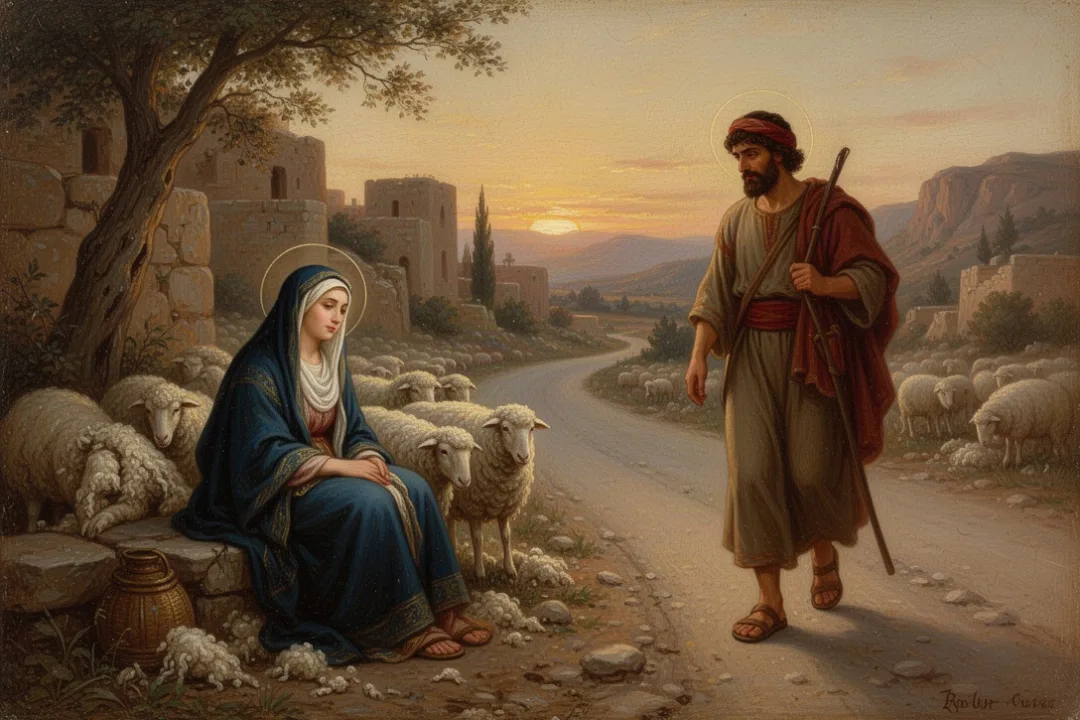
Tamar disguises herself. After Judah’s wife dies, Judah travels to Timnah for sheep shearing. Tamar covers herself and sits near the road, where Judah sees her.
Judah approaches Tamar. Because she is veiled, he does not recognize her. They negotiate a payment, and Tamar asks for Judah’s seal, cord, and staff as a pledge until he sends the promised goat.
Tamar becomes pregnant. She removes the disguise, returns home, and keeps Judah’s personal items.
Judah accuses Tamar of sexual immorality. When he hears that she is pregnant, he orders that she be brought out and punished.
Tamar reveals the evidence. She sends Judah’s seal, cord, and staff to him and asks him to identify their owner.
Judah admits his responsibility. He recognizes the items and says that Tamar is more righteous than he is because he failed to give her to Shelah.
Tamar gives birth to twins. Perez emerges first, followed by Zerah. Perez becomes the ancestor of the Davidic royal line.
The sequence matters because the story exposes a sharp contrast between Judah’s public judgment of Tamar and his private failure toward her. He is quick to condemn her but slow to admit that his own broken promise created the crisis.
Why Tamar disguises herself in Genesis 38
Tamar disguises herself because Judah has denied her the future he promised. As a widow connected to Judah’s family, she has limited power to force him to act. Her disguise enables her to confront the man responsible for her situation and obtain offspring connected to the family line.
The text does not present every aspect of Tamar’s plan as a model for ordinary conduct. Instead, it tells a story about a vulnerable woman using the limited means available to address a serious injustice. The narrative’s moral focus falls especially on Judah’s failure to keep his word and his later recognition of that failure.
Tamar also takes Judah’s seal, cord, and staff. These are not random objects. They identify him and establish his responsibility when he later tries to condemn her. Her wisdom is shown in the way she preserves evidence rather than relying on an argument that Judah could simply dismiss.
What Judah means when he says Tamar is more righteous
Judah’s statement that Tamar is more righteous than he is does not mean that every action in the encounter was morally uncomplicated. It means that Tamar had a stronger claim in the specific dispute between them. Judah had withheld Shelah from her and had failed to honor his responsibility, while Tamar acted to secure the family future she had been denied.
His admission is one of the first clear signs of moral recognition in Judah’s life. Earlier, Judah helped persuade his brothers to sell Joseph. In Genesis 38, he begins to face the consequences of his choices. Later, when Benjamin is threatened in Egypt, Judah offers himself in Benjamin’s place. His willingness to accept responsibility over Tamar’s pregnancy helps prepare the reader for that later change.
Judah does not appear to sleep with Tamar again after he recognizes her. Genesis also says that he does not have sexual relations with her afterward. The narrative therefore treats the encounter as a singular event connected to the family line, not as the beginning of a continuing relationship.
How the story relates to ancient family obligations
Genesis 38 reflects a setting in which family identity, inheritance, and descendants were deeply connected. A widow without children could face economic vulnerability and the loss of her place in her husband’s household. The responsibility to provide an heir for a deceased brother appears in several biblical passages, although the practice in Genesis 38 occurs before the later laws given to Israel.
Deuteronomy 25 describes a related practice often called levirate marriage. In that later law, a man may marry his deceased brother’s widow so that the dead brother’s name will continue. Genesis 38 should not be read as a simple copy of the Deuteronomy procedure, because the stories differ in their details and historical setting. Still, both passages show concern for a widow, a family name, and the preservation of an heir.
Onan’s wrongdoing is often discussed only in terms of his sexual act. The broader context shows that his refusal to provide offspring for his deceased brother is central. He accepts the relationship while deliberately preventing the result required by his family obligation. His action is exploitative because he benefits from the arrangement while denying Tamar and his brother’s household the future it is meant to provide.
Read the chapter in its social setting: Tamar’s vulnerability comes from widowhood, childlessness, dependence on Judah’s household, and the failure of the men responsible for her protection. Those details explain why the narrative treats Judah’s broken promise as a major offense.
Why Genesis 38 is placed inside Joseph’s story
Genesis 38 interrupts the story of Joseph, but its placement is deliberate. The chapter gives background for Judah’s character development before he becomes the brother who pleads for Benjamin. It also contrasts two forms of wrongdoing: Judah participates in selling Joseph, while Tamar exposes Judah’s own failure to act justly.
The chapter also creates a contrast between Judah and Joseph. Joseph resists sexual pressure from Potiphar’s wife in Genesis 39, while Judah willingly approaches a woman he believes is a prostitute. Their stories are not identical, and Genesis does not present Tamar as equivalent to Potiphar’s wife. The comparison helps readers see the different moral pressures surrounding each man.
Most importantly, Genesis 38 shows that the family through which Israel’s royal line will come is not presented as morally flawless. Judah’s descendants emerge through a deeply troubled household. The Bible does not hide the scandal surrounding the family. Instead, it shows responsibility acknowledged and a damaged family line continuing through God’s providence.
What Tamar’s pregnancy and the birth of the twins signify
Tamar gives birth to twins named Perez and Zerah. The birth scene repeats a familiar Genesis pattern in which the expected order is disrupted. Zerah appears to come first when a hand with a scarlet thread emerges, but Perez breaks through and is born ahead of his brother.
This reversal resembles other biblical stories in which the younger or unexpected child receives prominence. Jacob and Esau, for example, become part of a broader pattern in Genesis where birth order does not automatically determine the line through which God’s purposes continue. In Tamar’s case, Perez becomes the significant ancestor.
The birth also restores Tamar’s place in the family story. She is no longer a discarded widow waiting for a promise Judah will not keep. She becomes the mother of sons whose descendants will be named in Israel’s history. The chapter turns a situation of exclusion into a point of lasting significance.
How Tamar fits into the genealogy of Jesus
Tamar is named in Matthew 1:3 in the genealogy of Jesus. Matthew identifies Judah and Tamar as the parents of Perez and Zerah, then traces the line through Perez to King David and eventually to Jesus. This is striking because biblical genealogies often focus on male ancestors, while Matthew deliberately names several women.
The women named in Matthew’s genealogy include Tamar, Rahab, Ruth, and “the wife of Uriah,” whom the surrounding biblical story identifies as Bathsheba. Their stories involve unusual circumstances, foreign connections, sexual scandal, widowhood, or social vulnerability. Matthew’s inclusion of Tamar draws attention to God’s work through people and situations that respectable genealogies might conceal.
Matthew does not repeat the entire Genesis account, but the reference assumes that readers know Tamar’s story. Her presence in the genealogy shows that Jesus’ family line includes people marked by suffering, injustice, complicated decisions, and the need for mercy. The genealogy presents this history openly rather than pretending the line was untouched by human failure.
It is also significant that Tamar is not remembered only as an anonymous woman connected to Judah. She is named. Her action, suffering, and place in the family line are given public recognition in the Christian Scriptures.
What the story teaches about justice and responsibility
Genesis 38 presents justice as more than punishment for visible wrongdoing. Tamar is vulnerable to public condemnation because her pregnancy can be seen, while Judah’s failure to give her Shelah is less visible. The chapter exposes how easily a powerful person can judge another while ignoring the obligations that helped create the situation.
Judah’s response provides an important model of accountability. He does not claim that Tamar misunderstood him or that the evidence is irrelevant. He identifies himself as the responsible party and acknowledges that Tamar has been treated more justly than he has treated her.
Promises create obligations. Judah’s words about Shelah matter because Tamar relies on them.
Private wrongdoing can produce public harm. Judah’s hidden refusal leaves Tamar exposed to poverty and dishonor.
Evidence can protect the vulnerable. Tamar’s possession of Judah’s items prevents a false accusation from standing.
Repentance begins with truthful recognition. Judah changes direction when he admits what he has done.
Family status does not erase responsibility. Judah has authority in the household, but that authority also makes his failure more serious.
The chapter does not offer a simple rule that every person facing injustice should imitate Tamar’s exact actions. It does show why biblical interpretation should pay attention to power, vulnerability, promises, and consequences, rather than judging a scene by one isolated detail.
What the story reveals about women with little social power
Tamar has no recorded speech until the moment she sends Judah’s belongings to him. For much of the story, decisions are made about her: she is given in marriage, returned to her father’s home, and denied to Shelah. Yet she is not passive. She studies the situation, identifies the broken promise, plans carefully, and acts with precision.
Her approach is direct but controlled. She does not publicly accuse Judah before she has proof. When he orders her punishment, she does not need to make a long defense. She presents the identifying objects and lets Judah confront the truth.
This makes Tamar one of Genesis’s most memorable examples of a person who has been pushed to the edge of a household but still exercises agency. Her story does not erase her suffering. It shows her taking action within a society where the people with formal authority have failed to protect her.
Common misunderstandings about Judah and Tamar
Tamar was not Judah’s daughter-in-law in an ordinary, unrelated sense
Tamar was married first to Er and then connected to Onan through the family obligation. Judah was her father-in-law, not her husband. Genesis 38 presents the relationship as a family and inheritance crisis involving a widow who has not been given the promised place in the household.
Judah did not knowingly choose Tamar as a sexual partner
Judah believed Tamar was a prostitute because she was veiled beside the road. The narrative makes his lack of recognition central to the later discovery. His ignorance of her identity does not remove his responsibility for the encounter or for his earlier treatment of Tamar.
Tamar is not named as a prostitute by the narrator
Judah assumes she is a prostitute, and the people in the area use language associated with such a woman. Tamar’s disguise serves the plot, but the text does not identify her ordinary social status that way. The distinction matters when describing what Genesis actually says.
Judah’s statement is not a blanket approval of deception
When Judah says Tamar is more righteous, he acknowledges his comparative guilt in the matter of Shelah. He does not provide a general statement that every method used in the encounter is morally exemplary. The judgment concerns the specific injustice between them.
Genesis 38 is connected to the Joseph story
The chapter is not irrelevant background. It explains part of Judah’s development, highlights the moral disorder within Jacob’s family, and establishes the ancestry of Perez. Its position between Joseph’s sale and Joseph’s rise in Egypt gives it a clear role in the larger Genesis narrative.
How Judah changes after the story with Tamar
Judah’s development can be traced through a series of decisions. In Genesis 37, he helps arrange Joseph’s sale rather than allowing the brothers to kill him, but his compromise still leads to Joseph’s enslavement. In Genesis 38, he fails Tamar and then admits his guilt. In Genesis 44, he offers himself as a substitute for Benjamin.
That later speech is especially meaningful because Judah now understands the pain his father would suffer if Benjamin did not return. He takes responsibility for Benjamin’s safety and offers his own freedom in the younger brother’s place. The man who once participated in sacrificing a brother now risks himself to protect one.
Genesis does not say that Tamar’s confrontation alone produces Judah’s later change. It does, however, place a crucial moment of recognition in his story. Judah learns that responsibility cannot be shifted onto the vulnerable person, and that lesson becomes visible in his later defense of Benjamin.
Questions to ask when studying Genesis 38
What promises does Judah make, and which promises does he keep?
How does Tamar’s widowhood affect her choices and social position?
Why does the narrative emphasize Judah’s personal belongings?
What does Judah learn when he recognizes Tamar?
How does the birth of Perez connect this private family crisis to Israel’s royal line?
Why does Matthew include Tamar in Jesus’ genealogy?
How does Genesis 38 prepare for Judah’s speech about Benjamin in Genesis 44?
Reading the chapter with these questions keeps attention on the story’s full movement: neglect, risk, exposure, confession, and restoration of a family line. It also prevents the account from being reduced either to a scandalous episode or to an uncomplicated morality tale.
Why Judah and Tamar still matter to Bible readers
Judah and Tamar’s story matters because it refuses to separate faith from the treatment of vulnerable people. Judah belongs to the family through which Israel’s promises will continue, but his status does not excuse his failure. Tamar, who appears powerless within that family, becomes the person who forces the truth into the open.
The chapter also shows that redemption in Genesis does not require a spotless past. Judah’s family line includes betrayal, death, broken promises, and morally difficult decisions. Yet the story continues toward Perez, David, and, in Matthew’s presentation, Jesus.
For readers, the enduring lesson is not that injustice should be ignored because a good outcome eventually follows. Tamar’s suffering is real, and Judah’s conduct is condemned by his own admission. The lasting hope lies in the fact that truth can expose wrongdoing, responsibility can be acknowledged, and God can work through people whom society has overlooked.
Frequently asked questions
Was Tamar married to Judah?
No. Tamar was Judah’s daughter-in-law. She first married Judah’s son Er and later became connected to his son Onan through the family obligation to provide an heir for a deceased brother. Judah himself did not marry her. Their encounter in Genesis 38 occurs after Judah has failed to give Tamar to his youngest son, Shelah.
Did Tamar commit adultery with Judah?
The situation does not fit the ordinary biblical category of adultery because Tamar was a widow and Judah was not her husband. Judah believed she was a prostitute, while Tamar knew his identity. The passage focuses on Judah’s failure to fulfill his obligation to her and his eventual admission that she was more righteous than he was.
Why are Tamar’s twins important?
Tamar’s twins, Perez and Zerah, continue the family line after a series of deaths and failed responsibilities. Perez becomes an ancestor of King David, and Matthew includes him in the genealogy of Jesus. Their unusual birth also echoes Genesis themes in which the expected order is reversed and the less-expected child receives prominence.
Is Tamar considered a biblical example of faith?
Tamar is not directly described with the same faith language used for some other biblical figures. However, her story shows courage, intelligence, persistence, and a determination to secure justice when Judah abandons his responsibility. Matthew’s decision to name her in Jesus’ genealogy also gives her a lasting place in the biblical story of God’s purposes.









Leave a Reply