Tamar is the name of three different women in the Bible, not one person whose story appears in several forms. The first is Judah’s daughter-in-law in Genesis 38, the second is King David’s daughter in 2 Samuel 13, and the third is a daughter of Absalom mentioned in 2 Samuel 14:27.
Their experiences are very different. Genesis Tamar seeks justice after being denied her family rights; David’s daughter Tamar suffers sexual violence and its devastating aftermath; Absalom’s daughter Tamar appears briefly in the royal family record. Reading them separately prevents confusion and makes the Bible’s treatment of family power, vulnerability, and inheritance easier to understand.
The Hebrew name Tamar is commonly associated with a date palm, a tree connected with beauty, fruitfulness, and strength. The name appears in several biblical family lines, but the women who bear it are not presented as one continuous character.
Tamar, Judah’s daughter-in-law: Her story is told in Genesis 38. She becomes connected to the family line of Judah through an unusual and painful series of events.
Tamar, David’s daughter: Her story appears in 2 Samuel 13. She is the full sister of Absalom and the half-sister of Amnon, who assaults her.
Tamar, Absalom’s daughter: She is named in 2 Samuel 14:27 as one of Absalom’s children. The text gives little information about her life.
These accounts belong to different generations. The first Tamar lived before Israel’s monarchy, while the second and third belong to David’s royal household. The shared name creates a connection for readers, but the biblical text does not say that the women were related directly through the name itself.
Keep the stories separate: Genesis 38 concerns Judah’s family and Tamar’s demand for justice; 2 Samuel 13 concerns David’s daughter and the harm done to her. Combining them obscures both women’s experiences.
Tamar’s stories also show that biblical family narratives are not limited to ideal examples. They include exploitation, political calculation, silence, mourning, and unresolved damage. At the same time, they show people acting within restrictive systems, sometimes with very little protection or power.
What happens to Tamar in Genesis 38?
Genesis 38 places Tamar within the family of Judah, one of Jacob’s sons. Judah arranges for Tamar to marry his firstborn son, Er. The biblical account says that Er is wicked and dies, but it does not explain the specific nature of his wrongdoing.
Under the family custom reflected in the passage, Tamar is then given to Onan, Er’s brother. The purpose is connected with producing offspring for the deceased brother’s line. Onan refuses to fulfill that obligation, and he also dies. The text presents his conduct as wrong, but it does not describe this episode as a general medical or contraceptive teaching. Its focus is Onan’s refusal to preserve his brother’s family line and his misuse of Tamar within that arrangement.
Judah has another son, Shelah, but he does not give Shelah to Tamar. Judah tells Tamar to remain a widow until Shelah is old enough, yet he does not follow through. Tamar is left in a precarious position: she has been married into Judah’s household, but she has no husband, child, or secure future within it.
Her status matters because ancient family life was closely tied to marriage, descendants, inheritance, and protection. Judah’s delay leaves Tamar without the future he had implied. The narrative does not portray her as freely choosing an independent life; instead, it emphasizes that the family has failed to honor its responsibility to her.
How Tamar confronts Judah’s failure
When Tamar realizes that Judah is not going to give her Shelah, she changes her clothing and sits near the road where Judah is likely to pass. Judah sees her but does not recognize her. Thinking she is a sex worker, he approaches her and promises payment.
Tamar asks for a pledge until he sends the payment. Judah gives her personal items that can identify him, including his seal, cord, and staff. She becomes pregnant from the encounter and then returns to her widow’s clothing. The details are central to the story because they later establish Judah’s identity and expose the unequal standards he has applied.
When Judah hears that Tamar is pregnant, he orders that she be brought out and punished for sexual immorality. At that point, Tamar produces the items Judah left with her and says, in effect, that the owner of these objects is the father. She does not need to accuse him with a long speech. The evidence forces Judah to recognize his own responsibility.
Judah admits that Tamar is more righteous than he is because he failed to give her his son Shelah. The narrative does not portray every detail of Tamar’s action as simple or comfortable. It does, however, clearly expose Judah’s hypocrisy and his neglect of Tamar’s rights.
Why Tamar has twins and why the birth matters
Tamar gives birth to twins, Perez and Zerah. The birth scene includes a struggle between the babies, with Zerah’s hand appearing first before Perez is born. Such birth reversals occur elsewhere in Genesis, where the expected order does not always determine which child becomes prominent.
Perez becomes especially significant in later biblical genealogy. Ruth 4 traces the line from Perez through Judah’s descendants to David. The opening genealogy of Matthew also includes Tamar among the women named in Jesus’ ancestry, along with Rahab, Ruth, and the wife of Uriah. Matthew’s genealogy does not retell Genesis 38 in detail, but its inclusion of Tamar shows that her story is considered relevant to the lineage it presents.
This does not erase the painful circumstances surrounding her pregnancy. Instead, it places Tamar within a family history that the Bible treats as real and complicated. Her presence in the genealogy challenges the idea that honorable history must contain only uncomplicated stories.
What does Tamar’s story in Genesis teach about justice?
Genesis 38 is often read as a story about Tamar’s resourcefulness, but that description should not hide the limits placed on her. She acts because the men responsible for her future have failed to provide what custom and family duty require. Her strategy is risky, and the punishment threatened against her is severe.
The story’s moral center appears when Judah acknowledges his failure. Tamar is not simply treated as a problem to be removed; the person who judged her is shown to be responsible for the situation. The narrative exposes how quickly a powerful man can condemn a vulnerable woman while ignoring his own obligations.
Readers should also notice what the story does not say. It does not give Tamar a long explanation of her inner thoughts, and it does not describe a formal court proceeding. The account is brief and shaped around the family line, but its brevity does not make her situation trivial. Her vulnerability is visible through her widowhood, dependence on Judah’s decision, and exposure to punishment.
Her security depends on family commitments: Marriage and descendants are linked to her social position.
Those commitments are withheld from her: Judah postpones Shelah and leaves her waiting.
She preserves identifying evidence: The seal, cord, and staff make it possible to establish the truth.
Judah’s judgment changes: He recognizes that his own conduct is the central wrong.
Her children continue the family line: Perez becomes part of the ancestry leading to David.
Some readers describe Tamar as deceptive because she disguises herself. Others emphasize that her action is a response to deception and abandonment by the household that owed her protection. A careful reading should acknowledge the tension rather than flatten the episode into a simple rule about disguise or sexual behavior.
Reading Genesis 38 responsibly: Tamar’s story should not be used to blame victims of sexual exploitation or to suggest that people must take dangerous measures to obtain justice. The narrative describes a particular ancient family system and highlights the failure of those with power.
The chapter also complicates the role of Judah. He begins as the man who abandons Tamar’s future, but he later admits his guilt. In the larger Joseph narrative, Judah will again speak on behalf of a family member and accept personal responsibility. Genesis 38 helps readers see that his development is not detached from his earlier wrongdoing.
Who is Tamar, David’s daughter, in 2 Samuel 13?
The second Tamar belongs to a much later generation. She is the daughter of King David and the sister of Absalom. Her half-brother Amnon becomes obsessed with her and, after arranging circumstances that isolate her, sexually assaults her.
Second Samuel 13 presents Amnon’s desire as destructive rather than romantic. Before the assault, Tamar recognizes that his plan is wrong and urges him to seek a legitimate marriage arrangement if he truly wants to be with her. The passage shows her trying to prevent the attack and appealing to the legal and family structures around them.
Amnon does not listen. He overpowers her, then abruptly hates her and sends her away. The change from desire to hatred is one of the passage’s most disturbing features. Tamar is treated as an object of appetite and then as a reminder of guilt, while Amnon attempts to control the consequences of his own act.
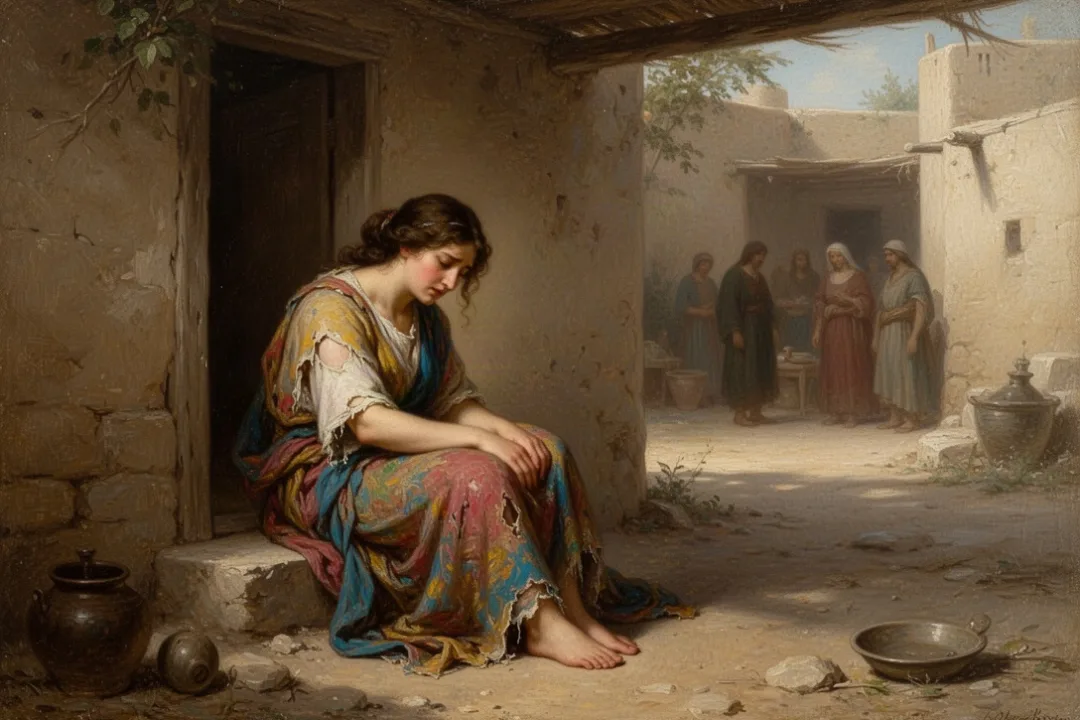
Afterward, Tamar tears her distinctive garment, places ashes on her head, and mourns openly. She also remains desolate in Absalom’s household. These actions communicate public grief, violated status, and lasting social damage. The biblical account does not present her mourning as weakness; it gives visible form to what has happened to her.
How David and Absalom respond to Tamar’s suffering
David becomes angry when he hears what happened, but the text does not show him taking effective action against Amnon. That failure is especially significant because David is both king and father. His silence leaves Tamar without the justice or protection that his authority might have provided.
Absalom tells Tamar to keep quiet and live with him. His response may reflect an attempt to protect her within the family, but it also contributes to the silence surrounding the assault. He then waits for an opportunity to take revenge on Amnon. Two years later, Absalom arranges Amnon’s death.
Absalom’s revenge does not restore Tamar’s life or undo the violence. It intensifies the crisis in David’s family and eventually contributes to Absalom’s flight and conflict with his father. The story shows how unaddressed abuse can spread through an entire household, especially when those with authority refuse to act.
It is essential not to treat Amnon’s assault as a love story, a family misunderstanding, or a consequence Tamar caused. The narrative assigns responsibility to Amnon. Tamar resists him, identifies the wrongness of his demand, and suffers after he ignores her.
Modern readers may also notice how little control Tamar has over what happens next. David does not publicly defend her, Absalom makes decisions around her, and the narrator does not record a later restoration of her household or public standing. Her silence in the later story should not be mistaken for healing.
What can Tamar’s story teach about sexual violence and silence?
Second Samuel 13 is difficult because it describes violence without offering a satisfying resolution. That difficulty is part of the text’s force. The chapter reveals not only the assault itself but also the failures that follow: anger without action, family secrecy, delayed revenge, and the absence of care centered on the survivor.
Tamar’s words before the assault show that she understands the danger clearly. She tries to reason with Amnon and points toward a lawful alternative, but his power and desire override her refusal. The account therefore provides no basis for blaming her clothing, presence, speech, or relationship to the royal family.
The passage can also help readers distinguish between justice and retaliation. Absalom’s killing of Amnon may arise from outrage over Tamar’s treatment, but it is still a private act of revenge. It does not create a safe process for Tamar or address the wider failure of David’s household.
Believe the person harmed: Tamar’s own words and visible mourning communicate the seriousness of the assault.
Place responsibility on the offender: Amnon chooses coercion and then rejects Tamar.
Do not confuse anger with protection: David’s anger produces no recorded justice for Tamar.
Recognize the cost of secrecy: Silence allows the family crisis to deepen.
Separate survivor care from revenge: Tamar needed safety, dignity, and support rather than decisions made over her.
For contemporary readers, this chapter may raise pastoral, legal, and personal questions. Anyone responding to sexual violence should prioritize immediate safety, medical care when needed, trauma-informed support, and appropriate reporting or professional help according to the situation. Biblical narratives can help name injustice, but they should never be used to pressure a survivor into silence, reconciliation, or confrontation.
Who is the third Tamar in the Bible?
The third Tamar is mentioned in 2 Samuel 14:27. She is a daughter of Absalom, David’s son and the brother of the assaulted Tamar. The verse names her alongside Absalom’s sons and describes her as beautiful, but the Bible does not provide a detailed account of her life.
Because Absalom’s daughter is named after his sister, some readers see the name as a family remembrance. The text does not explicitly explain why she receives that name, so that interpretation should remain tentative. It is reasonable to observe the connection without claiming more than the passage states.
This brief reference places Tamar’s name within David’s royal descendants. It also shows how biblical genealogical notices can preserve a person’s identity even when the narrative gives few details. Being mentioned briefly does not make this Tamar the same woman as Judah’s daughter-in-law or David’s daughter.
The family relationships can be kept clear in this sequence:
Judah’s Tamar is connected to Perez, whose line eventually leads to David.
David’s daughter Tamar is the sister of Absalom and the victim of Amnon’s assault.
Absalom’s daughter Tamar is named in the next generation of David’s family.
The third Tamar’s short appearance also encourages restraint in interpretation. The biblical text tells readers her name and family connection, but it does not give enough information to construct a full biography, personality, or theological message around her.
Why does Tamar matter in the Bible’s larger story?
Tamar matters because her name appears at several points where family identity, inheritance, and power are under pressure. Judah’s daughter-in-law becomes part of the ancestry associated with David. David’s daughter exposes the moral collapse within the king’s household. Absalom’s daughter continues the name into another royal generation.
The first Tamar is connected with the continuation of a family line after men fail to protect her position. The second is remembered in a story that condemns the abuse of power but leaves the damage painfully unresolved. Holding both accounts together shows that the Bible can preserve the survival of a lineage and the suffering of an individual without pretending they are the same kind of story.
Her inclusion in Matthew’s genealogy also deserves careful attention. Tamar is not presented as a decorative name added to an otherwise uncomplicated ancestry. Her story involves sexual vulnerability, social risk, and a confrontation with Judah’s hypocrisy. By naming her, Matthew preserves a woman whose place in the family line emerged through circumstances many readers would find troubling.
That does not mean the genealogy approves every action in Genesis 38. It means the ancestry is not sanitized. The line includes people whose lives reveal failure, exclusion, courage, and unexpected turns. Tamar’s name shows that a complicated past is not hidden from the biblical record.
For readers studying these passages, several interpretive habits are useful:
Read the chapter references before drawing connections between people with the same name.
Pay attention to who has authority and who bears the consequences of another person’s decision.
Distinguish the narrator’s description from later assumptions about motive.
Do not turn a survivor’s silence into evidence that the harm was minor.
Allow unresolved grief and injustice to remain visible rather than forcing a neat ending.
Tamar in the Bible is therefore not one simple symbol. The three women represent different experiences within family and royal structures: a widow seeking the future denied to her, a daughter harmed by a powerful relative and abandoned by her household, and a child briefly preserved in a genealogy. Their stories demand both theological reflection and careful attention to the human beings described in the text.
Frequently asked questions
Is Tamar in Genesis 38 the same person as David’s daughter?
No. They lived in different generations and belong to different family lines. Genesis 38 describes Tamar as Judah’s daughter-in-law, while 2 Samuel 13 describes Tamar as David’s daughter and Absalom’s sister. The shared name is the main connection between them, although both stories involve questions of family duty, vulnerability, and the consequences of male power.
What does the name Tamar mean?
Tamar is generally associated with the date palm. Biblical names can carry symbolic associations, but the passages do not always explain why a particular child received a name. In the case of Absalom’s daughter, the text simply records her name and family connection. Readers should avoid treating the meaning of the name as a complete interpretation of each woman’s story.
Was Tamar wrong to disguise herself in Genesis 38?
Genesis 38 presents her disguise within a situation created by Judah’s failure to give her Shelah. The narrative ultimately condemns Judah’s hypocrisy and has him admit that Tamar was more righteous than he was. It does not provide a universal instruction to use deception, and it should not be used to justify blaming people who experience sexual exploitation or coercion.
Does the Bible say what happened to David’s daughter Tamar afterward?
No. Second Samuel 13 says that she lived desolate in the house of her brother Absalom, but it does not record a later marriage, recovery, or public restoration. That silence is part of the tragedy of the account. Readers should not assume that the absence of later details means the assault had no lasting effect.











Leave a Reply