The house of Israel is a biblical name for the people descended from Jacob, whose name God changed to Israel. Depending on the passage, it can refer to all twelve tribes, the northern kingdom after Israel divided, or the covenant community addressed by Israel’s prophets.
Understanding the phrase requires attention to context, history, and audience. “House” does not usually mean a building. It means a family, dynasty, tribe, or people connected by ancestry and shared allegiance. A passage using the term may be discussing Jacob’s descendants as a whole, the kingdom called Israel, or a future restoration promised by God.
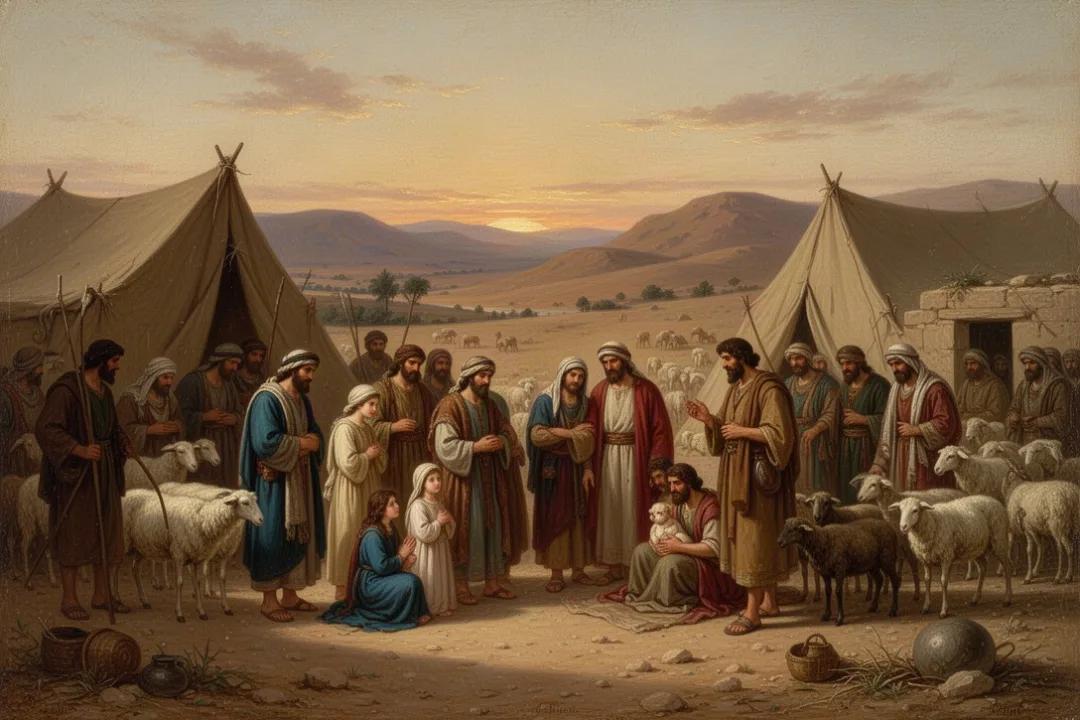
The phrase begins with Jacob, the grandson of Abraham and son of Isaac. In Genesis 32, Jacob receives the name Israel after wrestling through a night of struggle with a divine figure. The name Israel becomes attached not only to Jacob personally but also to his children and their descendants.
Jacob’s twelve sons become the ancestors of the twelve tribes of Israel. Their names are Reuben, Simeon, Levi, Judah, Dan, Naphtali, Gad, Asher, Issachar, Zebulun, Joseph, and Benjamin. In later tribal lists, Joseph may be represented through his sons Ephraim and Manasseh, while Levi may be treated separately because of its priestly responsibilities. As a result, the exact list can vary according to the passage’s purpose.
The word “house” often describes a connected family or people. Scripture uses similar language for the house of David, the house of Aaron, and the house of Judah. Thus, “house of Israel” can mean the extended family of Jacob, the nation formed by that family, or the people living within Israel’s covenant relationship with God.
Some passages use the phrase broadly. For example, Exodus describes God bringing the house of Israel out of Egypt, meaning the people liberated from slavery under Moses. Other passages use it in a narrower political sense, especially after the nation divides into two kingdoms.
Reading tip: When you see “house of Israel,” first ask who is being addressed, where the passage occurs in Israel’s history, and whether the surrounding verses mention Judah, Ephraim, Samaria, Jerusalem, or the twelve tribes.
How Israel became a people and a covenant nation
The story of the house of Israel develops through several biblical covenants. God promises Abraham that his family will become a great people and that other nations will be blessed through him; these themes appear throughout Genesis. The promises are carried through Isaac and Jacob, rather than ending with one generation.
Jacob’s family grows in Egypt, where the descendants of Israel eventually become an enslaved population. The book of Exodus presents their rescue under Moses as a defining event. God brings the people out of Egypt, establishes a covenant with them at Sinai, and gives them laws governing worship, justice, community life, and treatment of vulnerable people.
The covenant helps explain why biblical writers speak of Israel as more than an ethnic group. The house of Israel is also a people with a calling. Israel is expected to worship the God who rescued them, practice faithfulness, and live as a distinct community among the nations.
That calling does not mean every individual member behaves faithfully. The Hebrew Bible repeatedly describes Israel’s disobedience, idolatry, injustice, and reliance on foreign powers. The prophets can accuse the house of Israel while still affirming God’s continuing relationship with the people.
Israel’s national story includes these major stages:
Patriarchal family: Jacob and his descendants form the ancestral house of Israel.
Exodus and covenant: the tribes are brought out of Egypt and bound together under Moses.
Settlement in the land: the tribes receive territories, though their political unity is uneven.
United monarchy: Saul, David, and Solomon rule over a largely united kingdom.
Divided monarchy: Israel and Judah become separate kingdoms after Solomon’s reign.
The phrase therefore carries both family meaning and national meaning. It can point backward to Jacob’s household, outward to the twelve tribes, or forward to the people’s responsibilities under the covenant.
Why the Bible distinguishes Israel from Judah
After Solomon’s reign, the kingdom divides. The northern tribes form the kingdom commonly called Israel, with Samaria as its capital in the later period. The southern kingdom is called Judah and includes Jerusalem. Benjamin is closely associated with Judah, while the Levites are scattered among the tribes for religious service.
From this point, “Israel” can have two meanings. It may still refer to the entire people descended from Jacob, or it may refer specifically to the northern kingdom. The surrounding context determines which meaning is intended.
Prophetic books often address “the house of Israel” and “the house of Judah” separately. This wording reflects the political division but also points to a shared ancestry. The two kingdoms are not unrelated nations; they are divided branches of the same larger people.
The northern kingdom falls to the Assyrian Empire in the eighth century BCE. Many inhabitants are deported, while others remain in the land or move elsewhere. The southern kingdom survives longer and is later conquered by Babylon, leading to the exile of many Judeans.
These events create the background for prophetic promises about restoration and reunion. Prophets do not always treat the northern tribes as permanently erased. Some envision God gathering dispersed Israelites, healing the division between Israel and Judah, and bringing the people back into faithful covenant life.
What “the ten lost tribes” means
The expression “ten lost tribes” comes from the northern kingdom’s conquest and the uncertainty surrounding the later locations and identities of many northern Israelites. The Bible records deportations and population movements, but it does not provide a complete modern census showing what happened to every family.
Some northern Israelites likely remained in the land, migrated south, joined the kingdom of Judah, or became part of communities elsewhere. The phrase “lost tribes” therefore should not automatically mean that every member vanished or that no descendants could remain identifiable.
Later Jewish and Christian traditions have proposed many theories about the tribes’ survival. Those theories vary widely and often go beyond what the biblical texts themselves establish. Claims that a modern ethnic or national group definitely represents one of the tribes should be evaluated carefully rather than treated as settled biblical fact.
The biblical emphasis is frequently theological rather than genealogical: God knows and can restore a dispersed people, even when human beings no longer possess complete records of ancestry.
How the prophets use the house of Israel
The prophets use “house of Israel” in several related ways. They may confront the people over idolatry, injustice, violence, false worship, and broken promises. They may also announce judgment through invasion, exile, famine, or political collapse. In both cases, the phrase identifies a community accountable to God.
Ezekiel addresses the house of Israel while the people are living in exile. His messages describe a nation that has become spiritually unfaithful, yet they also include promises of renewal. In Ezekiel 36, restoration involves cleansing, a new heart, and a new spirit. The focus is not merely the return to territory; it includes changed conduct and renewed relationship with God.
Ezekiel 37 uses the image of two pieces of wood to represent Judah and Joseph, associated with the southern and northern parts of the divided people. The symbolic action points toward reunification under one king. This passage is one of the clearest biblical pictures of the house of Israel as a people fractured by history but promised a future restoration.
Jeremiah also speaks about the house of Israel and the house of Judah. In Jeremiah 31, the prophet announces a new covenant that will differ from the covenant made when Israel came out of Egypt. The promise emphasizes God’s law written within the people and a restored relationship in which they know God.
Hosea frequently addresses the northern kingdom through names such as Ephraim and Israel. His marriage imagery portrays the covenant as a relationship damaged by unfaithfulness, while the book also speaks of compassion and restoration. Amos condemns the northern kingdom’s religious hypocrisy and exploitation of the poor, showing that worship cannot be separated from justice.
These prophetic uses reveal an important tension:
Israel is judged for violating the covenant and harming others.
Israel is remembered as the people connected to God’s earlier promises.
Israel is invited to return through repentance and renewed loyalty.
Israel is promised restoration in passages that look beyond immediate judgment.
The prophets therefore do not use the name merely as a neutral label. “House of Israel” carries a history of election, responsibility, failure, judgment, mercy, and hope.
How the New Testament refers to the house of Israel
The New Testament continues to use Israel as a biblical and historical term. Jesus is born within the people of Israel, and the Gospel narratives place his life within Israel’s Scriptures, covenant story, worship, and hopes for restoration.
In Matthew 10 and Matthew 15, Jesus describes a mission directed first toward the “lost sheep” of Israel. These passages present his ministry as connected to Israel’s covenant story. They do not erase the later mission to non-Jewish nations; rather, they show an order in which Israel receives a particular place in the Gospel narrative before the message expands more broadly.
In Acts 2, Peter addresses the “whole house of Israel” after the events of Pentecost. The expression identifies his audience as the Jewish people gathered in Jerusalem. His speech interprets Jesus through Israel’s Scriptures and calls the hearers to respond to what God has done.
The book of Hebrews refers to Jeremiah’s promise of a new covenant with the house of Israel and the house of Judah. Hebrews 8 does not present the phrase as a random national slogan. It uses the prophetic promise to explain a covenant arrangement centered on inward transformation and forgiveness.
Paul’s letters also distinguish Israel, Gentiles, and the church in different contexts. Romans 9–11 discusses Israel’s historical privileges, unbelief, Gentile inclusion, and God’s continuing purposes. Interpretations of these chapters differ among Christians, particularly over how Israel relates to the church and to future biblical promises.
Galatians 6:16 includes the expression “Israel of God,” which has generated different readings. Some interpreters understand it as referring to Jewish believers in Jesus, others to the whole community shaped by faith in Christ, and others to a particular group within the churches. The verse should not be used casually to settle every question about Israel, the Jewish people, or the church.
Revelation 7 lists tribes associated with Israel among a vast redeemed multitude. The tribal list differs from several Old Testament lists, which reminds readers that biblical tribal names can serve theological and symbolic purposes as well as genealogical ones.
Interpretive caution: Christian traditions differ on how Old Testament promises to the house of Israel relate to the church, the Jewish people, and the future. A responsible reading should distinguish what a passage explicitly says from later theological conclusions.
How the house of Israel relates to Jewish identity today
The biblical house of Israel is foundational to Jewish history, Scripture, memory, and identity. Jewish peoplehood includes ancestry, religious tradition, communal belonging, and a shared historical story. These dimensions do not always fit neatly into a modern category such as nationality or genetics.
The term should not be treated as a simple test of biological descent. Ancient tribal records were disrupted by conquest, exile, migration, intermarriage, and changes in political boundaries. Many Jewish people identify with Israel as a people through family history and religious tradition without claiming membership in a specifically documented tribe.
Judaism also preserves distinctions among Jewish identity, priestly descent, and tribal heritage. Some families maintain traditions of being Cohanim, descendants associated with the priestly line, or Levites. Such traditions are meaningful within Jewish communities, although they do not provide a complete public map of all twelve tribes.
The modern State of Israel shares the biblical name and is deeply connected to Jewish history, but the terms are not identical. Biblical Israel refers to an ancient people and its covenantal story; the modern state is a contemporary political nation established in the twentieth century. The two are related in history and identity, yet they should not be automatically equated in every biblical interpretation.
Likewise, “house of Israel” should not be used as a substitute for every use of “Jew.” In some biblical periods, “Jew” is connected especially with Judah or Judea, while “Israel” can refer to the broader people or specifically to the northern kingdom. The meanings shift across centuries and passages.
How to interpret a passage about the house of Israel
A careful reading can prevent many common misunderstandings. Start by identifying whether the passage is from the patriarchal period, the united monarchy, the divided kingdom, the exile, the post-exilic period, or the New Testament.
Read the surrounding verses. Look for references to Judah, Ephraim, Samaria, Jerusalem, exile, tribes, kings, or Gentiles.
Identify the speaker and audience. A prophet speaking to exiles may use the phrase differently from a Gospel writer addressing Jewish listeners.
Determine whether “Israel” is broad or narrow. It may mean Jacob’s descendants as a whole or the northern kingdom in contrast with Judah.
Separate history from prophecy. A passage may describe a past political event, announce judgment, or promise a future restoration.
Compare related passages. References in Genesis, Exodus, Kings, the prophets, the Gospels, Acts, Romans, and Hebrews can clarify how the phrase is being used.
Avoid forcing one meaning everywhere. The same words can carry different scopes in different books and periods.
Several questions are especially useful when studying the phrase:
Is the passage discussing ancestry, national territory, covenant responsibility, or future hope?
Does “house” describe a family line, a political kingdom, or a worshiping community?
Is the writer contrasting the house of Israel with the house of Judah?
Does the passage include non-Israelite peoples, and if so, how?
Is the text describing what happened, criticizing what is wrong, or promising what God will do?
These questions help preserve the phrase’s full meaning. The house of Israel is not only a reference to an ancient population. It is a name shaped by the story of Jacob, the twelve tribes, the exodus, the covenant, the divided kingdoms, exile, prophetic judgment, and hopes of renewal.
What the phrase does and does not establish
The phrase clearly establishes a connection with Jacob and the people of Israel. It can identify the nation as a covenant community and, in some settings, the northern kingdom. It also appears in promises concerning Israel’s restoration and relationship with God.
It does not, by itself, identify a modern political position, prove the ancestry of a particular contemporary group, or settle debates among Christian traditions. Those claims require additional evidence and interpretation.
It also does not imply that every biblical reference has the same scope. A verse about the northern kingdom should not automatically be applied to all twelve tribes, and a promise addressed to the whole covenant people should not automatically be reduced to the population of Samaria.
The most reliable approach is both historical and literary: read the phrase in its own passage, locate it within Israel’s changing history, and recognize how biblical writers use it to speak about identity, accountability, judgment, mercy, and restoration.
Frequently asked questions
Is the house of Israel the same as the twelve tribes of Israel?
Often, but not always. “House of Israel” can refer broadly to all twelve tribes descended from Jacob. In other passages, especially those written after the kingdom divided, “Israel” means the northern kingdom rather than the entire people. The surrounding references to Judah, Ephraim, Samaria, Jerusalem, or exile show which meaning is most likely.
Why is Israel sometimes distinguished from Judah in the Bible?
After Solomon’s reign, the nation divided into a northern kingdom called Israel and a southern kingdom called Judah. Biblical writers continued to use “Israel” broadly in some contexts, but they also used it narrowly for the northern kingdom. Prophets often name both Israel and Judah to acknowledge their political separation while emphasizing their shared ancestry.
Are the ten lost tribes completely unknown?
The Bible records the Assyrian conquest and deportation of the northern kingdom, but it does not provide a complete account of every person’s later identity or location. Some people likely remained, migrated, joined Judah, or became part of communities elsewhere. Later theories about specific modern groups go beyond what the biblical record conclusively establishes.
Does the house of Israel mean the modern country of Israel?
Not exactly. The biblical phrase refers to an ancient people, their tribal history, and their covenant relationship with God. The modern State of Israel is a contemporary political nation with historical and cultural connections to biblical Israel, but the two terms should not be treated as interchangeable in every passage or theological argument.








Leave a Reply