Names of God & Their Meanings: A Comprehensive Guide
Names of God & Their Meanings: A Comprehensive Guide
Names of God carry profound significance across cultures and faiths. They are more than labels; they are windows into divine relationship, attributes, and mystery. In this comprehensive guide, we explore how different traditions name the divine, what those names mean, and how believers use and encounter these names in prayer, liturgy, and daily life. The aim is to illuminate the semantic breadth of names of God while honoring the reverence with which they are held in different spiritual communities.
Across civilizations, people have sought to articulate the unlimited in finite words. Names of God function as conceptual anchors, offering facets of the divine that can be approached through devotion, contemplation, and ethical living. Some names emphasize relationship—Creator, Parent, Shepherd—while others highlight power, mercy, or transcendence. Still others point to the divine mystery beyond all description. In this overview, we sketch the common purposes of divine names, before diving into regional and religious traditions in detail.
Relationship and address: Many names are forms of address that signal a specific kind of relationship, such as Father, Lord, or Friend. These names invite trust, care, and accountability.
Attributes and deeds: Names often encode attributes like mercy (compassion), justice, wisdom, or sovereignty, reminding believers of how the divine relates to the world.
Liturgical use: Prayer and ritual frequently employ certain names to invoke blessings, protection, or guidance.
Cultural and linguistic context: Names reflect linguistic family, historical development, and local devotion, creating a tapestry of sacred language.
Mystery and transcendence: Some names point to the unknowable core of God, inviting humility and wonder.
In all traditions, careful naming respects both reverence and scholarly understanding. The following sections explore major traditions and their distinctive naming practices, while offering representative lists of key names and their meanings.
Judaism: Sacred Names and Their Meanings
In Judaism, the divine name carries extraordinary sanctity. The most famous is the Tetragrammaton, the four Hebrew letters YHWH, traditionally regarded as ineffable by observant Jews. Other names express attributes or roles of God in Scripture and liturgy.
Origin, meaning, and usage
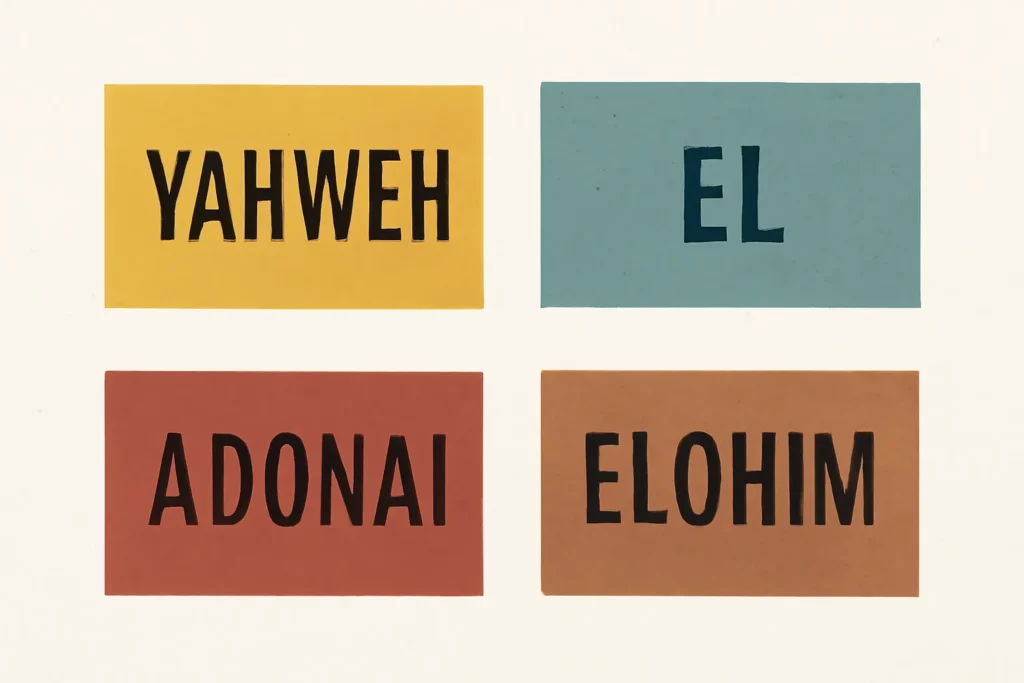
YHWH (the Tetragrammaton): often rendered as Yahweh or traditionally translated as the LORD in English Bibles. The exact pronunciation is considered sacred and is traditionally not spoken aloud in Jewish liturgy; instead, readers say Adonai or Hashem when encountering the divine name in Scripture. The underlying sense is a verb form related to to be, pointing to mystery, self-existence, and eternal presence.
Elohim: a grammatically plural form used throughout Genesis and elsewhere, often understood as a plural of majesty or as a reference to the composite fullness of divine power. In Jewish reading, Elohim is usually matched with singular verbs and is associated with the Creator’s justice and sovereignty.
Adonai: literally “my Lords,” used in prayer as the spoken substitute for the divine name. It conveys a personal, covenantal relationship and reverent address.
El Shaddai: commonly translated as God Almighty, emphasizing divine sufficiency, protection, and nourishment for the People.
El Elyon: “God Most High,” highlighting sovereignty and universal kingship beyond earthly rulers.
El Olam: “Everlasting God,” pointing to eternity and enduring covenantal faithfulness.
YHVH-Rapha (often seen as a compound name, “the Lord who heals”): emphasizes healing, restoration, and care for body and spirit.
Names in liturgy and scripture
Hashem (“the Name”): a common liturgical substitute for the divine name in conversation and study.
Ha-Kadosh, Baruch Hu (the Holy One, Blessed be He): reverential phrases used in prayer and blessing.
El Shaddai” and YHWH appear in Scripture with various thematic emphases—covenant, blessing, and redemption—woven into the biblical narrative.
Important note: In Jewish tradition, the use of the divine name is governed by long-standing reverence, with names occasionally evoked through scriptural reading, blessing, and prayer. The names themselves convey a spectrum of qualities—from power and sovereignty to mercy and healing—reflecting the depth of the divine-human relationship in Jewish life.
Christianity: Names of God in Scripture and Worship
Christian theology often uses a broader set of divine names that arise from Old and New Testament revelation, including titles for Christ and the Holy Spirit. While Christology centers on the person of Jesus, the biblical text also preserves ancient names for God the Father and descriptive titles for the Triune God.
Yahweh or Jehovah: a vocalization tradition of the divine name in Christian Bibles, often underscored with the meaning “the Lord” or “the self-existent one” and tied to God’s historic faithfulness to Israel and the church.
Abba: an intimate Aramaic term meaning Father, expressing childlike trust and personal relationship with God.
El Shaddai: “God Almighty,” reinforcing God’s capacity to bless and sustain believers through every circumstance.
El Elyon: “God Most High,” signifying sovereignty over all powers and realms.
Adonai: a respectful substitute for YHWH in worship, emphasizing Lordship and covenant relationship.
Jesus (the Greek form of Yeshua): meaning “the Lord saves” or “salvation of the Lord,” central to Christian faith as the incarnate Son and savior.
Logos (“Word”): a Greek term in the Gospel of John describing Jesus as the divine Logos through whom all things were made and who reveals God to humanity.
Paraclete (Comforter/Advocate): a New Testament designation for the Holy Spirit, guiding, teaching, and comforting believers.
Holy Spirit (Paraclete, Spirit of Truth): the third person of the Trinity, associated with empowerment, sanctification, and presence.
Names tied to attributes and roles
Jehovah-Jireh (“The Lord Will Provide”): inspired by Genesis 22, highlighting God’s provision in times of need.
Jehovah-Rophe (“The Lord who Heals”): speaks to physical and spiritual healing.
Jehovah-Nissi (“The Lord is My Banner”): symbolizing victory and divine protection in battle or struggle.
Jehovah-Shalom (“The Lord is Peace”): underscoring peace that passes human understanding.
In Christian practice, these names appear in prayers, hymns, creeds, and sacraments. The names also reflect the multifaceted understanding of God as Father, Son, and Spirit, celebrated in worship across denominations. In sacred music and liturgy, the divine name serves as a doorway to contemplation of Christ’s work, the Spirit’s presence, and the Father’s steadfast love.
Islam: The One God and His Names
In Islam, the fundamental creed centers on Allah, the Arabic term for “the God.” The monotheistic emphasis is complemented by the 99 Names of Allah (Asma’ul Husna), each expressing a divine attribute. These names invite Muslims to reflect on God’s perfection and to model moral behavior in light of divine attributes.
Representative names and meanings
Allah: The One God, the absolute, unique, and indivisible Creator and Sustainer of all that exists.
Ar-Rahman: “The Most Merciful,” the expansive mercy that encompasses all beings.
Ar-Rahim: “The Most Compassionate,” a closely related attribute emphasizing ongoing care and forgiveness for believers.
Al-Malik: “The King,” sovereign ruler of the universe.
Al-Quddus: “The Holy,” free from any deficiency or imperfection.
As-Salam: “The Source of Peace,” the one who grants safety and harmony.
Al-Mu’min: “The Guarantor of Faith,” who protects and sustains trust and integrity.
Al-Aziz: “The Mighty,” a symbol of irresistible power and majesty.
Al-Khabir: “The All-Aware,” knowledge of all things, seen and unseen.
Al-Hakam: “The Judge,” God’s perfect justice and decree.
Al-Wadud: “The Loving,” affectionate and caring toward creation.
Ar-Razzaq: “The Provider,” who sustains all creatures.
Understanding the Asma’ul Husna is often a devotional practice: Muslims may recite a name during prayer, reflect on its meaning, and seek to emulate the attribute in daily conduct—mercy, justice, patience, gratitude, and humility. The names are not merely labels; they form a framework for ethical living, worship, and contemplation of divine presence in the world.
Hinduism: Names of God Across Paths and Manifestations
Hindu devotional life embraces a rich plurality of divine names and forms. The same ultimate reality, often called Brahman or Paramatma, is approached through countless manifestations, names, and attributes. Some names highlight personal forms and avatars, while others point to the abstract, formless principle.
Names reflecting form, avatar, and cosmic function
Vishnu, Vāsudeva, Nārāyaṇa: names associated with the preserver aspect of the cosmos, often worshipped as the all-pervasive, benevolent Lord who sustains creation.
Krishna, Govinda, Hari: beloved forms of the divine who reveal beauty, mischief, and intimate relationship with devotees. These names are central to bhakti traditions.
Rāma, Ramacandra: hero of the epic Ramayana, emblematic of dharma (righteous duty) and virtuous leadership.
Shiva, Mahādeva, Bhava: the destroyer and regenerating force within the trimura (triple powers), often associated with asceticism, transformation, and cosmic cycles.
Shakti or Devi: the feminine principle of power and dynamism, revered as Parvati, Durga, Lakshmi, Kali, and Saraswati in various temples and liturgies.
Om (Aum): a sacred syllable representing the primordial sound and essence of the universe, used in meditation and mantra practice as a doorway to the ultimate reality beyond form.
Names for philosophical and devotional dimensions
Isvara: a respectful designation for a personal god who governs, loves, and cares for creation.
Paramātmā: “Supreme Self” within all beings, a unifying presence that pervades the cosmos.
Rudra or Mahā-Rudra: a fierce, transformative aspect of the divine associated with cosmic dissolution and renewal.
In practice, Hindu devotion often centers on a chosen form (ishta) and its name, but many traditions also honor the idea of a single Absolute reality with innumerable manifestations. This allows for both personal relationship with a beloved form and reverence for the impersonal, all-encompassing principle that undergirds the universe.
Sikhism: Waheguru and the Divine Name
Sikh spiritual life centers on the Name of God and the Creator’s presence in all beings. The language of devotion often emphasizes reciprocal relationship with Waheguru, the name by which many Sikhs approach the divine with awe, love, and dedication.
Central names and their practical meanings
Waheguru: commonly translated as Wonderful Teacher or Wonderful Lord, this name invites seekers to contemplate the divine mystery and attain spiritual awakening through remembrance of the divine name.
Ek Onkar: “One Creator,” a foundational expression in the Sikh scriptural tradition signaling monotheism and the unity of all existence.
Akal Purakh: “Timeless Being” or “Infinite Reality,” referring to the unchanging, eternal nature of God beyond time and space.
Nam or Naam: the personal devotional practice of remembering and repeating God’s name as a path to spiritual perfection.
In Sikh practice, the emphasis is on remembrance (simran), service (seva), and community (sangat). The sacred names are used in prayer and hymn, inviting adherents to align their thoughts, actions, and heart with the divine will and to perceive God’s presence in every moment.
Other Traditions: Additional Voices and Perspectives
Beyond the major world religions, many spiritual communities articulate their own lists of divine names and attributes. The basic pattern across these voices is to articulate relationship, sovereignty, mercy, wisdom, and transcendence in words that believers can utter, meditate upon, or chant.
Baha'i Faith: Names of God as Attributes
God: The ultimate, unknowable source of all existence; names and attributes of God are used to describe aspects of the divine presence while recognizing that God’s essence remains beyond full human comprehension.
Names and attributes in Baha’i writings: The Faith often speaks of optimistic attributes such as mercy, justice, unity, and wisdom as divine qualities that believers strive to reflect in their own lives, acknowledging that these are reflections of God’s nature in creation.
In Baha’i thought, the divine names function as a bridge between God and humanity. Names are not separate gods but attributes through which God relates to the world. The goal is to imitate these attributes while recognizing the ultimate unity of the divine Source.
Cross-Tradition Themes: How Names Shape Practice and Belief
Though the names differ across traditions, several common threads recur, offering a map for understanding their meaning and use:
Relationship: Names often address God in ways that express closeness, dependence, or covenantal bond—Father, Lord, Friend, Creator, Teacher.
Attributes: Names encode core divine characteristics such as mercy, justice, wisdom, power, and compassion.
Cosmic function: Some names identify God as Creator, Sustainer, Preserver, Judge, or Destroyer—roles that reveal the order of the cosmos and humanity’s place within it.
Invocation and practice: Names are recited in prayers, meditations, liturgies, hymns, and rituals to invite divine presence and guidance.
Transcendence and mystery: Even as names reveal aspects of God, they also humble worshipers by pointing to God’s inexhaustible mystery.
Practical Guide: How to Engage with Divine Names
Whether you are reading sacred texts, praying, or meditating, here are practical approaches to engaging with the divine names in a respectful, meaningful way:
Study with context: Learn the linguistic roots, historical setting, and theological nuance behind each name. Names are often polysemous and carry layers of meaning that become clear through study.
Cross-reference scriptures and prayers: See how names are used across different books, prayers, and liturgies to appreciate the breadth of meaning and purpose.
Use reverent speech: In many traditions, certain names are considered too sacred for casual speech. Follow community norms and liturgical practice to maintain reverence.
Contemplative repetition: Mantra-like repetition of names (e.g., Waheguru, Om, or Allah) can cultivate focus and a sense of divine nearness, while avoiding mere mechanical recitation.
Ethical living as response: Names point to divine attributes; living in a way that reflects mercy, justice, peace, and compassion is a form of honoring the divine name in daily life.
Scholars and practitioners often emphasize humility when approaching the divine names. Names are a map, not the territory itself. By engaging with them faithfully, believers seek to cultivate virtue, wisdom, and a deeper sense of God’s presence in the world.
Common Misunderstandings and Clarifications
Names of God are meaningful but can be sources of confusion if not read in their religious context. Here are a few clarifications to help prevent misinterpretation:
Names are not separate deities: In monotheistic traditions, names reveal attributes of a single divine reality rather than multiple independent gods.
Pronunciation matters: In some traditions, the exact vocalization of certain names is reserved for particular religious leaders or contexts; respectful usage is advised.
Historical development: Names evolve with language, culture, and theology. What a name means in ancient texts may carry nuanced, modern interpretations in contemporary practice.
Context is essential: A name’s meaning can shift depending on whether it is used in creation, mercy, judgment, or union with God in prayer.
Conclusion: The Living Ties That Bind Names to Devotion
Names of God are a linguistic and spiritual bridge across time, culture, and tradition. From the Tetragrammaton in ancient Hebrew to Waheguru in the Punjabi spiritual tradition, from the 99 divine attributes of Allah to the many forms of the divine in Hindu devotion, these names invite believers to contemplate the breadth and depth of the sacred. They remind us that the divine cannot be fully captured in a single title, yet the act of naming—addressing, meditating on, and reverently speaking—opens a doorway to encounter, trust, and transformation.
Whether you are a student of comparative religion, a person of faith seeking deeper prayer, or simply curious about world spirituality, the study of names of God offers a rich linguistic, theological, and devotional landscape. The diversity of names across traditions attests to humanity’s universal longing to know the divine—to name it, to approach it, and to live in light of its presence in every moment of existence.










Leave a Reply