Nelson's Illustrated Bible Dictionary: how to use it
Nelson's Illustrated Bible Dictionary: how to use it
You are reading a Bible passage and come across a place, object, or religious term you do not recognize. A quick search may produce several definitions, but you want something grounded in Scripture and historical context. Nelson's Illustrated Bible Dictionary is designed for that kind of question: it explains biblical words, people, places, customs, and ideas in a reference format that is usually faster to consult than a full commentary.
The book is associated with Thomas Nelson and has been published in more than one edition or format. Exact contents can therefore vary, but its central purpose remains consistent: to help readers understand the background and meaning of biblical terms. Its illustrations and reference features make it useful for personal study, teaching, sermon preparation, and general Bible reading.
What Nelson’s Illustrated Bible Dictionary is designed to do
A Bible dictionary is an alphabetical reference work, not a regular dictionary of modern English. Its entries focus on the language and world of the Bible. Depending on the edition, Nelson's Illustrated Bible Dictionary may cover names, places, objects, plants, animals, theological concepts, historical settings, cultural practices, and important events.
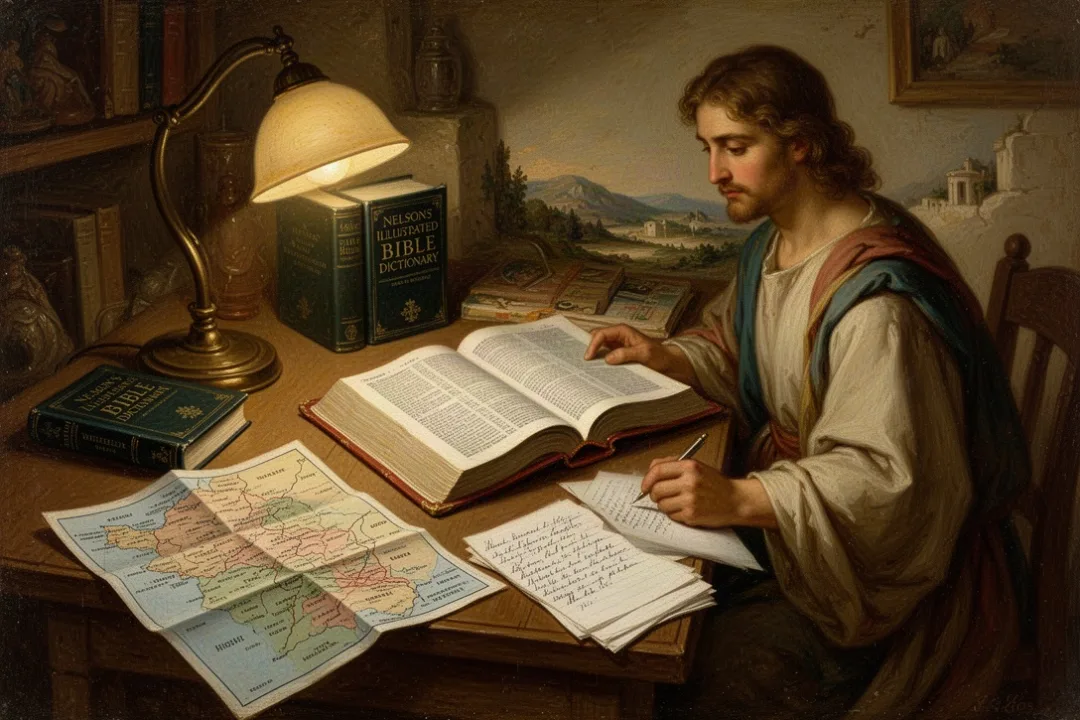
The “illustrated” part matters because visual information can clarify subjects that are difficult to picture from words alone. Maps may help you follow a journey, diagrams may show an ancient object, and photographs or artwork may provide a sense of geography, architecture, clothing, or daily life. These resources support the definitions; they do not replace the biblical text.
The dictionary is also different from a concordance. A concordance helps you locate every occurrence of a word in a particular Bible translation. A Bible dictionary explains a subject. If you need to know where a term appears, use a concordance or search tool; if you need to understand what the term refers to, consult the dictionary.
Best use: Read the relevant Bible passage first, then use the dictionary to clarify unfamiliar terms and historical details. The entry should add context to the passage rather than become a substitute for reading it.
How to use Nelson’s Illustrated Bible Dictionary step by step
A reference book becomes more useful when you approach it with a specific question. These steps help you avoid opening an entry at random and losing sight of the passage you are studying.
Read the passage in context. Read several verses before and after the term. Notice whether it refers to a person, location, object, action, or idea.
Write down the exact question. You might ask, “What was a synagogue?” “Where was Moab?” or “Why does this passage mention hyssop?” A focused question leads to a more useful lookup.
Check alternate forms of the word. Names can have different spellings in English, and a person may be listed by a title, family connection, or place of origin. Look for cross-references when the first search does not work.
Read the entire entry. Definitions often include several meanings, Bible references, related names, and historical notes. The first sentence may not answer the particular question raised by your passage.
Study the accompanying visual material. Use maps, diagrams, and illustrations to connect the description with a physical setting or object.
Return to the Bible text. Ask how the new information affects your understanding of the passage. Keep interpretations tied to what the text actually says.
Confirm significant conclusions. For difficult theological, historical, or translation questions, compare the entry with a trusted commentary, study Bible, or another reference work.
This method works for a short devotional reading as well as a detailed study. You do not need to research every name or place. Choose details that help explain the passage’s message, setting, or imagery.
What kinds of entries you can find
The range of subjects is one of the main reasons readers choose an illustrated Bible dictionary. A single passage can lead to several kinds of entries, and each type answers a different question.
People: Entries may identify biblical figures, summarize their role, and point you toward passages where they appear.
Places: Geographic entries can describe cities, regions, rivers, mountains, nations, and sites connected with major events.
Objects: Items such as lamps, altars, scrolls, musical instruments, weapons, and household tools may receive explanations of their use.
Customs and daily life: Information about meals, marriage, mourning, clothing, agriculture, worship, and hospitality can make unfamiliar scenes easier to understand.
Religious terms: Words connected with sacrifice, covenant, priesthood, prayer, sin, holiness, redemption, and worship may be explained in biblical context.
Natural subjects: Plants, animals, weather, farming, and landscape features often appear because they are used directly or figuratively in Scripture.
Historical and cultural subjects: Entries may discuss empires, occupations, political structures, writing practices, and surrounding peoples.
Major events and themes: Some editions include broader entries that bring together references to important events, doctrines, or biblical themes.
Not every entry will have the same depth. A short entry may simply identify a minor person or object, while a major theological or historical subject may receive several paragraphs and supporting references. The amount of space does not necessarily indicate how important the subject is to Christian faith; alphabetical reference works must also cover many small details.
Why the illustrations and maps are useful
Words such as “ephod,” “censer,” “city gate,” or “shekel” can remain abstract even after you read a definition. An illustration gives you a visual framework. It can show the shape of an object, the arrangement of a structure, or the relative position of places mentioned in a narrative.
Maps are especially helpful when studying journeys and political boundaries. They can help you follow the movement of Abraham’s family, Israel’s history, the exiles, Jesus’ ministry, or Paul’s travels. A map does not answer every historical question, but it can reveal distances, neighboring regions, and geographic obstacles that are easy to miss when you read only the names.
Visual material should still be treated as an aid rather than absolute proof. Ancient sites, objects, and clothing are sometimes reconstructed from incomplete evidence. An illustration may represent a plausible appearance, while a map may simplify changing borders across different periods. Use the image to form a clearer picture, then read the entry’s explanation and references carefully.
How the dictionary helps with Bible geography
Place names are among the most practical reasons to consult a Bible dictionary. A location may appear only once, have several names, or carry significance because of its relationship to other places. An entry can help you identify the region, understand its neighbors, and locate related passages.
When looking up a place, pay attention to four details:
Location: What larger region, country, or territory contained it?
Historical period: Was the place significant during the patriarchal period, the monarchy, the exile, the Roman period, or another setting?
Biblical associations: Which people, journeys, battles, teachings, or events are connected with it?
Alternate names: Does the place appear under another spelling or name in different passages or translations?
Geography can also sharpen the meaning of a narrative. A wilderness is not simply an empty backdrop; it may involve scarcity, danger, travel, and dependence on limited water sources. A mountain, border town, seaport, or major road can affect how you understand movement and conflict in the text.
How to study biblical people without confusing similar names
Many biblical names appear more than once. The same name may belong to a king, priest, disciple, soldier, or ordinary member of a family. When you find an entry, compare its identifying details with the passage you are reading. Look for the person’s family, tribe, occupation, location, time period, and relationship to other figures.
Names may also be connected to titles or descriptions. A person can be identified as someone’s son, a ruler of a particular city, or a member of a specific group. These details are not decorative; they help distinguish one individual from another and explain why the person matters in that passage.
A dictionary entry may gather several references under one name, but that does not mean every occurrence concerns the same individual. Check each reference in the Bible. This small habit prevents a common mistake: combining details from different people simply because their names are identical or similar.
How to use entries about customs, objects, and everyday life
Bible readers often recognize the central action of a passage but miss the cultural assumptions behind it. A reference entry can explain why a person tore clothing in grief, why a sandal or garment appears in a symbolic act, or how agricultural images would have sounded to an ancient audience.
For these subjects, separate description from interpretation. The description tells you what a custom or object was. The interpretation considers what it means in a particular passage. A dictionary may provide useful background, but the surrounding verses determine how that background functions in context.
For example, if a passage mentions a household lamp, the entry may explain its fuel, shape, or ordinary use. That information can make a metaphor more vivid, but it does not automatically establish every possible spiritual meaning. Let the passage’s wording, structure, and wider biblical setting guide the application.
Use caution with symbolic details: A biblical object can have a practical meaning in one passage and a symbolic meaning in another. Do not assume that every physical detail carries the same interpretation throughout Scripture.
How Nelson’s Illustrated Bible Dictionary compares with other study tools
No single reference work answers every kind of Bible question. Choosing the right tool saves time and keeps your study focused.
Study Bible notes: Provides brief comments directly beside a particular translation’s text, often with cross-references and outlines.
Bible commentary: Discusses a passage in greater detail, including structure, interpretation, historical setting, and theological questions.
Bible concordance: Lists where words appear in a specific translation and may include original-language information.
Bible atlas: Concentrates on geography, routes, regions, borders, and historical maps.
Original-language lexicon: Examines Hebrew, Aramaic, or Greek terms and their meanings in particular contexts.
Nelson's Illustrated Bible Dictionary is often most useful as a first reference. It can give you enough information to understand a passage and enough references to decide whether deeper research is needed. If you are preparing a sermon, writing a lesson, or studying a disputed interpretation, use it alongside additional resources rather than treating one entry as the final word.
How to judge an entry carefully
Reference books are written by people and reflect editorial decisions. A dictionary can be valuable while still having limits in scope, length, translation choices, and theological emphasis. Read entries with attention to what they establish clearly and what they present as an interpretation.
Consider these questions:
Does the entry distinguish biblical statements from historical reconstruction?
Does it provide Scripture references that you can read for yourself?
Does the explanation fit the specific passage, or is it discussing a different use of the word?
Are there multiple scholarly views on the subject that may deserve comparison?
Does the edition reflect the translation and publication details you expected?
These questions are especially helpful for subjects such as authorship, chronology, disputed locations, the meaning of Hebrew or Greek words, and archaeological identification. A concise reference entry may simplify a debate that specialists continue to discuss. That does not make the dictionary useless; it means you should recognize when the question requires more than a short definition.
Which edition or format should you choose?
Readers may encounter a hardcover, paperback, large-print, used, digital, or revised edition under a similar title. Before buying, check the full title, publication information, editor or contributor details, page count, condition, and sample pages. Retail listings sometimes shorten titles or combine information from different editions.
Choose a physical copy if you like browsing, marking pages, and keeping a reference book beside your Bible. A digital edition may be more convenient if you want searchable text, portability, or quick access while using a Bible app. A used copy can be a practical choice, but inspect the binding, missing pages, highlighting, odors, and whether maps or supplementary sections are included.
Consider your primary purpose before deciding. A reader who needs occasional definitions may prefer a compact format. A teacher or serious student may value a larger edition with more extensive entries, visual material, cross-references, and indexes. Since contents vary, compare the actual edition rather than assuming every copy has identical features.
Practical ways to use it in personal or group study
For personal reading, choose one or two terms that affect your understanding of the passage. Write a brief note in your study journal: the term’s definition, the relevant reference, and one way the information clarifies the text. This keeps background research from taking over the reading itself.
In a group setting, assign each participant a different type of question. One person can check geography, another can examine a cultural practice, and another can identify related biblical references. Share the findings, then return to the passage and discuss which details actually affect its meaning.
Teachers can use illustrations and maps to provide context before asking students to interpret a passage. A visual explanation of a city, route, object, or agricultural practice can remove confusion without requiring a long lecture. Keep the Bible passage central and distinguish what the text states from what the reference work helps you infer.
For sermon or lesson preparation, begin with the passage and your own observations. Consult the dictionary after identifying unfamiliar terms, then compare its information with your chosen commentary and other reliable resources. Record page numbers and edition details so that your notes remain useful if you later consult a different copy.
Common mistakes to avoid when using a Bible dictionary
The most common mistake is treating a dictionary definition as though it were the complete meaning of a word in every passage. Biblical words can have a range of meanings, and context determines which sense is active. An entry provides possibilities and background; the passage provides the immediate setting.
Another mistake is spending more time on an interesting detail than on the passage’s central claim. A map or artifact image can invite further research, but not every detail deserves equal attention. Ask whether the information clarifies the people, problem, setting, or message of the text.
Also avoid assuming that a modern translation’s English word matches one fixed original-language word. Translators may choose different English terms depending on context. When the wording matters, consult a resource that specifically addresses the original languages and compare several translations responsibly.
Finally, do not use the dictionary to settle a question it was not designed to settle. It can support understanding, but it cannot replace careful reading, sound interpretation, prayerful reflection, or consultation with qualified resources when a topic is complex.
Who will benefit most from Nelson’s Illustrated Bible Dictionary
This reference work can serve readers at several stages of Bible study. New readers often appreciate clear explanations of unfamiliar names and customs. More experienced readers may use it to verify geographic details, review historical background, or find related subjects while preparing a lesson.
It is particularly useful for people who prefer a single, browsable reference volume rather than searching many websites. The combination of alphabetized entries and visual aids makes it practical for quick questions. Its limitations are easier to manage when you know what you need: background and identification from the dictionary, detailed interpretation from commentaries and other specialized tools.
When a passage raises a question such as “Who was this person?”, “Where was this place?”, “What did this object look like?”, or “What did this custom involve?”, Nelson's Illustrated Bible Dictionary is a sensible place to begin. Read the entry in context, check its references, and return to the biblical passage with a clearer picture of the world it describes.
Frequently asked questions
Is Nelson's Illustrated Bible Dictionary suitable for beginners?
Yes. Its alphabetical format and explanatory entries make it approachable for readers who are unfamiliar with biblical names, places, objects, and customs. Beginners should start with a specific passage and look up only the terms that affect their understanding. The book can provide useful background without requiring prior knowledge of Hebrew, Greek, or ancient history.
Is a Bible dictionary the same as a Bible commentary?
No. A Bible dictionary explains subjects such as people, places, words, objects, and cultural practices. A commentary works through a passage and discusses its structure, meaning, interpretation, and application. The two resources complement each other: use the dictionary for background, then use a commentary when you need sustained explanation of the passage itself.
Can Nelson's Illustrated Bible Dictionary help with word studies?
It can provide helpful background on biblical terms and point you toward related passages, but it is not a substitute for a specialized original-language lexicon. English words may represent different Hebrew or Greek terms, and one original-language term may have several meanings. For detailed word studies, compare the entry with a reliable language resource and the immediate context.
How can I tell which edition I own?
Check the title page and copyright page inside the book. They usually identify the publisher, publication year, editors or contributors, edition information, and format. Also compare the table of contents, page count, illustrations, maps, and indexes with a retailer’s listing. Similar titles can describe different editions, so the publication details matter when you need to verify specific features.








Leave a Reply