If you have seen Patmos mentioned in the Bible and wondered why this small island matters, the answer appears in the opening chapter of Revelation. John says he was on the island called Patmos because of his faithfulness to God and his testimony about Jesus Christ. There, he received the vision that became the book of Revelation.
Patmos was not the setting for a major event in Jesus’ earthly ministry, nor is it named throughout the Old and New Testaments. Its significance comes from its connection with John’s prophetic vision and the message sent to the churches of Asia Minor. The island represents a real place of hardship, but Revelation presents John’s isolation as a setting in which God gave him a message for the wider church.
Patmos is mentioned directly in Revelation 1:9. John identifies himself as a fellow believer who shares with his readers in suffering, the kingdom of God, and patient endurance. He then explains that he was on Patmos because of the word of God and his witness to Jesus.
That single reference establishes the island’s biblical importance. Patmos is the place from which John addressed the churches represented in Revelation 2–3 and described the visions that follow. The book does not provide a detailed travel account, a description of the island’s landscape, or a full explanation of how John arrived there.
Revelation also says that John received the vision on the Lord’s Day and heard a voice behind him. The voice instructed him to write what he saw and send it to seven churches in the Roman province of Asia. These churches included Ephesus, Smyrna, Pergamum, Thyatira, Sardis, Philadelphia, and Laodicea.
Patmos therefore functions as the geographical starting point for a message with a much wider destination. John was physically separated from the congregations, but the vision connected him to them. The island’s role is not that it was holy because of a previous biblical event; it became significant because of what John experienced there.
What Revelation says about John’s time on Patmos
Revelation 1:9 gives three closely related ideas: tribulation, the kingdom of God, and patient endurance in Jesus. John does not present himself as an observer standing above the churches. He calls himself their brother and companion in suffering, showing that he shared the pressures faced by Christians in the Roman world.
His reason for being on Patmos is also carefully worded. John says he was there because of the word of God and the testimony of Jesus. This can indicate that his Christian preaching and witness led to his presence on the island. The verse connects Patmos with faithful testimony, not with retreat from responsibility.
The passage does not explicitly say that John was sentenced to a particular form of forced labor, nor does it name the Roman official who sent him there. Later Christian tradition commonly associated Patmos with John’s exile under the emperor Domitian, but the biblical text itself gives fewer historical details. A careful reading distinguishes what Revelation states from information supplied by later tradition.
Read the wording carefully: Revelation identifies Patmos as the place where John was because of his witness, but it does not spell out every detail of his legal status, the length of his stay, or the exact Roman policy involved.
John’s location matters because it emphasizes the cost of Christian witness. He was not writing from a position of political power or personal comfort. His message came from someone who knew faith under pressure, which helps explain why Revelation repeatedly speaks to endurance, loyalty, worship, and hope.
What kind of place Patmos was
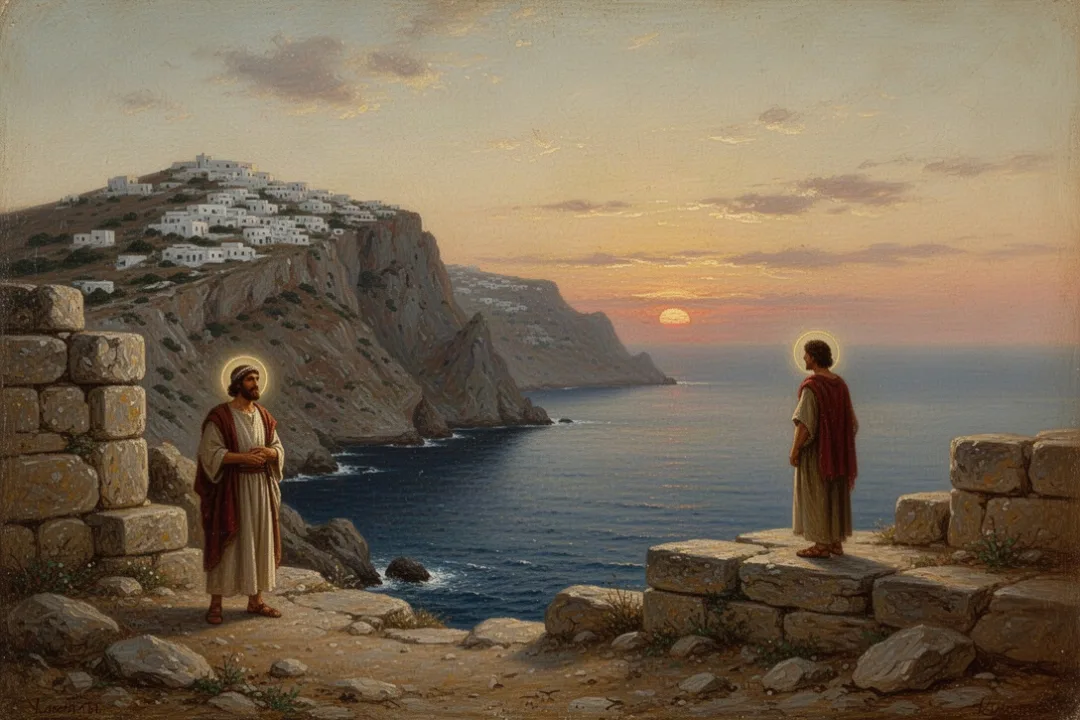
Patmos is a small, rocky island in the Aegean Sea, part of the island group commonly called the Dodecanese. It lies in the eastern Aegean near the western coast of Asia Minor, in the broader region connected with the Roman province of Asia. The island’s location made it reachable by sea but also naturally separated from the mainland.
Ancient Patmos was not one of the great political or commercial centers of the eastern Mediterranean. Its relatively modest size and rugged terrain made it a suitable place for separation from ordinary public life. Even without adding details about a particular prison system, the setting would have communicated distance, confinement, and vulnerability.
The Bible does not describe Patmos as an uninhabited desert. It was an island with a population and a history, yet John’s circumstances placed him apart from the communities to which he ministered. The physical setting helps readers picture the contrast between John’s isolation and the large spiritual scope of his message.
Patmos also sits within a maritime world. Travel between the islands and coastal cities depended on ships, weather, and political conditions. The seven churches addressed in Revelation were not on Patmos itself; they were located on the mainland and in nearby parts of Asia Minor. John’s writing therefore moved outward from a remote island toward established Christian communities.
Why John may have been on Patmos
The most direct answer comes from Revelation 1:9: John was on Patmos because of the word of God and his testimony about Jesus. The verse strongly connects his situation with Christian witness and suffering. It does not frame his presence as a voluntary retreat for prayer, a sightseeing visit, or a private spiritual exercise.
Many readers understand the verse as describing exile or banishment. This fits the broader setting of a Christian leader facing opposition, and it agrees with later church tradition that connects John’s time on Patmos with Roman persecution. Still, the Bible does not use the verse to provide a detailed legal record.
Some interpreters have discussed whether Patmos was used for a form of political or penal exile, but the exact historical arrangement is not certain from Revelation alone. Roman punishments could vary according to a person’s status and the judgment imposed. The safest conclusion is that John was on the island under circumstances connected to his Christian witness and that he experienced this separation as part of the church’s tribulation.
This distinction matters for interpreting the book. Revelation does not say that hardship automatically proves a person has been abandoned by God. John’s location is difficult, but it becomes the setting for divine communication and faithful service. His circumstances limit him physically without limiting the reach of the message he receives.
How Patmos connects with the seven churches
After identifying Patmos, John explains that he was told to write what he saw and send it to seven churches. These congregations were in the Roman province of Asia, an area that included important cities connected by regional roads and sea routes. The letters in Revelation 2–3 address their strengths, failures, pressures, and need for perseverance.
Patmos and the seven churches are connected through a chain of witness. John receives the vision on the island, records it, and sends it to communities facing their own challenges. The message is not designed only for a solitary prophet; it is intended to encourage, correct, and warn the church.
The seven churches also show that Revelation speaks to real congregations before it speaks in broad symbolic terms about the future. The believers in Smyrna faced suffering. The church in Pergamum lived amid competing religious loyalties. Laodicea was challenged over its spiritual condition. These messages give a practical setting for understanding the book’s larger call to faithful endurance.
John’s island location may have made communication more difficult, but it did not make him irrelevant. His ministry continued through a written message. The pattern is significant: physical separation does not cancel spiritual responsibility. John remained a brother and witness to churches he could not simply visit whenever he wished.
What Patmos means in the message of Revelation
Patmos is first a real geographical place, and readers should not replace that fact with symbolism. At the same time, its role in Revelation gives it theological significance. The island becomes associated with witness under pressure, patient endurance, and God’s ability to work through conditions that appear limiting.
John’s experience shows that a difficult location is not necessarily a spiritually empty one. He was separated from the churches, yet he was not separated from God. The opening vision presents the risen Christ as present among the churches, which means John’s isolation does not remove him from the life of the Christian community.
Patmos also highlights the cost of speaking faithfully. John does not describe suffering as an abstract concept. He identifies himself as someone who shares in it. The message of Revelation therefore begins with a witness who has endured pressure and continues to write, rather than with a detached prediction about events far away.
The island can also help readers avoid a common misunderstanding of Revelation. The book is not merely a collection of mysterious images to decode. It is a pastoral message shaped by real churches, real opposition, and a real call to remain faithful. Patmos provides the setting for that message, while the churches provide its immediate audience.
How Patmos relates to John’s identity
Revelation names its author as John, but the opening chapter does not identify him by the fuller title “John the apostle.” Christian tradition has often identified the writer with John, one of Jesus’ apostles and a central figure in early Christian memory. Some modern scholars have examined the language and style of Revelation and have distinguished its author from the writer of the Gospel of John or the letters associated with John.
The biblical text itself allows readers to say that John received the Revelation on Patmos. It does not require readers to settle every question about his identity before understanding the passage. The author’s role in the book is clear: he is a servant, witness, prophetic recipient, and messenger to the churches.
This restraint is useful when studying the passage. The central point is not the author’s biography but the content of his witness. John’s authority in Revelation comes from the message he was instructed to record and deliver, not from a lengthy account of his personal history on the island.
Later Christian writers and traditions provide additional information about John and Patmos, including associations with a cave where he is said to have received the vision. Such traditions may be meaningful to Christian history and pilgrimage, but they should be described as tradition rather than explicit biblical detail.
Common mistakes when interpreting Patmos
Patmos is a short biblical reference, so it is easy to fill in gaps with assumptions. These common mistakes can lead to claims that sound certain but go beyond what Revelation says.
Calling Patmos a prison without qualification: The Bible connects John’s presence with his witness and suffering, but it does not describe the island in detail as a prison.
Stating that Domitian is named in Revelation: The book does not name the emperor who may have been responsible for John’s circumstances. The Domitian connection comes from later historical tradition.
Assuming John was completely alone: Patmos was a populated island. John was separated from the churches, but the text does not say he had no human contact at all.
Treating every detail of the traditional cave as biblical: Revelation says John received the vision on Patmos, but it does not identify a cave or describe the physical room where he wrote.
Making Patmos the main subject of Revelation: The book centers on God’s purposes, Jesus Christ, the churches, judgment, worship, and hope. Patmos is the setting of the opening witness.
Ignoring the seven churches: John’s vision was sent to congregations with specific spiritual needs. Their circumstances help explain the book’s calls to endurance and faithfulness.
These distinctions do not make Patmos less important. They make the interpretation more reliable. You can affirm that John suffered for his testimony and received Revelation on the island without claiming details that the biblical passage leaves unstated.
Practical ways to study Patmos in the Bible
A useful study begins with the immediate passage rather than with later paintings, travel accounts, or popular descriptions. Read Revelation 1:9–20 first, then examine the messages to the churches in chapters 2–3. This keeps the island connected to the purpose for which John was told to write.
Read Revelation 1:9–20: Mark what John says directly about his location, condition, audience, and vision.
List the confirmed details: Patmos is named, John is there because of God’s word and Jesus’ testimony, and he is instructed to write to seven churches.
Separate history from tradition: Treat claims about a specific emperor, legal punishment, or cave as historical or ecclesiastical tradition unless the biblical text confirms them.
Read Revelation 2–3: Notice how the messages address suffering, compromise, courage, false teaching, spiritual weakness, and endurance.
Ask what the setting contributes: Consider how John’s isolation and hardship shape the book’s emphasis on faithful witness and hope.
Keep the main focus on Christ: Revelation opens with John on Patmos, but the vision directs attention to Jesus’ authority and presence among the churches.
Maps can also help. Locate Patmos in relation to the Aegean Sea, Asia Minor, and the seven churches. Seeing the distances clarifies that John’s message came from an island setting but was meant for communities spread across a wider region.
A helpful question to ask: “What does the text say, and what comes from later tradition?” That single question protects you from both dismissing the historical setting and overstating details the Bible does not provide.
What Christians can learn from John’s Patmos experience
John’s experience offers a sober view of Christian service. Faithfulness did not protect him from displacement, pressure, or separation from other believers. Yet his hardship did not make his ministry meaningless. He continued to bear witness, and his written message became a source of instruction for churches beyond the island.
Patmos also shows the value of patient endurance. Revelation places endurance alongside suffering and the kingdom of God, not as an optional personality trait. John’s readers were being taught to remain loyal while waiting for God’s purposes to be fulfilled.
The setting encourages Christians who feel limited by circumstances. A person may be separated from a congregation, restricted by illness, displaced from home, or unable to serve in familiar ways. John’s example does not promise that every hardship will immediately change, but it shows that faithful witness can continue in restricted circumstances.
Finally, Patmos points readers away from fascination with the island itself and toward the message John received. Its importance lies in the fact that God met his servant there and gave him words for the churches. The island is memorable because it became the setting for a vision centered on Jesus Christ, the church’s endurance, and God’s ultimate victory.
Frequently asked questions
Was Patmos a prison island in the Bible?
Revelation does not call Patmos a prison island or describe its penal system. It says John was there because of God’s word and his testimony about Jesus. Many readers understand this as exile or banishment, and later tradition connects it with Roman punishment. The biblical text confirms John’s hardship and isolation but leaves the exact legal conditions undescribed.
Did John write the whole book of Revelation on Patmos?
Revelation identifies Patmos as the place where John received the vision and was instructed to write. It does not describe every stage of composition, copying, or delivery. The important biblical point is that John recorded and sent the message to seven churches in Asia, linking his island experience with the congregations that first received the book.
Is the Cave of the Apocalypse mentioned in Scripture?
No. Revelation says John was on Patmos and received his vision there, but it does not name a cave or specify the room where the revelation occurred. The cave associated with John belongs to later Christian tradition and pilgrimage. It can be discussed as a historical tradition, but it should not be presented as a detail explicitly recorded in the Bible.
Why does Revelation begin by mentioning Patmos?
The reference establishes John’s circumstances as a suffering witness and explains why he was separated from the churches. It also introduces the setting from which he was told to send a message to seven congregations. Patmos reinforces Revelation’s emphasis on endurance: John was under pressure, yet he continued to serve the church through the vision and written testimony he received.










Leave a Reply