The seven churches in Asia in Revelation explained
The seven churches in Asia in Revelation explained
If you are reading Revelation and wondering why it begins with letters to seven particular churches, the answer is both historical and pastoral. The seven churches in Asia were Christian communities in the Roman province of Asia, a region located mainly in western Asia Minor, in what is now Turkey. They were not seven churches representing the entire continent of Asia.
The churches were Ephesus, Smyrna, Pergamum, Thyatira, Sardis, Philadelphia, and Laodicea. In Revelation chapters 2 and 3, each receives a message from Jesus through John. The messages address real local conditions—persecution, false teaching, spiritual weakness, compromise, faithfulness, and complacency—while also speaking to Christian communities beyond those ancient cities.
John names the churches near the beginning of Revelation, along with the island of Patmos, where he says he was when he received the vision. The province of Asia was a Roman administrative region on the western side of modern Turkey. Its cities were connected by major roads and trade routes, making them significant centers of commerce, government, religion, and culture.
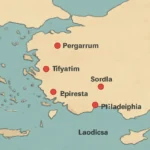
The churches are listed in an order that appears to follow a practical travel route, beginning at Ephesus on the western coast and moving generally north, then east and south. The exact route is not the central point of the passage, but the sequence helps explain why these seven communities may have been chosen as a connected group.
Ephesus: A major port and commercial center on the western coast.
Smyrna: A prosperous coastal city known today as Izmir.
Pergamum: An important city farther north, associated with political and religious power.
Thyatira: An inland manufacturing and trade center.
Sardis: An older royal city with a reputation for past greatness.
Philadelphia: A smaller city in a region affected by earthquakes and cultural change.
Laodicea: A wealthy inland city near Colossae and Hierapolis.
Geographical clarification: “Asia” in Revelation refers to the Roman province of Asia, not the modern continent. The seven churches were concentrated in western Anatolia, especially in areas now within Turkey.
Why Revelation addresses seven churches
The number seven has a prominent place in Revelation and often conveys the idea of completeness or fullness. The seven churches were actual congregations with different circumstances, but the messages were also preserved for churches more broadly. Each letter ends with an appeal for anyone who can hear to listen to what the Spirit says to the churches.
That wording matters because the letters are not merely private reports about seven ancient congregations. They are messages that examine the spiritual condition of a community. A church may be active but loveless, orthodox in some respects but tolerant of destructive teaching, outwardly alive but inwardly weak, or materially comfortable yet spiritually poor.
Each message follows a recognizable pattern, although not every letter includes every element. The risen Christ is described using imagery from John’s vision, the church is evaluated, encouragement or correction is given, and a promise is offered to those who remain faithful.
The church is addressed by name. The message is specific rather than general.
Christ is presented in a fitting way. The description often connects with the church’s challenge or need.
The church’s strengths are recognized. Several churches receive clear praise before correction.
Its central weakness is exposed. The letters do not judge only public reputation.
A call to repentance or endurance is given. The communities are urged to respond, not merely feel condemned.
A promise is made to the faithful. The promises use symbolic language connected with life, victory, belonging, and God’s presence.
What Jesus says to the church in Ephesus
Ephesus receives the first message. It was a prominent city with substantial commercial and religious importance, and the Christian church there is praised for hard work, endurance, and careful testing of people who claimed spiritual authority. The congregation appears to have taken false teaching seriously rather than accepting every religious claim without examination.
Its serious problem was that it had left its first love. The phrase is commonly understood as describing a decline in love for Christ and for fellow believers, although the wording can include both dimensions. Ephesus was active and discerning, but its activity had become disconnected from the affection and devotion that should animate Christian obedience.
The instruction is to remember the earlier condition, repent, and return to the works that marked the church before its love grew cold. The warning about removing its lampstand communicates the danger of losing its role as a faithful witness. The church’s correct beliefs and energetic service could not substitute for love.
The promise to the one who conquers refers to the tree of life in God’s paradise. That image reaches back to the opening chapters of Genesis and forward to the life and restoration imagery near the end of Revelation. For Ephesus, the message is clear: discernment must be joined to love, and religious activity cannot preserve a church that no longer loves what it claims to serve.
What Jesus says to the church in Smyrna
Smyrna receives a very different message. This congregation is described as suffering and experiencing poverty, yet it is called rich in the sense that matters most to the letter. The contrast shows that material hardship does not indicate spiritual failure. A church can have limited resources and still be deeply faithful.
The believers in Smyrna faced hostility and were warned that some of them would experience imprisonment and further testing. The message does not promise that their immediate circumstances will become comfortable. Instead, they are told to remain faithful even when faithfulness is costly. The reference to a limited period of suffering presents their trial as real but not endless.
Smyrna is one of the two churches in these chapters that receives no direct rebuke. Its commendation is not based on influence, public approval, or financial strength. It is based on perseverance under pressure. The promise of the crown of life uses victory imagery, while the assurance concerning the second death points to ultimate security beyond physical death.
The letter to Smyrna can help correct a common assumption: comfort and success are not reliable measures of a church’s spiritual health. A congregation may appear small, poor, or vulnerable while demonstrating extraordinary trust and courage.
What Jesus says to the church in Pergamum
Pergamum is described as a place where Satan’s throne is located. The phrase has been interpreted in various ways, including the city’s strong connection with imperial authority, pagan worship, and religious institutions. The point is not necessarily to identify a single building. It portrays Pergamum as a setting where loyalty to Christ faced intense opposition.
The church is praised for holding firmly to Christ’s name, even when one of its members, Antipas, was killed for his faith. Revelation gives no further biographical information about Antipas, so it is best not to add details that the text does not provide. His mention shows that the congregation had already paid a serious price for Christian witness.
At the same time, Pergamum tolerated people who promoted teaching associated with Balaam and the Nicolaitans. The references connect false teaching with participation in idolatrous practices and sexual immorality. The church had not abandoned Christ publicly, but it allowed compromise inside the community.
The call to repentance is directed to the church as a whole, even though the problem involved particular people. This shows that congregations bear responsibility for what they permit. The promise to the conqueror includes hidden manna and a white stone with a new name, images that suggest divine provision, acceptance, and a personal identity granted by God.
What Jesus says to the church in Thyatira
Thyatira receives the longest of the seven messages. The church is praised for love, faith, service, endurance, and growth in its works. Unlike Ephesus, Thyatira is commended for increasing activity rather than declining effort. Yet it is also criticized for tolerating a woman symbolically called Jezebel, whose teaching led servants of God toward sexual immorality and idolatrous practices.
The name Jezebel likely recalls the Old Testament queen associated with idolatry and opposition to the worship of Israel’s God. Revelation uses the name as a symbolic identification, not as evidence that the historical queen was living in Thyatira. The concern is that a persuasive influence within the church was encouraging believers to treat participation in surrounding religious life as harmless.
Thyatira was known for trade associations, or guilds, that could have involved shared meals and religious customs. The exact social pressure faced by its members cannot be reconstructed with complete certainty, but economic and community life could make separation from idolatrous practices difficult. Revelation’s warning addresses the temptation to preserve social or commercial security by compromising Christian allegiance.
The church is not told that every member has accepted the teaching. Those who have not embraced it are urged to hold on to what they have. The promise of authority over the nations and the morning star presents the faithful with a share in Christ’s victorious rule and the hope of his presence. Thyatira teaches that love and service do not excuse tolerance of destructive teaching.
What Jesus says to the church in Sardis
Sardis has a reputation for being alive, but the message says it is dead. This is one of the sharpest contrasts in the letters: public reputation and spiritual reality do not match. The church appears to have been known for vitality, yet its works are found incomplete before God.
The congregation is told to wake up, strengthen what remains, remember what it received and heard, obey it, and repent. These commands suggest a church that is not beyond recovery but is in urgent danger. It must not depend on its past name or reputation. It needs renewed attentiveness and active faithfulness.
A small number of people in Sardis have not soiled their garments. The garment imagery communicates moral and spiritual integrity. The promise that they will walk with Christ in white indicates honor, purity, and belonging. Those who conquer are also promised that their names will not be blotted out of the book of life and that Christ will acknowledge them before the Father and the angels.
Sardis offers a needed warning for established congregations, ministries, and individual believers: a respected history cannot replace present obedience. Attendance, buildings, programs, and public recognition may all exist while spiritual life is weakening underneath.
What Jesus says to the church in Philadelphia
Philadelphia is described as having limited strength, yet it has kept Christ’s word and not denied his name. The message does not treat weakness as shameful. Instead, it recognizes that a congregation with modest influence can still show remarkable faithfulness.
The church is promised an open door that no one can shut. This may refer to an opportunity for witness, access to God’s kingdom, or secure belonging; the text does not force only one of these meanings. The central assurance is that opposition cannot ultimately cancel the place Christ has given to his faithful people.
Philadelphia also receives a promise of protection in an approaching time of testing. Christians interpret this passage in different ways, particularly concerning the timing and nature of that testing. The text clearly encourages endurance, but it should not be used to make confident predictions about specific modern events.
The believers are told to hold fast so that no one takes their crown. The promise to become a pillar in God’s temple conveys permanence and security, especially meaningful for people living in a region known for earthquakes and instability. The new name of God, the name of the city of God, and Christ’s new name all signify permanent identity and belonging.
What Jesus says to the church in Laodicea
Laodicea is the best-known of the seven churches because of the image of being neither cold nor hot. The message criticizes the church for lukewarmness, a metaphor for ineffective or unacceptable devotion. The believers say they are rich, prosperous, and in need of nothing, but Jesus describes them as poor, blind, naked, and miserable in spiritual terms.
Laodicea was a wealthy city with a strong local economy. It was known for banking, textile production, and medical traditions, including an eye treatment associated with the region. Revelation may draw on these local associations when it speaks of gold refined by fire, white clothing, and eye salve. The imagery exposes the difference between material self-sufficiency and spiritual dependence.
The church is urged to obtain true riches, white garments, and healing for its sight. These are symbolic remedies, not commercial instructions. The message calls for repentance and renewed fellowship. The well-known image of Christ standing at the door and knocking occurs in this setting, and it addresses a church rather than only an individual seeker.
Laodicea also receives a statement about discipline as an expression of love. Correction is presented as an invitation to become earnest and repent, not as evidence that restoration is impossible. The promise to sit with Christ on his throne gives the final word to faithful perseverance, not to the church’s current complacency.
What the repeated phrase “to the one who conquers” means
Every message includes a promise to the one who conquers, although the promise is expressed differently. Conquering does not mean gaining political control, defeating opponents through force, or achieving social prestige. In these chapters, it means remaining faithful to Christ through pressure, temptation, false teaching, suffering, or spiritual decline.
The language is especially significant because Revelation presents Christian victory through faithful witness. The churches are not told to imitate the power structures around them. They are called to endure, reject compromise, repent when necessary, and remain loyal to the one who has already conquered through death and resurrection.
Ephesus: Access to the tree of life.
Smyrna: Protection from the second death and the crown of life.
Pergamum: Hidden manna and a white stone bearing a new name.
Thyatira: Authority connected with Christ’s victorious rule and the morning star.
Sardis: White garments, secure recognition in the book of life, and acknowledgment before God.
Philadelphia: A permanent place in God’s temple and the name of God’s city.
Laodicea: A share in Christ’s royal reign.
These promises are not seven unrelated rewards. Together, they present a picture of life with God, cleansing, identity, security, authority, and intimate fellowship with Christ. The symbolism invites faithful endurance while directing attention toward Revelation’s larger hope.
How the seven churches differ from one another
The letters are useful partly because they refuse to treat every church as having the same problem. Ephesus has discernment but lacks love. Smyrna suffers and remains faithful. Pergamum holds to Christ but permits compromise. Thyatira grows in service while tolerating corrupt teaching. Sardis has a living reputation but is spiritually dying. Philadelphia has little strength but keeps Christ’s word. Laodicea is wealthy yet spiritually complacent.
This range prevents simplistic self-assessment. A church should not ask only whether it is active, orthodox, large, poor, influential, or persecuted. It should ask whether its love is alive, whether its witness is faithful, whether it disciplines harmful teaching, and whether its confidence rests in God rather than its resources.
A practical test: Read each message by asking two questions: “What does this church value or do well?” and “What does it tolerate, neglect, or misunderstand?” Healthy evaluation makes room for both encouragement and repentance.
How Christians can read these messages responsibly
The seven churches should first be read as real congregations in real cities. Their challenges arose in particular social, political, economic, and religious settings. Applying the messages responsibly requires attention to that historical setting before drawing lessons for a modern congregation or individual.
At the same time, the letters are intentionally preserved for the wider church. They are not locked in the first century. Their questions remain recognizable: Can a church defend correct doctrine while losing love? Can it become comfortable with practices that conflict with its confession? Can it rely on reputation, wealth, or institutional strength? Can a small congregation remain faithful when it has little influence?
Several habits can make personal or congregational reading more fruitful:
Read the description of Christ first. It establishes the authority and perspective behind the evaluation.
Separate praise from correction. Neither should be ignored because the other is more comfortable.
Identify the specific behavior being addressed. Avoid turning every image into a vague statement about morality.
Ask what repentance would look like. Repentance in these letters involves concrete change, not merely regret.
Consider the promise alongside the warning. The goal is faithful endurance and restored relationship with God.
Avoid forcing current events into every symbol. Revelation uses vivid imagery, but confident speculation can distract from its direct calls to faithfulness.
Are the seven churches symbolic of seven periods of church history?
Some interpreters have understood the seven churches as representing successive eras in church history. This approach is sometimes called the historical or church-age interpretation. It can offer a broad framework for reflection, but the text itself directly addresses seven first-century congregations in Asia. It does not plainly identify each church with a later historical period.
Other readers understand the churches as representative types that can appear in any age. This approach gives attention to the repeated call for all who hear to listen. It also fits the obvious differences among the communities without requiring a precise timeline of church history.
A careful reading can acknowledge that Christians have used different interpretive models while keeping the clearest foundation in view: the letters spoke to actual churches first. Their continuing value comes from the spiritual patterns they reveal, not from an obligation to match each city with a particular century.
What the seven churches teach about Christian witness
Revelation presents witness as more than speaking publicly about belief. The churches witness through endurance, moral distinctiveness, resistance to idolatry, love, service, repentance, and loyalty under pressure. Their public credibility depends on the integrity of their shared life.
The letters also show that witness can fail in opposite ways. A church may become so concerned with rejecting error that it loses love. Another may preserve affection and activity while becoming careless about corruption. A third may protect its reputation instead of acknowledging spiritual weakness. Faithful witness requires truth, love, courage, humility, and ongoing dependence on Christ.
The seven churches in Asia therefore function as both historical communities and spiritual mirrors. Their cities have changed, and many of their ruins remain archaeological sites, but the questions raised by the messages remain direct. Is the church awake? Is it faithful? Does it love? What has it tolerated? What must it hold on to, and what must it leave behind?
Frequently asked questions
Were the seven churches in Asia all located in modern Asia?
No. “Asia” in Revelation refers to the Roman province of Asia, located mainly in western Asia Minor. The seven churches were in cities within present-day Turkey. The term did not mean the entire continent of Asia as modern geography defines it.
Which church in Revelation was described as lukewarm?
Laodicea was described as lukewarm. Its problem was spiritual complacency: the church believed it was wealthy and self-sufficient, while the message exposed its deep need for renewal. The imagery uses the city’s local associations to challenge confidence in material prosperity.
Did the seven churches exist at the same time?
The letters address seven Christian congregations that existed in the first-century Roman province of Asia. Revelation does not provide complete founding dates for each church, so it is safest to say they were contemporary communities within the same broad historical setting.
What does “the one who conquers” mean in the seven letters?
It refers to remaining faithful to Christ through suffering, temptation, false teaching, compromise, or spiritual weakness. Conquering is not presented as political domination. It means persevering in loyalty, responding to correction, and maintaining faithful witness until the end.






Leave a Reply