Philippians identifies Paul and Timothy as its senders, although the letter’s personal voice and first-person accounts show Paul as the main writer. Paul was an apostle of Jesus Christ, and Timothy was a trusted coworker who served alongside him. The letter is addressed to the Christians in Philippi, including its overseers and deacons.
Philippi was a Roman colony in Macedonia, in the northern part of what is now Greece. Paul first visited the city during his second missionary journey, after receiving a vision that directed him toward Macedonia. Acts 16 describes the beginning of the Philippian church through the conversion of Lydia, the imprisonment of Paul and Silas, and the faith of the jailer and his household.
The church at Philippi had a particularly close relationship with Paul. Its members supported his ministry financially and sent help through Epaphroditus, one of their representatives. Philippians was written partly as a thank-you letter for that support and partly as pastoral encouragement for believers facing pressure, disagreement, and opposition.
Paul wrote while imprisoned, but the exact place is not stated with certainty. Rome, Caesarea, and Ephesus have all been suggested by interpreters because each location fits some details of the letter. The safest conclusion is that Philippians comes from a period when Paul was under official restraint for preaching Christ, and that he expected his situation might lead either to release or death.
Central idea: Philippians shows that Christian joy does not depend on comfortable circumstances. Paul writes from imprisonment, yet he focuses on Christ, the progress of the gospel, and the spiritual well-being of other believers.
The letter has no long explanation of the gospel’s basic facts because Paul already knew this congregation well. Instead, he addresses how the gospel should shape their relationships, courage, priorities, and response to hardship. His purpose is both personal and practical: he thanks the church, reports on his circumstances, corrects harmful attitudes, and calls the believers to live as one faithful community.
What is the historical setting of Philippians?
Philippi was established as a Roman colony after Roman military victories in Macedonia. Its residents lived under Roman political influence, and the city’s public identity was closely connected to Roman citizenship, law, and imperial authority. That setting helps explain why Paul’s language about citizenship in heaven in Philippians 3:20 would have carried particular force for the original readers.
The church began under difficult circumstances. According to Acts 16, Paul and Silas were beaten and imprisoned after Paul freed a slave girl from a spirit associated with fortune-telling. An earthquake opened the prison doors, but Paul and Silas did not escape. The jailer then heard the message about Jesus, believed, and was baptized with his household.
These events gave the Philippian Christians a shared memory of God’s power in suffering. They had seen that following Christ could bring social conflict and physical danger. Paul’s later imprisonment therefore was not an abstract theological example; it resembled the kind of hardship that their own congregation understood.
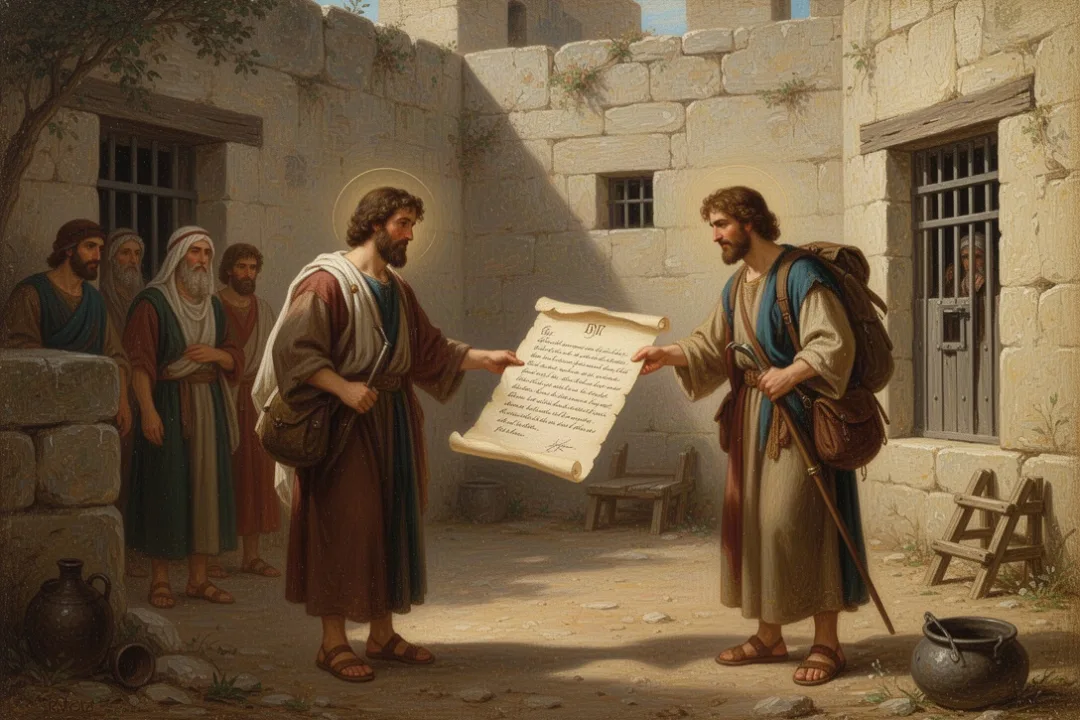
Epaphroditus carried the Philippians’ gift to Paul and became seriously ill while serving him. After recovering, he was sent back to Philippi with the letter. Paul presents him as a valued coworker and brother, not merely as a messenger. This detail shows that Christian ministry in the early church depended on trust, sacrifice, and cooperation among people in different places.
Philippians also reflects tensions within the congregation. Euodia and Syntyche, two women who had worked alongside Paul, are urged to reach agreement in the Lord in Philippians 4:2-3. The disagreement is not described in detail, so readers should avoid guessing at its cause. The clear point is that unity requires deliberate reconciliation, even among faithful people who have served together.
Paul’s imprisonment: His chains become an opportunity for the message about Christ to spread.
The church’s generosity: The Philippians repeatedly support Paul when other churches do not.
Internal pressure: Believers must resist selfish ambition and learn to serve one another.
External opposition: The congregation is called to remain courageous and steady in faith.
The Roman setting also adds meaning to Paul’s statement that believers should live as worthy citizens of the gospel in Philippians 1:27. The wording can suggest conduct appropriate to a common civic identity. Paul redirects that idea toward the community formed by the gospel: Christians belong to Christ and should represent that allegiance together, whether Paul is present or absent.
What are the main themes in Philippians?
Joy rooted in Christ rather than circumstances
Joy is one of the most recognizable themes in Philippians, but Paul does not treat joy as constant cheerfulness or denial of pain. He knows that imprisonment, conflict, illness, and possible death are real. Christian joy, as Philippians presents it, is a deep confidence that Christ is at work and that life has meaning under God’s care.
Paul rejoices when Christ is proclaimed, even when some preachers have mixed motives. He rejoices in the Philippians’ partnership and in the prospect of their spiritual growth. His joy is therefore connected to the advance of the gospel and the faithfulness of God’s people, not to personal comfort or public success.
Humility shaped by the example of Jesus
Philippians 2:5-11 gives the letter’s central portrait of Jesus. Paul describes Christ as willingly taking the position of a servant, accepting humiliation and death on a cross, and then being exalted by God. Rather than reproducing the passage’s wording, its message can be summarized this way: Jesus used his status for self-giving service, and God vindicated him.
Paul introduces this teaching while addressing selfish ambition and rivalry. The point is not simply to admire Jesus’ humility but to imitate its pattern in relationships. Christians are told to consider the interests of others, not because their own needs do not matter, but because gospel unity requires selfless concern.
Perseverance through suffering
Paul’s imprisonment does not mean that God’s work has failed. In Philippians 1, he explains that his circumstances have helped make Christ known among guards and other people. He also says that his situation has encouraged fellow believers to speak about Jesus with greater boldness.
This does not make suffering good in itself, nor does it require believers to stay in dangerous situations when wise protection is possible. Philippians teaches that hardship can be placed in God’s hands and may become a setting for faithful witness. Paul’s confidence rests in God’s purpose beyond immediate appearances.
Knowing Christ as the believer’s highest priority
In Philippians 3, Paul lists achievements that once gave him religious status: ancestry, education, zeal, and obedience to Jewish law as he understood it. He does not say that discipline and heritage are meaningless in every context. He says that compared with knowing Christ, they cannot serve as the foundation of his righteousness or confidence before God.
Paul’s relationship with Christ includes faith, participation in Christ’s sufferings, and hope in resurrection. His language is not about reaching spiritual perfection through human effort. Instead, he describes an ongoing pursuit in which he has not yet arrived but continues toward the goal God has set before him.
Contentment and generous partnership
Philippians 4:10-20 is the setting for Paul’s teaching about contentment. He has learned how to live with abundance and with need, with plenty and with hunger. His ability to endure changing conditions comes from Christ’s strength, not from self-sufficiency or a promise of unlimited success.
The surrounding verses also clarify the meaning of Philippians 4:13. Paul is not claiming that a believer can accomplish every desired project or obtain every goal. He is saying that Christ enables him to remain faithful across changing circumstances, including deprivation and hardship. The passage belongs with a theme of steady dependence, not personal achievement.
Read Philippians 4:13 in context: The verse concerns Paul’s strength to endure both poverty and abundance while serving Christ. It should not be used as a guarantee that every personal ambition will succeed.
How is the book of Philippians organized?
Philippians is a short letter, but its ideas develop in a deliberate sequence. Paul moves from thanksgiving and prayer to a report about his imprisonment, then to instruction about unity and humility. The final chapters address opposition, false confidence, practical reconciliation, anxiety, contentment, and the church’s financial gift.
Philippians 1: greetings, prayer, and the progress of the gospel
Paul begins with gratitude for the Philippians’ partnership “from the first day” of their faith. His prayer in Philippians 1:9-11 asks that their love grow with knowledge and discernment, so that they can recognize what truly matters and live fruitful lives.
He then explains how imprisonment has advanced the gospel. Paul’s central concern is not whether he receives freedom but whether Christ is honored. His well-known statement about living and dying expresses a profound priority: life gives him opportunities for fruitful service, while death brings him into Christ’s presence. He does not romanticize death; he recognizes the value of continuing to help the church.
Philippians 2: unity, service, and faithful coworkers
Chapter 2 applies the call to unity through the example of Jesus. Believers are urged to reject rivalry and empty status-seeking. Paul also tells them to work out their salvation with reverence and dependence on God, meaning that their conduct should express the saving work God is carrying out among them.
Paul describes Timothy as someone who genuinely cares about the Philippians’ welfare. He also commends Epaphroditus, who nearly died while serving the mission. These portraits show that humility is not merely an idea in Philippians; it appears in ordinary acts of costly service.
Philippians 3: true confidence and the goal ahead
Paul warns the church against teachers who would make circumcision and other Jewish identity markers the basis of belonging to God’s people. The warning is forceful because the issue concerns the foundation of salvation and identity. Paul insists that confidence must rest in Christ rather than in religious credentials.
He compares his life to a runner pressing toward a goal. The image emphasizes direction and perseverance rather than instant perfection. Believers should remember what Christ has already accomplished while continuing to grow in faith, hope, obedience, and anticipation of Christ’s return.
Philippians 4: reconciliation, prayer, contentment, and thanks
Chapter 4 returns to the practical life of the congregation. Paul urges steadfastness, calls for reconciliation between Euodia and Syntyche, and encourages gentleness. He then addresses anxiety by directing believers toward prayer, gratitude, and disciplined attention to what is true, honorable, just, pure, lovely, and commendable.
The letter ends with Paul’s thanks for the Philippians’ financial support. He is grateful for the gift, but he carefully distinguishes gratitude from dependence. God has supplied his needs, and the Philippians’ generosity is described as an offering pleasing to God. The closing greetings remind readers that the letter is both theological teaching and personal correspondence.
What does Philippians teach Christians today?
Philippians speaks to communities that are trying to remain faithful under pressure. Its guidance begins with shared purpose: believers are not competitors seeking recognition but partners in the gospel. Churches can apply this by valuing cooperation, honoring quiet service, and addressing disagreements before they damage trust.
The letter also challenges the way people measure success. Paul does not evaluate his ministry by comfort, popularity, or freedom from obstacles. He asks whether Christ is being made known and whether believers are becoming more mature. That perspective can help you assess work, leadership, and ministry by faithfulness and fruit rather than visibility alone.
Its teaching about humility is especially practical. You can imitate the pattern of Philippians 2 by listening before defending yourself, sharing credit, serving without recognition, and considering how your decisions affect people with less power. Humility does not mean ignoring injustice or allowing abuse; it means refusing to make self-importance the center of every relationship.
Philippians also offers a careful approach to anxiety. Paul does not shame worried people or pretend that prayer removes every difficult circumstance immediately. He points believers toward prayerful dependence, gratitude, wise attention, and the peace of God. Those practices can exist alongside counseling, medical care, community support, and practical action.
Remember your shared identity: Let belonging to Christ shape how you treat other believers.
Choose service over status: Look for ways to use influence for another person’s good.
Bring concerns to God: Name specific fears in prayer instead of carrying them alone.
Practice disciplined attention: Give sustained thought to what is true, good, and worthy of respect.
Learn contentment gradually: Receive both abundance and limitation without making either one your master.
Keep moving toward Christ: Treat spiritual growth as a continuing response to grace.
The letter’s teaching about money is equally balanced. Paul welcomes generosity, yet he does not manipulate the Philippians or make giving a test of spiritual worth. Healthy Christian support is voluntary, relational, and directed toward genuine ministry. Recipients should show gratitude and integrity, while donors should give without seeking control or praise.
Philippians can also correct two opposite misunderstandings. Christian joy is not denial of grief, and Christian confidence is not the belief that every plan will succeed. Paul’s joy exists alongside tears and uncertainty, while his confidence is anchored in Christ’s presence and resurrection hope.
Which passages in Philippians are especially significant?
Several passages are frequently read because they gather the book’s main ideas into memorable statements. Philippians 1:3-11 combines gratitude, partnership, prayer, and hope for God’s continuing work. It presents spiritual maturity as love informed by knowledge and discernment rather than affection without wisdom.
Philippians 1:27-30 calls the church to live consistently with the gospel and to stand together when opposed. The emphasis is communal: courage is not merely a private emotional quality but a shared witness. The believers’ unity under pressure demonstrates that their faith is stronger than fear of public hostility.
Philippians 2:1-11 connects unity with the humility of Christ. It is one of the New Testament’s most important passages about Jesus’ self-emptying service and exaltation. Read in context, it is not only a statement about Christ’s identity; it is also a direct challenge to selfish ambition within the church.
Philippians 3:7-14 describes Paul’s changed values and continuing pursuit of Christ. These verses help explain why religious accomplishments cannot replace grace. Paul’s goal is not merely to know facts about Jesus but to share in the life, power, suffering, and resurrection hope associated with him.
Philippians 4:4-9 brings together joy, gentleness, prayer, peace, and disciplined thought. Philippians 4:10-20 then explains contentment and generosity. Together, these passages show that inner peace is connected with how believers pray, think, relate to others, and handle material resources.
A careful reading should keep each verse connected to its paragraph and the whole letter. Familiar lines can lose their meaning when removed from their setting. Philippians is not a collection of isolated slogans; it is a coherent appeal to a real church learning how to live faithfully in difficult circumstances.
Frequently asked questions
How many chapters are in the book of Philippians?
Philippians has four chapters. It is one of Paul’s shorter New Testament letters, but its compact form contains substantial teaching about Christian joy, humility, unity, suffering, spiritual growth, prayer, contentment, and generosity. The letter’s four chapters move from thanksgiving and Paul’s imprisonment to practical instruction for the church and a closing expression of gratitude for financial support.
What is the main message of Philippians?
The main message is that believers can remain joyful and faithful because their life is centered on Jesus Christ rather than changing circumstances. Paul connects this confidence with humility, unity, perseverance, prayer, contentment, and service. The letter does not promise an easy life; it teaches that Christ gives meaning and strength during both abundance and hardship.
Why was Paul in prison when he wrote Philippians?
Paul was imprisoned because of his public ministry and proclamation of Jesus. Philippians does not identify the exact location, so interpreters differ about whether the letter came from Rome, Caesarea, or Ephesus. Regardless of location, Paul’s imprisonment provides the setting for his teaching that hardship can become an opportunity for the gospel and does not place a believer outside God’s care.
What does Philippians say about anxiety?
Philippians 4:6-9 directs believers to bring their concerns to God through prayer and thanksgiving, then to cultivate disciplined attention toward what is true, honorable, just, pure, lovely, and commendable. This is not a command to hide distress or reject practical help. It presents prayer, gratitude, wise thinking, and God’s peace as resources for facing worry.












Leave a Reply