When was the book of Romans written? Date and context
When was the book of Romans written? Date and context
The book of Romans was probably written around AD 56–58, with many scholars placing it near AD 57. Paul most likely wrote the letter from Corinth near the end of his third missionary journey, before traveling to Jerusalem with financial support from Gentile believers.
Romans does not identify its date in a modern calendar format, so its timing must be reconstructed from the letter’s internal details and the wider account of Paul’s ministry in Acts. The evidence points to a period when Paul had completed much of his work in the eastern Roman Empire but had not yet visited the Christian community in Rome.
The broad scholarly dating places Romans in the mid-to-late 50s AD. A date around AD 57 is often used because it fits several details in the letter: Paul says that he has preached extensively in the eastern regions, plans to travel to Jerusalem, and hopes to visit Rome afterward.
The exact year cannot be proven with complete certainty. Ancient writers did not usually date letters in the way modern readers expect, and the surviving evidence does not provide a single calendar reference that settles the question. Still, the combination of Paul’s travel plans, the collection for Jerusalem, and the political setting gives a reasonably narrow range.
Some proposed dates are slightly earlier or later, but they generally remain within the same period. The most useful answer is therefore not one exact year but a historically grounded range: Romans was written sometime between AD 56 and AD 58, probably during Paul’s stay in Corinth.
Short answer: Paul most likely wrote Romans around AD 57 from Corinth, near the end of his third missionary journey.
Why Corinth is the most likely place where Romans was written
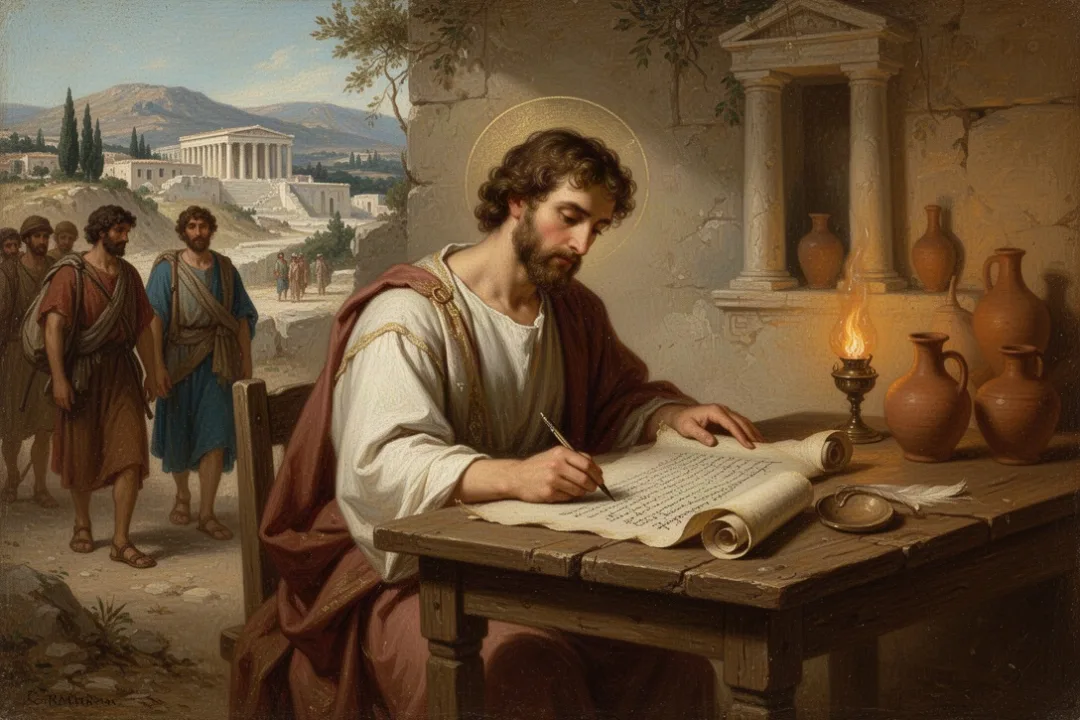
Several clues connect Romans with Corinth, the prominent Greek city where Paul spent an extended period. At the end of the letter, Paul commends Phoebe, a servant or minister of the church at Cenchreae, the eastern port of Corinth. Her connection with the letter strongly suggests that Romans was sent through the Corinthian area.
Paul also mentions Gaius, who offers hospitality to him and to the whole church. Gaius was associated with Corinth in the New Testament’s account of Paul’s ministry. These references do not function like a modern return address, but together they provide strong evidence for Corinth as the letter’s place of composition.
The letter also mentions Erastus, described in connection with the city’s public administration. Erastus was known in Corinthian Christian circles, although the precise relationship between the biblical figure and archaeological evidence from Corinth remains debated. This detail fits the wider picture of a letter emerging from a Christian community in a major Roman city.
Corinth was a practical location for Paul’s plans. It stood on important land and sea routes, had an established church, and was close to the route Paul expected to take toward Jerusalem. From there, Paul could communicate with believers in Rome and explain his plans for a future visit to the western Mediterranean.
What Paul’s travel plans reveal about the timing
Romans was written at a transition point in Paul’s missionary work. He says that he has completed his ministry in a broad area east of Rome and now wants to travel to Jerusalem before going to Rome and eventually Spain. That sequence helps place the letter near the end of a major phase of his activity.
The letter describes Paul as preparing to deliver a financial collection gathered from Gentile churches for believers in Jerusalem. He presents this collection as a practical expression of shared responsibility between Gentile and Jewish Christians. Because the collection was still in progress or about to be delivered, Romans must have been written before Paul’s journey to Jerusalem associated with it.
Acts describes Paul traveling to Jerusalem after spending time in Macedonia and Greece. Although Acts does not reproduce Romans or name the letter’s composition, its chronology fits the situation described in Romans. Paul is in the Greek world, has organized the collection, and is preparing to move east before seeking support for a mission farther west.
This is why Romans is generally dated after Paul’s work in Macedonia and Greece but before his arrival in Jerusalem. It was not an early letter written when Paul was first establishing Christian communities. It came after years of ministry, conflict, travel, and theological reflection.
How Acts helps establish the date of the letter
The book of Acts provides the main narrative framework for dating Romans. Acts describes Paul’s third missionary journey, including extended work in Ephesus, travel through Macedonia and Greece, and the plan to return to Jerusalem. Romans fits naturally near the end of this sequence.
Acts does not give a simple statement such as “Paul wrote Romans in AD 57.” Historians must compare the movements in Acts with references in Paul’s letters and with the known chronology of the Roman world. This method produces an approximate date rather than a mathematically certain one.
One significant clue is Paul’s decision to travel through Macedonia and Achaia before returning to Jerusalem. Romans indicates that believers in those regions had contributed to the collection. The letter therefore appears to belong to the same period described in Acts when Paul was organizing and carrying that gift.
The chronology also places Romans after Paul’s prolonged ministry in Ephesus. In Romans, Paul speaks as someone who has established communities across a wide eastern territory and now seeks a new mission field. That language makes more sense late in his missionary career than at its beginning.
What the letter itself says about its historical setting
Romans contains several personal and logistical details that help locate it in time. Paul has not yet visited Rome, but he knows enough about the congregation to address its situation in detail. He has a settled reputation among many churches and is actively planning a visit to the capital.
Paul also says that he hopes Rome will help support his planned mission to Spain. This suggests that he viewed the Roman church as an established community capable of providing fellowship, hospitality, and possibly financial assistance. The letter was therefore written before that proposed western mission, not after it.
The mention of Phoebe is especially useful. Paul recommends her to the Roman Christians and asks them to receive her appropriately. Many interpreters understand her to have carried the letter from the Corinthian region to Rome. If so, Romans was written shortly before her journey, giving the letter a clear place within Paul’s travel plans.
Other greetings at the end of Romans show that Paul knew people connected with the Roman church even though he had not personally visited it. The greetings reflect a mobile network of Christians who had moved between cities. They also show why a letter from Corinth could reach Rome through trusted travelers and church workers.
Romans was written before Paul visited the Roman church
One clear chronological fact is that Romans predates Paul’s first recorded visit to Rome. Paul addresses a church he has not founded and says that he has repeatedly planned to come but has been prevented. His proposed visit is still in the future when the letter is written.
That distinction matters because Romans reflects a carefully prepared introduction to Paul’s teaching and ministry. He is not writing a follow-up to a personal visit. Instead, he is presenting his understanding of the gospel to a diverse Christian community and explaining why he wants to meet them.
Paul’s eventual arrival in Rome occurred later, after a difficult journey and imprisonment. Acts describes him reaching the city under guard, where he lived for a period while awaiting the outcome of his case. Romans must therefore be placed well before that episode.
The difference between the letter’s date and Paul’s later visit also explains its tone. Romans is both theological and relational. Paul wants to clarify his message, address tensions between Jewish and Gentile believers, and establish trust before arriving in person.
How the Roman church’s situation fits the mid-first century
The Roman Christian community appears to have included both Jewish believers and Gentile believers. That mixed setting helps explain many of the letter’s themes, including the role of the law, the significance of Abraham, Israel’s place in God’s purposes, and the responsibilities of believers with different convictions.
The date of Romans is connected to the changing social and political circumstances of Jews in Rome. During the first century, Jewish residents and communities experienced periods of disruption and movement within the empire. Such changes may have affected the composition of the Roman churches, although the exact local history cannot be reconstructed in every detail.
When Jewish Christians returned to Rome after a period away, Gentile believers may have become more prominent in some congregations. Their differing experiences could contribute to disputes over food, sacred days, identity, and communal authority. Romans addresses these issues as matters that require humility, patience, and mutual welcome.
These circumstances do not provide a precise date by themselves. They do, however, make sense of a letter written in the middle of the first century, when Christian communities were developing across ethnic, cultural, and geographic boundaries within the Roman Empire.
Why Paul wrote Romans at this particular point in his ministry
Paul had several reasons for writing Romans in the late 50s. First, he wanted to establish a relationship with a church he had not founded. Second, he was preparing for a journey to Jerusalem and hoped to receive support for a mission to the western regions. Third, he wanted to set out the message he preached in a form that could be understood by a varied audience.
The letter also allowed Paul to address questions that had become central to the early Christian movement. How are people made right with God? What is the relationship between faith and the law? How should Jewish and Gentile believers live together? What does God’s faithfulness mean for Israel and the nations?
Romans is not simply an abstract theological essay. Its teaching is connected to real community tensions, missionary plans, and relationships among churches. The date helps readers see why these themes appear together. Paul is writing as an experienced missionary who is preparing for a new phase of work.
His plans also explain the letter’s balance of doctrine and practical instruction. Romans discusses humanity’s need, God’s saving work through Christ, life shaped by the Spirit, Israel’s place in salvation history, Christian obedience, government, hospitality, and disagreements over personal practice.
How Romans compares with Paul’s other letters
Romans is usually regarded as one of Paul’s later surviving letters, though it is not necessarily his final letter in chronological order. It was written after Paul had gained substantial experience in founding and guiding churches throughout the eastern Mediterranean.
Compared with letters such as 1 Corinthians and Galatians, Romans often presents its argument in a more extended and systematic form. That does not mean Paul was writing without a specific audience or practical concern. Rather, the Roman setting gave him an opportunity to explain his message to a church he had not personally established.
Paul’s earlier correspondence shows him responding to immediate crises, including division, moral problems, questions about worship, and challenges to his authority. Romans also contains pastoral concerns, but its argument develops with greater breadth. The timing allowed Paul to draw together themes that had shaped his ministry for years.
The letter’s position in Paul’s career also matters for interpreting his confidence. He speaks as someone with a mature sense of vocation and a clear geographical strategy: complete work in the east, visit Jerusalem, establish a relationship in Rome, and pursue ministry in the west.
Common mistakes when dating Romans
Assigning an exact year without qualification: AD 57 is a useful estimate, but the evidence supports a range rather than an indisputable single year.
Placing Romans after Paul’s arrival in Rome: The letter was written before his first recorded visit to the city.
Ignoring the Jerusalem collection: Paul’s planned delivery of financial aid is one of the strongest chronological clues.
Assuming Acts gives the date directly: Acts supplies a narrative framework, but the date comes from comparing several sources of evidence.
Separating theology from history: Paul’s discussion of faith, the law, Israel, and Christian conduct addresses the real circumstances of a mixed Roman congregation.
Treating Corinth as absolutely certain: Corinth is the leading proposal because of the people and places mentioned, but ancient evidence rarely provides modern certainty.
These mistakes often arise because readers want a single date stated with more precision than the evidence allows. Historical dating works by weighing clues. A responsible explanation distinguishes between what is highly probable, what is plausible, and what remains unknown.
A practical method for studying the date of Romans
If you want to evaluate the dating for yourself, read Romans alongside the relevant sections of Acts rather than treating the letter as detached from Paul’s movements. Pay attention to what Paul says he has already done, what he is doing now, and what he plans to do next.
Read the closing chapters first: The greetings, travel plans, and references to the collection provide the clearest historical clues.
Mark Paul’s future plans: Notice that Jerusalem, Rome, and Spain appear in a planned sequence.
Compare the narrative in Acts: Look for Paul’s time in Macedonia, Greece, and Jerusalem.
Identify the named coworkers: Phoebe, Gaius, and others help connect Romans with a particular network of churches.
Separate firm evidence from reconstruction: Distinguish the broad period from details such as the exact month or year.
Read the theological sections in context: Connect arguments about Jews and Gentiles with the realities of a mixed Christian community.
This approach also prevents a common reading problem: treating Romans as though it were written in a vacuum. The letter’s major themes become clearer when you remember that Paul was writing during a period of travel, mission planning, church cooperation, and internal disagreement.
Reading tip: Start with Romans 15–16 and then compare those chapters with Acts 19–21. The travel plans and personal references provide the strongest clues for dating the letter.
What remains uncertain about the date and place
Although Corinth is the most likely location, some questions remain open. Scholars differ over the precise chronology of Paul’s journeys and the relationship between individual events in Acts and the letters. Ancient records are incomplete, and the surviving texts were not written to provide a modern historical timeline.
The exact year is also uncertain because the dating of Paul’s ministry depends partly on broader chronological anchors. Historians use events connected with Roman administration, travel seasons, Paul’s interactions with churches, and the sequence of his letters. Different reconstructions may shift the date by a year or two.
There is also discussion about how Romans was delivered and circulated. Phoebe’s role is widely viewed as significant, but the letter may have been read publicly and copied for other communities after reaching Rome. Its intended audience was the Roman church, yet its teaching was suitable for wider Christian use.
These uncertainties do not undermine the main conclusion. The evidence consistently places Romans in the later part of Paul’s eastern missionary activity, before his journey to Jerusalem and before his eventual visit to Rome.
Why the date matters for understanding Romans today
Knowing when Romans was written helps readers understand its urgency and purpose. Paul was not writing from a quiet study removed from the concerns of churches. He was traveling, raising support for believers in need, managing relationships across ethnic lines, and planning a new mission.
The date also highlights the letter’s place in the development of early Christianity. By the late 50s AD, communities of believers existed across the eastern Mediterranean and in the imperial capital. Their connection was real but not always easy, especially when Jewish and Gentile Christians brought different histories and practices into the same churches.
Romans speaks into that situation by placing God’s saving work and the unity of believers at the center. Its historical setting does not limit the letter’s meaning. Instead, it shows how Paul’s teaching was intended to shape actual communities facing questions about identity, obedience, disagreement, and mission.
The most dependable answer remains clear: Romans was probably written around AD 57, within the broader range of AD 56–58, most likely from Corinth before Paul traveled to Jerusalem. That setting explains both the letter’s detailed theological argument and its strong emphasis on partnership among diverse believers.
Frequently asked questions
Who wrote the book of Romans?
The letter identifies Paul as its author. Paul dictated the main text to a coworker named Tertius, who greets the Roman Christians near the end of the letter. Paul then appears to have added a personal closing. The content, travel plans, and early Christian testimony all support its connection with Paul’s ministry.
Was Romans written before or after 1 Corinthians?
Romans was probably written after 1 Corinthians. Paul had already spent significant time working in Corinth and other eastern regions when he wrote Romans. The letter’s mature discussion of his missionary plans and the Jerusalem collection places it late in his major eastern ministry, whereas 1 Corinthians addresses an earlier crisis in the Corinthian church.
Did Paul write Romans while he was in Rome?
No. Paul wrote Romans before his first recorded visit to the city. He was most likely in Corinth or the surrounding Corinthian region, preparing to travel to Jerusalem. He wrote to introduce himself, explain his message, and seek a relationship with the Roman church before pursuing ministry farther west.
What is the main purpose of the book of Romans?
Romans explains Paul’s understanding of the gospel and its implications for both Jewish and Gentile believers. It addresses humanity’s need, faith, life through the Spirit, Israel’s place in God’s purposes, Christian conduct, and unity amid disagreement. Paul also uses the letter to prepare the Roman church for a future visit and mission partnership.











Leave a Reply