Psalm 100 King James Version (KJV) - Verse-by-Verse Reading
Psalm 100 King James Version (KJV) - Verse-by-Verse Reading
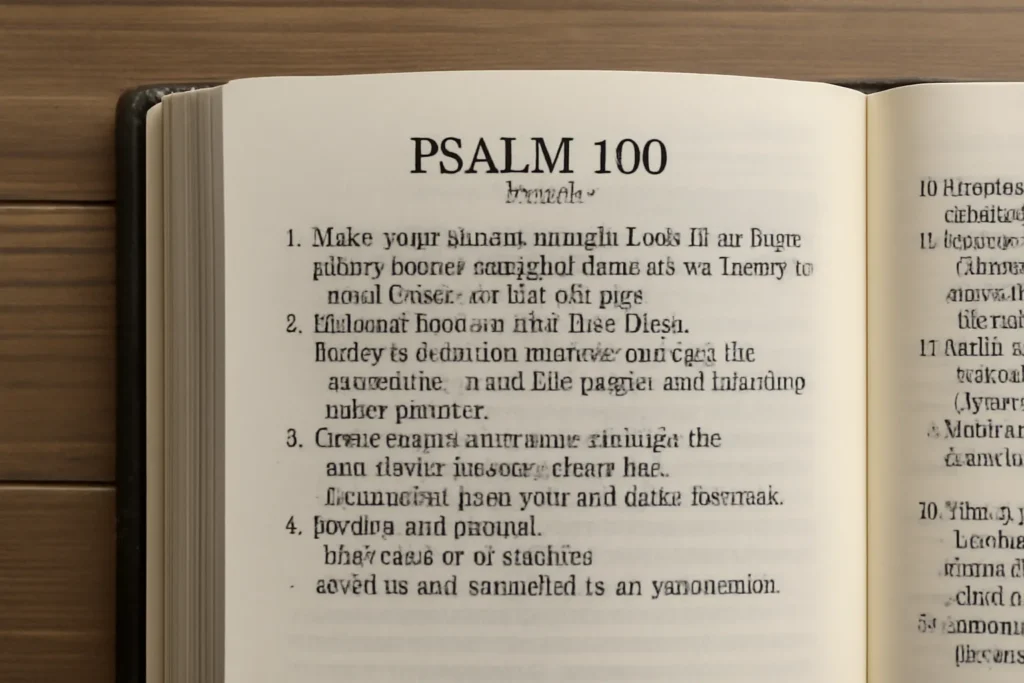
Psalm 100 in the King James Version (KJV) is a compact, soul-stirring invitation to worship. This article offers a detailed, verse-by-verse reading of the text, while inviting readers to consider its language, imagery, and enduring relevance. Although the psalm comprises only five verses, its theological breadth spans praise, gratitude, trust, identity, and belonging within God’s covenant people and creation.
The following study uses variations of the psalm 100 in the King James tradition to illuminate how a single brief composition can carry layers of meaning. It is helpful to compare the KJV phrasing with modern translations, yet the focus remains on the distinctive cadence of the King James text: formal, declarative, and memorable. Throughout this article, you will see key terms highlighted to guide reflection: joy, faith, thanksgiving, praise, mercy, truth, and generations.
Verse 1: Make a joyful noise unto the Lord, all ye lands
1 Make a joyful noise unto the Lord, all ye lands.
The opening verse is a broad, audacious invitation: worship is not confined to a sect or tradition but is commanded to be offered by all ye lands. The joyful noise is not a quiet murmur but a public, celebratory cry—a sound that breaks through fear, apathy, or indifference. The wording foregrounds expression over eloquence; the worshiper’s audibility signals sincerity and communal vitality. In contexts of both ancient Israel and contemporary faith communities, the idea of making a joyful noise invites participation: every listener becomes a potential singer, every crowd becomes a chorus, and every life becomes a vessel for praise.
As a seed-verse, the line sets a mood and a mission: worship is active, communal, and outward-facing. In a broader literary sense, the call to make a joyful noise establishes sound as a vehicle of theology—the believer’s voice becomes a conduit of gratitude and reverence. Some modern readers hear echoes of this in musical worship or public declarations of faith; others encounter it as a personal muse to lift one’s voice, whether in quiet gratitude or exuberant song.
Key idea: worship is a public, joyful act that involves the whole created order.
Imagery: sound as an offering and as a witness to God’s character.
In other English renderings, you may find subtle shifts: phrases like “shout for joy to the Lord” or “sing joyfully to the Lord” emphasize different shades—bold proclamation or melodic praise. In the KJV, the phrase “joyful noise” emphasizes exuberance that can accompany gratitude in communal settings as well as personal devotion. This verse, therefore, can be a prompt for a church or family to begin an encounter with God through united, unreserved praise.
Verse 2: Serve the Lord with gladness: come before his presence with singing
2 Serve the Lord with gladness: come before his presence with singing.
The second verse moves from the act of praising to the practice of serving. The injunction to “serve the Lord with gladness” grounds worship in action—service is a form of worship that is joyful, not merely dutiful. The invitation to “come before his presence with singing” links inner disposition with outward expression; singing becomes both a personal offering and a communal gesture that marks entrance into the divine presence.
Gladness here is more than a mood; it is a posture of life that permeates service, foreshadowing New Testament ideas about serving in love and with delight. The verse also implies a ritual dimension: approaching God with songs is an established mode of encounter, reminiscent of temple practice where music accompanies sacrifice and prayer.
In translation practice, some versions soften the language to “serve the Lord with joy” or “serve the Lord with gladness, worship before him”—yet the essential impulse remains: worship is wholehearted service performed with a cheerful heart, and song is the vehicle by which that service is offered. The KJV’s cadence here preserves a ceremonial tone that resonates with the Psalter’s broader pattern of temple worship and psalmic exhortation.
Verse 3: Know ye that the Lord he is God: it is he that hath made us, and not we ourselves; we are his people, and the sheep of his pasture
3 Know ye that the Lord he is God: it is he that hath made us, and not we ourselves; we are his people, and the sheep of his pasture.
This verse functions as a theological anchor for the entire psalm. The double clause, “Know ye that the Lord he is God”, proclaims monotheistic trust and declares the Lord’s identity as sovereign God. The following clause, “it is he that hath made us, and not we ourselves”, asserts creaturely dependence and divine authorship of life. The final image, “we are his people, and the sheep of his pasture”, draws on classic pastoral symbolism in which a shepherd tends, guides, and protects a flock. The whole verse invites a response grounded in knowledge: knowledge of God’s identity and knowledge of human reliance, which together produce reverence and trust in God’s care.
The shepherd metaphor and care
Describing God as a shepherd who tends a flock recurs throughout the Psalter. For Psalm 100, this metaphor is not merely decorative; it shapes expectations about God’s governance and the way the people live in relation to him. The sheep are not autonomous agents; they rely on the shepherd’s guidance, protection, and provision. This dependency becomes a basis for gratitude and loyalty: if God has formed us and formed our communities, our response should be a conscious belonging to him.
In terms of linguistic nuance, the KJV’s use of “Know ye” is an exhortation to communal acknowledgment. Some modern translations render the clause simply as “Know that the Lord is God”, which foregrounds the truth itself. Yet in the KJV, the insistence on knowledge as a basis for worship has a pedagogical texture: the people are taught who their God is, so that they may respond accordingly in praise, service, and daily living. The image of “the sheep of his pasture” thus becomes a living portrait of belonging—God’s care creates a community that is never abandoned or forgotten.
Verse 4: Enter into his gates with thanksgiving, and into his courts with praise: be thankful unto him, and bless his name
4 Enter into his gates with thanksgiving, and into his courts with praise: be thankful unto him, and bless his name.
The fourth verse shifts from doctrine to practice, translating worship into a spatial and ceremonial journey. The imagery of gates and courts evokes the architecture of the sanctuary. But the movement is not merely architectural; it describes a motive and a disposition: approach God with thanksgiving and praise, and proclaim gratitude publicly by blessing his name.
The verse highlights two parallel imperatives: thanksgiving and praise. Thanksgiving is an inward gratitude that acknowledges God’s gifts; praise is the outward declaration of who God is. The text thereby teaches that the life of worship is a rhythm: gratitude leads to blessing, and blessing is an expression of praise that honors the divine name. Taken together, the lines describe a worshipper who does not approach God with entitlement or suspicion but with a cheerful recognition of God’s generous character.
Scholars note that the language also resonates with garden and temple imagery: gates as the threshold into communal life, courts as the space where praise rings out and the name of God is honored. In a broader pastoral sense, the verse invites believers to cultivate an everyday practice of gratitude and recognition, turning ordinary experiences into acts of worship.
Practical reflections for contemporary readers
Begin encounters with God by naming blessings you have received—this is the thanksgiving that opens true worship.
Let praise cascade into daily life: greet others, bless others, and steward what you have in ways that honor God’s name.
Verse 5: For the Lord is good; his mercy is everlasting; and his truth endureth to all generations
5 For the Lord is good; his mercy is everlasting; and his truth endureth to all generations.
The closing verse crowns the psalm with a concise proclamation of God’s character and fidelity. The triad—goodness, mercy, and truth—gives a compact theology of God. Goodness speaks to benevolence and positive intent toward creation; mercy signals steadfast, compassionate love that overcomes fault; truth signals faithfulness, reliability, and the integrity of God’s promises. The phrase “endureth to all generations” expands the horizon of faith across time, linking the psalmist’s present with the memory of Israel’s past and the hope of future worship.
In the King James rendering, the cadence—breath, rhythm, and balance—gives the closing line a sense of assurance. Readers can hear a steady drumbeat: God is good, mercy lasts, truth remains, and this holds for every generation. The universality implied by all generations is significant for liturgy and catechesis, because it frames worship as a continuous, intergenerational practice rather than a momentary sentiment.
Across translations, you may encounter slight lexical variations. Some render “steadfast love” or “faithfulness” for “mercy”, or render “endureth” as “endures”. The essential claim remains the same: God’s goodness, mercy, and truth are enduring, trustworthy, and the foundation on which generations can build worship, memory, and daily life. The KJV’s formal diction helps preserve a sense of gravity and timelessness, inviting readers to rest in these divine attributes as they continue to praise and serve him.
Context, structure, and theological themes
Psalm 100 is often categorized as a psalm of praise, a short, confidently crafted hymn that functions well in both personal devotion and public liturgy. Its five verses form a compact arc: a universal call to worship, an invitation to joyful service, a confession of God’s identity and creation, a ritual pathway into God’s presence, and a summative proclamation of God’s character. The psalm thus operates on multiple levels—doctrinal, practical, and devotional.
Liturgical shape
The psalm’s architecture lends itself to communal recitation or singing in worship settings: a call to worship (Verse 1), a call to service (Verse 2), a confession of divine sovereignty and care (Verse 3), a step-by-step parade into God’s sanctuary (Verse 4), and a doctrinal summary (Verse 5). This makes Psalm 100 adaptable for various occasions—Thanksgiving services, daily morning devotions, or seasonal celebrations—because its core motifs are universal and timeless.
Thematic triads
and gratitude in response to God’s goodness, mercy, and truth.
Identity and belonging: we are his people, a community under divine care as sheep in his pasture.
Hospitality of worship: God’s gates and courts symbolize access to him through worship, prayer, and reverent living.
In comparative terms, Psalm 100 sits alongside other “psalms of praise” that honor the sovereignty of God and celebrate his faithful care. Across biblical literature, such hymns provide a pattern for how communities remember, respond, and reorient their lives around God’s character. The KJV’s diction—elevated yet accessible—helps preserve the sense of reverence without sacrificing clarity, making the psalm a continuing resource for prayer and worship in diverse settings.
Language, variation, and semantic breadth in Psalm 100 (KJV)
The King James Version of Psalm 100 has a distinctive cadence that has influenced English-language sacred poetry for centuries. Studying the text side-by-side with other translations highlights how specific word choices affect interpretation and mood. Here are some key terms and how they function within the KJV tradition and in a wider semantic landscape:
In the 1769 edition of the KJV, the language is modernized in spelling while generally preserving the same sense as the 1611 text. The variations between these editions are mostly orthographic rather than doctrinal, but they can subtly affect cadence and readability. For example, endureth in the KJV retains a formal, almost liturgical savor that some readers associate with reverence and permanence—an intentional stylistic cue that the divine attributes in Verse 5 have lasting, generational impact.
When readers consult modern paraphrases or other translations, they may encounter variants such as “sing for joy”, “give thanks”, or “the Lord is good”. Each variant can illuminate a different facet of worship: public proclamation, private gratitude, and shared testimony. Yet the core message remains consistent across versions: worship is an act of response to God’s character and a recognition of our identity within God’s creation.
Practical guidance for verse-by-verse reading today
Read aloud each verse or section to engage your auditory sense and center attention on God’s words.
Reflect on imagery—gates, courts, pasture—and consider how everyday space can become a threshold into worship.
Personalize the theology—who is God to you today, and how does his goodness shape your choices?
Practice gratitude—begin with thanksgiving before presenting requests, mirroring the psalm’s progression from invitation to thanksgiving to praise.
Involve others—use this psalm as a communal call to worship in family devotions, small groups, or congregational services.
For individuals seeking to apply Psalm 100 in daily life, a practical approach can be organized around a simple routine: mornings can begin with a brief recitation of Verse 1, followed by an action-oriented reading of Verse 2 (service, gladness, and singing). Verse 3 then invites you to reframe your identity around God’s sovereignty, while Verse 4 offers a template for approaching life as a continual act of thanksgiving and blessing. Verse 5 closes with a robust triad—God’s goodness, mercy, and truth—that anchors daily decisions in a durable, trustworthy character.
Additional reflections and recommended practices
Beyond reading, you can explore Psalm 100 in several thoughtful formats. Consider the following ideas, which are compatible with the verse-by-verse approach:
Lectio continua style: read each verse, then pause to listen for a single word or phrase that stands out, journaling its impact.
Music and chant: use the psalm as a melodic template for worship songs or a simple chant that preserves the cadence of the King James text.
Image-based meditation: reflect on the pastoral imagery (sheep, pasture) and imagine God’s care as a landscape you inhabit daily.
Community reading: assign a verse per reader in a small group, followed by discussion on how the verse speaks to contemporary life.
In all these ways, Psalm 100 becomes more than a historical artifact; it becomes a living invitation to encounter the God who is seen, known, and trusted across generations.
In the King James Version, Psalm 100 stands as a concise, powerful hymn that bridges the height of doctrinal confession with the practicality of daily life. It begins with a universal call to worship, invites a joyful service, grounds worship in the divine identity as Creator and Shepherd, maps a pathway into worship through thanksgiving and praise, and finally anchors belief in God’s enduring goodness, mercy, and truth. The verse-by-verse reading reveals a coherent architecture: praise flows from knowledge of God, and concrete acts of gratitude and blessing seal the relationship between God and his people.
Whether you approach Psalm 100 as a devotional exercise, a liturgical template, or a piece of spiritual literature, its message remains clear: worship is a communal, joyous, and faithful response to a God who loved the world into being, who sustains his people with mercy, and who remains steadfast across all generations. As readers today stand at the threshold of God’s gates, may the words of this ancient hymn guide their steps toward gratitude, praise, and a life shaped by the good and faithful nature of God.










Leave a Reply