Raphael Archangel: Meaning, Symbolism, and Powers Explained
Raphael Archangel: Meaning, Symbolism, and Powers Explained
The Raphael Archangel is one of the most enduring figures in the Christian, Jewish, and broader Western spiritual imagination. Known primarily as a healer, guide, and patron of travelers, this divine messenger embodies a blend of compassion, wisdom, and practical aid. In this article, we explore the meaning of the name, the rich symbolism surrounding Raphael, and the range of powers attributed to this archangel across traditions. We will also consider how Raphael has been depicted in art, literature, and devotional practice, and offer ways to connect with this celestial helper in everyday life.
To understand the Raphael meaning, we begin with the name itself. The traditional rendering comes from the Hebrew Rephael or Refael, which is commonly translated as “God heals” or “the healing of God.” This etymology is not merely linguistic; it points to a central attribute attributed to the archangel throughout Scripture and later devotional literature: healing as an act that flows from divine mercy and power.
Scriptural Origins and the Tobit Narrative
Raphael’s most explicit appearance is in the deuterocanonical Book of Tobit, a text revered in Catholic and Orthodox traditions and found in the Apocrypha of the Bible. In Tobit, Raphael appears as a seemingly ordinary traveler who accompanies Tobias on a perilous journey. It is only after the mission is completed that he reveals his true identity as one of the seven archangels who stand before the throne of God.
Key moments and themes in Tobit
Guidance: Raphael directs Tobias on a path that preserves his safety and leads him toward a cure for Tobit's blindness.
Healing: The unnamed angel instructs Tobias in how to use the fish’s organs to heal Tobit's eyes and to expel a demon that has tormented Sarah, Tobias’s future wife.
Providence: The narrative emphasizes that healing and deliverance come through divine intervention, mediated by a compassionate messenger.
Revelation: At the story’s end, Raphael discloses his identity and explains that his mission was to test and assist Tobias as part of a larger plan.
These episodes anchor Raphael in the memory of healing as a sacred, practical, and ongoing process. Across traditions, the Tobit account provides the archetypal pattern for how Raphael operates: as a faithful and powerful mediator who brings aid in moments of need, often in ways that require practical action as well as prayer.
Raphael Across Traditions
Beyond Tobit, Raphael is recognized in different religious and cultural frameworks, each shaping his symbolism and roles in distinct ways.
In Judaism and Christian Orthodoxy
In Jewish tradition, the archangel is recognized in late rabbinic literature and in some kabbalistic writings as an angel of healing and as one of a number of heavenly beings who assist humanity. In the Eastern Orthodox Church, Raphael is honored as a healing angel and a guardian of travelers, often venerated in liturgical texts and iconography. The emphasis in these contexts is on his merciful intervention and his role as a mediator who brings God’s healing power into human life.
In Catholic Tradition
The Catholic Church venerates Raphael as one of the archangels who assist humanity. While the canonical Bible names only Michael, Gabriel, and (in some traditions) Raphael, Catholic devotion, liturgical calendars, and Christian art have frequently included Raphael as a healing and protective figure. He is associated with the sacraments of healing (anointing and confession in broad symbolic terms), with pastoral care, and with the patient art of guiding a seeker toward spiritual and physical wholeness.
Raphael’s reach extends into literature, mysticism, and modern spiritual practice. In some new-age or interfaith explorations, he is portrayed as a patron of healing arts, consciousness expansion, and compassionate leadership. In popular culture, Raphael often appears as a symbol of hopeful, practical assistance—that is, help that meets people where they are and leads to tangible outcomes.
Symbolism: Colors, Objects, and Iconography
Art and mysticism have contributed a rich symbolic vocabulary around Raphael. What he holds, what colors surround him, and how he is depicted all convey layered meanings about his powers and purposes.
Common symbols
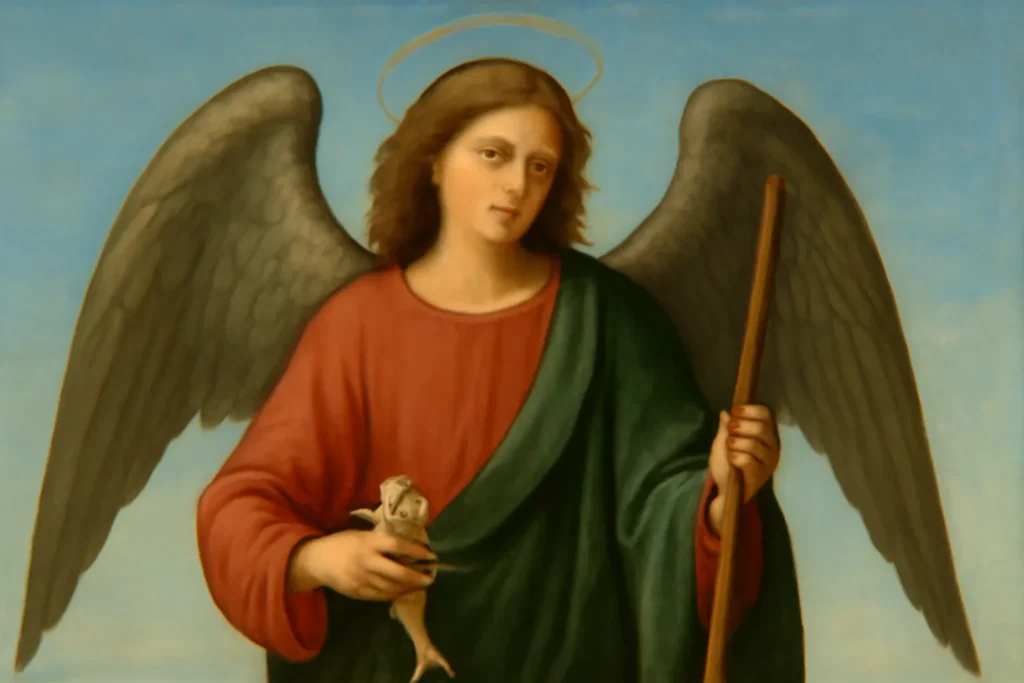
Staff or walking staff: a sign of guidance, travel, and support on the journey of life.
Fish or fish imagery: connected to the Tobit narrative, where a fish becomes a source of healing and a sign of providential care.
Book or scroll: knowledge, learning, and the transmission of divine wisdom.
Healing vessel or flask: symbolizes the healing arts and the flow of restorative energy.
Wings: traditional archangelic attributes, indicating speed, reach, and the ability to ferry human cries to heaven and divine responses back to earth.
Colors associated with Raphael
Blue or azure tones: often signify heavenly healing, clarity, and truth.
White: purity, compassion, and the purity of divine intention in service to others.
Gold or warm undertones: the radiance of divine blessing and the uplifting energy of spiritual aid.
In devotional art, Raphael’s iconography tends to present him as a luminous, approachable figure—someone who embodies the sweetness of mercy as well as the strength of divine intervention. This aesthetic communicates a message: healing and guidance are not distant abstractions but accessible, personal encounters with the divine.
Powers and Practical Roles Explained
Raphael’s powers are typically described in terms of healing, protection, guidance, and the impartation of wisdom. Here is a more detailed look at the range of abilities commonly attributed to this archangel.
Healing powers
The most prominent attribute is healing—bodily, emotional, and spiritual. Raphael is invoked in contexts ranging from medical care to soul-repair. Some key aspects include:
Bodily healing: restoration of health, relief from illness, and the restoring of vitality after injury or disease.
Emotional and psychological healing: comfort in grief, alleviation of fear, and the soothing of trauma through compassionate presence.
Spiritual healing: mending of broken relationships with the divine, rekindling faith, and guiding seekers toward reconciliation with God.
Guidance and protection on journeys
The Tobit narrative makes a clear case for guidance and protection during travel and life’s journeys. Raphael is invoked as a guardian who
helps travelers navigate danger and uncertainty
offers practical instructions that avert harm
opens paths toward healing outcomes that seem unlikely at first
Wisdom, learning, and the transmission of knowledge
As a divine messenger, Raphael also embodies the gift of knowledge. In both biblical and later mystical literature, he is connected with:
insight into medical understanding and healing practices
the transmission of practical wisdom for living a compassionate, purposeful life
the capacity to reveal hidden truths at the right moment to protect and guide the faithful
Intercession and companionship in crisis
Raphael’s presence is often described as solace in crisis—an assurance that divine compassion is at work even in dark or confusing circumstances. This aspect makes Raphael appealing to people seeking both comfort and direction when facing illness, loss, or moral conflict.
Throughout art history, painters and sculptors have used certain motifs to convey Raphael’s essence without needing words. The depiction choices help the viewer sense his attributes before any textual explanation is offered.
Classic depictions
Radiant, serene face signaling divine mercy
Blue cloak and white robes to evoke heavenly purity and healing energy
Pilgrim staff emphasizing the travel companion role
Fish imagery linked to Tobit and the healing of blindness
Modern visual culture
Contemporary devotional imagery often places Raphael in scenes of medical care, hospital chapels, or healing rituals. He may be shown standing behind a doctor, whispering guidance to a patient, or tending to a traveler at a crossroads—an artistic reminder that healing and aid come from a divine source and are accessible to modern people as they navigate the complexities of life.
How to Connect with Raphael in Daily Life
Many readers seek practical ways to invite Raphael into their routines, whether for personal healing, family protection, or spiritual growth. Here are some approaches that reflect the archangel’s traditional roles and powers.
Prayer and invocation
Offer a simple invocation such as: “Raphael, heavenly physician, guide my steps and heal what is wounded within me. Lead me toward truth, compassion, and safe paths.”
Use a short morning or evening prayer focusing on healing, guidance, and protection.
Ritual and ritual objects
Keep a small symbolic object—such as a blue-green stone, a staff ornament, or a fish symbol—as a reminder of Raphael’s healing mission.
In a personal devotional space, place a depiction of Raphael along with a glass vial or bottle to symbolize healing blessings.
Meditation and contemplation
Engage in quiet meditation focusing on themes associated with Raphael: healing, journey, and wisdom. Visualize a cool blue light surrounding you as you breathe in healing energy and exhale fear or pain.
Service and acts of mercy
Since Raphael’s work centers on healing and guidance, practical acts of mercy—volunteering, supporting healthcare workers, visiting the sick, or offering practical help to travelers and the distressed—are aligned with his call to service.
Practical Context: Healing, Science, and Spirituality
In modern times, the figure of Raphael can serve as a bridge between science, medicine, and spirituality. Acknowledging the healing power that human beings can foster through medicine, compassionate care, and community support, Raphael’s archetype encourages a holistic approach to wellbeing.
Raphael as patron of healers and travelers
Healers: physicians, nurses, therapists, and caregivers often invoke Raphael for the compassionate energy needed to heal and to comfort.
Travelers: anyone moving through uncertain terrain—whether literal travel or life transitions—may call on Raphael for safe passage and protection.
Integrating science and spirituality
Raphael’s healing motif allows for a dialogue between empirical practice and spiritual care. While modern medicine relies on evidence and technique, the arcing presence of Raphael invites a sense of ethical care, emotional support, and hope—all essential for holistic healing.
Like many ancient figures, Raphael’s image can be misunderstood or simplified. Here are a few clarifications to keep the understanding accurate and meaningful.
Myth vs. canonical text
Misconception: Raphael is a lone figure who stands apart from other archangels in the canonical Bible. Reality: Raphael is named in Tobit, which is considered canonical in some traditions and apocryphal in others; his status as an archangel is well established in Catholic and Orthodox traditions, even if not universally named in all Christian canons.
Misconception: Raphael’s role is only healing. Reality: Healing is central, but his broader mission includes guiding, protecting, and transmitting divine knowledge to humanity.
Over-simplifications in popular culture
Misconception: Raphael appears only in medical or hospital settings. Reality: His symbolism covers a wide range—travel, spiritual awakening, moral discernment, and the healing of relationships, not just physical illness.
Misconception: Healing means instant miracles. Reality: Raphael’s healing work often involves patient, long-term processes, including preparation, prayer, and practical action.
Historical and Scholarly Reflections
Scholarly reflections on Raphael emphasize the way this archangel embodies the concept of divine intervention that is both transcendent and immanent. In art history, theological discourse, and devotional practice, Raphael represents the convergence of mercy, knowledge, and practical care—an archetype that invites believers to participate in healing as a communal and ongoing endeavor.
Conclusion: Why Raphael Matters Today
In a world where healing is often a complex blend of medicine, community support, and spiritual resilience, the figure of the Raphael Archangel speaks with enduring relevance. His name—literally a statement of divine mercy—remains a reminder that healing is not merely a medical event but a life process that involves courage, guidance, and compassionate action. Whether you encounter Raphael in sacred texts, in a painting that lightens a mood, or in the quiet practice of prayer and reflection, the archangel offers a model of humane, patient care and steadfast support.
Canonical presence: Named in Tobit as one of the archangels who stand before God.
Primary powers: Healing (bodily, emotional, spiritual), guidance, protection, and the transmission of divine wisdom.
Symbolism: Staff, fish, book, wings, and color motifs (blue, white, gold).
Devotional practice: Prayer, meditation, acts of mercy, and symbolic rituals to invite healing and guidance.
Modern relevance: Bridge between medicine and spirituality; a patron for healers and travelers in contemporary life.
As you explore the meaning, symbolism, and powers attributed to the Raphael Archangel, you may discover a rich framework for approaching healing and guidance in your own life. Whether you are seeking relief from illness, a clearer path through a difficult journey, or a renewed sense of compassionate purpose, Raphael’s archetypal presence offers a timeless invitation: that healing is a divine gift accessible to all who call upon it with faith, courage, and active care.









Leave a Reply