The phrase Seven Deadly Sins refers to a traditional list of vices that early Christian and medieval theologians described as the root causes of many other sins. Although the Bible does not present a single, official catalog titled the seven deadly sins, this framework emerged from a long process of moral reflection, biblical exegesis, and pastoral teaching. In many Christian traditions, the list is also called the seven capital sins or the cardinal sins (cardinal meaning principal or pivot). This article traces the origins, meanings, and biblical context of this influential moral schema, and it considers how it has shaped faith, art, and everyday life across centuries.
Origins and Historical Development
Early Christian Thought: From Logismoi to Moral Taxonomies
In the earliest centuries of Christian reflection, desert fathers and theologians wrestled with how human beings fall into sin. The Greek term often translated as “evil thoughts” or “logismoi” described repetitive patterns of temptation that unsettled the soul. While Evagrius Ponticus was not the first to catalog these temptations, his influential formulations laid a groundwork for later moral psychology. The idea that certain persistent thoughts or dispositions drive a wide range of sinful behavior would eventually crystallize into a recognizable list in Western Christianity.
The rhetorical and pastoral goal behind naming these vices was practical: to help monks, clergy, and lay Christians identify their habitual sins, confess them, and seek virtue through discipline, prayer, and solidarity. In this sense, the project was less about cataloging Scripture and more about guiding conscience, reform, and spiritual growth.
Pachomius, Desert Fathers, and Monastic Practice
Long before the Latin West coined a formal list, early monastic communities in Egypt and Syria emphasized self-examination and ascetic practice. The life of the deserts fostered a language of temptations—an array of impulses that could entangle the soul. In some ways, the monastic tradition contributed to a culture in which certain vices were singled out as especially dangerous to solitary practice and communal harmony. The emphasis on self-discipline, fasting, watchfulness, and humility set the stage for later ethical systems that would consolidate these ideas into a compact, teachable set of sins.
Pope Gregory I and the Codification into Seven
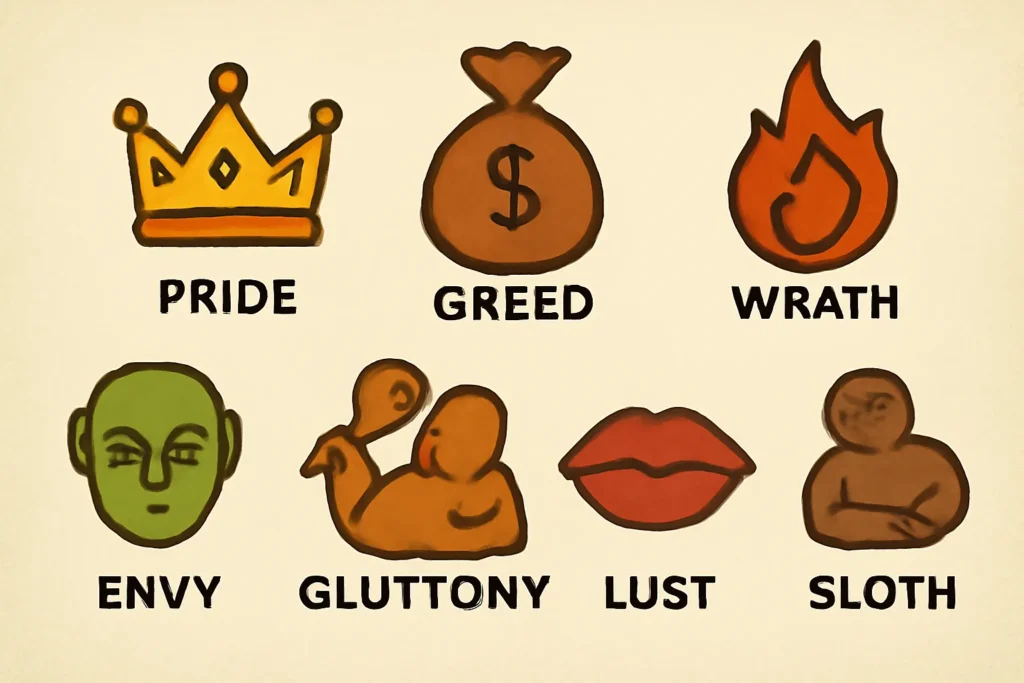
The turning point in the medieval shaping of the list came with Pope Gregory I (also known as Gregory the Great) in the late 6th century. Gregory synthesized and refined earlier ideas into a compact roster of seven deadly sins, sometimes called the seven capital sins or the seven cardinal sins. His formulation is usually given as:
Pride
Greed (Avarice)
Lust
Envy
Gluttony
Wrath
Sloth (acedia or spiritual laziness)
Gregory’s project was not merely to name sins but to present a hierarchical system in which each vice represents a fundamental disposition that can lead a person away from virtue. The ordering is often read as a progression: pride at the root of all other sins, followed by the other vices that may spring from that condition. Gregory’s list became the standard in Western Christianity and deeply shaped catechesis, preaching, and art for centuries.
Dante, Scholastic Synthesis, and Medieval Popularization
In the medieval period, the seven deadly sins became a dominant motif in literature, theology, and visual culture. Dante Alighieri’s Divine Comedy (early 14th century) imports the seven sins into the moral landscape of the afterlife, giving each sin a distinctive punishment that allegorically mirrors the vice. This literary channel helped popularize the list beyond cloistered communities and into the broader culture.
Scholastic thinkers, most notably Thomas Aquinas, engaged with the seven deadly sins within a broader framework of virtue ethics and natural law. Aquinas treated these vices as perverse orientations of the human will—distorted loves that misdirect desire away from the good. His synthesis connected the cardinal sins with the cardinal virtues, creating a comprehensive moral map: each deadly sin corresponds to a virtuous antidote, and the spiritual life is a process of aligning loves with God and neighbor.
The Seven: A Theological Map of Vice
The canonical list of the seven deadly sins—Pride, Greed (Avarice), Lust, Envy, Gluttony, Wrath, and Sloth—has been expressed and interpreted in multiple ways across centuries. While the ordering varies in some sources, the core set remains remarkably stable in Western Christian tradition. Each sin is a complex moral psychology: not merely an isolated action, but a pattern of disordered loves that warps the will, shapes behavior, and harms both the person and the community.
Pride
Definition: An inflated sense of self-importance, a demand for superiority, and a preference for one’s own will over God’s will.
Biblical flavor: Pride is frequently named in Scripture as the root of many misdirections. Proverbs 16:18 warns that “Pride goes before destruction, a haughty spirit before a fall.”
Pastoral note: Pride often masquerades as self-sufficiency or independence, making humility a key Christian virtue.
Greed (Avarice)
Definition: An excessive love of wealth or material security that eclipses concern for others and for God.
Biblical flavor: The Bible warns against greed in multiple places, sometimes under the banner of covetousness or misused stewardship. Luke 12:15 cautions, “Watch out! Be on your guard against all kinds of greed; life does not consist in an abundance of possessions.”
Pastoral note: Greed disrupts community by prioritizing possessions over persons and by fostering envy and exploitation.
Lust
Definition: An inordinate or disordered desire for sexual pleasure that objectifies others and distorts relationships.
Biblical flavor: Lust is often linked to the misuse of sexual gifts and to desires that overpower reason and charity. Jesus’ teaching in Matthew 5 and 6 addresses how lust can corrupt intention and action.
Pastoral note: The moral emphasis is not merely prohibition but transformation—cultivating chastity, fidelity, and respect for others as persons.
Envy
Definition: A resentful longing for what others possess, coupled with a desire to see their misfortune or a desire to possess what belongs to another.
Biblical flavor: Envy disrupts community trust and love. The commandment to love one’s neighbor as oneself counters envy by orienting the heart toward generosity and solidarity.
Gluttony
Definition: Excessive or improper indulgence in food or drink, often understood as any overconsumption that distracts from higher goods.
Biblical flavor: Biblical texts emphasize temperance and stewardship, and gluttony is commonly seen as a misdirected appetite that can crowd out compassion and hospitality.
Wrath
Definition: Excessive anger or a desire for vengeance that can sour judgment and destroy reconciliation.
Biblical flavor: Wrath is treated as a distortion of righteous zeal and is set against the fruit of the Spirit, which includes peace and self-control.
Sloth
Definition: A spiritual laziness or acedia; a reluctance to pursue moral or spiritual good, sometimes described as a failure to love or to persevere in virtue.
Biblical flavor: Sloth is not mere laziness but a failure to respond to God’s grace, resulting in a stagnant or withdrawn life of faith.
Across centuries, theologians have treated these seven capital vices as interconnected: pride underlies greed, lust, envy, gluttony, wrath, and sloth; a corrected life involves cultivating the corresponding cardinal virtues—humility, charity, chastity, gratitude, patience, and diligence (and the virtue of hope and temperance more broadly). The practical aim of this moral map is not punitive punishment but conversion: to reorder loves so that God and neighbor stand at the center of human desire.
Biblical Context: How the Seven Relate to Scripture
A common question about the seven deadly sins is whether they appear in the Bible by name. The short answer is: not as a single, explicit list. The longer answer is that biblical ethics, narrative, and wisdom literature continually address themes that the medieval list later organized under the umbrella of these vices. The Bible contains many passages that illuminate each sin and its antidotes, and the tradition of moral theology draws a web of connections between biblical exhortations and the later taxonomy.
Pride as a recurrent biblical theme
Pride is portrayed in Scripture as a dangerous orientation of the heart. It appears in creation narratives as humanity’s attempt to “be like God” (Genesis 3) and recurs in warnings against arrogance before God and others. The Psalms and Proverbs repeatedly condemn pride as destructive and advocate humility, trust, and reverence.
Greed or avarice is treated as a form of idolatry—placing wealth or security ahead of God. Jesus warns against storing up treasures on earth (Matthew 6:19-21) and teaches about the dangers of wealth’s disruptiveness to relationship with God. The Epistles likewise critique greed as incompatible with the life of faith.
Lust and the ethics of desire
The biblical tradition does not condemn sexual desire itself but calls for its proper channeling within responsible, faithful relationships. Jesus’ teaching, Paul’s exhortations about sexual integrity, and wisdom literature all articulate a vision of desire ordered toward love, self-control, and mutual respect.
Envy is treated as a corrosive force that fractures community life. Biblical writers exhort generosity, contentment, and reconciliation as antidotes to envy, emphasizing that love of neighbor is the primary proof of true righteousness.
Gluttony and temperance in worship and life
Gluttony intersects with questions of temperance, stewardship, and hospitality. In biblical terms, self-control and moderation are virtues that keep the heart oriented toward God and neighbor, while excess can lead to social harm and spiritual dullness.
Wrath, justice, and righteous anger
Wrath in Scripture is a nuanced theme. While God is described as righteous and just, the Bible often urges believers toward mercy, reconciliation, and the long arc of peace. The moral ethic distinguishes righteous zeal for justice from uncontrolled anger that wounds the soul and others.
Sloth, fidelity, and the call to perseverance
Sloth in biblical terms is tied to a calling to faithful endurance—an exhortation to persist in prayer, good works, and worship. The New Testament letter writers encourage steadfastness and diligence as expressions of living faith.
In sum, the biblical context for the seven deadly sins is less a ready-made list of “these seven” and more a robust map of human temptation, moral formation, and the ongoing work of conversion in light of the gospel. Medieval theologians gathered concrete patterns from Scripture and from Christian life to articulate a framework that could be taught, preached, and embodied in communities.
Seven Variants, Seven Names: Terminology and Semantic Breadth
Scholars and translators often use a spectrum of terms to discuss the same ethical concerns. In addition to seven deadly sins, you may encounter references to the seven capital sins, the seven cardinal sins, or even discussions of capital vices. Some literature prefers the phrase mortal sins in a different theological sense, though mortal sins is a broader category in Catholic moral theology referring to sins that break a person’s relationship with God and destroy charity. The language shifts across cultures and eras, but the core ethical concerns remain recognizable.
Impact on Culture: Art, Literature, and Catechesis
The influence of the seven deadly sins extends well beyond theology into art, music, literature, and popular sermons. In medieval cathedrals, visual cycles depicted each sin in ways designed to teach the faithful about moral dangers; in literature, authors used the framework to stage moral tests and personal transformations. The Dantean map of Hell, for example, personifies these vices and links them to specific circular punishments, turning abstract moral categories into vivid, memorable narratives.
In catechism manuals, the vices function as teaching tools: each deadly sin is paired with a virtue, a practical antidote that believers can cultivate in daily life. The pedagogical aim is twofold: to warn against misdirected loves and to invite the acquisition of the corresponding virtues—humility in place of pride, charity in place of greed, chastity in place of lust, kindness instead of envy, temperance instead of gluttony, patience instead of wrath, and diligence instead of sloth.
Contemporary Relevance: Questions, Critiques, and Reinterpretations
In modern scholarship and pastoral practice, the traditional list remains influential but is often presented with caveats. Some readers emphasize that the Bible does not specify the seven as an exhaustive catalog; others note that the vices overlap with other moral categories, such as sins of omission (nihil acts) and social sins rooted in injustice. Contemporary theologians tend to present the seven deadly sins as part of a broader moral ecology: a set of lenses through which to examine motives, desires, and social structures, rather than a rigid checklist.
Debates about moral psychology in the ancient and medieval church also highlight how the list functions pastorally. Critics sometimes argue that a rigid list can oversimplify moral life or stigmatize certain dispositions, while defenders claim that a well-ordered list helps believers diagnose, confess, and pursue transformation. In many modern contexts, the “seven habits” are framed as opportunities for spiritual formation, not as condemnations of character.
Practical Applications: How to Engage with the Seven Deadly Sins Today
Self-examination: Use the list as a mirror to observe habitual patterns of desire and behavior. Journaling, prayer, or spiritual direction can help uncover hidden attachments that distort love.
Virtue cultivation: For each vice, cultivate its opposite virtue. The goal is not guilt but growth—humility, generosity, chastity, gratitude, patience, and perseverance are concrete anchors for daily living.
Community discipline: Christian communities often use shared practices—confession, accountability groups, and mercy ministries—to support members in overcoming vice and embracing virtue.
Scriptural engagement: Read biblical passages that illuminate each vice and its antidote. Contextual reading helps believers discern how ancient wisdom informs contemporary ethics.
Pastoral reflection: Pastors and theologians can present the seven deadly sins as a heuristic—an accessible gateway to deeper moral and spiritual formation—without reducing moral life to a checklist.
Conclusion: The Enduring Message of the Seven Cardinal Sins
The Seven Deadly Sins—in its various names and forms—offers a historically rich map of human frailty and moral growth. From the cloistered cells of the early monasteries to the bustling pulpits of modern churches, this ethical framework has sought to illuminate how disordered loves distort not only personal virtue but also communal life. Its enduring value lies in its invitation to examine the heart: to recognize the impulses that pull us away from love of God and neighbor, and to pursue a life governed by humility, charity, temperance, patience, and other virtues that sustain human flourishing.









Leave a Reply