Shekinah glory means the manifest presence of God dwelling among his people. The word comes from the Hebrew root shakan, meaning “to dwell” or “to settle,” although Shekinah itself does not appear as a standalone word in the Hebrew Bible.
The expression developed in later Jewish interpretation and became common in Christian teaching. It refers not to a separate being or divine substance, but to the way God makes his presence known—sometimes through glory, fire, cloud, light, or holiness, and sometimes through the quiet reality that God is with his people.
Shekinah is an English spelling of a Hebrew term often transliterated as Shekhinah. It is related to a Hebrew verb meaning to dwell, reside, or remain. The underlying idea is that the transcendent God chooses to be present in a particular place or among a particular people.
That idea addresses a significant biblical question: How can the God who created heaven and earth be present with human beings? Biblical writers describe God as present everywhere, yet they also describe specific places where his presence is recognized in a distinctive way. The Shekinah concept gives language to that special, experienced presence.
In Jewish tradition, the Shekhinah is often associated with God’s presence among Israel, in the tabernacle, in the Temple, and with faithful communities gathered for prayer or study. It does not mean that God is limited to a building. Rather, a sacred location or gathered community can become a visible reminder of God’s nearness.
Christian writers use Shekinah glory in a similar but often more explicitly Christ-centered way. They may use it to describe the glory of God revealed in the tabernacle, the Temple, the transfiguration of Jesus, or the presence of God among believers. The phrase is especially common in sermons, worship settings, and theological writing about God’s visible or powerful presence.
Plain meaning: Shekinah glory is a theological term for God’s dwelling and manifest presence. It does not describe an independent angel, force, or fourth member of the Trinity.
The phrase combines two ideas that overlap but are not identical. Shekinah emphasizes dwelling or presence, while glory points to the majesty, honor, radiance, and weight of God’s revealed character. Together, the words describe God making his holy presence known among people.
Why the word Shekinah is not found in the Bible
Readers often search the Bible for the exact word Shekinah and are surprised not to find it. The term is not used as a noun in the Hebrew Bible or in the New Testament. It comes from later Jewish interpretive tradition, where teachers used language based on shakan to describe biblical passages about God dwelling among Israel.
This does not mean the idea is unrelated to Scripture. The Bible repeatedly says that God dwells among his people, fills sacred places with glory, and reveals his presence through signs such as cloud and fire. Shekinah is a later label for a biblical pattern rather than a biblical character or technical name for God.
Several biblical passages use forms of the Hebrew root connected with dwelling. Exodus 25:8 describes God’s desire for a sanctuary among the Israelites, and Exodus 29:45–46 presents the Lord as dwelling among them. These passages provide much of the conceptual background for later discussions of the Shekhinah.
The New Testament also uses dwelling language when describing God’s presence. John 1:14 presents Jesus as dwelling among humanity and connects that presence with divine glory. The wording draws on the imagery of God’s tent or tabernacle among Israel, while Christians commonly interpret it as pointing to God’s self-revelation in Jesus.
Later Jewish translations and paraphrases sometimes use expressions such as “the presence of the Lord” where the biblical text speaks directly of God. This helped develop a tradition of speaking about the divine presence in a way that respected both God’s nearness and his transcendence.
It is useful to distinguish three levels of language:
Biblical language: God dwells among his people, fills the sanctuary with glory, and appears through cloud, fire, or other manifestations.
Rabbinic language: Shekhinah names the divine presence as described and interpreted in Jewish tradition.
Christian devotional language: Shekinah glory describes God’s revealed presence, often in connection with Jesus, the Holy Spirit, worship, or the church.
These categories overlap, but they should not be treated as interchangeable in every setting. A Jewish teacher and a Christian preacher may use the word Shekhinah with different theological assumptions. Understanding the term requires attention to the tradition and passage being discussed.
How the Hebrew Bible portrays God’s dwelling presence
The strongest biblical background for Shekinah glory is the tabernacle in the wilderness. After Israel’s deliverance from Egypt, God instructs the people to make a sanctuary so that he may dwell among them, as described in Exodus 25. The tabernacle is not presented as a structure that confines God. It is a covenant sign that God accompanies Israel.
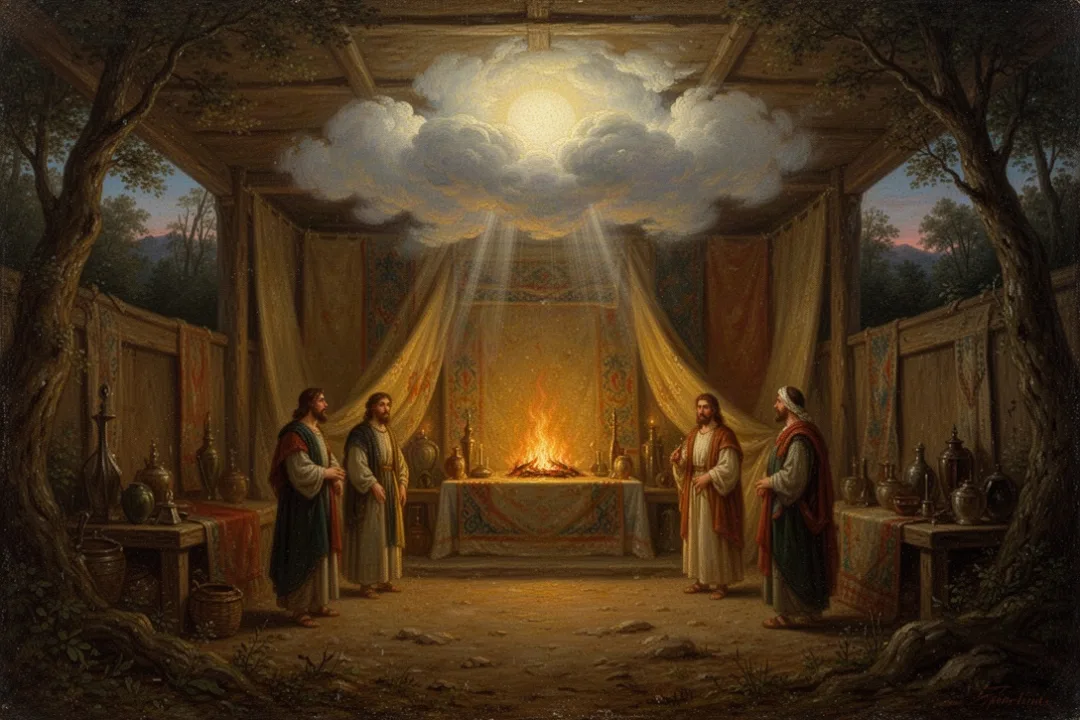
When the tabernacle is completed, a cloud covers it and the glory of the Lord fills it, according to Exodus 40:34–38. The cloud communicates both presence and mystery. It shows that God is near, while the overwhelming glory indicates that his holiness cannot be treated casually or controlled by human beings.
The cloud also serves a practical purpose in Israel’s wilderness journey. When it lifts, the Israelites travel; when it remains, they stay in place. This image links God’s presence with guidance and dependence. The people do not simply visit a holy place and then live independently. They are called to move and wait according to God’s direction.
At Mount Sinai, the divine presence is associated with cloud, fire, thunder, and a trembling mountain in Exodus 19. These signs communicate God’s holiness and authority. They should not be reduced to special effects; they represent the distance between ordinary human experience and an encounter with the living God.
The Ark of the Covenant is another important part of this imagery. It represents the covenant between God and Israel and is connected with the inner sanctuary of the tabernacle. Above the ark was the mercy seat, where biblical descriptions place the symbolic meeting point between God and his people. This does not mean God was physically contained there. It means the ark marked a sacred location for covenant communion.
When Solomon dedicates the Temple, a cloud fills the house of the Lord, as recorded in 1 Kings 8 and 2 Chronicles 5. The priests cannot continue their normal service because the glory of the Lord fills the Temple. The scene emphasizes that the building matters because of God’s presence, not because architecture itself possesses divine power.
At the same time, the biblical writers resist the idea that any building can contain God. Solomon’s prayer in 1 Kings 8 acknowledges that even the highest heavens cannot contain him. The Temple is therefore a place where God causes his name and presence to be honored, while God remains greater than every physical location.
The prophet Ezekiel gives a sobering picture of the glory departing from Jerusalem because of persistent idolatry and injustice, especially in Ezekiel 8–11. This passage shows that divine presence is not a guarantee of automatic protection. God’s holiness is connected with moral seriousness, and sacred symbols cannot shield a community that turns away from covenant faithfulness.
Later in Ezekiel, the vision of a restored Temple includes the return of God’s glory, particularly in Ezekiel 43. This restoration imagery expresses hope that God will again dwell among a renewed people. The theme of presence therefore includes judgment, departure, restoration, and renewed fellowship.
What “glory” adds to the meaning of Shekinah
In the Bible, “glory” often translates the Hebrew word kavod, which can convey weight, honor, importance, or splendor. God’s glory is not merely a bright appearance. It is the overwhelming reality of who God is—his holiness, authority, beauty, faithfulness, and power made known.
Sometimes glory is described with visible imagery. The fire and cloud at the tabernacle, the brightness associated with divine appearances, and the radiance connected with Moses after meeting God all help readers imagine the impact of divine revelation. These images communicate that God’s presence is perceptible and transformative, not an abstract idea.
Other passages describe glory without focusing on light. God’s acts of rescue, judgment, mercy, and covenant faithfulness reveal his glory. Psalm 19 connects the heavens with the declaration of God’s glory, while Isaiah 6 portrays a vision in which the whole earth is filled with God’s glory. The central point is the disclosure of God’s character, not a required visual phenomenon.
This distinction matters because people sometimes use “Shekinah glory” to mean a dramatic atmosphere in a worship service. Strong emotion, music, silence, physical sensations, or unusual events may be meaningful to participants, but none of them automatically proves that the Shekinah is present. Biblical glory cannot be measured only by intensity or outward display.
God’s revealed presence can be awe-inspiring, but it can also call people to repentance, compassion, obedience, and trust. In Isaiah 6, the prophet’s vision of God’s holiness leads to an awareness of personal uncleanness and then to a willingness to serve. The pattern suggests that genuine awareness of God’s glory changes how people live.
The New Testament develops this theme around Jesus. John 2 describes Jesus’ first sign as revealing his glory to his disciples. The transfiguration accounts in Matthew 17, Mark 9, and Luke 9 portray Jesus in radiant glory before his death. These scenes connect divine glory with Jesus’ identity, while also showing that glory cannot be separated from suffering, obedience, and resurrection.
Paul uses glory language in several ways, including the transformation of believers as they reflect the Lord’s character in 2 Corinthians 3. The emphasis is not simply on seeing a supernatural light. It is on being changed into greater conformity to Christ. For many Christians, that is a central practical meaning of Shekinah glory: God’s presence reveals him and reshapes those who receive it.
How Shekinah relates to the Temple, Jesus, and the Holy Spirit
In Jewish thought, the Shekhinah is closely connected with God’s presence among Israel, but it should not be mistaken for a physical object. The Temple, synagogue, home, community, and acts of prayer may all become settings in which God’s presence is recognized. The focus remains on God dwelling with people, not on a sacred material substance.
Christian theology often sees a major development of this theme in the person of Jesus. John 1:14 uses tabernacle-like language to describe the Word dwelling among humanity. Christians understand this as teaching that God’s presence is uniquely revealed in Jesus, whose life, teaching, death, and resurrection make the character of God known.
The Gospel accounts also connect Jesus with Temple imagery. In John 2, Jesus speaks about the Temple in a way that the Gospel later explains as referring to his body. Christian interpretation often sees this as a shift from a particular building as the central sign of God’s presence toward the person of Christ as the definitive meeting place between God and humanity.
The New Testament then extends dwelling imagery to the church and individual believers. Paul describes the community of believers as God’s temple in 1 Corinthians 3:16–17 and 2 Corinthians 6:16. In 1 Corinthians 6:19, he uses temple language for the believer’s body in relation to the Holy Spirit.
These passages do not mean that Christians become divine or that every personal feeling is a direct message from God. They mean that God’s Spirit is understood to live among and within God’s people. The concept carries both privilege and responsibility: those who claim God’s presence are called to holiness, unity, justice, and love.
Christian references to the Shekinah may therefore include several related ideas:
God’s presence in Christ: Jesus reveals God in a unique and personal way.
God’s presence through the Holy Spirit: the Spirit lives among believers and forms them into a worshiping community.
God’s presence in gathered worship: Christians may recognize God’s nearness when they pray, hear Scripture, and encourage one another.
God’s future presence: Revelation 21 portrays God dwelling with humanity in the renewed creation, completing the biblical story of divine presence.
Different Christian traditions place different emphasis on these applications. Some speak of a tangible or manifest presence during worship. Others prefer more cautious language and focus on God’s covenant promise to be with his people. Both approaches need to distinguish God’s constant presence from a particular experience of that presence.
A helpful distinction: God may be present everywhere, yet the Bible also describes moments when that presence is recognized in an unusually clear or powerful way. “Manifest presence” refers to this experienced disclosure, not to God becoming present only at that moment.
What Shekinah glory means for prayer and everyday life
The meaning of Shekinah glory becomes practical when it shapes how you understand God’s nearness. It can encourage prayer that is more than asking for things. Prayer becomes an act of turning toward the God who already sees, hears, and sustains you.
The biblical imagery also encourages reverence without fear-driven superstition. The cloud and glory at the tabernacle show that God is near, but they also show that God is holy. A healthy response includes wonder, humility, honesty, and a willingness to let God correct harmful attitudes and actions.
Shekinah language can also challenge the idea that worship depends on a particular emotional atmosphere. A congregation may experience deep joy, quiet reflection, or ordinary faithfulness without dramatic signs. God’s presence should not be judged only by volume, visible excitement, or unusual physical reactions.
For Christians, awareness of God’s dwelling presence should influence relationships and conduct outside church gatherings. If believers are described as a dwelling place of the Spirit, then the way they treat neighbors, strangers, the vulnerable, and one another matters. Presence and ethics belong together.
For Jewish readers, the concept can point toward the sacredness of communal life, prayer, study, hospitality, and covenant responsibility. Traditional Jewish interpretations often emphasize that the divine presence is found not merely in an impressive sanctuary, but among people who honor God and live faithfully.
You can reflect on the meaning of Shekinah glory through questions such as these:
Where do I recognize God’s presence? Consider Scripture, prayer, community, service, creation, or moments of moral clarity.
How does awareness of God change my conduct? Look for patience, truthfulness, mercy, courage, and responsibility rather than only emotional intensity.
Am I treating sacred language carefully? Avoid using “Shekinah” to claim certainty about every unusual experience or to manipulate other people.
Do I separate God’s presence from a specific building? Sacred spaces can help people worship, but God is not confined to them.
The theme also offers comfort during seasons when God seems hidden. Biblical accounts include both overwhelming manifestations and long periods of waiting. The absence of a dramatic experience does not necessarily mean the absence of God. Shekinah points to a promise of dwelling presence, not a demand that you always feel spiritually charged.
At the broadest level, Shekinah glory describes the mystery of the holy God choosing to live among human beings. The tabernacle, Temple, Christ, Holy Spirit, gathered community, and renewed creation all contribute to this biblical pattern. The term is later than the Bible, but it gathers together a theme that runs through the whole story of Scripture: God is not distant from his people and does not abandon his purpose to dwell with them.
Frequently asked questions
Is Shekinah glory the same as the Holy Spirit?
Not exactly. Shekinah is a term for God’s dwelling or manifest presence, while the Holy Spirit is described in Christian theology as a divine person. Christian writers may connect the Holy Spirit with Shekinah glory because the Spirit represents God’s presence among believers, but the two terms should not be treated as synonyms.
Does Shekinah glory always appear as light or fire?
No. Light, fire, cloud, and radiance are important biblical images, but Shekinah refers more broadly to God’s revealed presence. Scripture also connects God’s presence with guidance, holiness, mercy, covenant faithfulness, and transformed lives. A dramatic visual or emotional experience is not required for the concept to apply.
Can a church building contain the Shekinah?
A church building can be used for worship and may feel sacred to a community, but Christian teaching generally does not present God as physically confined to a building. The New Testament emphasizes God’s presence among believers and through the Holy Spirit. The building can serve worship without becoming a container for God.
How should someone pronounce Shekinah?
In American English, it is commonly pronounced “shuh-KYE-nuh,” though pronunciations vary because the word is transliterated from Hebrew. You may also see the spelling “Shekhinah,” which more clearly represents the Hebrew consonant often rendered with “kh.” Both forms refer to the same term.








Leave a Reply