Story of Abraham and Isaac in the Bible: Meaning and Context
Story of Abraham and Isaac in the Bible: Meaning and Context
The story of Abraham and Isaac appears in Genesis 22. God tells Abraham to take Isaac, his beloved son, to the land of Moriah and offer him there; Abraham obeys, but an angel stops him before Isaac is harmed. A ram caught in a nearby thicket becomes the sacrifice instead, showing that Isaac is spared and that the account ends with God’s provision rather than a completed human sacrifice.
The passage is often called the binding of Isaac, or the Akedah in Jewish tradition. It raises difficult questions about obedience, trust, sacrifice, and the character of God. Its meaning becomes clearer when you read it alongside the promises, failures, and family history recorded earlier in Genesis.
Where the story of Abraham and Isaac fits in Genesis
Abraham’s story begins with God’s call to leave his homeland and travel toward a land God will show him. God promises to make him a great nation and to bless other peoples through his family. That promise matters in Genesis 22 because Abraham’s future depends on the son God gave him.
Abraham and Sarah wait a long time for their promised child. Their first son, Ishmael, is born through Hagar, Sarah’s servant, but Isaac is the son associated with the covenant promise in the Genesis narrative. Isaac’s name is connected with laughter because Sarah and Abraham respond with disbelief and joy to the announcement that they will have a child in old age.
Genesis 21 describes Isaac’s birth and the departure of Hagar and Ishmael from Abraham’s household. It also describes a covenant between Abraham and Abimelech. Genesis 22 follows these events with the phrase that God tested Abraham, making the purpose of the command explicit from the beginning for the reader, even though Abraham does not receive that explanation in the same way.
The story step by step in Genesis 22
God tests Abraham. God calls Abraham and commands him to take Isaac, his only son in the relevant promise, to Moriah and offer him there. The wording emphasizes Isaac’s unique place in Abraham’s life and in the promise.
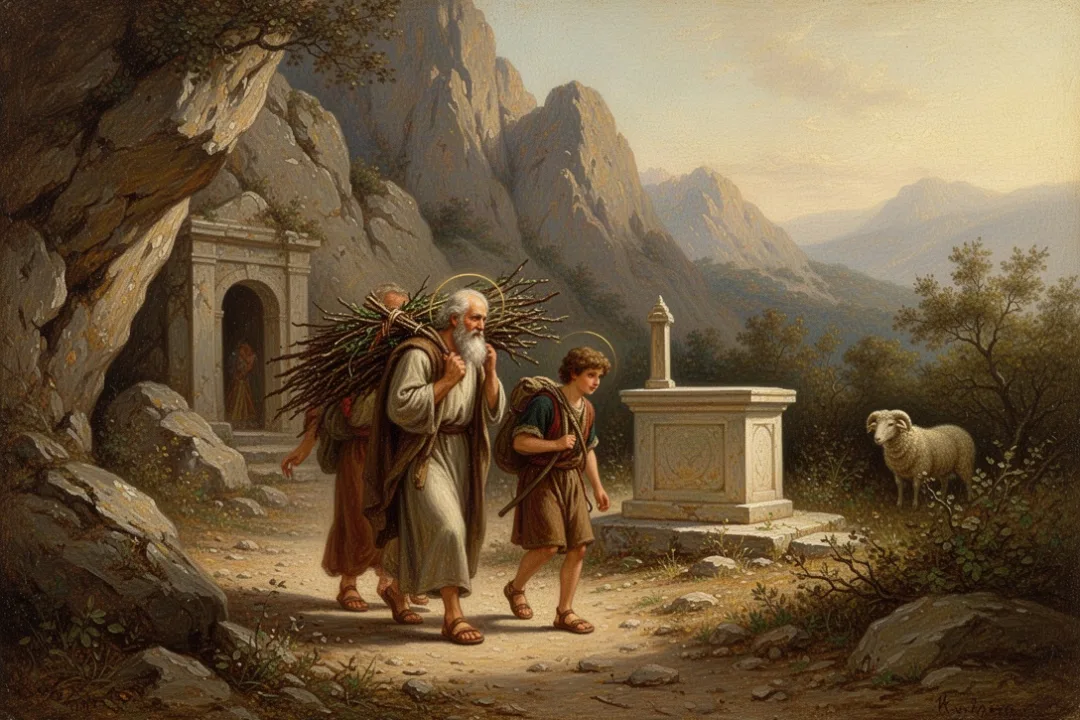
Abraham travels with Isaac. He takes two servants, a donkey, wood for the offering, fire, and a knife. The journey lasts three days, creating a deliberate period of anticipation before the climactic moment.
Abraham and Isaac continue alone. Abraham tells the servants that he and Isaac will worship and return. Isaac carries the wood, while Abraham carries the fire and knife.
Isaac asks about the offering. He notices that they have wood and fire but no animal. Abraham answers that God will provide the lamb for the offering, a statement that becomes significant when the story reaches its turning point.
Abraham prepares the altar. At the appointed place, he builds an altar, arranges the wood, binds Isaac, and places him on it. The text presents this as a serious act rather than a symbolic conversation with no danger.
God stops Abraham. As Abraham takes the knife, the angel of the Lord calls to him from heaven and commands him not to harm Isaac. The test has reached its decisive moment.
A ram replaces Isaac. Abraham sees a ram caught by its horns in a thicket and offers it as a burnt offering. He names the place in connection with the Lord’s provision.
God reaffirms the promise. Afterward, the angel declares that Abraham has not withheld his son and repeats promises concerning descendants, blessing, and the nations. The chapter ends with news about Abraham’s wider family.
Central point: Genesis 22 does not describe Isaac being killed. The command is interrupted, Isaac is released, and a ram is sacrificed in his place.
Why God tests Abraham in the biblical account
Genesis says directly that God is testing Abraham. That does not mean God lacks information and needs to discover Abraham’s character. The test brings Abraham’s response into the open and demonstrates what his faith looks like when the promise seems impossible to preserve.
The command appears to threaten the very promise God made. Isaac is the son through whom Abraham’s family line is to continue, yet God asks Abraham to surrender him. The tension is intentional: Abraham must act while facing a situation he cannot reconcile by ordinary reasoning.
The passage does not present testing as proof that God routinely asks people to imitate Abraham by placing loved ones in danger. The command belongs to this particular narrative and is stopped by God. A responsible reading should distinguish descriptive biblical events from instructions for modern behavior.
What Abraham’s obedience means in Genesis 22
Abraham’s obedience is shown through action. He rises early, prepares for the journey, takes the required materials, and continues to the place God identifies. The text gives little direct access to his emotions, so readers should be cautious about claiming that he felt no fear or doubt.
His response also includes trust in God’s promise. When he tells the servants that he and Isaac will return, the statement may indicate confidence that Isaac will somehow come back with him. The passage does not explain exactly how Abraham understands God’s plan, so several interpretations remain possible.
Later biblical writers use Abraham as an example of faith expressed through obedience. Hebrews 11 presents him as trusting God even when asked to offer Isaac, while James 2 connects Abraham’s faith with action. These later references interpret the event, but they do not remove the story’s emotional and ethical difficulty.
What Isaac’s role adds to the story
Isaac is not merely an object in the narrative. He carries the wood, asks a perceptive question, and goes with Abraham to the altar. The account does not clearly state Isaac’s age. He is old enough to carry wood and understand that a sacrifice requires an animal, but the text does not provide enough information to identify him confidently as a child, teenager, or adult.
Isaac’s question about the missing animal creates the story’s central tension. Abraham has brought everything needed for the offering except the victim. His answer about God providing the lamb can be read as trust, as a guarded response to a painful question, or both.
The Hebrew verb often translated “bound” gives the account its traditional name, the binding of Isaac. The narrative does not record Isaac’s speech after the angel intervenes. That silence has led Jewish, Christian, and literary interpreters to consider what Isaac may have understood, feared, or remembered.
What Moriah and the altar contribute to the meaning
God directs Abraham to a region called Moriah. Genesis 22 does not give a detailed description of the location beyond identifying the destination and the mountain. Later biblical tradition connects Moriah with the temple area in Jerusalem through 2 Chronicles 3, although the Genesis passage itself does not spell out every part of that connection.
The mountain setting separates the event from ordinary life. Abraham leaves the servants behind, climbs with Isaac, builds an altar, and waits for God’s command. The physical ascent mirrors the spiritual pressure of the narrative: each step brings him closer to an act he cannot undo without divine intervention.
Altars in Genesis mark encounters with God, acts of worship, and responses to divine promises. Here the altar initially appears to be the place where Isaac will die, but it becomes the place where God provides a substitute. That reversal is central to how the story presents worship and sacrifice.
Why the ram matters as a substitute
When Abraham sees a ram caught by its horns, he offers it instead of Isaac. The animal is not an incidental detail. It gives concrete form to Abraham’s earlier statement that God would provide and changes the outcome from human death to animal sacrifice.
The ram also helps distinguish Genesis 22 from religious practices in which a human being is actually offered. The narrative presents God as stopping the sacrifice of Isaac, not accepting it. The replacement therefore functions as a substitution and as evidence of provision.
Abraham names the place in relation to the Lord’s seeing or providing, depending on how the Hebrew expression is translated and interpreted. The name preserves the memory of what happened there: Abraham faced an impossible demand, and God supplied what was needed at the decisive moment.
Read the ending carefully: The ram is not a minor rescue detail. It is the story’s answer to the missing sacrifice and the clearest sign that Isaac’s life is preserved.
How the covenant promise shapes the tension
God’s earlier promises to Abraham make Isaac more than a beloved son. Isaac is tied to the future of Abraham’s household and descendants. If Isaac dies, the promise appears to collapse, which is why Genesis 22 feels like a direct confrontation between God’s command and God’s previous word.
Genesis often develops its themes through repeated promises and threats to those promises. Abraham has already faced uncertainty about land, descendants, family safety, and the delay before Isaac’s birth. The test on Moriah gathers these themes into one extreme scene.
The story does not say that Abraham understands every detail. Its focus is on whether he will trust the God who made the promise, even when the immediate command seems to put that promise at risk. The later reaffirmation of blessing shows that the covenant continues after the test.
What the story says about human sacrifice
Readers often ask whether Genesis 22 endorses human sacrifice. The narrative does not. God commands Abraham to offer Isaac, but then explicitly prevents him from doing so. The only completed sacrifice in the scene is the ram.
The Bible contains other passages that condemn the sacrifice of children, especially when associated with pagan worship. Leviticus 18 and Deuteronomy 12 warn Israel against practices that give children to a deity, while later prophetic passages condemn such acts. Those texts help establish that the Genesis narrative should not be used to justify harming children.
The moral shock of the story remains real even with that distinction. A reader does not need to minimize the command in order to understand the ending. The narrative creates a genuine ethical crisis and resolves it through divine intervention, not through an argument that the crisis was insignificant.
Jewish interpretations of the binding of Isaac
In Jewish tradition, the Akedah is a major subject of interpretation, prayer, and remembrance. The story can be read as a profound account of Abraham’s faith, Isaac’s participation, God’s mercy, and the significance of the ram. Jewish interpretations are diverse, so no single explanation represents every Jewish reader.
Some interpretations focus on Abraham’s willingness to follow God and on the merit associated with his faithfulness. Others give more attention to Isaac, including his willingness to be bound and the spiritual meaning of his experience. The narrative’s sparse description of Isaac’s emotions leaves room for sustained reflection.
The ram’s horns also carry symbolic associations in Jewish worship because the shofar is traditionally made from a ram’s horn. The connection does not mean that every detail of Genesis 22 should be reduced to one symbol, but it shows how the story has continued to shape Jewish religious memory.
Christian readings of Abraham and Isaac
Christian readers often connect the story with themes of faith, sacrifice, substitution, and God’s provision. Hebrews 11 refers to Abraham’s trust in God’s ability to fulfill the promise even in the face of death. James 2 uses Abraham’s action to illustrate faith demonstrated through obedience.
Many Christian interpreters also see a pattern that points forward to Jesus: a beloved son, a sacrificial setting, and provision in connection with sacrifice. This is a theological interpretation of the Genesis account rather than a claim that Isaac and Jesus are identical figures or that Genesis 22 directly narrates the New Testament events.
Christian traditions differ in how strongly they emphasize this connection. Some focus on substitution and the ram; others highlight Abraham’s faith, the Father’s giving of the Son, or the contrast between Isaac being spared and Jesus’ crucifixion. Reading Genesis 22 in its own context first helps prevent later interpretations from erasing the original narrative.
How the Islamic tradition differs on Abraham’s son
The Quran tells a related account of Abraham being tested in connection with offering his son, but it does not name the son in the relevant passage. Islamic interpretation has historically included disagreement about whether the son was Ishmael or Isaac, with many Muslim traditions identifying him as Ishmael.
That distinction matters when someone asks specifically for the Bible story. The biblical account in Genesis 22 names Isaac. Islamic retellings may share themes of obedience, divine provision, and a son spared from sacrifice while differing in the son’s identity and surrounding details.
It is more accurate to describe these as related Abrahamic traditions than to blend them into one account. Respectful comparison recognizes both the shared themes and the differences in scripture, names, interpretation, and religious meaning.
Common misunderstandings about Genesis 22
Isaac was sacrificed. He was bound and placed on the altar, but God stopped Abraham before he killed him. The ram was sacrificed instead.
The Bible says Isaac was a small child. Genesis does not give his age. His ability to carry wood shows that he was not an infant, but it does not establish a precise age.
Abraham acted without any promise of return. His statement to the servants suggests that he expected to return with Isaac, though the text does not explain exactly how he expected that to happen.
The story teaches that every religious command should be obeyed without question. Genesis 22 records a unique event that ends with God rejecting the killing of Isaac. It is not a general license for violence or abuse.
The ram is only a convenient ending. The substitute is central to the meaning of the passage and fulfills the story’s emphasis on God’s provision.
What the story reveals about Abraham as a father
Abraham is shown both as a faithful servant and as a father placed under unbearable pressure. The narrative does not provide a private conversation between Abraham and Sarah about the journey, nor does it describe the family’s response afterward. That omission makes the account more austere and leaves important emotional questions unanswered.
His love for Isaac is stated directly before the command. The test therefore involves not an abstract possession but the child Abraham loves and through whom he expects God’s promise to continue. Abraham’s obedience cannot be separated from the personal cost presented by the text.
At the same time, the account does not ask readers to praise emotional detachment. Abraham’s silence may show restraint, shock, trust, or the narrative’s deliberate economy. The safest conclusion is that the story emphasizes his actions while leaving his inner experience partly hidden.
How to read the ethical difficulty honestly
A careful reading should allow two truths to stand together: Genesis presents Abraham as trusting God, and the command to sacrifice a child is morally disturbing. Pretending that the command is easy weakens the passage rather than strengthening it. The story is designed to test the reader’s understanding of faith, authority, and divine goodness as well as Abraham’s obedience.
Readers should also distinguish the biblical narrative from modern claims that God has ordered a person to harm someone else. Any voice that directs violence, abuse, or the killing of a child should not be treated as validated by Genesis 22. The passage itself ends with a prohibition against harming Isaac.
For personal study, it can help to ask several focused questions:
What promises has God already made in the chapters before Genesis 22?
What does Abraham know, and what remains unknown to him?
How does Isaac’s question expose the tension in the scene?
Why does the story emphasize the ram and the naming of the place?
How do later biblical books interpret Abraham’s faith?
What ethical conclusions are supported by the ending, and which conclusions go beyond the text?
Where to read the full account and related passages
Read Genesis 22:1–19 for the complete account of Abraham’s test, Isaac’s binding, the angel’s intervention, the ram, and the reaffirmation of blessing. Genesis 21 provides the immediate family context, including Isaac’s birth and the separation of Hagar and Ishmael.
For later biblical reflection, read Hebrews 11:17–19 and James 2:21–24. These passages emphasize different aspects of Abraham’s response. Hebrews highlights trust in God’s promise, while James stresses that faith is shown through action.
When comparing religious traditions, read the relevant Quranic passage in its own context rather than assuming it reproduces Genesis word for word. The shared Abrahamic themes are significant, but the identity of the son and some details differ across traditions.
What the story of Abraham and Isaac means as a whole
Genesis 22 is a story about a faith that is tested at the point where God’s promise seems impossible. Abraham is asked to surrender Isaac, but Isaac is not killed. God stops the act, provides a ram, and reaffirms the covenant promise.
The passage therefore holds together obedience and anguish, promise and apparent contradiction, and sacrifice and substitution. Its central movement is not from command to completed child sacrifice, but from command to intervention and provision.
For readers of the Bible, the most faithful interpretation pays attention to the entire sequence: the promise of Isaac, the command, the journey, Isaac’s question, the binding, the angel’s call, the ram, and the renewed blessing. No single detail carries the meaning by itself. The story’s force comes from how those details turn a terrifying test into an account of preservation and trust.
Frequently asked questions
Did Abraham actually sacrifice Isaac in the Bible?
No. Abraham bound Isaac and prepared to offer him, but the angel of the Lord stopped him before he caused harm. Abraham then saw a ram caught in a thicket and offered that animal instead. Genesis 22 presents Isaac’s rescue as the decisive outcome, not a completed human sacrifice.
How old was Isaac when Abraham took him to Moriah?
Genesis does not state Isaac’s age. He was capable of carrying the wood for the offering and recognizing that an animal was missing, so he was not an infant. Claims that he was definitely a young child, teenager, or adult go beyond what the passage directly says.
Why did God ask Abraham to offer Isaac?
Genesis identifies the event as a test of Abraham. The command placed Abraham’s trust under extreme pressure because Isaac was the son connected to God’s promise. The account does not present the request as a general model for harming others; God stops Abraham and provides an animal instead.
Is Abraham and Isaac’s story the same in the Quran?
The Quran includes a related account of Abraham’s test involving his son, but the son is not named in the passage itself. Islamic interpretations have differed, although many identify him as Ishmael. Genesis 22 specifically names Isaac, so the biblical and Islamic accounts share themes while differing in important details.









Leave a Reply