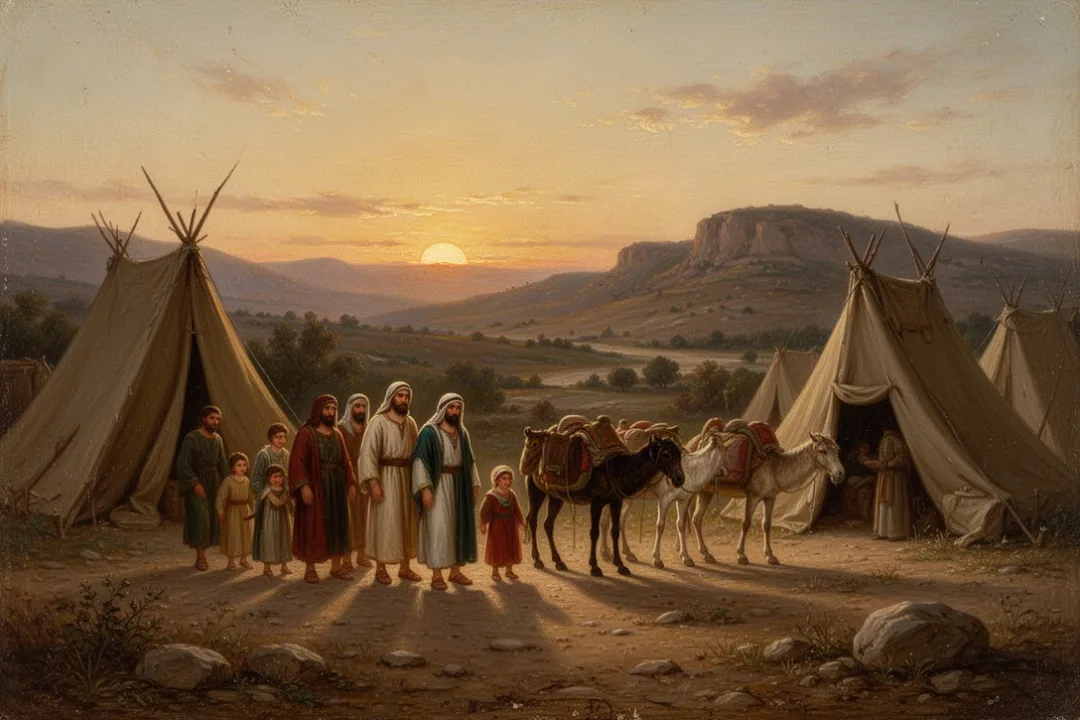
Abraham is traditionally regarded as the first Jew, although the word “Jew” was not used in his time and Jewish identity developed over many generations.
In Jewish tradition, Abraham is the first person to recognize and serve the one God in a deliberate, personal way. The Book of Genesis presents him as leaving his homeland in response to God’s command and entering into a covenant that would shape the future of his descendants. For that reason, Jewish teaching often treats Abraham as the founder of the Jewish people and the first ancestor of the Jewish faith.
Abraham is also the first biblical figure described as receiving a covenant that carries a physical sign. In Genesis 17, God establishes a covenant with Abraham and his descendants, and circumcision becomes its identifying sign. The passage connects this covenant with the promise that Abraham will become the ancestor of many nations and that his descendants will have a special relationship with God.
However, calling Abraham “the first Jew” is a traditional description rather than a literal use of the ancient vocabulary. Abraham lived before the terms Israelite, Judean, and Jew existed as names for a people. Genesis usually identifies him as a Hebrew, or as Abram and later Abraham, rather than as a Jew.
The distinction matters because religious tradition and historical language are answering slightly different questions. If the question means “Who began the ancestral and spiritual story of the Jewish people?” the answer is Abraham. If it means “Who was the first person historically called a Jew?” there is no single known individual who can be identified with certainty.
The clearest answer: Abraham is the traditional first Jew, but “Jew” became a historical group name only after the emergence of Israel, Judah, and the Judean community.
How Abraham, Isaac, Jacob, and Judah fit into the story
The biblical account presents Jewish ancestry as a family story that unfolds across several generations. Abraham has a son, Isaac, and Isaac has twin sons, Esau and Jacob. Jacob is later given the name Israel, and his twelve sons become the ancestors of the twelve tribes of Israel.
Judah, one of Jacob’s sons, is especially important to the later meaning of “Jew.” Judah is not the first Jew in the usual traditional sense. He is one of the sons of Israel and therefore part of the generation after Abraham, Isaac, and Jacob. His importance comes from the tribe and kingdom that later bear his name.
The biblical family sequence can be outlined this way:
Abraham is the ancestral founder associated with the first covenant.
Isaac continues the covenant line through Abraham’s family.
Jacob receives the name Israel and fathers the twelve tribal ancestors.
Judah becomes the ancestor of the tribe and kingdom of Judah.
The Judeans eventually give rise to the broader name “Jews.”
This sequence explains why Abraham is central even though the word “Jew” comes through Judah. Jewish identity is not based only on descent from Judah. It also includes the wider covenantal family descended from Israel, as well as people who joined the community through conversion and other forms of belonging.
The Hebrew Bible gives different names to the people at different stages. Abraham is called a Hebrew in Genesis 14, a term whose precise origin and meaning remain debated. His descendants are called the children of Israel or Israelites after Jacob receives the name Israel. Later, people associated with the kingdom of Judah are called Judeans. The English word Jew developed from this last designation.
That development does not mean Judaism began only with the kingdom of Judah. The religious and ancestral tradition reaches back to Abraham and the patriarchs, while the public name used for the community changed as its history changed. A person can therefore be described as the first ancestor of the Jewish people without claiming that he carried the later label “Jew.”
When the name “Jew” began to describe a people
The English word “Jew” comes through a long linguistic history. It is related to the Hebrew word Yehudi, meaning a person connected with Judah, and to related terms in Aramaic, Greek, Latin, and other languages. At first, the name referred most directly to people from the kingdom or region of Judah.
After the period of the divided monarchy, the northern kingdom of Israel was conquered by Assyria, while the southern kingdom of Judah continued for a longer period. Judah was later conquered by Babylon, and many of its inhabitants were taken into exile. By the Persian period, the name associated with Judah had become increasingly important for identifying the community living in Judah and for Judeans living outside the region.
The shift from a territorial label to a broader religious and communal identity happened gradually. A “Judean” could mean someone from Judah geographically, someone descended from the people of Judah, or someone who belonged to the community organized around its ancestral law and worship. These meanings overlapped rather than changing overnight.
The Book of Esther, set in the Persian Empire, repeatedly uses the term Yehudi for Mordecai and other members of the community. The Hebrew Bible also uses related language in later historical and prophetic settings. These references show that the term was established by the time of the biblical texts associated with the Persian period, but they do not identify the first person ever called a Judean or Jew.
Ancient communities did not always use one fixed definition of identity. A person could be identified by ancestry, hometown, language, religious practice, political loyalty, or membership in a recognized people. The word “Jew” eventually came to cover several of these dimensions, which is why modern definitions can seem broader than the original geographic meaning of the word.
Several historical changes helped strengthen the identity represented by the term:
Exile and migration spread Judean communities beyond the land of Judah.
Torah-based practice gave communities shared rules and customs across different regions.
Synagogue life provided local settings for prayer, teaching, and communal organization.
Ancient empires classified populations using names connected with their ancestral homelands.
Religious continuity allowed the community to preserve identity even without political independence.
For this reason, historians generally avoid naming one individual as the first Jew. The evidence points to a long process in which Israelite, Judean, and Jewish identities overlapped and gradually acquired new meanings.
Why Moses and Sinai are also central to Jewish identity
Abraham is the traditional first ancestor, but Moses is the central figure in the formation of Israel as a covenant community. The biblical story describes Abraham’s descendants becoming enslaved in Egypt, escaping under Moses’ leadership, and entering into a national covenant at Mount Sinai.
At Sinai, the Israelites receive laws that govern worship, ethics, family life, economic conduct, festivals, courts, and treatment of vulnerable people. The covenant is no longer presented only as a promise to one family. It becomes the foundation of a people with shared obligations and a collective religious life.
This distinction helps explain two different answers to the question. Abraham represents the beginning of the ancestral covenant, while Moses represents the establishment of Israel as a people bound by Torah. Someone asking about the first ancestor of Judaism may hear “Abraham.” Someone asking when a recognizable national-religious community formed may receive an answer centered on the Exodus and Sinai.
The Hebrew Bible does not describe the Israelites at Sinai with the later English word “Jews.” It calls them Israel or the children of Israel. Their identity is connected to descent from Jacob, liberation from Egypt, covenant with God, and obedience to the law given through Moses.
Jewish tradition preserves both Abraham’s importance and Moses’ importance. Abraham is associated with faith, hospitality, covenant, and the beginning of the family story. Moses is associated with revelation, law, national leadership, and the shaping of a community. Neither figure can be removed from the traditional account without changing what Jewish identity means.
The Bible itself presents covenant membership as more than biology. Non-Israelites sometimes join the community, and the Torah repeatedly describes one law applying to the native-born and the resident outsider in particular contexts. Later Jewish law develops formal processes for conversion, but the underlying tradition already shows that belonging can involve both ancestry and commitment.
Two useful distinctions: Abraham is the traditional first ancestor of the Jewish people; Moses is the leader through whom the Israelites receive the Torah and become a covenant community.
What historians can and cannot say about the first Jew
Historical research approaches the question differently from religious tradition. Historians compare inscriptions, archaeological evidence, ancient administrative records, biblical texts, and later writings. These sources can show when names and institutions appear, but they cannot always identify the exact moment when a population began to think of itself in a new way.
There is no surviving record that says, “This person was the first Jew.” Ancient identity labels were used by different writers for different purposes, and many records have not survived. The earliest available evidence may reflect a name already in use rather than the moment it was first created.
Scholars also distinguish between the people described in the biblical narratives and the evidence that can be independently examined from the ancient Near East. The patriarchal stories are foundational to Judaism, but the historical evidence for Abraham as an individually verifiable person is limited. That does not diminish his religious significance; it means that faith-based tradition and historical reconstruction operate with different kinds of evidence.
The name Israel appears in an ancient Egyptian inscription commonly dated to the late second millennium BCE. This provides evidence that a group known as Israel existed by that period. It does not identify Abraham, establish every detail of the biblical account, or show that the group was already called Jewish.
Evidence for Judah and Judeans becomes clearer in later periods, especially in records connected with the kingdoms and empires that ruled the region. After the Babylonian exile and during Persian and Hellenistic rule, Judean identity appears in increasingly visible political, religious, and literary contexts. By then, “Judean” was a meaningful designation, but the transition to the modern religious and ethnic meanings of “Jew” continued over time.
A careful historical answer therefore sounds less definite than the traditional answer:
There is no documented first Jew whose name is known to historians.
Abraham is the traditional first ancestor of the Jewish people.
Israelite identity develops around Jacob’s descendants and the Exodus tradition.
Judean identity becomes prominent through the kingdom and province of Judah.
The broader meaning of “Jew” develops through exile, diaspora, law, worship, and communal continuity.
This approach avoids two opposite mistakes. One mistake is treating the later word “Jew” as though it were used unchanged from the time of Abraham. The other is claiming that Judaism suddenly appeared only when the word first entered surviving records. Both the tradition and the historical evidence point to development across generations.
How the meaning of “Jew” changed after the biblical period
By the Second Temple period, “Jew” or its ancient equivalents could refer to a person’s descent from Judea, religious practices, connection to the Temple, adherence to Jewish law, or membership in a wider Jewish community. These meanings were not always identical, and different writers emphasized different aspects.
Jewish communities existed in the land of Judea as well as in places such as Mesopotamia, Egypt, Syria, Asia Minor, and later many other regions. A person did not have to live in Jerusalem or Judea to belong to the Jewish people. Shared practices, texts, festivals, ancestry, and community institutions helped maintain identity across distance.
The destruction of the Second Temple by Rome in 70 CE brought major changes, but it did not end Jewish identity. Rabbinic Judaism developed through teachers, legal interpretation, prayer, study, and local communities. The word “Jew” increasingly functioned as a broad designation for a people connected by ancestry, religious tradition, and communal life rather than by residence in one kingdom.
Modern Jewish identity still includes several dimensions. Some Jews understand Jewishness primarily as a religion; others emphasize peoplehood, ancestry, culture, history, or a combination of these. Jewish communities also recognize converts as Jews, although different movements and legal traditions may apply different standards regarding conversion and recognition.
That modern range of meaning makes the original question more complicated, but it also clarifies the answer. A person does not become the first Jew merely because he or she lived earlier than everyone else in the biblical story. The label reflects a historical identity that formed gradually and was later applied to an ancient ancestral tradition.
If you need a short answer, say: Abraham is traditionally considered the first Jew. If you need a historically precise answer, add that the term “Jew” derives from Judah and became a group designation centuries after the patriarchal period. This wording respects Jewish tradition while avoiding anachronism.
Frequently asked questions
Was Abraham called a Jew in the Bible?
No. The Bible does not normally use the later term “Jew” for Abraham. It identifies him as Abram or Abraham and, in some passages, as a Hebrew. “Jew” developed from terms associated with Judah and became common as a designation for Judeans and their descendants much later.
Was Judah the first Jew because the word comes from his name?
No. Judah was one of Jacob’s twelve sons and the ancestor of the tribe and kingdom of Judah. The word “Jew” ultimately relates to Judah, but the traditional Jewish story begins with Abraham, several generations before Judah. The name’s origin and the religion’s ancestral beginning are separate questions.
Did Judaism begin with Abraham or Moses?
Jewish tradition connects both figures with the beginning of Judaism in different ways. Abraham begins the ancestral covenant and is viewed as the founding patriarch. Moses leads the Israelites from Egypt and gives them the Torah at Sinai, establishing the laws and communal covenant that shape Jewish religious life.
Can historians identify the first Jewish person?
No. Surviving evidence does not name a single individual as the first Jew. Historians can trace the development of Israelite and Judean identities through texts, inscriptions, and archaeology, but the transition to the broader identity called Jewish occurred gradually rather than at one recorded moment.










Leave a Reply