When someone commits a horrifying murder, you may wonder whether the Bible supports the death penalty or calls Christians to reject it. The answer is not a simple yes or no. The Bible contains laws that prescribe execution for certain offenses, especially in ancient Israel, but it also stresses human dignity, careful judgment, protection from wrongful conviction, repentance, and mercy.
That tension explains why sincere readers reach different conclusions. Some believe biblical justice permits capital punishment when a government uses it fairly for the most serious crimes. Others believe the Bible’s movement toward mercy, the teaching of Jesus, and modern concerns about error and unequal enforcement make capital punishment incompatible with Christian discipleship. Understanding the question requires looking at the Bible’s different covenants, laws, genres, and purposes rather than relying on one isolated verse.
What the Old Testament says about capital punishment
The Old Testament, also called the Hebrew Bible by many readers, records several offenses for which the law of ancient Israel prescribed death. These included intentional murder, certain forms of idolatry, serious sexual offenses, kidnapping, and violations of particular covenant commands. The laws appear mainly in Exodus, Leviticus, Numbers, and Deuteronomy.
For example, Exodus 21 distinguishes between deliberate killing and an unintended death. A person who plans and carries out a murder faces severe punishment, while someone whose actions cause an accidental death is treated differently. Numbers 35 develops this distinction through the system of cities of refuge, where a person who caused an accidental death could flee for protection from a revenge killing while the case was examined.
This distinction matters because the biblical law does not treat every death as murder. It recognizes intent, circumstances, evidence, and the difference between accident and deliberate violence. A person could not simply be executed because a death had occurred. The legal framework required an investigation and a judgment about what had happened.
Deuteronomy 17:6 and 19:15 also establish a high standard for testimony. A death sentence was not to rest on a single witness; the law required the testimony of multiple witnesses. Deuteronomy 19 warns against false testimony and describes serious consequences for anyone who deliberately accuses another person falsely.
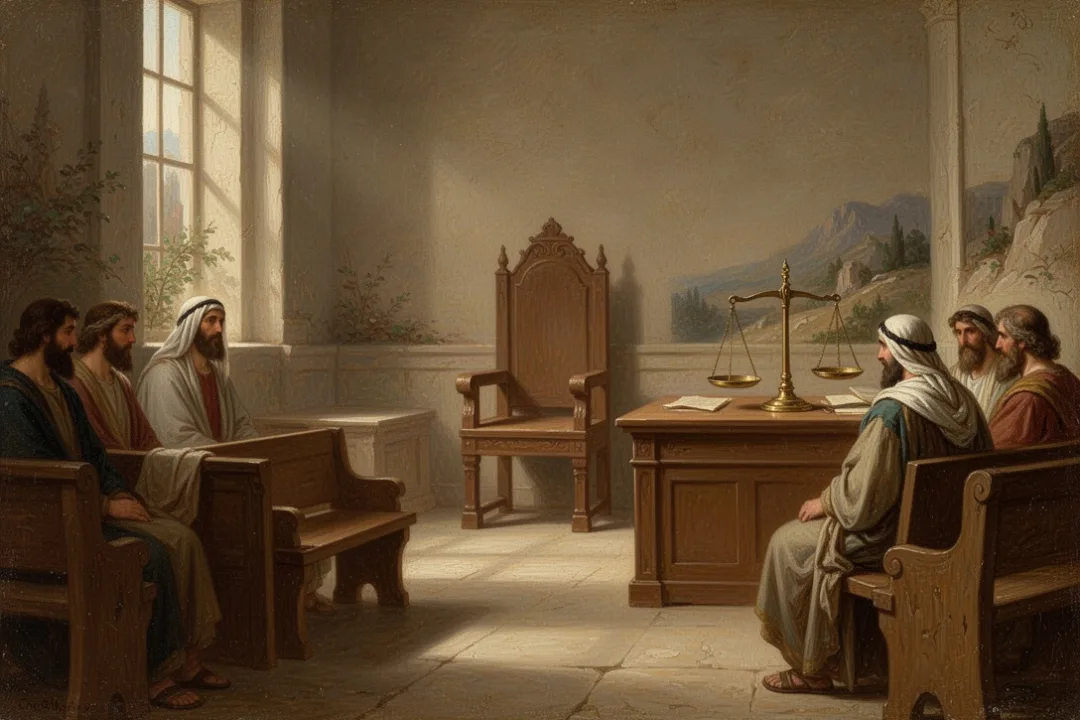
Central principle: In the Old Testament legal system, capital punishment was connected to a formal judgment, not private revenge. The repeated emphasis on witnesses, intent, and impartial decisions limits the idea that biblical justice permits impulsive or uncontrolled killing.
The law’s treatment of murder is connected with the belief that human beings bear the image of God. Genesis 9:6 links the punishment for murder with the sacred status of human life. Interpreters disagree about whether this passage directly authorizes every modern government to use the death penalty, but its moral logic is clear: murder is extraordinarily serious because the victim possesses God-given dignity.
At the same time, the Old Testament includes several protections against mistaking vengeance for justice. Leviticus 19:18 forbids personal vengeance and resentment. Deuteronomy 32:35 presents vengeance as belonging to God rather than to individuals seeking retaliation. These teachings do not eliminate legal penalties, but they distinguish public justice from private revenge.
The Old Testament also shows that even people guilty of grave wrongs may receive mercy. Cain is marked and protected after killing Abel in Genesis 4. David is not executed after his crimes against Uriah, although he is confronted, judged, and suffers serious consequences in the biblical narrative. These examples do not cancel the legal penalties prescribed elsewhere, but they show that the Bible does not present punishment as the only possible response to guilt.
How ancient Israel’s laws fit their covenant and government
A major interpretive question is whether laws given to ancient Israel should be applied directly to modern states. Israel was not described merely as a private religious community. It was a covenant nation with civil, religious, and ceremonial laws closely joined together. The same legal collection addresses worship, property, courts, sexual conduct, agriculture, ritual purity, and public order.
Many Christians therefore distinguish between Israel’s covenant law and the responsibilities of contemporary governments. They may believe that the Old Testament establishes a general principle about the seriousness of murder without concluding that every detail of Israel’s penal code should be copied into modern criminal law.
For instance, ancient Israel’s law included capital penalties for offenses that most modern Christians do not treat as crimes punishable by death. Christians who regard the Old Testament as authoritative commonly explain this by referring to the difference between Israel’s covenant identity and the church’s mission. The New Testament does not instruct Christian churches to establish a theocratic state with the full penalty system of ancient Israel.
There is also a difference between describing what Israel’s law required and commanding every government to do the same thing. Biblical passages may show that capital punishment was permitted within a particular covenant structure without proving that it is morally required in every later society.
Another safeguard is the Bible’s repeated concern for the vulnerable, the poor, and the outsider. Exodus 23 warns against perverting justice and accepting bribes. Deuteronomy repeatedly calls judges to impartiality. Leviticus 19 prohibits partiality in court, whether favoring the poor or the powerful.
Those principles raise difficult questions for modern death-penalty systems. Can the courts reliably distinguish intentional murder from other killings? Are defendants with limited money able to receive competent legal representation? Are racial, economic, or social biases affecting charging, sentencing, and jury decisions? A person who supports capital punishment on biblical grounds still has to take these concerns seriously because justice requires more than a severe penalty.
Intent: Was the killing planned, deliberate, reckless, accidental, or committed under extreme circumstances?
Evidence: Is the conviction supported by reliable evidence rather than a single accusation or coerced confession?
Impartiality: Are similar cases treated alike regardless of wealth, race, status, or public pressure?
Due process: Has the accused received a fair hearing, competent representation, and meaningful opportunities to challenge the evidence?
Proportionality: Does the punishment fit the offense without becoming an expression of revenge?
These questions are not modern additions that distract from the Bible. They reflect biblical concerns about honest witnesses, impartial courts, and the danger of condemning the innocent. The Bible’s legal material can support a serious view of public justice while also making careless use of state power difficult to defend.
What Jesus teaches about judgment, mercy, and violence
Jesus does not give a direct statement saying, “A government must abolish the death penalty,” nor does he issue a detailed criminal code. His teaching does, however, reshape how his followers understand enemies, retaliation, mercy, and judgment.
In the Sermon on the Mount, recorded in Matthew 5–7, Jesus challenges his listeners to reject personal retaliation, love their enemies, pray for those who mistreat them, and pursue reconciliation. His teaching about turning away from revenge does not necessarily settle every question about the state’s criminal authority, but it clearly forbids a disciple from treating an offender as less than human.
Jesus also warns against condemning others self-righteously. Matthew 7 uses the image of a person trying to remove a speck from someone else’s eye while ignoring a plank in their own. The point is not that wrongdoing should never be addressed. Rather, judgment must be joined to humility, self-examination, and moral seriousness.
In John 8, religious leaders bring a woman accused of adultery to Jesus and invoke the law while seeking to trap him. Jesus refuses to participate in a public execution and exposes the accusers’ own guilt. This passage is interpreted in different ways, including questions about its textual history and the legal requirements surrounding the case. It should not be used as a complete criminal-law code, but it does offer a powerful picture of mercy interrupting a demand for punishment.
Jesus’ response to violence during his arrest also matters. In Matthew 26, when one of his followers uses a weapon, Jesus tells him to put it away and warns about the destructive consequences of violence. Jesus accepts suffering rather than using force to preserve himself. Christians disagree about how directly this example applies to public officials protecting others, but it places a strong limit on personal violence and revenge.
The New Testament also emphasizes the possibility of repentance. Jesus welcomes people known for serious wrongdoing, including tax collectors whose work was associated with exploitation. In Luke 19, Zacchaeus responds to Jesus by promising restitution. The story does not erase victims’ losses or remove every legal consequence, but it shows that moral transformation remains possible.
“Blessed are the merciful” — Matthew 5:7, expressed in summary rather than as a quotation from a specific translation.
Mercy in the Bible is not the same as indifference to harm. Biblical mercy takes suffering seriously, protects the vulnerable, and seeks restoration where possible. It also refuses to define a person only by the worst thing that person has done. For Christians who oppose capital punishment, this emphasis supports preserving the offender’s life while pursuing accountability through another sentence.
Christians who support capital punishment generally respond that Jesus’ commands about enemy love concern personal conduct, not every responsibility of a civil authority. They may argue that a government can impose a penalty for public protection without hatred or vindictiveness. The disagreement centers partly on whether execution can ever be administered as restrained justice rather than retaliation.
What the New Testament says about government authority
Romans 13:1–7 is the New Testament passage most often cited in discussions of government punishment. Paul describes governing authorities as responsible for restraining wrongdoing and says that the ruler does not bear the sword without purpose. Some readers understand the sword as including the power to impose death; others believe the passage speaks generally about legitimate coercive authority without requiring capital punishment.
The passage does not provide a complete list of acceptable penalties. Its main concern is that public authority has a role in maintaining order and addressing wrongdoing. It also calls Christians to respect lawful authority, pay what they owe, and live responsibly. The text does not say that every action taken by a government is automatically just or beyond criticism.
First Peter 2:13–17 similarly discusses civil authorities and calls believers to do good, honor others, and live as free people who do not use freedom as an excuse for evil. These instructions were given to Christians living under an empire whose justice was far from perfect. They cannot reasonably mean that every government decision is morally correct.
Some supporters of the death penalty connect Romans 13 with Genesis 9 and the Old Testament’s treatment of murder. Their argument is that the state may use the highest penalty for the most serious crime, especially when a person intentionally kills another human being. They may also point to the need to protect society and affirm the value of victims’ lives.
Opponents interpret the New Testament’s emphasis differently. They argue that the government’s authority to punish does not automatically include an obligation or permission to execute. The “sword” may signify the state’s general coercive power, while contemporary societies can protect the public through imprisonment. They also point to Jesus’ emphasis on mercy, reconciliation, and enemy love.
Both positions should avoid claims the text does not make. Romans 13 does not explicitly say, “Every murderer must be executed.” It also does not say that imprisonment is always sufficient. The passage establishes a role for government; it leaves many questions about the form, limits, and administration of punishment to moral and legal reasoning.
Reading Romans 13 carefully: Government authority in the New Testament is a responsibility to serve justice, not a blank check for cruelty. Any punishment must be measured against the biblical demands for impartiality, protection of the innocent, and respect for human life.
The New Testament’s central message is also not a political platform about sentencing. It focuses on the death and resurrection of Jesus, the forgiveness of sins, the formation of a faithful community, and the hope of God’s final judgment. That focus does not make public policy irrelevant, but it means Christians should be cautious about claiming that one modern penalty is the unmistakable biblical answer.
Why Christians disagree about capital punishment today
Christian disagreement usually involves different ways of weighing several biblical principles rather than rejecting the Bible altogether. One group gives priority to the state’s authority to punish intentional murder and the Old Testament’s recognition of execution. Another gives priority to mercy, the possibility of repentance, the danger of irreversible error, and the witness of Jesus against retaliation.
Christians who support capital punishment often make several arguments:
Human life has exceptional value: Because people bear God’s image, deliberate murder deserves the strongest available condemnation.
Government has a protective duty: Romans 13 is read as recognizing the state’s authority to restrain serious evil and defend the public.
Proportional justice matters: Some believe a life sentence does not fully express the moral gravity of intentionally taking an innocent life.
Execution need not be personal revenge: They distinguish a carefully administered legal penalty from hatred, vigilantism, or emotional retaliation.
Christians who oppose capital punishment also make several arguments:
Jesus intensifies the call to mercy: His commands about enemy love, forgiveness, and nonretaliation challenge the use of death as a human response to wrongdoing.
Repentance remains possible: Execution permanently ends the offender’s earthly opportunity to change, make amends, or serve others.
Courts can make irreversible mistakes: A wrongful prison sentence is terrible, but an execution cannot be corrected after new evidence appears.
Unequal application undermines justice: If wealth, race, geography, or legal representation affects who receives death, the system fails biblical standards of impartiality.
Public safety may not require execution: Permanent imprisonment can incapacitate a dangerous person without taking life.
The Bible does not discuss modern DNA testing, forensic evidence, life without parole, appellate review, or the administration of death rows. Therefore, a biblical evaluation has to apply enduring principles to present circumstances. The question is not only, “Was execution permitted in ancient Israel?” It is also, “Can a modern system administer this irreversible punishment with the fairness, certainty, and restraint that justice requires?”
A reader can therefore affirm several biblical convictions at once: murder is profoundly evil, victims deserve protection and care, governments have legitimate authority, personal revenge is wrong, offenders must be treated as human beings, and mercy is central to Christian faith. The practical conclusion may differ depending on which principles a person believes carry the greatest weight in present conditions.
For a careful personal study, compare Genesis 4 and 9, Exodus 21, Numbers 35, Deuteronomy 17 and 19, Matthew 5–7, Matthew 26, John 8, Romans 12–13, and 1 Peter 2. Read each passage in context rather than treating a single phrase as a complete answer. Consider what the passage says directly, what it assumes about ancient society, and how it relates to the Bible’s wider witness about justice and mercy.
Whatever position you reach, the biblical approach should reject cruelty and casual certainty. It should honor victims, seek truthful judgments, oppose vengeance, protect the innocent, and recognize that ultimate judgment belongs to God. Those commitments are essential for both supporters and opponents of capital punishment.
Frequently asked questions
Does the Bible clearly command the death penalty for murder?
The Old Testament prescribes death for intentional murder within ancient Israel’s legal system, but the Bible does not plainly command every modern government to execute murderers. The New Testament recognizes government authority to punish wrongdoing without specifying one required sentence. Christians therefore disagree about whether ancient penalties establish a continuing obligation or a general principle about justice.
Did Jesus abolish capital punishment?
Jesus never directly announces the abolition of capital punishment. His teachings strongly emphasize mercy, enemy love, forgiveness, humility, and freedom from personal revenge. Christians differ over whether those teachings govern civil sentencing directly or primarily describe the conduct of individual disciples. Jesus’ response to accusations and violence challenges vindictive punishment, but it does not provide a detailed modern criminal code.
What does “an eye for an eye” mean in the Bible?
The phrase appears in passages such as Exodus 21 and Matthew 5. In its original legal setting, it expressed proportionality: punishment should not exceed the harm done. Jesus refers to it while teaching his followers not to answer personal wrongdoing with retaliation. It should not be treated as permission for private revenge or as an automatic command to impose identical physical harm.
Can a Christian oppose capital punishment and still believe in biblical justice?
Yes. A Christian may believe that intentional murder deserves the strongest condemnation while arguing that execution is irreversible, vulnerable to error, or unnecessary for public safety. That position can appeal to biblical teachings about the value of life, mercy, impartial courts, repentance, and protection from vengeance. Other Christians reach the opposite conclusion by emphasizing government authority and proportional punishment.










Leave a Reply