The phrase Sixth Commandment Bible signals a careful look at one of the most discussed directives in the biblical text. This article surveys the commandment commonly numbered as the sixth in the Decalogue, its precise wording in the original languages, the ranges of interpretation across ancient and modern traditions, and the ways in which its meaning has been applied and debated in history and in contemporary ethical thought. Rather than presenting a single, simple slogan, this study explores the meaning and context of the commandment, the linguistic choices that translate it, and the questions it raises about human life, justice, and human community.
Throughout this article, the phrase the Sixth Commandment will appear in several forms—the sixth commandment, the commandment against murder, the prohibition on taking a life, and the sixth commandment in Scripture—to reflect the breadth of scholarly and devotional usage. The goal is not merely to repeat a label but to illuminate what the commandment means, in what context it arose, and how it continues to shape moral reasoning in diverse faith traditions.
In the canonical texts traditionally designated as the Decalogue, the commandment commonly associated with the sixth position appears in two parallel versions:
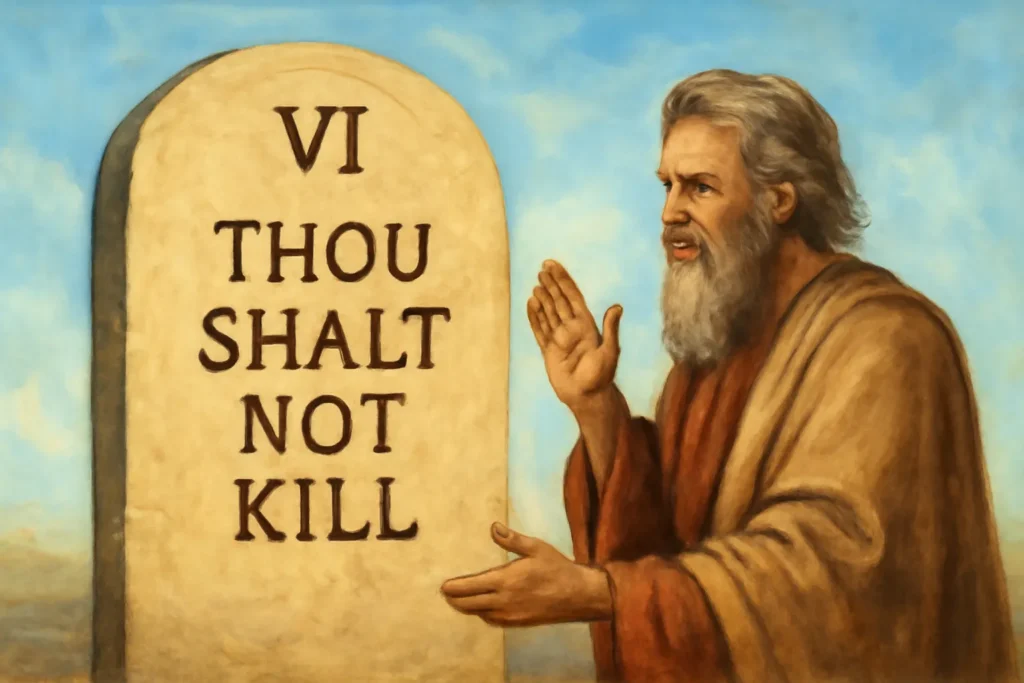
Exodus 20:13 (the Exodus version): "Thou shalt not kill."
Deuteronomy 5:17 (the Deuteronomy version): "Thou shalt not kill."
In most English Bibles, these verses are rendered as a prohibition against killing. However, a closer look at the wording in some translations and in the original Hebrew shows a nuanced distinction. Many scholars and translators prefer rendering the commandment as “you shall not murder” rather than “you shall not kill”, arguing that the Hebrew term (ratsach) more narrowly refers to intentional, unlawful killing—often with malice or premeditation—rather than all forms of killing that might occur under other contexts (such as war, capital punishment administered by a duly constituted authority, or unintentional deaths). Because of this distinction, the phraseology matters for interpreting what the commandment forbids and what it might permit in certain circumstances.
For readers who encounter the phrase “the sixth commandment” across different traditions, the core prohibition remains central: the sanctity of human life and the moral expectation that one should not unjustly end another person’s life. Yet the surrounding legal, ceremonial, and ethical frameworks in which this prohibition operates can differ significantly between traditions, which leads to diverse conclusions about related matters such as self-defense, war, and justice.
Different names and variations: semantic breadth for the same commandment
To understand the sixth commandment bible more fully, it helps to see how scholars, theologians, and readers speak of it with varied descriptors. Below are common variants you’ll encounter, each highlighting a facet of its meaning:
The Sixth Commandment — the standard designation in many Christian traditions that follow the order of the Decalogue in Exodus 20 and Deuteronomy 5.
Commandment VI — a numbered, compact reference used in seminary notes and interfaith discussions that compare the Decalogue across traditions.
The commandment against murder — a phrase that foregrounds the ethical act the commandment condemns as opposed to killing in a broader sense.
/thou shalt not kill — the classic phrasing found in the King James Version and some other translations; often discussed as a translation artifact with important interpretive implications.
The prohibition on taking a life unjustly — a descriptive paraphrase used in ethical essays and sermons to translate the commandment’s moral thrust into practical life scenarios.
The sixth commandment in Scripture — a statement that emphasizes the biblical context and its canonical placement within the Ten Words or Ten Commandments.
These variants are not mere stylistic differences. Each framing draws attention to different aspects of the commandment—its juridical dimension, its moral gravity, its historical development in Jewish and Christian law, and its ongoing relevance for debates about how societies regulate violence and protect vulnerable people.
Historical and cultural context: why this commandment mattered in the ancient world
In the ancient Near East, legal codes regulated life, property, inheritance, and communal order. The sixth commandment bible sits at the intersection of personal morality and civil order. Several contextual notes help illuminate its significance:
Life as a sacred good: In Israelite thought, human life is created in the image of God (a concept connected to later biblical theology). This gives a moral gravity to acts that destroy life, and it grounds prohibitions against murder in a broader theological framework about the value and dignity of each person.
Protection of the vulnerable: The prohibition against unjust killing protects family lines, communities, and the vulnerable—especially widows, orphans, and strangers. The social order depends on prohibiting murder to maintain trust and safety within the covenant community.
Legal distinctions within homicide: Ancient Hebrew law often distinguishes between different types of killing—unintentional killing, manslaughter, premeditated murder, and capital punishment decided by the community. This differentiation is reflected in related laws and in the establishment of cities of refuge in some biblical traditions.
Relation to other commandments: The sixth commandment is part of a broader ethical matrix. It is commonly paired with prohibitions against theft, false testimony, and bearing false witness, forming a code designed to sustain justice, family integrity, and communal harmony.
In this sense, the sixth commandment bible is not merely a prohibitive line. It participates in a larger moral economy that shapes how individuals relate to one another and how a society structures its institutions around the protection of life and the administration of justice.
Interpretive trajectories across faith traditions
Among the world’s major religious traditions that engage with the Bible, the sixth commandment receives distinct emphases, with continuities and differences that reflect theological priorities, historical development, and liturgical practice.
Judaism
In Jewish tradition, the Decalogue appears in the books of Exodus and Deuteronomy, and the prohibition against murder is understood within the broader framework of halakha ( Jewish law). The emphasis is often placed on strict prohibitions against taking life unjustly and on the moral and legal implications for a society that must balance mercy, justice, and communal order. Jewish commentators also discuss distinctions between various kinds of killing, the sanctity of life, and the responsibilities of authorities in administering justice.
Catholic and Western Christian perspectives
In Catholic teaching, the commandment is commonly numbered as the sixth commandment and is often read alongside the broader moral law that governs life’s value. Catholic interpretation emphasizes the intrinsic sanctity of human life and recognizes that Holy Scripture and Church tradition allow for morally legitimate uses of force in specific circumstances (such as self-defense or just war) under careful ethical scrutiny. The Catholic tradition also engages with questions about abortion, euthanasia, and capital punishment in light of this commandment and related teachings on human dignity.
Protestant approaches
Many Protestant communities also regard the commandment as a direct prohibition on murder, while engaging contemporary ethical issues through the lens of Scripture, natural law (in some traditions), and reason. Debates about capital punishment, self-defense, and war frequently draw on the underlying principle of protecting life, while debating what constitutes a just use of force.
Eastern Orthodox voices
In Orthodox Christianity, the sanctity of life and the moral gravity of killing are discussed within the broader contours of the Jesus ethic, the commandment’s place in the Decalogue, and the tradition of patristic interpretation. The emphasis tends to be on holiness, repentance, and the transformation of the heart as the path to living out the commandment in daily life.
Key interpretive issues: justifications, exceptions, and moral nuance
While the core idea is clear—do not take an innocent life—various interpretive questions arise in practice. These issues are central to understanding the sixth commandment bible in real-life ethics and public policy settings.
Self-defense and protection of others: How do communities balance the right to defend oneself with the obligation not to take life unjustly? Some traditions permit proportional force to prevent imminent harm, while others emphasize avoidance and de-escalation whenever possible.
War and state justice: Are there circumstances in which killing is morally or legally sanctioned by a legitimate authority? The concept of just war, defensive war, or punitive actions by the state sits at the juncture of biblical ethics and political philosophy.
Abortion and euthanasia: Modern debates about abortion and end-of-life decisions are often framed in light of the commandment’s emphasis on life’s sacredness. Different traditions offer varying conclusions about when (if ever) such actions might be morally permissible, reflecting broader theological commitments about personhood and suffering.
Accidental death and manslaughter: If death results from negligence or accident, what moral or legal responsibility is appropriate? The biblical laws sometimes differentiate between intent and recklessness and assign different penalties accordingly.
Sanctity of life and social justice: The commandment’s call to protect life extends beyond the individual to considerations of systemic injustice, poverty, and vulnerability. Some interpreters link the sixth commandment to broader social ethics aimed at reducing violence and ensuring humane treatment of all people.
These issues show how the sixth commandment bible functions as a hinge between personal ethics and public law. It invites believers to reflect on both the motive of the heart (intention, hatred, malice) and the conduct that harms another person (the act of killing). The tension between mercy and justice often appears in sermons, theological treatises, and ethical debates as communities seek to translate the ancient commandment into present-day practice.
The language question: “kill” versus “murder”
A recurring topic in discussions of the sixth commandment is the difference between “kill” and “murder” in translation. In the Hebrew text, the sense is closer to killing with intent or malice; in some contexts, the commandment’s scope may include acts that are legally justifiable (e.g., capital punishment carried out by a legitimate court). The translation choice in English languages—whether to render the commandment as “kill” or “murder”—influences how readers understand moral boundaries and legal exemptions.
When readers encounter the sixth commandment bible in different English Bible versions, they may notice these patterns:
KJV and some older translations often use “Thou shalt not kill,” which historically carries a broad sense of ending life and has shaped public understanding in many Christian cultures.
Modern translations such as the ESV, NIV, and NRSV frequently render the commandment as “you shall not murder,” signaling a sharper distinction between unlawful homicide and legitimate or accidental killings.
Jewish translations and interpretation tend to emphasize the moral prohibition against murder while noting distinctions with accidental death and with those acts that are sanctioned by civil authority in certain circumstances.
The linguistic distinction matters not only for exegesis but also for ethical discussion in contemporary society. It affects debates about assisted dying, self-defense, military action, and state power. Readers should be aware that the debate over kill versus murder in the Sixth Commandment is both linguistic and moral, reflecting a long history of interpretation and application.
How the Sixth Commandment is taught and applied in modern life
In educational settings, sermons, and theological discourse, the Six Commandment is often presented as a foundational moral norm with broad implications for personal conduct and public policy. Here are some practical dimensions often highlighted:
Personal morality: A core expectation to steward one’s life and the lives of others with care, restraint, and forgiveness. It invites believers to examine anger, hatred, and violent impulses as moral concerns that require transformation through virtue and spiritual disciplines.
Family and community life: The commandment contributes to a social ethic that values safety, trust, and mutual responsibility. Within families and neighborhoods, it undergirds norms against violence and encourages reconciliation and nonviolent conflict resolution.
Public ethics and policy: Debates on capital punishment, self-defense laws, domestic violence, and war often return to questions about the sanctity of life, proportionality, and justice. The commandment serves as a baseline for discussions about when, if ever, ending a life may be considered morally acceptable by a community or state.
Bioethics and medical ethics: In modern bioethics, questions about abortion, euthanasia, and end-of-life care intersect with biblical ethics about life’s sanctity. Different traditions interpret these issues through the lens of the commandment and related biblical teaching on the value of human life.
Because these issues are deeply personal and culturally contested, readers should approach the topic with humility, a willingness to listen to diverse perspectives, and an appreciation for how sacred texts are read differently across time and communities.
Common biblical and theological questions about the sixth commandment
People who study the Sixth Commandment frequently raise several guiding questions. Here are some of the most common ones, along with concise responses that reflect traditional and contemporary perspectives:
Does this commandment forbid all killing? Most scholars distinguish between unlawful killing (murder) and actions such as self-defense, war, or capital punishment that may be permitted under certain conditions. The nuance often depends on the translation and the broader ethical framework a tradition adopts.
What about killing in war? Just-war traditions in various Christian and Jewish streams argue that killing in war can be morally justifiable under stringent criteria, while still recognizing the gravity of ending human life.
How does this apply to abortion? Interpretations vary widely. Some traditions see abortion as incompatible with the sanctity of life, while others distinguish between stages of development, medical risk to the mother, and other morally weighed factors. The commandment is a starting point for the discussion rather than a final, uniform answer across all communities.
Is capital punishment allowed? Views differ. Some readers see the commandment as limiting state violence to a narrow, regulated framework (with rigorous legal safeguards), while others argue for abolition on theological or ethical grounds.
How do we interpret intent? The biblical distinction between intent and negligence can shape judgments about responsibility, punishment, and mercy. The life-affirming goal of justice often guides how communities respond to wrongdoing without crushing the prospects for repentance and rehabilitation.
Glossary of key phrases and concepts
To support readers who encounter this topic in different contexts, here is a compact glossary of terms frequently used in discussions of the sixth commandment:
Sanctity of life — the belief that life is sacred because it is given by God and possesses intrinsic value.
Homicide — the act of one person killing another, typically in a context that is illegal or morally condemned.
Murder — often used to denote unlawful, intentional killing, sometimes with malice or premeditation; distinguished in some translations from other kinds of killing.
Unintentional killing — killing that results without malicious intent or awareness, which may be treated differently in legal and ethical frameworks (e.g., manslaughter or accidents).
Self-defense — the use of force to protect oneself or others from imminent danger, commonly discussed as a potential exception to the commandment under strict conditions.
Just war — a tradition within Christian ethics that seeks to justify war under a defined set of conditions when peace and justice require it.
Cities of refuge — biblical concept (found in texts such as Numbers and Deuteronomy) that provided asylum for those who killed unintentionally, illustrating nuance beyond a blanket ban on killing.
Proportionality — a principle in just-war and self-defense ethics that force used should be proportionate to the threat faced.
Why this commandment remains relevant
Even as societies evolve and new ethical dilemmas arise, the sixth commandment continues to be a touchstone for conversations about the value of life, the responsibilities of individuals, families, and states, and the limits of violence in pursuing justice. Its enduring relevance rests on a few core convictions:
Human life is precious, and the protection of life is a foundational social good that supports peaceful coexistence and mutual trust.
Justice requires restraint and deliberation, not impulsive or indiscriminate violence, in order to prevent cycles of harm.
Mercy and accountability must be balanced. Communities are challenged to pursue justice while also offering pathways to reconciliation and rehabilitation where possible.
Dialogue across traditions helps illuminate the most ethically rigorous paths, especially when contemporary dilemmas test traditional interpretations.
In this broader frame, the Sixth Commandment is not merely a historical artifact but a living ethical conversation that invites faithful reflection, careful interpretation, and compassionate action in everyday life.
Conclusion: reading the Sixth Commandment in a changing world
The study of Sixth Commandment Bible meanings invites readers into a careful balancing act: recognizing the commandment’s call to protect life and recognizing the legitimate needs of justice, defense, and public order. The distinction between murder and killing—and the implications of that distinction in war, self-defense, and state action—offers a lens through which to examine contemporary issues without losing sight of the commandment’s moral core: a reverence for human life grounded in a theological vision of humanity created in the image of God.
Whether you approach the text from a Jewish, Catholic, Orthodox, Protestant, or secular ethical perspective, the sixth commandment remains a foundational reference point. Its meaning is not exhausted by a single translation or a single historical moment. Instead, it invites ongoing study, discussion, and careful discernment as communities navigate the challenges of violence, justice, and mercy in the modern world. The sixth commandment bible thus serves as a doorway into a broader moral conversation—one that asks not only what not to do, but how to live rightly in a world where human life is valued and safeguarded.









Leave a Reply