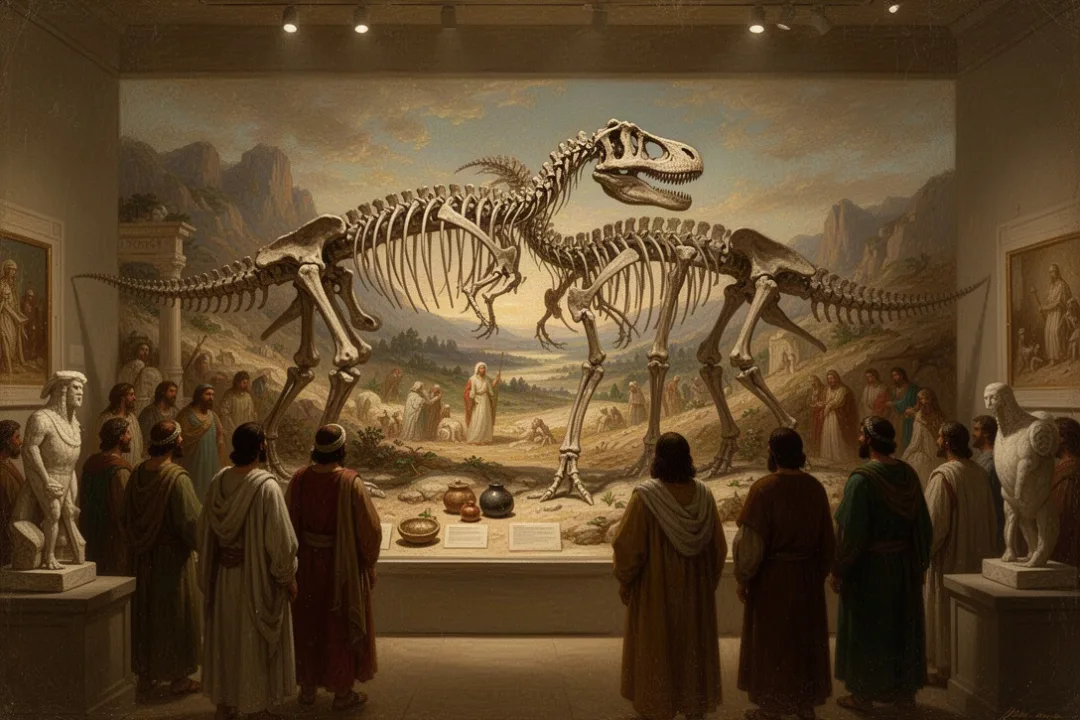
Dinosaurs are not named directly in the Bible. The word “dinosaur” was coined in the 19th century, long after the biblical books were written, and the Bible does not describe fossils, dinosaur species, or a scientific category matching modern paleontology. Some readers connect certain passages—especially descriptions of Behemoth and Leviathan—with dinosaurs, but those interpretations are debated.
The answer depends partly on how you understand biblical language and partly on how you relate Scripture to the scientific evidence for Earth’s history. The relevant passages may describe real animals using poetic imagery, represent powerful creatures symbolically, or preserve ancient ideas about chaos and creation. None of the texts identifies a creature as a dinosaur in a clear, unmistakable way.
The Bible was written and compiled over many centuries in the ancient Near East. Its main languages are Hebrew, Aramaic, and Greek, while “dinosaur” comes from modern scientific terminology. The term was introduced by the British scientist Richard Owen in 1841, so biblical writers could not have used it in the modern sense.
That does not mean biblical authors had no awareness of large reptiles or unusual animals. Ancient people encountered crocodiles, snakes, hippopotamuses, elephants, whales, and other impressive creatures. They also used poetic descriptions to express strength, danger, disorder, and God’s authority over creation.
The Bible is not arranged as a catalog of every animal that has ever existed. Its references to animals serve particular purposes within narratives, laws, wisdom poems, prophetic visions, and worship. An animal can be absent simply because it is not relevant to the passage’s message.
Direct answer: No biblical passage explicitly says that a dinosaur existed, and no animal in the Bible can be identified with certainty as a dinosaur. Behemoth and Leviathan are the two passages most often discussed in connection with the question.
What the main biblical passages actually describe
Readers usually reach this question through a small group of passages. Looking at them in context helps separate what the text says from later interpretations. The most frequently discussed references are:
Behemoth in Job 40:15–24, a huge creature associated with strength, vegetation, and a powerful tail.
Leviathan in Job 41, a formidable creature that humans cannot easily capture or control.
Leviathan in Psalms and Isaiah, where the creature can symbolize the sea, chaos, or hostile powers.
Sea monsters and great creatures in Genesis 1:21, created by God among the living things of the sea.
Dragons or serpent-like creatures in several translations, which may represent snakes, large sea creatures, or symbolic enemies depending on the passage.
These references should not automatically be treated as hidden dinosaur names. They belong to different literary settings, and their meanings depend on Hebrew vocabulary, ancient imagery, poetic style, and the surrounding argument.
How to evaluate a possible dinosaur reference step by step
A careful reading starts with the original claim: Does the text identify a dinosaur? If not, the next question is what kind of creature or image the passage most naturally presents. This approach avoids forcing a modern category into an ancient text.
Read the entire passage. Do not build an interpretation from one striking phrase. Job 40 and 41, for example, form part of God’s response to Job and use extended poetic descriptions.
Identify the literary form. Poetry may use vivid exaggeration, metaphor, and symbolism differently from a historical narrative or a legal instruction.
Examine the animal’s features together. One feature, such as a strong tail, should not decide the interpretation when the rest of the description points elsewhere.
Compare related biblical uses. Leviathan appears in several settings, and those passages can clarify whether the name refers to an animal, a mythic image, or a symbol of opposition.
Consider the ancient setting. Biblical writers described the natural world using the knowledge and imagery available in their time, not modern paleontological terminology.
Distinguish interpretation from evidence. A possible resemblance is not the same as a direct identification, and a theological view about creation is not itself proof of a dinosaur reference.
This process allows room for different Christian conclusions while keeping the text’s actual wording and context in view. It also explains why sincere readers can disagree without one side necessarily ignoring the Bible.
Could Behemoth in Job 40 be a dinosaur?
Behemoth is described in Job 40:15–24 as a powerful creature that eats grass like an ox. The passage emphasizes its enormous strength, bones, limbs, and ability to remain secure near rivers and marshes. It says that its tail is like a cedar, a detail that has led some interpreters to identify it with a sauropod dinosaur or another long-tailed prehistoric animal.
Young-earth creationist writers often argue that the description does not fit a hippopotamus because a hippopotamus has a relatively small tail. They suggest that the passage may preserve a human encounter with a surviving dinosaur, perhaps one that lived alongside people after a recent creation or a global flood.
That interpretation is possible within a particular creation framework, but the passage does not state that Behemoth is a dinosaur. Other interpreters understand Behemoth as a hippopotamus, an idealized large land animal, or a poetic representation of untamable strength. The description may combine recognizable animal traits with literary enlargement.
There is also a translation issue. The phrase often rendered “tail like a cedar” uses imagery of firmness, movement, or impressive size, but it does not provide a complete anatomical description. The comparison may concern the creature’s power or motion rather than the exact shape and length of its tail.
The wider context matters most. God presents Behemoth as an animal that only God can fully master, challenging Job’s limited understanding of creation. The purpose is not to classify the creature scientifically. It is to show that the world contains forces beyond human control and that God’s wisdom exceeds human judgment.
Why the passage remains debated: Behemoth’s size, diet, habitat, and tail have led to several proposals, but no interpretation explains every detail with universal agreement. Calling it a dinosaur requires assumptions beyond what the passage explicitly says.
Could Leviathan in Job 41 be a dinosaur?
Job 41 describes Leviathan as a creature too powerful for a person to capture easily. The chapter mentions armor-like scales, formidable teeth, strength, and an intimidating presence. Some translations use language about smoke, fire, or sparks coming from the creature, which has encouraged the idea that Leviathan was a fire-breathing dinosaur.
Many readers connect Leviathan with a marine reptile, such as a mosasaur, or with another extinct aquatic creature. In this view, ancient people may have encountered a surviving prehistoric animal or passed down memories of one. The proposal attracts attention because Leviathan is associated with the sea and seems more extraordinary than a familiar crocodile.
Other interpreters identify Leviathan with a crocodile described poetically. Crocodiles have armored scales, powerful jaws, strong tails, and an aquatic habitat, all of which fit some features in Job 41. The language about fire may be poetic imagery, an image of reflected light, or a traditional way of portraying a terrifying creature rather than a biological claim about combustion.
Leviathan also has a symbolic role elsewhere in the Bible. Psalm 74:14 portrays God as defeating Leviathan in a poetic account of divine victory. Isaiah 27:1 describes Leviathan as a twisting sea serpent that God will punish, and the image is connected with opposition and chaos. These passages make it difficult to treat the name as a simple, consistent label for one zoological species.
Ancient Near Eastern cultures commonly used sea monsters and serpents as symbols of disorder or threatening powers. Biblical writers use that imagery to emphasize that God rules over the sea and chaos. Job 41 may still draw on a real creature, but the chapter’s purpose is theological and poetic rather than scientific.
What “dragons” mean in English Bible translations
The word “dragon” appears in some English Bible translations, but it does not always represent the same kind of creature. Translators may use “dragon,” “serpent,” “jackal,” “sea monster,” or another term for Hebrew words whose meaning depends on context. A modern reader should therefore avoid assuming that every “dragon” reference means a dinosaur.
One Hebrew term, tannin or a related plural form, can refer broadly to a large serpent-like creature or sea monster. In Genesis 1:21, many translations speak of great sea creatures rather than dragons. The verse places these creatures among the living beings God creates, but it does not describe their appearance in enough detail to identify them as dinosaurs.
In Exodus, a staff becomes a serpent in the presence of Pharaoh, while other passages use serpent imagery in symbolic or poetic ways. In Ezekiel, references to a great creature in the waters can function as imagery for a ruler or nation. Translation choices reflect these different contexts.
English “dragon” also carries modern associations from medieval legends and fantasy literature. Those associations can obscure what the original biblical words conveyed. A translation that uses “dragon” may be preserving an image of danger or chaos, not naming a species that modern zoology would classify.
How creation views shape interpretations of dinosaurs
Discussions about dinosaurs in the Bible often involve two separate questions. The first is textual: What do the biblical passages mean? The second is historical and scientific: When did dinosaurs live, and when did humans appear? Keeping those questions distinct makes the disagreement easier to understand.
Young-earth creationists generally interpret the genealogical and creation passages in a way that places the creation of the earth and living things within a relatively recent period. Many in this tradition believe dinosaurs were created during the same creation week as other land animals and that some may have survived until the Flood or afterward. They may identify Behemoth or Leviathan as examples of those animals.
Old-earth creationists accept an ancient earth and usually place dinosaurs millions of years before humans. They may still affirm that God created and sustains the natural world, while reading the biblical creation texts as theological accounts rather than a modern scientific timeline.
Evolutionary creationists likewise accept the extensive fossil record and the scientific conclusion that non-avian dinosaurs disappeared long before human civilization. They understand Genesis as teaching about God, creation, human purpose, and responsibility without treating it as a technical account of paleontology.
These positions involve broader interpretations of Scripture, science, chronology, and biblical genre. A person’s preferred explanation of Behemoth is often influenced by that larger framework, rather than by Job 40 alone.
What paleontology says about dinosaurs and humans
Modern paleontology identifies dinosaurs through fossils, anatomy, rock layers, and relationships among species. Non-avian dinosaurs lived during the Mesozoic Era and disappeared at the end of the Cretaceous Period, approximately 66 million years ago. Birds are widely understood by scientists to be living dinosaurs, but the large non-avian dinosaurs commonly pictured in museums are extinct.
The available evidence does not support the idea that humans and non-avian dinosaurs lived together in ordinary historical settings. Human beings appear very late in the fossil record compared with dinosaurs, and no accepted archaeological evidence shows humans hunting, domesticating, or living alongside Tyrannosaurus, Triceratops, or similar animals.
Some Christian readers accept this evidence and see no conflict between dinosaurs and biblical faith. They understand the Bible’s purpose as explaining who created the world and what humanity’s relationship to God should be, not as listing every geological era or extinct species.
Other Christians question mainstream geological timescales and interpret evidence through a young-earth model. Their arguments may include claims about fossil formation, geological layers, or animal survival after a catastrophic flood. These claims belong to a broader debate and should not be presented as proof that the Bible explicitly mentions dinosaurs.
What Genesis says about creatures and creation
Genesis 1 describes God creating living creatures in the sea, birds in the sky, and land animals, followed by humanity. It identifies broad groups such as sea creatures, birds, livestock, creatures that move along the ground, and wild animals. The account does not name individual species, and it does not mention dinosaurs, mammals, or any other modern taxonomic category.
Some readers argue that dinosaurs could fit within the broad category of land animals created by God. That is a reasonable theological observation, but it is different from saying Genesis specifically describes dinosaurs. The text gives a structured account of creation’s order and goodness, not a fossil-based inventory.
Genesis 6–9, which describes Noah’s Flood, also does not mention dinosaurs. The account names broad groups of animals entering the ark but does not identify individual species. Claims that dinosaurs were on the ark are therefore inferences made from a particular reading of the story, not statements directly supplied by the text.
Why poetic language matters in Job
Job is wisdom literature containing speeches, lament, debate, and poetic descriptions of the natural world. Its imagery often communicates emotional and theological force rather than offering measurements that could be tested in a laboratory. The descriptions of Behemoth and Leviathan appear near the end, where God answers Job by presenting examples of creation beyond human mastery.
Poetry can describe a real animal in heightened terms. A lion may be portrayed as exceptionally fierce, or a storm as a warrior, without requiring every phrase to function as a literal scientific statement. The same principle may apply to the creature descriptions in Job.
This does not make the passages meaningless or fictional. It means interpretation should account for genre, metaphor, ancient conventions, and the book’s argument. A reader who treats every image as a technical description may reach conclusions that the original audience would not have expected.
Common arguments for dinosaur references and their limits
Several arguments appear frequently in discussions of dinosaurs and the Bible. Each one highlights a real feature of the text, but each also has limits that should be acknowledged.
“Behemoth has a tail like a cedar.” Supporters say this sounds more like a long-tailed dinosaur than a hippopotamus. Critics respond that poetic comparison does not provide enough anatomical precision to identify a species.
“Leviathan breathes fire.” Supporters view the language as evidence of a dragon-like reptile. Others read it as poetic imagery, atmospheric language, or a dramatic portrayal of a crocodile-like creature.
“Dragons appear in several translations.” The word may reflect translation choices for serpent-like or sea creatures. It does not automatically carry the modern meaning of a dinosaur.
“Dinosaurs are part of God’s created animals.” This fits many theological understandings of creation, but it does not establish that a particular biblical verse refers to dinosaurs.
“People preserved memories of dinosaurs.” Ancient dragon stories may reflect fossils, large living reptiles, symbolism, or imaginative storytelling. Similar stories alone cannot prove direct human contact with dinosaurs.
These arguments are strongest when presented as interpretations rather than certainties. They become weaker when a possibility is treated as though it were an explicit biblical statement.
How to discuss dinosaurs and the Bible responsibly
A responsible explanation begins by stating the direct evidence plainly: the Bible does not use the word dinosaur. It then identifies the passages that generate discussion and describes the leading interpretations without exaggerating their certainty.
It is also helpful to separate three categories of claims:
Explicit biblical claims: statements the text directly makes, such as God creating living creatures or Job describing an untamable animal.
Interpretive proposals: conclusions drawn from details, such as identifying Behemoth with a sauropod or Leviathan with a marine reptile.
Scientific claims: conclusions based on fossils, anatomy, geological evidence, and biological classification.
These categories can overlap in a person’s worldview, but they should not be confused. Saying “some Christians interpret Behemoth as a dinosaur” is accurate. Saying “the Bible clearly proves that dinosaurs lived alongside humans” goes beyond what the text and evidence establish.
Readers who want to study the issue further can compare several Bible translations, read Job 38–41 as one continuous section, examine every biblical reference to Leviathan, and learn how paleontologists identify dinosaurs. Looking at the whole set of evidence is more reliable than relying on an isolated illustration or a single striking phrase.
What the Bible’s message is about these creatures
Whether Behemoth was a hippopotamus, an idealized beast, a now-extinct animal, or a poetic figure, the message of Job does not depend on a final zoological label. God points Job toward the scale and complexity of creation, showing that human beings do not control or fully understand everything in the world.
Leviathan serves a similar purpose. Its danger and power emphasize that even the most frightening forces are not beyond God’s authority. In the Psalms and prophets, sea-monster imagery reinforces God’s victory over chaos and opposition.
That emphasis allows readers with different views of creation to agree on the central theological point. The Bible acknowledges a world larger, older, stranger, and more powerful than human experience alone can explain. It does not need to name dinosaurs for them to fit within a belief that God is the creator of all living things.
Frequently asked questions
Does the Bible say that dinosaurs were on Noah’s ark?
No. The Flood account describes animals in broad categories but does not mention dinosaurs or identify individual species. Some young-earth creationists infer that dinosaurs may have been included, while others believe dinosaurs lived millions of years before humans. The idea is a theological interpretation of the account, not an explicit statement in the biblical text.
Is Behemoth definitely a dinosaur?
Behemoth is not definitely identified as a dinosaur. Its size and tail lead some readers to suggest a long-tailed prehistoric animal, while other interpreters connect it with a hippopotamus or poetic imagery based on powerful land animals. Job’s purpose is to emphasize God’s authority over creation, not to provide a formal species description.
Is Leviathan the same as a dragon?
Leviathan and dragons overlap in some English translations and ancient imagery, but they are not necessarily the same thing. The biblical name can describe a sea creature, serpent-like figure, or symbol of chaos depending on the passage. Job 41 may draw on a dangerous real animal, while Psalms and Isaiah use Leviathan more symbolically.
Can Christians believe in dinosaurs and trust the Bible?
Yes. Christians hold different views about the age of the earth, the interpretation of Genesis, and the meaning of Behemoth and Leviathan. Many accept the scientific evidence that non-avian dinosaurs lived millions of years before humans, while others interpret the biblical chronology differently. Belief in dinosaurs does not by itself determine a person’s view of Scripture.







Leave a Reply