Noah’s Ark Bible story: Meaning, details, and lessons
Noah’s Ark Bible story: Meaning, details, and lessons
When you hear the phrase “Noah’s Ark”, you may picture animals walking in pairs toward a wooden boat. You may also wonder what the Bible actually says, whether the story is meant to be read literally, and why it remains important thousands of years later. The account appears in Genesis chapters 6–9, where Noah builds an ark, survives a devastating flood with his family and animals, and receives a covenant marked by the rainbow.
The story is more than an account of a large boat. It addresses human violence, divine judgment, obedience, rescue, and new beginnings. Genesis presents Noah as a person who trusts God in a corrupt society, but it also shows his weaknesses after the flood. Reading the whole passage helps you see both its moral seriousness and its message of mercy.
The central account begins in Genesis 6:5 and continues through Genesis 9:17. Genesis 6 introduces the condition of humanity and God’s decision to judge the earth through a flood. Genesis 7 describes the flood itself, Genesis 8 records the waters receding, and Genesis 9 presents God’s covenant with Noah.
Several other biblical books refer to Noah. Jesus mentions the days of Noah when teaching about the unexpected nature of future judgment in Matthew 24:37–39 and Luke 17:26–27. Hebrews 11:7 presents Noah as an example of faith expressed through obedient action. First Peter 3:20–21 also refers to the flood while discussing salvation and baptism, although that passage has a broader theological purpose than simply retelling Genesis.
These references do not replace the Genesis account. They show that later biblical writers understood Noah as a significant figure whose story raised questions about faith, warning, judgment, and deliverance.
What happens in the Noah’s Ark Bible account
Genesis describes a world filled with corruption and violence. God announces judgment but also provides a means of preservation through Noah, whom the text describes as righteous in his generation and as someone who walked with God. Noah is instructed to build an ark and bring his household and representative animals into it.
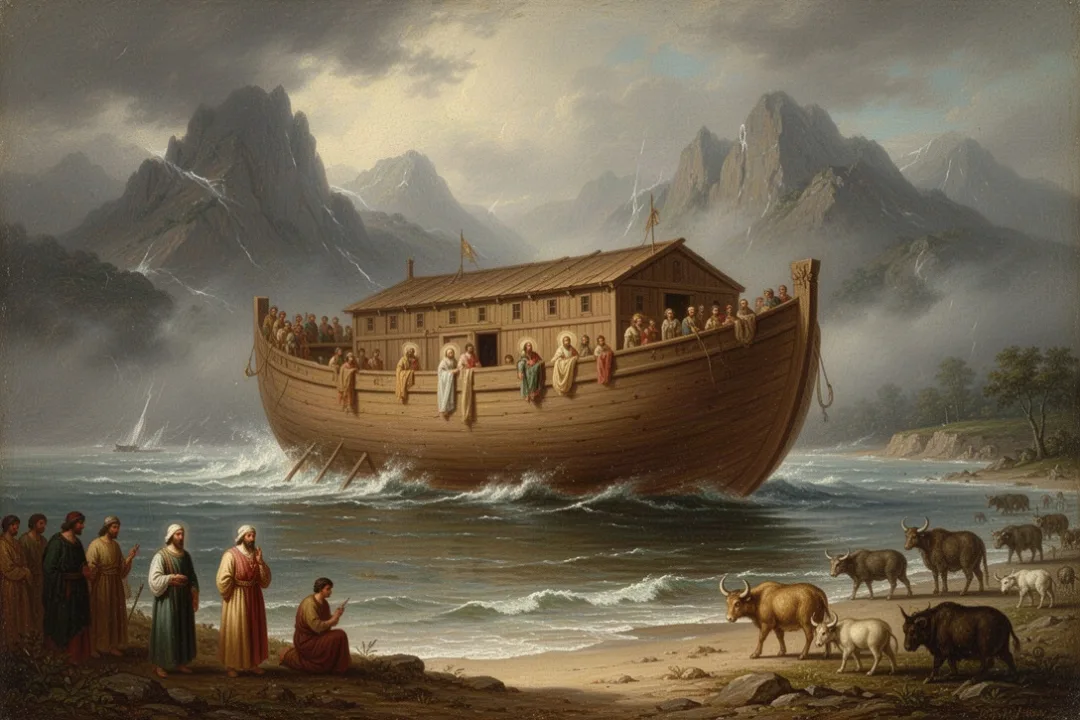
The ark is not presented as a graceful sailing vessel designed for exploration. Its purpose is to float and preserve life. God gives Noah detailed instructions for its construction, including its materials, compartments, a covering, and an opening. The text also specifies its dimensions using ancient units called cubits.
Rain falls, waters rise, and the ark floats above the earth. Genesis says that the flood covers the land and that living creatures outside the ark die. The story is deliberately severe: it portrays the flood as an act of judgment against widespread human evil, not merely as a natural disaster.
After the waters remain for a period of time, God causes them to recede. Noah sends out birds at intervals to determine whether the ground has become dry. When Noah, his family, and the animals leave the ark, Noah builds an altar and offers sacrifices. God then establishes a covenant with Noah, his descendants, and every living creature, promising that a flood will not again destroy all life on earth. The rainbow serves as the covenant sign.
Why Genesis says the flood happened
The stated reason for the flood is the moral corruption of humanity. Genesis emphasizes violence, wickedness, and the fact that people’s thoughts were continually inclined toward evil. This description matters because the flood is not framed as arbitrary punishment or as a conflict between rival gods.
In the biblical presentation, God is responding to a world in which human wrongdoing has become pervasive. The account uses strong language to communicate the seriousness of violence and injustice. It also presents judgment as coming from the Creator who has authority over human life.
At the same time, the story creates a difficult moral question: why would a judgment that affects nearly every living creature be necessary or just? The Bible does not offer a short philosophical explanation that resolves every concern. Instead, Genesis holds together several claims: human evil is real, judgment is serious, Noah is preserved by grace, and God commits himself to a future covenant.
A careful reading: The flood story should not be reduced to “be good and you will be safe.” Genesis portrays Noah’s obedience within a larger story of God’s grace, judgment, preservation, and promise.
What the ark represents in the biblical story
The ark is a means of preservation in the middle of judgment. It does not save Noah because the vessel itself has magical power. Noah and his family survive because God provides the ark and directs them into it. This makes the ark a concrete sign of God’s provision rather than an independent source of salvation.
The ark also represents a protected space where life is kept alive. Animals that could not survive the flood are brought into the vessel, and the human family receives shelter there. Genesis repeatedly draws attention to the preservation of living creatures, showing that the scope of the covenant includes more than Noah alone.
Some Christian readers see the ark as a foreshadowing of salvation through Christ or as an image of the church. Those connections can be meaningful within Christian theology, particularly because First Peter links the flood with salvation imagery. Still, the primary meaning of the ark in Genesis should come first: it is the vessel through which God preserves Noah, his family, and the animal life entrusted to them.
What the Bible says about the ark’s design
Genesis 6 gives the ark a length of 300 cubits, a width of 50 cubits, and a height of 30 cubits. Because the length of a cubit varied in the ancient world, modern conversions are estimates. Using a cubit of roughly 18 inches would produce dimensions of about 450 feet long, 75 feet wide, and 45 feet high.
The shape described in Genesis is proportionally long and relatively narrow, which would make it suitable for stability rather than speed. The passage says the ark had rooms or compartments, a side door, and an opening near the top. It also mentions three levels.
Genesis says the ark was made from “gopher wood,” but the exact type of wood is uncertain. The text also says it was coated inside and out with a substance that made it watertight. Translators differ in how they render some construction details, so diagrams and models should be treated as informed reconstructions rather than exact blueprints.
The dimensions invite practical questions about engineering and animal capacity. A large vessel could contain substantial space, especially if animals were represented by kinds rather than every modern species. Yet the Bible does not provide enough information to calculate every detail of the ark’s internal organization, food storage, waste management, ventilation, or animal care.
How many animals were on Noah’s Ark?
The number depends on which part of Genesis you are reading. Genesis 6:19–20 describes bringing a male and female of every kind of land animal and bird. Genesis 7:2–3 gives additional instructions concerning clean animals and birds, using language that is commonly understood as seven pairs of some clean animals and birds, though translations and interpretations differ.
The text does not use the modern biological category of “species.” Its word for animal group may refer to broader kinds. For that reason, attempts to state one exact total go beyond what Genesis itself provides.
Land animals: The passage focuses on creatures that live on land and breathe air.
Birds: Birds are included among the creatures preserved through the ark.
Clean animals: Genesis gives special instructions about these animals for purposes connected with sacrifice.
Aquatic life: Fish and other water-dwelling creatures are not described as needing to enter the ark.
The phrase “two of every kind” is therefore a useful shorthand, but it can conceal the passage’s details. Genesis emphasizes the preservation of representative animal groups, not a modern inventory of every breed, subspecies, or domesticated variety.
How long did Noah remain in the ark?
The flood narrative includes several time markers, but they are not arranged as a simple modern travel itinerary. Genesis says the flood began in Noah’s six hundredth year, and it records periods of rain, rising water, waiting, receding water, and drying ground. Noah and his family remained in the ark for many months.
Genesis 7:11 mentions the second month and seventeenth day of Noah’s six hundredth year when the flood began. Genesis 8:14 says that by the second month and twenty-seventh day of Noah’s six hundred and first year, the earth was dry and the occupants left the ark. On that reading, the full period inside the ark was approximately a year, though interpretations of the ancient calendar and the wording of the dates vary.
The repeated waiting is part of the story’s meaning. Noah does not leave simply because the rain has stopped. He waits for God’s direction, sends birds to test the conditions, and exits only after receiving instructions. The narrative portrays patient obedience, not frantic self-preservation.
What the rainbow covenant means
After the flood, God establishes a covenant with Noah and every living creature. The promise is not limited to Noah’s family. It includes future generations and the earth’s animals, showing that the covenant has a broad, creation-wide scope.
The rainbow is described as the sign of this covenant. In the biblical account, it functions as a visible reminder of God’s promise not to destroy all life on earth with another flood. The sign does not mean that violence and judgment will never occur in any form. It specifically concerns the promise against another universal flood of that kind.
This covenant gives the story a direction beyond destruction. The flood is followed by preservation, blessing, responsibility, and a renewed relationship between God and humanity. Noah receives language that echoes the creation account, including the call to be fruitful and multiply. The world is not presented as perfect after the flood, but life continues under God’s promise.
What Noah does after leaving the ark
Noah’s first recorded act after leaving the ark is to build an altar and offer sacrifices. This response shows gratitude and worship, but the narrative does not portray Noah as flawless. Later, Genesis 9 describes Noah becoming drunk and lying uncovered in his tent, followed by conflict involving his sons.
That episode is easy to skip when the story is presented to children, yet it is important for understanding the biblical portrait of Noah. He is commended for faith and obedience, but he remains a vulnerable human being. The flood does not remove sin from the human heart or create a perfect society.
Genesis therefore resists a simplistic message in which one righteous person permanently fixes the world. Noah is faithful in a crucial moment, but the continuing human story still requires God’s patience and covenant mercy. His imperfections also remind readers that biblical heroes are not always models in every action.
Does the Noah’s Ark story describe a worldwide flood?
Christians and Jews have read the flood account in different ways. Some understand Genesis as describing a global flood that covered the entire earth. Others interpret it as a vast regional flood remembered and presented in universal language, while some read parts of the account more symbolically or theologically.
The Hebrew wording uses sweeping expressions about the earth and all living creatures. Readers who favor a global interpretation consider those statements decisive. Readers who favor a regional interpretation point to the way “all the earth” can sometimes describe the known world or a broad region in biblical writing, along with questions about geology, animal distribution, and logistics.
Scientific evidence does not provide a simple consensus that settles every theological interpretation of Genesis. There is evidence that major floods have affected ancient communities, especially in the river regions of the Near East, but connecting a particular geological event to every detail of the biblical narrative requires assumptions.
A responsible reading distinguishes between what the text clearly says and questions it does not answer. Genesis clearly presents a catastrophic flood, an ark, Noah’s preservation, and a covenant. It does not explain the modern scientific classification of animals or provide a complete geological account.
How Noah’s Ark compares with other ancient flood stories
Flood traditions appear in several ancient cultures, including Mesopotamian stories that predate the final form of the book of Genesis. The Epic of Gilgamesh includes a flood survivor who builds a large boat, preserves living creatures, and releases birds. The Atrahasis Epic also contains a major flood narrative.
These similarities are significant because they show that flood traditions circulated in the ancient Near East. They may reflect shared cultural memory, literary interaction, or the common experience of destructive floods. Similar details do not by themselves prove that one story copied another, nor do they prove that all accounts describe exactly the same event.
Genesis also differs from these stories in important ways. Its account presents one sovereign God rather than a quarrelsome group of competing gods. The stated cause is human violence and corruption, and the covenant with Noah gives the narrative a distinctive theological emphasis. The rainbow promise establishes a moral and cosmic framework that is central to the biblical account.
Common mistakes when reading Noah’s Ark
Many misunderstandings arise when the story is reduced to a few familiar images. The following habits can help you read Genesis 6–9 with greater care:
Do not treat children’s artwork as the whole account. The colorful animal procession is memorable, but Genesis also focuses on violence, judgment, waiting, sacrifice, and covenant.
Do not assume the Bible gives an exact animal count. The text speaks of kinds and gives different instructions for certain animals; it does not list every modern species.
Do not ignore the difficult moral questions. A serious reading should acknowledge the severity of the flood rather than presenting it only as an adventure story.
Do not claim certainty where the text is uncertain. The meaning of “gopher wood,” the exact cubit length, and several logistical details are not fully explained.
Do not make Noah morally perfect. Genesis praises his faithfulness while also recording his later failure.
Do not separate judgment from mercy. The story includes both the destruction caused by judgment and the preservation provided through God’s covenant.
Do not use the story as a simple prediction formula. Later biblical references focus on readiness and accountability, not on calculating a timetable for future events.
Reading tip: Start with Genesis 6–9 in one sitting, then read it again by following repeated words such as “covenant,” “remember,” “waters,” “earth,” and “all.” Repetition often reveals the passage’s main concerns.
Practical ways to study Genesis 6–9
You can study the passage without settling every question about geology, boat construction, or animal taxonomy. Begin by observing the text itself, then compare interpretations only after identifying what Genesis actually emphasizes.
Read the entire passage. Include Genesis 6:1–22, chapters 7 and 8, and Genesis 9:1–17. Stopping at the flood often leaves out the covenant and Noah’s later life.
Mark the commands. Notice what God tells Noah to build, bring, enter, wait for, and leave.
Track the repeated movements. The waters rise, remain, recede, and dry. These movements organize the narrative.
Identify the people and creatures included in the covenant. The promise reaches beyond Noah to his descendants and the living world.
Compare translations carefully. Differences involving cubits, clean animals, and ancient terms may affect how a detail is understood.
Separate observation from interpretation. Write down what the text says before asking what it means for theology, ethics, or science.
A study Bible or reputable commentary can help with ancient geography, Hebrew terms, and the structure of Genesis. It is useful to consult more than one perspective, especially on whether the flood should be understood as global, regional, literary, or a combination of historical memory and theological interpretation.
What Christians can learn from Noah’s faith
Hebrews 11:7 portrays Noah’s faith as active trust. He responds to a warning about events not yet seen and builds the ark in obedience. The point is not that Noah possessed complete information. He acted on God’s instruction despite living in a society that, according to Genesis, had become deeply violent and corrupt.
That emphasis can challenge readers who separate belief from conduct. In the Noah narrative, faith involves hearing, trusting, working, waiting, and responding. Noah’s obedience is not presented as a way to manipulate God. It is a response to grace and warning.
The story also warns against assuming that delay means a warning is meaningless. Later biblical references to Noah focus on people carrying on with ordinary activities while failing to recognize the significance of coming judgment. The issue is not that eating, drinking, marrying, or working is inherently wrong. The issue is refusing to take moral accountability seriously.
What the story teaches about creation and responsibility
The covenant in Genesis 9 includes animals as well as people. That detail supports a view of human responsibility that is broader than personal survival. Humanity is given authority in creation, but the narrative also shows that human violence can bring devastation to the wider living world.
The ark preserves biodiversity within the story’s own categories. Noah is not told to save only his household and leave the animals behind. He is instructed to protect living creatures, which gives the account an ecological dimension even though Genesis does not use modern environmental language.
The covenant also establishes a continuing world in which seasons, planting, harvest, cold, heat, summer, winter, day, and night will continue. This promise does not remove human responsibility. It provides a stable setting in which people must still answer for violence, bloodshed, and the treatment of other life.
Why the Noah’s Ark story still matters
The Noah’s Ark Bible account continues to matter because it speaks to several permanent human concerns at once. People ask how God responds to evil, whether judgment is real, how life can be preserved amid catastrophe, and whether a broken world can have a future.
Genesis does not answer these questions with a sentimental story about animals on a boat. It presents a world damaged by violence, a God who judges evil, a family preserved through obedience, and a covenant that restrains total destruction. The rainbow then becomes a sign of promise after catastrophe.
For Christian readers, later references to Noah connect the account with faith, salvation, and future accountability. For Jewish readers, Noah belongs to the early history of humanity and to the development of covenant themes in Genesis. For readers approaching the story as literature or ancient history, it remains a powerful narrative about catastrophe, survival, moral failure, and the hope of a renewed world.
Read slowly, the story asks more than whether a boat could hold animals. It asks what kind of world human violence creates, what obedience looks like when it is unpopular, and how a promise can shape life after judgment. Those questions are at the heart of Genesis 6–9.
Frequently asked questions
Was Noah the only righteous person in the world?
Genesis describes Noah as righteous and as someone who walked with God, but it does not provide a complete moral ranking of every person alive before the flood. The text contrasts Noah with a society characterized by corruption and violence. His description highlights his distinctive faithfulness within that setting, not necessarily the claim that no other individual ever showed any goodness.
Did Noah bring dinosaurs onto the ark?
The Bible does not mention dinosaurs or identify the animals using modern scientific categories. Genesis speaks of animal “kinds,” a term that does not map neatly onto species, families, or other modern classifications. Questions about extinct animals therefore depend on an interpretation of the passage and on assumptions about the meaning of “kinds,” not on a specific statement in the text.
Why did Noah send birds out of the ark?
Noah used birds to learn whether the floodwaters had receded and dry ground had appeared. Genesis describes this as a sequence of tests rather than a single release. The birds gave Noah information about the changing conditions outside, while the broader narrative emphasizes that he ultimately left the ark only after God instructed him to do so.
Is the rainbow in the Noah story a new invention?
Genesis presents the rainbow as the sign of God’s covenant after the flood, but it does not necessarily say that rainbows had never existed before. The new element is the covenant meaning attached to the rainbow: it becomes a visible reminder of God’s promise not to destroy all living creatures with another flood.






Leave a Reply