When someone remembers Solomon as the wise king who built the temple, it is natural to ask how his story ended. Did he remain faithful to God, or did his wealth and power pull him away? The Bible gives a clear account of Solomon’s later failures and death, but it does not provide a simple statement about his final spiritual condition.
Solomon died after ruling Israel for 40 years, and his son Rehoboam succeeded him. Before that, however, Solomon’s heart turned toward the gods worshiped by some of his foreign wives. According to 1 Kings 11, he built places for these gods, provoked the Lord, and left behind a kingdom already weakened by heavy labor, taxation, resentment, and political opposition.
The short answer: Solomon ended his life as a powerful but compromised king. The Bible records his idolatry and the consequences that followed, but it does not directly say whether he repented before he died.
How Solomon became king and received extraordinary wisdom
Solomon was a son of David and Bathsheba. He did not automatically inherit the throne without conflict: near the end of David’s life, another son, Adonijah, attempted to claim kingship. Through David’s instructions and the actions of the prophet Nathan, Bathsheba, and the priest Zadok, Solomon was publicly established as king.
Early in Solomon’s reign, God appeared to him in a dream at Gibeon and invited him to ask for what he wanted. Solomon asked for a discerning heart so he could govern God’s people wisely rather than asking for long life, riches, or victory over enemies. In 1 Kings 3, God responds favorably and grants him exceptional wisdom, along with wealth and honor.
The familiar judgment involving two women who both claimed the same baby illustrates this wisdom. Solomon proposed a test that exposed each woman’s concern for the child, allowing him to identify the true mother. The story presents him as a king whose insight served justice, especially during the early part of his reign.
Solomon’s reputation spread beyond Israel. First Kings 4 describes his broad knowledge, administrative skill, and international renown. The visit of the Queen of Sheba in 1 Kings 10 shows a foreign ruler testing him with difficult questions and being impressed by his answers, his court, and the worship connected with the temple.
What Solomon built during his reign
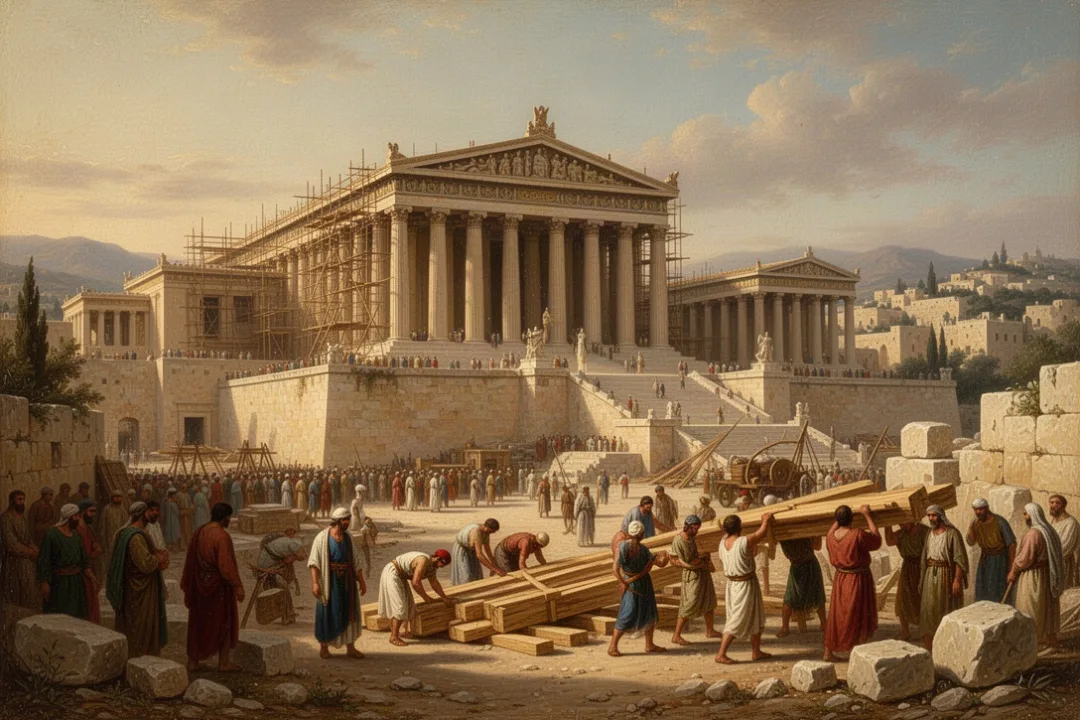
Solomon is most closely associated with the Jerusalem temple, the central sanctuary built on the temple mount. David had wanted to build a permanent house for God, but the task was assigned to Solomon. The construction required skilled workers, cedar and other materials, organized labor, and cooperation with the king of Tyre.
First Kings 6–8 describes the temple’s construction and dedication. Solomon prayed for the temple to be a place where God’s name was honored and where people could seek mercy. His prayer also recognized that the heavens could not contain God, so the building was not meant to limit God’s presence. It served as a designated place for worship and prayer.
Solomon also built a royal palace, administrative buildings, fortifications, storage cities, and other projects. First Kings presents these works as evidence of an organized and prosperous kingdom. The account also shows their cost: Solomon required large amounts of labor and collected significant taxes and supplies from the people.
The temple was a major achievement, but the scale of Solomon’s building program created a burden. First Kings 5 describes labor arrangements connected with the projects, while 1 Kings 9 and 10 describe taxes, forced labor, and royal wealth. The kingdom looked impressive from the outside, yet its prosperity was not evenly experienced by everyone.
Why Solomon’s wealth and political alliances became a problem
Solomon strengthened Israel through trade, diplomacy, marriages, military organization, and economic control. He developed relationships with neighboring rulers and benefited from international commerce. Gold, luxury goods, horses, chariots, and other signs of wealth appear repeatedly in the accounts of his reign.
These achievements were not automatically condemned. The problem was that Solomon’s power began to conflict with the covenant expectations for Israel’s king. Deuteronomy 17 warns that a king should not accumulate excessive horses, wives, or silver and gold. Solomon’s reign is portrayed as an expansion of precisely these forms of royal excess.
His alliances often included marriages to women from surrounding nations. Political marriages could secure peace and strengthen trade, but the biblical account focuses on their religious consequences. Solomon loved many foreign women, and 1 Kings 11 says they turned his heart toward other gods as he grew older.
The issue was not simply that Solomon had foreign wives. The central problem was that he accepted and participated in worship that Israel’s covenant forbade. Instead of remaining wholly devoted to the Lord, he accommodated the religious practices of his wives and built worship sites connected with foreign deities.
How Solomon’s heart turned toward other gods
First Kings 11 describes Solomon as loving the Lord earlier in his reign, but it later says that his heart was not fully devoted to God as David’s had been. The contrast with David does not mean David was sinless; David committed serious sins. It highlights a difference in his overall response to God and Solomon’s later divided loyalty.
Solomon built high places for Ashtoreth, associated with the Sidonians, and Milcom, associated with the Ammonites. The passage also mentions worship connected with Chemosh, a god of Moab. These sites were built on the hill east of Jerusalem, making Solomon’s religious compromise visible near the capital.
The Bible treats this as a direct violation of God’s commands. Solomon had been warned not to follow other gods, yet he did not remain faithful to that instruction. First Kings 11 says the Lord became angry with him and announced that the kingdom would be torn away from his house, although not entirely during Solomon’s lifetime and not all at once.
The text does not say that Solomon abandoned the worship of the Lord in every respect. That is part of what makes his decline significant. He appears to have tried to combine worship of the Lord with the worship of other gods, creating a divided religious life. In biblical terms, that divided loyalty was itself a serious failure.
Do not confuse success with approval: Solomon’s wealth, international reputation, and impressive buildings continued for a time even after his disobedience. The narrative shows that outward prosperity did not prove that his relationship with God was healthy.
What consequences did Solomon face before he died?
After describing Solomon’s idolatry, 1 Kings 11 records several adversaries whom God raised against him. Hadad the Edomite became an opponent, and Rezon of Aram challenged Israel’s influence from the north. These threats indicate that the peace associated with Solomon’s earlier reign was beginning to unravel.
The most important opponent was Jeroboam son of Nebat, an Israelite from the tribe of Ephraim. Solomon appointed Jeroboam over forced labor connected with the house of Joseph. The prophet Ahijah met him on the road, tore a new cloak into twelve pieces, and gave him ten pieces as a symbolic sign that God would give him ten tribes.
Ahijah’s message connected the coming division with Solomon’s unfaithfulness. The northern tribes would be taken from Solomon’s dynasty and given to Jeroboam, while one tribal portion would remain associated with David’s line for the sake of Jerusalem and the promise made to David. The division would occur after Solomon’s death, but the cause was already present during his reign.
Solomon responded by trying to kill Jeroboam, who fled to Egypt and remained there until Solomon died. This detail shows that Solomon’s final years were marked not only by religious compromise but also by political fear and opposition. A king who had once been celebrated for peace was now facing internal rebellion and a threat to his dynasty.
First Kings 11 also explains that the kingdom would not be completely removed from David’s line. God’s judgment was limited in timing and extent because of David and because of Jerusalem. The text presents both judgment for Solomon’s disobedience and continued faithfulness to the larger promise connected with David’s house.
How Solomon died and who ruled after him
First Kings 11:42–43 gives the basic ending to Solomon’s reign. He ruled over all Israel in Jerusalem for 40 years, then died and was buried in the city of David, where earlier kings of Judah had been buried. His son Rehoboam succeeded him.
The biblical account does not describe Solomon’s illness, final words, or exact age at death. It also does not report a dramatic assassination, battlefield death, or unusual punishment. The record simply moves from his death to the succession of Rehoboam.
Rehoboam’s succession exposed how fragile Solomon’s kingdom had become. The people, led by Jeroboam, asked the new king to reduce the heavy yoke imposed by Solomon. Rehoboam rejected the advice of the older counselors and chose the harsher advice of younger advisers, promising even greater severity.
That decision triggered the division of the kingdom. Ten tribes followed Jeroboam and formed the northern kingdom, commonly called Israel. The tribes associated with Judah, along with Benjamin in the biblical account, remained under Rehoboam’s rule in the southern kingdom, commonly called Judah.
Solomon therefore died before seeing the full political collapse of the united monarchy, but the conditions for the split had already developed under his rule. His son’s poor decision was the immediate trigger, while Solomon’s labor policies, taxation, religious compromise, and centralization helped create the underlying tension.
What happened to Israel after Solomon’s kingdom divided?
After the division, Jeroboam established new worship centers at Bethel and Dan. First Kings presents these actions as another major religious failure because Jeroboam created alternative centers and images that drew the northern tribes away from worship at Jerusalem.
Rehoboam ruled the southern kingdom, but his reign began with the loss of most of the former united kingdom. The division weakened both political unity and military strength. The Bible continues to evaluate later kings in light of this split, often tracing its roots back to the sins of Solomon and Jeroboam.
The division did not mean that Solomon’s building projects instantly disappeared. The temple remained in Jerusalem, and Solomon’s name continued to carry prestige. Yet the kingdom’s political unity, which had been one of the great accomplishments associated with his reign, was gone.
This outcome gives Solomon’s story a serious tension. He built the temple, expanded the kingdom, and achieved extraordinary fame, but his policies and spiritual disloyalty contributed to a crisis that became visible immediately after his death. His reign looked strong at its height, but it did not produce a stable succession.
Does the Bible say Solomon repented?
The Bible does not explicitly say that Solomon repented of his idolatry. First Kings records God’s warning, Solomon’s disobedience, the rise of adversaries, and his death, but it does not include a scene in which Solomon confesses his sin or returns to exclusive worship of the Lord.
This silence matters. Readers sometimes assume that Solomon must have repented because the book of Ecclesiastes is traditionally connected with him and contains reflections on the emptiness of pleasure, wealth, achievement, and human wisdom. Ecclesiastes identifies its speaker as “the Teacher” or “the Preacher,” depending on the translation, and presents him as a son of David who ruled in Jerusalem. Many Jewish and Christian readers have associated that figure with Solomon, but the book does not plainly name him.
Even if Solomon was the historical or literary figure behind Ecclesiastes, the book should not be treated as an unmistakable record of repentance after 1 Kings 11. It offers profound reflections on mortality, work, wisdom, pleasure, injustice, and reverence for God, but it does not narrate Solomon’s personal return from idolatry.
The same caution applies to Proverbs and Song of Songs. Solomon is strongly associated with both books in biblical tradition, but their final forms and authorship are complex questions. They cannot supply a definite account of what Solomon personally believed or did during his last days.
Some readers also ask whether Solomon was saved or condemned. Scripture does not directly answer that question. It reveals his serious sin and its consequences, but it does not pronounce a final judgment on his eternal destiny. A responsible reading should avoid claiming certainty where the biblical text remains silent.
How Chronicles presents Solomon differently
The account in 2 Chronicles 1–9 focuses heavily on Solomon’s wisdom, temple construction, worship, wealth, and international reputation. It includes many of the same major achievements found in Kings, but it does not record Solomon’s foreign wives, idolatry, adversaries, or the prophetic announcement that the kingdom would be torn from his dynasty.
This difference does not necessarily mean that Chronicles denies the material in Kings. The two books have different emphases and were written for different theological purposes and audiences. Kings traces the history of Israel and Judah while explaining why judgment and exile came. Chronicles gives greater attention to the temple, worship, priests, Levites, David’s line, and the religious life of Judah.
Because Chronicles ends Solomon’s story on a more positive note, readers should use both accounts. First Kings is the primary passage for understanding Solomon’s decline and the reasons for the coming division. Second Chronicles highlights his legitimate achievements and the importance of the temple without retelling every failure found in Kings.
First Kings 1–2: Solomon becomes king after a succession dispute.
First Kings 3–4: God grants Solomon wisdom and the kingdom prospers.
First Kings 5–8: Solomon builds and dedicates the temple.
First Kings 9–10: His building program, wealth, trade, and reputation expand.
First Kings 11: His foreign wives lead him toward other gods, adversaries rise, and Jeroboam receives a prophecy about the kingdom.
First Kings 12: Rehoboam’s harsh response leads to the division after Solomon’s death.
Second Chronicles 1–9: Solomon’s wisdom, temple, wealth, and international fame receive extended attention.
Common mistakes when interpreting Solomon’s ending
Several conclusions are often repeated about Solomon even though they go beyond what the Bible actually says. Separating clear statements from speculation makes his story easier to understand.
Mistake: saying Solomon definitely repented. The Bible does not describe a clear repentance after his idolatry. Ecclesiastes may be associated with Solomon, but that association does not settle the question.
Mistake: saying Solomon definitely lost his salvation. Scripture records his disobedience but does not directly state his eternal destiny. It is safer to describe the sin and leave the final judgment to God.
Mistake: claiming Solomon died because God instantly struck him down. First Kings says he died after a 40-year reign, but it does not give a supernatural cause of death.
Mistake: treating all foreign marriages as the entire issue. The main concern in 1 Kings 11 is Solomon’s divided worship and participation in idolatry, along with the royal excess associated with his many alliances.
Mistake: assuming the kingdom split only because Rehoboam was foolish. Rehoboam’s decision was the immediate cause, but Solomon’s taxation, labor demands, and religious failure had prepared the conditions for rebellion.
Mistake: overlooking the positive parts of Solomon’s reign. His failure does not erase his wisdom, temple construction, administrative achievements, or the blessing he received early in life.
What Solomon’s story teaches about wisdom and faithfulness
Solomon’s story challenges the assumption that intelligence automatically produces faithfulness. He was renowned for wisdom, understood justice, managed a large kingdom, and composed or collected sayings associated with wisdom. Yet knowledge and discernment did not prevent him from making choices that divided his loyalty.
His life also shows that a strong beginning does not guarantee a faithful ending. Solomon asked for wisdom and initially governed with insight, but later allowed wealth, political alliances, sexual relationships, and religious accommodation to reshape his priorities. The biblical warning is not that achievement is evil; it is that achievement can coexist with deep disobedience.
Another lesson concerns leadership. Solomon’s private decisions had public consequences. His worship choices affected the nation, and his economic policies created resentment that his successor inherited. In the biblical narrative, a ruler’s faithfulness is never treated as merely personal because the ruler’s choices influence an entire people.
At the same time, Solomon’s story does not suggest that every success was meaningless. The temple was genuinely important, his prayer at its dedication contains serious theological reflection, and his early request for wisdom was commendable. The tension is deliberate: a person can accomplish significant good and still require correction for serious failure.
The most precise answer to what happened to King Solomon is therefore both historical and spiritual. Historically, he died in Jerusalem after 40 years as king, and Rehoboam followed him. Spiritually, the Bible says Solomon turned toward idolatry and faced divine discipline, but it does not tell readers plainly whether he repented or how God finally judged him.
Where to read Solomon’s story in the Bible
If you want to follow the events in order, begin with David’s final days and Solomon’s accession. The passages below provide the clearest path through his life, achievements, failures, and aftermath.
First Kings 1–2: Read how Solomon became king and dealt with the threats surrounding his succession.
First Kings 3: Consider his request for wisdom and the judgment that demonstrates his discernment.
First Kings 4–8: Follow the organization of the kingdom, the temple construction, and the temple dedication.
First Kings 9–10: Examine the expansion of Solomon’s projects, wealth, trade, and international reputation.
First Kings 11: Read the account of his foreign wives, idolatry, adversaries, Jeroboam, and death.
First Kings 12: See how Rehoboam’s response to the people led to the division of the kingdom.
Second Chronicles 1–9: Compare Chronicles’ emphasis on Solomon’s wisdom, worship, temple, and prosperity.
Ecclesiastes: Read its reflections on wisdom, pleasure, work, death, and reverence for God without assuming that its speaker is unquestionably Solomon.
Frequently asked questions
Did Solomon lose the kingdom before he died?
No. Solomon remained king until his death, but God announced that the kingdom would be torn from his dynasty after his reign. The actual division took place when his son Rehoboam became king and rejected the people’s request for lighter burdens. Ten tribes then followed Jeroboam, while Rehoboam retained the southern kingdom centered on Jerusalem.
Was Solomon the richest man in the Bible?
Solomon is described as extraordinarily wealthy, with extensive gold, trade, royal possessions, and international gifts. However, the Bible does not present a precise ranking of every wealthy person in Scripture, so calling him the richest man ever goes beyond what the text establishes. It does clearly portray his wealth as exceptional among Israel’s kings.
Did Solomon write Ecclesiastes?
Ecclesiastes does not directly name Solomon as its author. Its speaker is described as a son of David and ruler in Jerusalem, which has led many readers to associate the book with Solomon. Other interpretations identify the speaker more generally as a wisdom teacher. The biblical text supports the association as a tradition, not as an explicit authorial statement.
Why did God allow Solomon’s kingdom to prosper despite his sin?
Solomon’s prosperity began before the account of his later idolatry, and God’s dealings with him included both blessing and judgment. The Bible also emphasizes God’s promise to David, which meant that judgment on Solomon’s house was limited and delayed. Continued outward success, therefore, should not be read as proof that God approved every later choice.








Leave a Reply