The CSB Bible is a modern English translation that aims to combine accuracy with clear, natural language.
“CSB” stands for Christian Standard Bible. Published by Holman Bible Publishers, it was released in 2017 as a revision of the Holman Christian Standard Bible, or HCSB. The translation is intended to communicate the meaning of the Hebrew, Aramaic, and Greek biblical texts in English that contemporary readers can understand.
What the Christian Standard Bible is and where it came from
The Christian Standard Bible belongs to the family of major English Bible translations created by committees of biblical scholars. It is not a paraphrase or a simplified retelling. Its translators worked from the original-language texts while making decisions about grammar, vocabulary, sentence structure, and cultural context.
The translation was published by Holman Bible Publishers, a long-established Christian publisher associated with Lifeway Christian Resources. The CSB grew out of the HCSB, which was first published in the early 2000s. The later revision retained the earlier translation’s basic goals while refining its wording, style, and consistency.
A translation committee, rather than one individual, produced the CSB. Committee translation allows scholars with different specialties to review difficult passages and evaluate proposed wording. Their work involves studying ancient manuscripts, comparing translation options, consulting other scholars, and testing whether the English communicates the intended meaning accurately.
The CSB is especially familiar in many evangelical and Baptist churches, but readers from a wide range of Protestant backgrounds use it. A translation’s publisher and history can help explain its audience, yet the text itself should be evaluated by reading representative passages and considering how well it serves your purpose.
The central idea: The CSB seeks a middle path between very literal English that may sound awkward and highly dynamic English that may interpret the text more freely.
How the CSB balances accuracy and readability
The CSB describes its approach as optimal equivalence. This means translators seek the most accurate wording possible while also using natural English. The method does not require every Hebrew or Greek word to be represented by one English word in the same order. Instead, it considers both the words and the meaning of the original sentence.
That distinction matters because biblical languages do not work exactly like English. Hebrew and Greek have their own idioms, figures of speech, verb systems, and patterns of emphasis. A strictly word-for-word rendering can preserve individual terms but sometimes produce an English sentence that is confusing or misleading. A more meaning-based rendering may communicate the sentence clearly but make more interpretive decisions for the reader.
The CSB attempts to adjust its approach according to the passage. A historical statement, legal instruction, or repeated theological term may receive relatively direct wording. A Hebrew idiom or a Greek expression that would sound unnatural in English may be rendered in a way that communicates its intended sense.
For example, biblical authors sometimes use body language or cultural expressions to communicate emotional states. Translating every component literally may obscure the point for modern readers. The CSB may preserve the image when English readers are likely to understand it, but it can use a more familiar expression when a literal rendering would confuse the meaning.
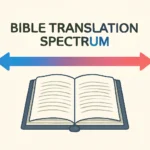
This approach places the CSB between translations that generally favor formal equivalence and those that generally favor dynamic equivalence. Those labels describe tendencies rather than strict categories. Every translation makes interpretive choices, including translations that appear highly literal.
Formal-equivalence translations tend to stay close to the wording and structure of the source languages.
Meaning-based translations tend to prioritize the sense and natural flow of the passage in contemporary English.
The CSB’s optimal-equivalence approach seeks to preserve important wording while allowing clear English when a direct rendering would miscommunicate.
Readability does not mean the CSB removes challenging ideas. Biblical passages about judgment, sacrifice, sin, covenant, resurrection, and discipleship remain substantial. The goal is to make the text understandable, not to make every statement comfortable or simple.
What the CSB sounds like in different parts of the Bible
The CSB’s style can vary according to the kind of writing being translated. Poetry requires attention to parallel lines, imagery, and rhythm. Narrative requires clear sequence and dialogue. Paul’s letters often contain long, carefully connected arguments. Wisdom literature uses compact sayings and contrasts. A useful translation must handle all of these forms without making them sound identical.
In the Old Testament, readers will find historical books, poetry, wisdom literature, and prophetic writing. The CSB generally keeps familiar biblical concepts such as covenant, holiness, righteousness, and redemption, while phrasing surrounding sentences in contemporary English. In poetic passages, line breaks and images help readers see the relationship between connected ideas.
In the New Testament, the CSB presents the Gospels as narrative accounts of Jesus’ life and ministry, Acts as an account of the early church, the letters as theological and pastoral instruction, and Revelation as apocalyptic prophecy. The translation’s wording can be direct in narrative passages while retaining the dense reasoning found in the epistles.
The CSB also tries to handle repeated words and themes with care. Repetition can be stylistic or theological, so changing every repeated term into a different synonym may hide an important connection. At the same time, forcing one English word into every context can make the translation sound unnatural. Translators must decide when consistency helps and when natural English better conveys the passage.
Readers should also remember that punctuation, paragraphing, headings, footnotes, and cross-references are editorial features surrounding the biblical text. They can be helpful, but they are not themselves part of the ancient manuscripts. Paragraph headings in a printed CSB edition may suggest an interpretation of the passage, so reading the text without headings can sometimes reveal its flow more clearly.
How the CSB handles familiar biblical language
Many readers know traditional phrases from the King James Version, the New King James Version, or older church usage. The CSB does not try to reproduce all of that traditional vocabulary. Instead, it generally uses current American English while retaining terms that carry important theological meaning.
For instance, a word such as “justification” may remain because it names a significant biblical doctrine. A less familiar word may be explained through surrounding context or a footnote rather than replaced with a vague modern synonym. This gives readers access to established Christian vocabulary without requiring every sentence to sound archaic.
The CSB also uses a mix of traditional and contemporary conventions for referring to God. As with other modern translations, its treatment of divine names follows decisions about the source text, English usage, and established translation practice. Readers who want to study the Hebrew names behind English renderings can consult the footnotes and a Hebrew reference work.
How the CSB compares with other popular Bible translations
No single translation is best for every task. The right choice depends on whether you want a Bible for public reading, close study, devotional reading, memorization, group discussion, or comparing different English renderings.
The CSB and NIV are both designed to be readable and accessible. The NIV often uses natural English and may phrase some passages more freely. The CSB tends to preserve more visible connections to the wording and structure of the source languages in certain places. Reading the same paragraph in both can show where translators made different decisions.
The CSB and ESV both appeal to readers who value a relatively close relationship to the original wording. The ESV often retains a more formal, literary style and some traditional phrasing. The CSB generally uses more contemporary sentence construction and vocabulary, which some readers find easier for sustained reading.
The CSB and NASB are both used for detailed study, but the NASB has traditionally emphasized a very formal approach. The CSB may sound less rigid in passages where a woodenly literal rendering would be difficult to understand. Readers who want to inspect specific Hebrew or Greek word relationships may appreciate consulting both.
The CSB and NLT differ more clearly in translation philosophy. The NLT is known for highly natural, meaning-focused English intended to make the text immediately accessible. The CSB usually leaves more of the original wording and structure visible. Many readers use the NLT for broad comprehension and another translation, such as the CSB, for closer comparison.
The CSB and KJV also reflect different eras of English. The KJV has lasting literary and ecclesial influence, but its vocabulary and grammar can be difficult for modern readers. The CSB is not designed to preserve the KJV’s style. It is intended to communicate biblical content in language used by contemporary readers.
Choose the CSB if you want a balance of natural English and close translation.
Compare it with the ESV or NASB when you want to examine more formal renderings.
Compare it with the NIV or NLT when you want to see how a more meaning-focused translation handles the same passage.
Keep a traditional translation such as the KJV or NKJV nearby if historic wording matters to your church, study, or memorization.
Differences between translations do not automatically mean that one is trustworthy and the others are not. Often, they reflect the fact that a Hebrew or Greek expression can be represented in several accurate ways. Significant differences deserve study, especially when they affect a major doctrine or a difficult textual question, but ordinary wording differences are a normal feature of translation.
Which CSB editions and study tools are available
The CSB is available in many formats, including standard text editions, compact editions, large-print editions, devotional Bibles, journaling Bibles, and study Bibles. The underlying translation is the same in these editions, but the added material, page design, typography, and reading experience can differ considerably.
A CSB Study Bible typically includes notes about historical background, vocabulary, theology, geography, manuscript questions, and cross-references. Study notes are written by editors and contributors, so they should be distinguished from the translation itself. They can clarify a passage, but readers may also want to compare them with other trusted study resources.
Some editions are built for specific uses. A reader who studies at a desk may prefer wide margins and extensive cross-references. Someone who reads in public may value larger type and a durable cover. A person working through a book slowly may prefer a journaling format with room for notes.
When choosing a CSB edition, consider these practical details:
Print size: Check the stated type size and whether the page uses a single or double column.
Study material: Decide whether you want notes, maps, charts, a concordance, or a plain text edition.
Binding: Hardcover, paperback, leather-like, and genuine leather options offer different levels of durability and cost.
Page layout: A reader Bible may emphasize uninterrupted reading, while a reference Bible may include many notes and cross-references.
Digital access: Apps and e-book editions can make searching, highlighting, and comparing translations easier.
Copyright pages and publisher information can help you identify which edition you have. This is useful when comparing printed wording, footnotes, or formatting. Bible publishers may update an edition’s design or supporting material without changing the translation itself.
For serious study: Read the CSB in complete paragraphs and whole books, then consult footnotes and compare another translation when a passage seems unclear or especially significant.
Who may benefit from reading the CSB
The CSB can serve readers who want a Bible that is clear enough for regular reading but still reflects the structure and terminology of the biblical languages. It works well for personal reading, church services, small groups, Bible classes, and memorizing passages in contemporary English.
It may be a good fit if you find a very formal translation difficult to follow but do not want a highly paraphrased version. Its sentence structure is generally accessible without removing the theological vocabulary needed for serious study. Readers who are new to the Bible may also find its language less unfamiliar than older translations.
Churches and study groups sometimes select one common translation so that everyone can follow readings and discussion together. If your church uses the CSB, having the same translation can make shared reading easier. If it uses another translation, the CSB remains useful as a comparison because different renderings can expose details you might otherwise miss.
The CSB is not a substitute for learning how to read context. A clear English sentence can still be misunderstood if it is separated from the surrounding paragraph, the book’s purpose, or the historical situation. Ask who is speaking, who is being addressed, what problem the passage responds to, and how the section connects with the rest of the book.
A practical reading routine can help you evaluate the translation for yourself:
Read an entire short book or several chapters without stopping at every footnote.
Mark repeated words, commands, promises, contrasts, and references to people or places.
Reread difficult paragraphs in the CSB and one or two other translations.
Use cross-references and study notes only after forming your own basic observations.
Consult a reputable commentary, Bible dictionary, or original-language resource when a major question remains.
Good passages for comparison include a narrative section from a Gospel, a psalm, a chapter from one of Paul’s letters, and a prophetic passage. These different genres reveal how the translation handles dialogue, poetry, argument, symbolism, and repeated themes. Over time, you will learn whether the CSB’s style helps you understand and remember Scripture.
The most useful Bible is one you will read carefully and consistently. The CSB offers a thoughtful balance of faithfulness, clarity, and contemporary English, making it a practical choice for many readers. Its purpose is not to replace every other translation, but to give English-speaking readers another careful way to encounter the biblical text.
Frequently asked questions
Is the CSB Bible a reliable translation?
The CSB is a respected translation produced by a committee of biblical scholars from the original Hebrew, Aramaic, and Greek texts. It uses an “optimal equivalence” approach, balancing close attention to the source wording with natural English. As with any translation, readers should consider context and compare other translations when studying difficult or disputed passages.
Is the CSB more literal than the NIV?
The CSB and NIV both prioritize readability, but the CSB generally aims to preserve more of the source text’s wording and structure in places where natural English allows it. The NIV may express some passages more freely. Neither label applies identically to every verse, so comparing complete paragraphs gives a more accurate impression than comparing isolated examples.
Is the CSB good for Bible study?
Yes. The CSB can work well for study because it combines contemporary language with recognizable theological vocabulary and attention to the original text. A study edition may add notes, maps, charts, and cross-references. For detailed research, pair it with another translation, a Bible dictionary, and a reliable commentary rather than depending on footnotes alone.
What is the difference between the CSB and HCSB?
The CSB is a revision of the Holman Christian Standard Bible. It keeps the earlier translation’s general purpose but updates wording, style, and some translation decisions for contemporary readers. The HCSB and CSB are related, but they are separate editions. If you are comparing passages, check which edition you own because wording and formatting may differ.










Leave a Reply