Gideon was an Israelite judge and military leader whom God called to rescue Israel from the Midianites. His story appears mainly in Judges 6–8, where he begins as a fearful man hiding from his enemies and becomes the leader of a surprisingly small army.
Gideon is remembered for the victory of 300 Israelites over a much larger Midianite force. His story, however, is not only about courage or military success. It also shows God’s patience with a hesitant servant, the danger of relying on signs, and the way a leader’s later decisions can damage the people he helped.
Gideon’s account is found in the Book of Judges, during a period when Israel repeatedly turned away from God, suffered oppression, cried out for help, and received deliverance through a judge. These judges were not judges in the modern courtroom sense. They were leaders raised up for particular crises, often combining spiritual, political, and military responsibilities.
Gideon lived after Deborah and Barak and before Jephthah and Samson. The biblical narrative presents him as one of several temporary deliverers rather than as a permanent king. Israel had no central monarchy at this time, and the people often followed local leaders and tribal structures.
His story begins when Midian, Amalek, and other eastern peoples repeatedly invaded the land. They destroyed crops and livestock, leaving the Israelites impoverished and afraid. The oppression was so severe that many Israelites hid in caves and mountain strongholds.
Judges explains that Israel’s suffering was connected to the people’s worship of the Baals and other local deities. God’s response was not simply to send a soldier. He first confronted the religious compromise that had contributed to Israel’s unfaithfulness.
Gideon’s family, tribe, and home
Gideon belonged to the tribe of Manasseh and lived in Ophrah. His father was named Joash, and the family had a local altar dedicated to Baal. Gideon was not introduced as a famous warrior, wealthy official, or obvious future leader.
When the angel of the Lord first came to him, Gideon was threshing wheat in a winepress. Threshing was normally done in an open, elevated place where wind could separate grain from chaff. Gideon’s location suggests that he was trying to hide the activity from the Midianites, who might seize the harvest.
This setting gives a concrete picture of Gideon’s circumstances. He was not standing confidently before an army. He was preserving a small amount of food in a concealed place because the enemy had made ordinary agricultural work dangerous.
The angel addressed him as a “mighty warrior,” as recorded in Judges 6, even though Gideon did not feel mighty. He immediately questioned why Israel was suffering if God was truly with the nation. He also described his clan as the weakest in Manasseh and himself as the least important member of his father’s household.
Gideon’s response reveals both honest distress and deep insecurity. He knew the stories of God’s past acts, but he struggled to see how those promises applied to the crisis around him. His questions were not abstract. He wanted to know why God seemed absent while Midian controlled the land.
Key idea: Gideon’s calling began with God’s presence, not Gideon’s confidence. The biblical story emphasizes that the deliverance would depend on God rather than on the leader’s natural strength.
How God called Gideon to deliver Israel
God commissioned Gideon to save Israel from Midian. Gideon’s first reaction was to ask for reassurance that the speaker truly represented God. He prepared an offering of meat and unleavened bread, and the angel caused fire to consume it. Gideon then realized that he had encountered a divine messenger and became afraid for his life.
God reassured him, and Gideon built an altar called “The Lord Is Peace,” based on the meaning of the name given in Judges 6. The name matters because Gideon’s circumstances were anything but peaceful. He was surrounded by oppression, yet God’s message gave him peace before the military crisis had ended.
Gideon’s first assignment was not to attack Midian. It was to tear down his father’s altar to Baal and cut down the associated Asherah pole. He was then to build a proper altar to the Lord and offer a sacrifice.
Gideon carried out the command at night because he was afraid of his family and the townspeople. This detail keeps the account realistic. Gideon obeyed, but his obedience was cautious rather than bold. When the people discovered what had happened, they demanded his death.
Joash, Gideon’s father, defended him. He argued that if Baal were truly a god, Baal could defend himself. Gideon then received the name Jerubbaal, commonly understood in connection with the challenge to Baal. The name continued to identify him in parts of the narrative.
Gideon’s early obedience followed a significant order: he had to confront idolatry at home before leading a public campaign. The narrative does not portray victory over foreign enemies as a substitute for faithfulness within Israel. The spiritual conflict and the national conflict were connected.
Why Gideon asked for signs and the fleece
After the Spirit of the Lord came upon Gideon, he summoned men from Manasseh, Asher, Zebulun, and Naphtali. The army gathered to face the Midianite coalition, but Gideon still asked God for a sign involving a fleece of wool.
First, he requested that the fleece be wet with dew while the ground around it remained dry. After God granted that sign, Gideon asked for the reverse: the fleece should be dry while the surrounding ground became wet. God granted that request as well.
Many readers know this as “putting out a fleece.” In modern speech, the phrase often means asking God for a confirming circumstance before making a decision. Gideon’s story is sometimes used to support that practice, but the passage should be handled carefully.
Gideon was not given a general instruction to test God whenever he felt uncertain. He had already received a clear calling, repeated reassurance, and direct confirmation. The fleece signs reveal his fear and need for assurance more than they establish a standard method for discovering God’s will.
The biblical narrative does not shame Gideon for asking. God patiently accommodated him. At the same time, Gideon’s repeated requests show that faith and fear were present together. His faith moved him to obey, while his fear led him to seek additional proof.
Other biblical passages caution against testing God or demanding signs as a condition of obedience. A sign may be meaningful in a particular biblical account, but personal circumstances are not automatically equivalent to Gideon’s calling. Wisdom, prayer, Scripture, counsel, and careful judgment also matter when you make decisions.
Why Gideon’s army was reduced to 300 men
Gideon’s forces initially numbered 32,000 men, while the Midianite camp was described as lying in the valley like a vast swarm. God told Gideon that Israel had too many soldiers. If Israel won with a large army, the people might claim that their own strength had saved them.
Gideon announced that anyone who was afraid could leave. Twenty-two thousand men went home, leaving 10,000. God then said there were still too many. The remaining soldiers were tested at the water, and only 300 were selected.
The text distinguishes the men by the way they drank. The exact reason this behavior mattered is not fully explained, and readers should avoid building confident theories on details the passage does not emphasize. The clear theological point is that the fighting force was reduced to an extremely small group.
Gideon was understandably afraid. God allowed him to go down near the enemy camp with his servant Purah and listen to a Midianite soldier recount a dream. The interpretation given by the soldier was that Gideon would defeat Midian. This encouragement strengthened Gideon, who returned to worship before organizing the attack.
The reduction of the army served two purposes. It made the victory unmistakably dependent on God, and it exposed the limits of human boasting. Gideon’s success could not reasonably be explained as the result of superior numbers or conventional military power.
The first reduction removed those who were afraid, showing that fear could not define the entire force.
The second test left only 300 men, making Israel’s numerical disadvantage extreme.
The dream in the enemy camp reassured Gideon before the battle began.
The final battle plan relied on confusion, not a prolonged contest of strength.
How Gideon defeated the Midianites
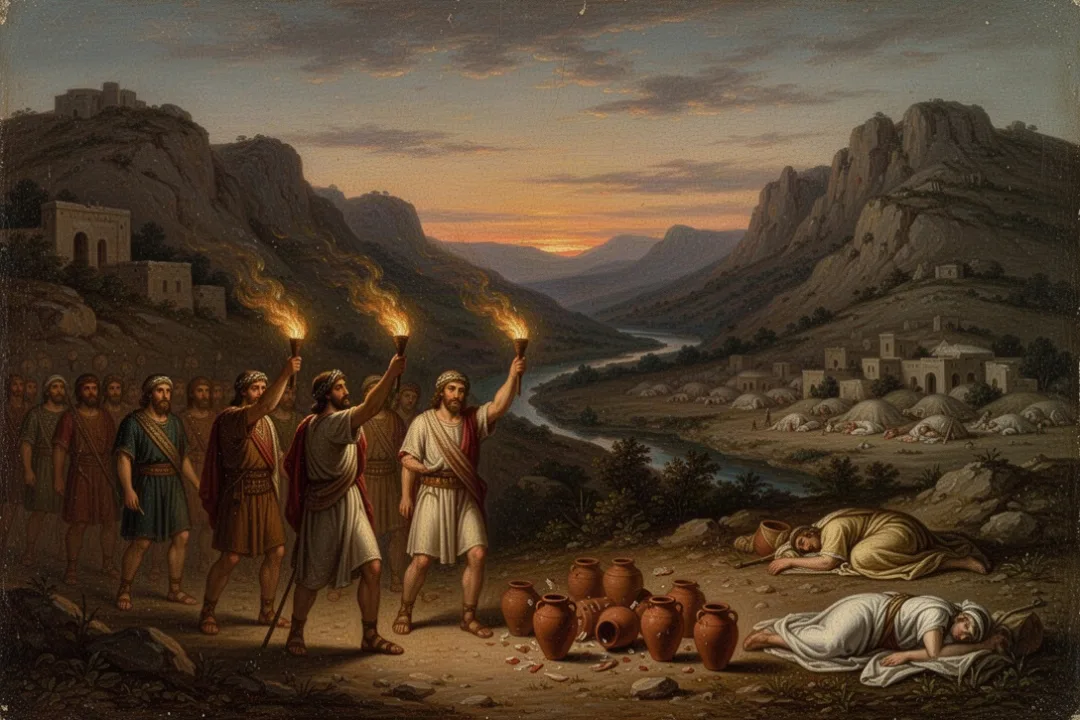
Gideon divided the 300 men into three companies. Each man received a trumpet, an empty jar, and a torch hidden inside the jar. The army approached the Midianite camp during the night and followed Gideon’s signal.
At the chosen moment, the Israelites blew their trumpets, broke the jars, exposed the torches, and shouted. The sudden noise and light created the impression of a much larger force surrounding the camp. The Lord caused confusion among the Midianites, and the enemy soldiers turned against one another before fleeing.
The tactic was effective because it combined timing, concealment, noise, and confusion. The jars hid the torches until the signal. The trumpets made the small force sound larger. The resulting panic disrupted the Midianite camp.
Gideon then called additional Israelites to pursue the fleeing army. He sent messages to the tribes of Ephraim, Asher, Zebulun, and Naphtali, and the pursuit extended beyond the initial victory. The Ephraimites captured two Midianite commanders, Oreb and Zeeb.
The victory was not entirely smooth. The men of Ephraim complained that Gideon had not called them earlier. Gideon responded diplomatically, praising what they had accomplished and saying that their later contribution was greater than his own initial action. His answer calmed their anger.
However, the narrative later records tension with the towns of Succoth and Penuel. Gideon asked for food for his exhausted soldiers, but the leaders of those towns refused because the Midianite kings Zebah and Zalmunna had not yet been captured. Gideon threatened judgment against them and later carried out that threat.
These episodes show Gideon as a capable but increasingly forceful leader. He could calm criticism in one setting, yet he responded harshly to resistance in another. The story does not present every decision he made as equally admirable.
What happened after Gideon’s victory
After the Midianite kings were captured, the Israelites asked Gideon to rule over them, along with his sons and descendants. Gideon refused the offer in words that acknowledged God’s kingship: he said that neither he nor his son would rule over Israel because the Lord was to rule over the people.
That response sounds like a strong rejection of monarchy. Gideon recognized that Israel’s true ruler was God, not a human military hero. Yet his later actions created a more complicated picture.
Gideon requested gold earrings taken from the defeated Midianites. He used the gold to make an ephod, a priestly object associated in the Old Testament with seeking divine guidance. The ephod was placed in Ophrah, but Judges says that all Israel became unfaithful through it and that it became a snare to Gideon and his household.
The passage does not give every detail about how the ephod functioned, so it is unwise to claim more than the text says. It clearly presents the object as a spiritual danger. Gideon had removed a Baal altar, but he later introduced an object that drew the people into improper devotion.
This contrast is one of the most sobering parts of his story. A person may win a major spiritual battle and still make damaging choices later. Past obedience does not make every later decision wise, and public success does not guarantee private faithfulness.
Gideon had many wives and fathered 70 sons. He also had a son named Abimelech through a concubine in Shechem. After Gideon’s death, Abimelech tried to establish power for himself and killed most of his brothers. One son, Jotham, escaped and later condemned Abimelech’s violence through a parable.
Gideon did not become Israel’s official king, but his household still developed patterns of status, power, and rivalry. The story suggests that rejecting a title does not automatically remove the desire or opportunity to exercise royal-style influence.
What Gideon teaches about faith and leadership
Gideon’s character is best understood as mixed and developing. He was not a fearless hero from the beginning, nor was he simply a disobedient doubter. He questioned God, asked for signs, obeyed difficult commands, worshiped after receiving reassurance, led effectively, and later made choices that harmed Israel.
His story shows that God can work through people who feel inadequate. Gideon’s family was socially unimpressive in his own estimation, and he considered himself the least significant member of his household. Yet God appointed him for a task that exceeded his resources.
At the same time, Gideon’s calling was not based on self-confidence. He did not rescue Israel by discovering hidden greatness within himself. The narrative repeatedly directs attention to God’s presence and power, especially through the reduction of the army.
Gideon also demonstrates that asking honest questions is different from refusing to obey. He wanted to understand why Israel was suffering and whether God would truly save the nation. His questions came from fear, but he eventually acted on the command he received.
His leadership also warns against confusing victory with spiritual maturity. Gideon defeated Midian, but he did not leave Israel in a fully faithful condition. The ephod, his household arrangements, and the later rise of Abimelech show that a successful leader can still create long-term problems.
Hebrews 11:32 includes Gideon among figures associated with faith. That reference does not erase the weaknesses recorded in Judges. Instead, it reminds readers that biblical faith is not limited to people with flawless records. Gideon trusted God enough to act, even while struggling with fear.
Practical lessons and common mistakes when reading Gideon
Gideon’s story can be applied thoughtfully, but it is easy to reduce it to a few slogans. The details matter because the narrative includes encouragement, correction, victory, compromise, and consequences.
Do not assume fear proves you have no faith. Gideon was afraid, yet he obeyed. Fear may reveal weakness, but it does not by itself determine whether a person will act faithfully.
Do not treat the fleece as a universal decision-making formula. Gideon’s signs belonged to a specific calling and biblical setting. Scripture does not promise that every uncertain decision will be settled by a random circumstance.
Look for the first obedience required. Gideon had to tear down the Baal altar before he led Israel against Midian. Personal faithfulness was not postponed until after public success.
Do not make the 300 men the main hero of the story. The reduced army emphasizes God’s deliverance rather than elite military technique or human toughness.
Read the whole account, not only the victory. Gideon’s later use of the gold and the trouble in his household are part of the biblical evaluation of his leadership.
Separate biblical description from biblical approval. The text reports Gideon’s many wives, threats, and ephod, but reporting an action does not mean Scripture endorses it.
Expect leaders to need accountability. Gideon’s accomplishments did not prevent later mistakes. Strong results should not place anyone beyond wise correction.
A practical way to study Gideon is to divide the account into three movements: calling, deliverance, and aftermath. Ask what God commands in each movement, how Gideon responds, what the people do, and what consequences follow.
You can also compare Gideon’s public words with his private actions. He refused the title of king, but he accepted wealth and maintained a large household. That contrast encourages careful reading rather than quick admiration or dismissal.
Reading tip: Let Gideon’s story challenge two extremes: he was neither a perfect hero nor a useless coward. He was a hesitant servant whom God used, whose later compromises still mattered.
How Gideon differs from other biblical leaders
Gideon differs from Moses and Joshua because his leadership was limited to a particular period of oppression rather than the founding or settlement of Israel as a nation. He also differs from David, who later became king and established a dynasty. Gideon achieved major military success but did not create a formal royal office for himself.
Compared with Deborah, Gideon appears more dependent on repeated reassurance. Deborah’s story emphasizes confident prophetic leadership, while Gideon’s story spends more time on his hesitation, signs, and gradual strengthening. Both were used to deliver Israel, but their personalities and responses were different.
Gideon also differs from Samson. Samson was personally powerful but frequently uncontrolled, while Gideon led an organized campaign involving an army and careful tactics. Yet neither story presents a simple model of consistent faithfulness. The Book of Judges repeatedly shows that Israel’s deliverers were imperfect.
The most important contrast may be between Gideon and the idea of a permanent king. Gideon’s refusal to rule formally points toward God’s kingship, but the disorder that followed him also shows why Israel longed for stability. The narrative does not settle that political question simply; it exposes the failures of both charismatic leaders and the people who follow them.
Why Gideon remains important for Bible readers
Gideon remains important because his story speaks to several questions that continue to trouble readers: How can someone obey while still being afraid? Why does God sometimes use very limited resources? How should people interpret signs? Can a strong beginning be followed by a weak ending?
The answer to the first question is visible in Gideon’s actions. He did not wait until he felt fearless. He moved forward through fear, supported by God’s reassurance. That does not make fear desirable, but it shows that courage can mean obedient action in the presence of fear.
The small army answers the second question. God deliberately reduced Israel’s military advantage so that the people would recognize the source of the deliverance. The story is not a promise that every small group will win every conflict. It is a specific account of God’s purpose in Israel’s history.
Gideon’s fleece addresses the third question by showing both divine patience and human uncertainty. God met Gideon in his weakness, but readers should not turn one unusual episode into a command to demand supernatural confirmation for every choice.
His later compromise answers the fourth question with unusual force. A faithful beginning matters, but it is not enough by itself. Character must be guarded after success, when praise, wealth, authority, and influence create new temptations.
Gideon was a judge, military deliverer, and flawed servant of God. He was called from obscurity, reassured through doubt, used to defeat a powerful enemy, and later associated with decisions that brought spiritual and family consequences. His life is therefore most useful when read as a complete story of faith mixed with weakness, obedience mixed with fear, and victory followed by responsibility.
Frequently asked questions
Was Gideon a prophet, a judge, or a king?
Gideon was primarily one of Israel’s judges, meaning a leader raised up to deliver the nation during a period of oppression. He also received messages from God and acted as a military leader, but the Bible does not present him as a king. When Israel asked him to rule, Gideon verbally rejected the position, saying that the Lord should rule over the people.
Why did God choose Gideon if he was afraid?
Gideon’s fear did not prevent him from eventually obeying. God met him with reassurance and gave him assignments in stages, beginning with the destruction of his father’s Baal altar. His story shows that God can use people who feel inadequate, while also showing that faith does not always eliminate uncertainty or the need for courage.
Did Gideon do something wrong by using the fleece?
The Bible records Gideon asking for two fleece signs, and God granted them. However, the passage does not present fleece-testing as a required method for every believer. Gideon had already received a direct calling and was seeking reassurance in a specific crisis. Prayer, Scripture, wisdom, and sound counsel should not be replaced by arbitrary signs.
What is the main lesson of Gideon’s 300 soldiers?
The reduced army emphasized that Israel’s victory came from God rather than superior numbers or military strength. The account is not a guarantee that every small force will overcome a larger one. It teaches that God can accomplish his purposes through limited human resources and that success should not become an excuse for human boasting.












Leave a Reply