David became king gradually: God chose and anointed him while Saul was still ruling, but David waited through years of service, danger, and political uncertainty before all Israel accepted him.
David’s path to the throne began in Bethlehem, where he was the youngest son of Jesse. He was not presented as the obvious successor. His older brothers appeared more likely to become leaders, but God directed the prophet Samuel to choose David rather than judge by age, height, or outward strength. The account appears in 1 Samuel 16.
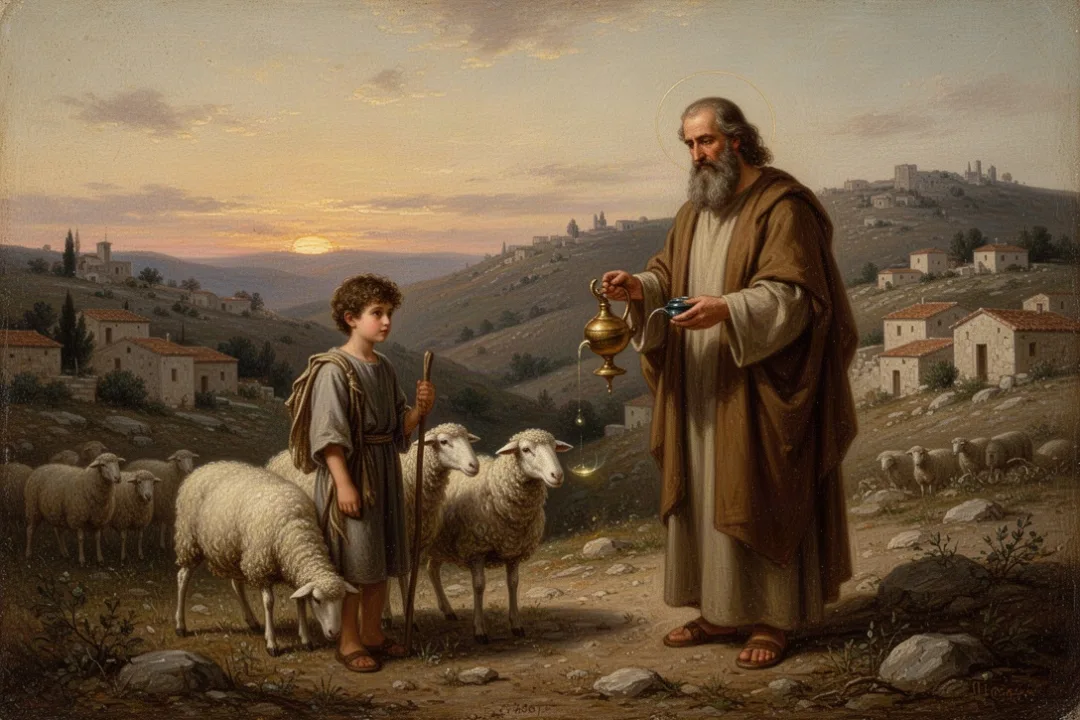
Samuel anointed David with oil as a sign that God had set him apart for future leadership. This act did not make David king immediately. Saul remained Israel’s reigning king, and David returned to his responsibilities as a shepherd and servant. The anointing identified David’s calling, but the public transfer of power would come much later.
The distinction between being chosen and taking the throne explains much of David’s story. David had a promise of kingship, but he did not use that promise as permission to seize power. He had to live with uncertainty while Saul continued to rule and increasingly viewed him as a threat.
The central point: David did not become king in one event. His rise involved private anointing, military reputation, years of waiting, Saul’s death, and the later consent of Israel’s tribes.
How David’s service to Saul increased his reputation
After Samuel anointed him, David entered Saul’s service. The biblical account describes David as a skilled musician who helped calm Saul when the king was troubled. He also became known as a capable fighter, a courageous speaker, and a thoughtful servant. These qualities allowed him to gain experience near the royal court before he had any official claim to the throne.
David’s fame grew after he defeated Goliath, the Philistine champion. The story in 1 Samuel 17 presents David as trusting God rather than relying on heavy armor or conventional military equipment. His victory protected Israel from immediate humiliation and made him widely admired among the people.
David’s success created a serious problem for Saul. The king heard people praising David’s military victories more enthusiastically than his own. Saul became jealous and afraid that David might replace him. From that point forward, David’s relationship with Saul shifted from royal service to dangerous rivalry.
David also became close to Jonathan, Saul’s son. Jonathan recognized David’s character and made a covenant of friendship with him. David married Michal, another of Saul’s children, and served as a military commander. These relationships connected David to the royal family, but they did not guarantee him the throne or protect him from Saul’s hostility.
Why David fled instead of taking Saul’s throne
Saul made repeated attempts to kill David, forcing him to leave the royal court. David gathered a group of supporters and spent years moving through wilderness areas, settlements, and foreign territory. These years transformed him from a promising young servant into an experienced leader who could command loyalty under pressure.
David’s followers sometimes encouraged him to kill Saul when circumstances made it possible. On more than one occasion, David came close enough to Saul to attack him. Yet David refused to murder the Lord’s anointed, meaning the king whom God had permitted to rule. David believed Saul’s judgment belonged to God rather than to his own ambition.
In one incident, David secretly cut a piece from Saul’s robe but did not kill him. In another, David and one of his men entered Saul’s camp at night and took the king’s spear and water container. David used these opportunities to demonstrate that he had not tried to assassinate Saul, even though Saul wanted him dead. These episodes are recorded in 1 Samuel 24 and 1 Samuel 26.
David’s restraint mattered politically as well as spiritually. If he had killed Saul, many Israelites might have regarded him as a violent usurper. By sparing Saul, David showed that he did not intend to gain the crown through a private act of revenge. His conduct helped establish a contrast between David’s patience and Saul’s fear-driven decisions.
How David protected his followers while Saul pursued him
David’s years as a fugitive were not passive waiting. He had to organize men, find food, make alliances, and protect communities from enemies. The biblical narrative describes a group of distressed and indebted men gathering around him. David became their commander and eventually led a force capable of defending towns and challenging hostile armies.
At one stage, David lived among the Philistines under the protection of Achish, a Philistine ruler. This arrangement shows how complicated his situation had become. David was an Israelite leader hunted by his own king, yet he found temporary safety among Israel’s enemies. The arrangement ended before David fought against Saul’s army.
David also sent gifts to elders in Judah and maintained relationships with communities that might later support him. These actions were part of practical leadership, not merely personal survival. He was building trust and demonstrating that he could govern people responsibly before he received a crown.
His conduct was not flawless. The biblical account includes moments of deception, violence, and morally difficult decisions during his years of exile. Still, the overall story emphasizes that David did not force the succession by killing Saul. His future rule developed through a mixture of divine calling, personal ability, public reputation, and the decisions of other leaders.
What happened when Saul died at Mount Gilboa
Saul eventually faced the Philistines in battle at Mount Gilboa. Saul’s sons, including Jonathan, died in the fighting, and Saul was fatally wounded. The account of his death appears in 1 Samuel 31. Saul’s death removed the king who had blocked David’s path, but it did not instantly unite Israel behind David.
A man from Saul’s camp later brought David news of the king’s death and claimed that he had personally killed Saul. David reacted by having the man executed, because the messenger said he had killed the Lord’s anointed. David then composed a lament for Saul and Jonathan rather than celebrating the end of his rival.
David’s response revealed how he wanted to be perceived as a future ruler. He honored Saul’s position and mourned Jonathan publicly. He also ordered the people of Judah to learn the lament known as the Song of the Bow. David was not presenting himself as the victorious enemy who had finally defeated Saul; he was presenting himself as a loyal Israelite leader grieving a national tragedy.
Saul’s death created a power vacuum. The Philistines still threatened Israel, Saul’s family retained supporters, and different regions did not immediately agree about the next king. David needed more than a private claim or an earlier anointing. He needed recognition from the people and their leaders.
How David became king over Judah at Hebron
After Saul’s death, David asked God where he should go. He was directed to Hebron, a major city in Judah. There, the men of Judah anointed him as their king. This event is recorded in 2 Samuel 2 and represents David’s first public kingship.
David was about thirty years old when he began to reign, according to the biblical account. By this point he had already spent years serving Saul, fighting enemies, fleeing persecution, and leading his own followers. The crown at Hebron marked a major change, but David ruled only over Judah at first.
The northern tribes did not immediately recognize him. Abner, the commander of Saul’s army, supported Ish-bosheth, one of Saul’s surviving sons. Ish-bosheth was made king over areas associated with the northern tribes, while David ruled from Hebron in the south. This created two competing royal centers in Israel.
The conflict between David’s supporters and Saul’s supporters lasted for a long period. The biblical writer explains that David’s house grew stronger while Saul’s house grew weaker. The struggle included military clashes and political negotiations, but it was not a single decisive contest that instantly settled the succession.
David’s base: Hebron and the tribe of Judah.
Ish-bosheth’s base: The northern tribes that remained connected to Saul’s family.
Abner’s role: Saul’s former military commander and a major power behind Ish-bosheth.
The larger issue: Whether Israel would continue under Saul’s family or accept David’s earlier anointing and growing leadership.
How Abner’s actions changed the struggle for the throne
Abner eventually broke with Ish-bosheth after a dispute involving one of Saul’s concubines. Abner became angry at the king’s accusation and offered to transfer his support to David. David agreed to meet with him, but Joab, David’s military commander, killed Abner in retaliation for Abner’s earlier killing of Joab’s brother.
David publicly condemned Joab’s action and ordered mourning for Abner. He made clear that he had not authorized the killing. This response helped David avoid being blamed for a political assassination that could have damaged his relationship with the northern tribes.
Not long afterward, two men murdered Ish-bosheth while he rested in his home. They brought his head to David, apparently expecting a reward. Instead, David had them executed for killing a defenseless man. He then arranged for Ish-bosheth’s head to be buried respectfully.
These incidents were crucial because they removed the main figures who could claim Saul’s royal succession. David did not arrange for either man to be killed, according to the narrative, and he punished those who presented the killings as services to him. His decisions communicated that he wanted to receive the kingdom through lawful recognition rather than through assassination.
Why all Israel finally accepted David as king
After Ish-bosheth’s death, the elders of Israel came to David at Hebron. They acknowledged that David had already led Israel’s armies and that God had identified him as the future shepherd and ruler of the nation. The tribes made a covenant with David, and they anointed him king over all Israel. This appears in 2 Samuel 5.
This was David’s second major anointing. The first came through Samuel, privately and years before. The second came from Judah at Hebron. The third stage was the recognition by the elders of all Israel. These repeated acts show that David’s kingship became public and national over time.
The elders’ decision rested on several factors. David had military experience, a strong reputation among the people, and an established record of leadership. Saul’s royal line had lost its main support, and David had treated Saul’s memory and surviving family with restraint. The tribes also believed that David was the leader God had designated for Israel.
David was thirty years old when he began to reign, and he ruled from Hebron for seven years and six months over Judah. After becoming king over all Israel, he ruled from Jerusalem for thirty-three years, according to the account in 2 Samuel 5. The exact calendar dates are debated, but the sequence is clear: David first ruled Judah, then became king over the united tribes.
How Jerusalem strengthened David’s new kingdom
Once David was king over all Israel, he attacked and captured Jerusalem from the Jebusites. The city occupied a strategic position between northern and southern parts of the land, making it a practical political capital. It had not been identified exclusively with either Judah or the northern tribes, so it could serve as a unifying center.
David established the City of David there and expanded his administration. Jerusalem became the location from which he could govern the united kingdom more effectively. Its capture also demonstrated that David’s kingship involved more than personal recognition: he could make strategic decisions that shaped the nation’s future.
David’s reign continued to include warfare, administration, worship, family conflict, and serious personal failures. Becoming king was not the end of his challenges. The biblical account presents his rule as significant while still showing the consequences of his choices, including the troubles that later affected his household and kingdom.
What David’s rise to power teaches about his kingship
David’s story combines calling and process. The anointing by Samuel mattered, but it did not remove the need for preparation, endurance, or public consent. David had to learn leadership while shepherding, serving Saul, commanding fugitives, defending towns, and negotiating with competing groups.
His rise also shows that biblical kingship involved more than military victory. David had opportunities to eliminate Saul and later opportunities to profit from the deaths of Saul’s supporters. By refusing to reward those killings, he protected the legitimacy of his rule and showed respect for the order he believed God had established.
At the same time, the story does not suggest that every event happened without human action. David made strategic choices, built alliances, managed armed followers, and accepted political support. Divine purpose and human responsibility operate together throughout the account.
David was chosen before he was crowned, and he was crowned in stages rather than by one sudden transfer of power.
Common mistakes when explaining how David became king
Several simplified answers leave out important parts of the biblical account. A careful explanation should distinguish between David’s anointing, his first reign in Judah, and his later rule over all Israel.
Mistake: saying David became king immediately after Samuel anointed him. Saul continued to reign for years, and David remained a servant, soldier, and fugitive before taking the throne.
Mistake: saying David killed Saul to gain power. David repeatedly refused to assassinate Saul. Saul died during a battle with the Philistines.
Mistake: saying all Israel accepted David as soon as Saul died. Judah first made David king at Hebron, while northern tribes supported Ish-bosheth for a time.
Mistake: treating David’s first anointing as his only one. David was anointed by Samuel, then by Judah, and later by the elders of all Israel.
Mistake: ignoring David’s political leadership. He built relationships, commanded followers, defended communities, and handled the deaths of rivals in ways that shaped public opinion.
Mistake: presenting David’s rise as a perfect or effortless process. His years of exile included difficult decisions, violence, fear, and moral failures alongside courage and faith.
Where to read the story of David becoming king
The main passages are found in 1 Samuel 16 through 31 and 2 Samuel 1 through 5. First Samuel 16 describes Samuel’s anointing of David. First Samuel 17 tells of Goliath, while chapters 18 through 27 trace David’s service to Saul and years of flight.
First Samuel 31 records Saul’s death. Second Samuel 1 describes David’s response, and chapter 2 records his anointing as king over Judah at Hebron. Chapters 3 and 4 cover the weakening of Saul’s house, the deaths of Abner and Ish-bosheth, and the political transition.
Second Samuel 5 records the elders’ recognition of David as king over all Israel, his capture of Jerusalem, and the beginning of his united reign. Reading these passages together prevents the common misunderstanding that David moved directly from shepherd to national king without a long period of testing and waiting.
How David became king in one sequence
Samuel anointed David in Bethlehem while Saul was still king.
David served Saul as a musician, warrior, and commander.
David defeated Goliath and became famous among the Israelites.
Saul persecuted David, leading David to live as a fugitive.
David spared Saul when he had opportunities to kill him.
Saul died in battle against the Philistines at Mount Gilboa.
Judah anointed David king at Hebron.
Ish-bosheth ruled the northern tribes for a period with Abner’s support.
Saul’s royal house weakened after Abner and Ish-bosheth died.
The elders of Israel anointed David king over the united nation.
David captured Jerusalem and made it his capital.
So, David became king through a long transition rather than a palace coup. God’s choice was announced early, but David’s actual rule emerged through years of faithful endurance, public leadership, the collapse of Saul’s dynasty, and the agreement of Judah and all Israel.
Frequently asked questions
How old was David when he became king?
The biblical account says David was thirty years old when he began to reign. This refers to the start of his kingship, first over Judah at Hebron. He did not become king over all Israel on that same day; the northern tribes recognized him later, after a period of conflict between David’s supporters and Saul’s remaining dynasty.
Did David become king immediately after killing Goliath?
No. David’s victory over Goliath made him famous and brought him into greater public attention, but Saul remained king. David continued serving Saul, later fled because Saul tried to kill him, and spent years as a military leader and fugitive before Judah anointed him at Hebron.
Who was king before David?
Saul was Israel’s first king before David. After Saul died, his son Ish-bosheth was recognized by several northern tribes for a time, while David ruled Judah from Hebron. This divided succession eventually ended when the elders of all Israel accepted David as their king.
Why did David spare Saul?
David believed Saul still held the position of king by God’s permission, even though Saul was pursuing him unjustly. David refused to claim the throne through assassination. Sparing Saul also demonstrated that David was not simply a violent rival seeking power and helped strengthen the legitimacy of his later rule.












Leave a Reply