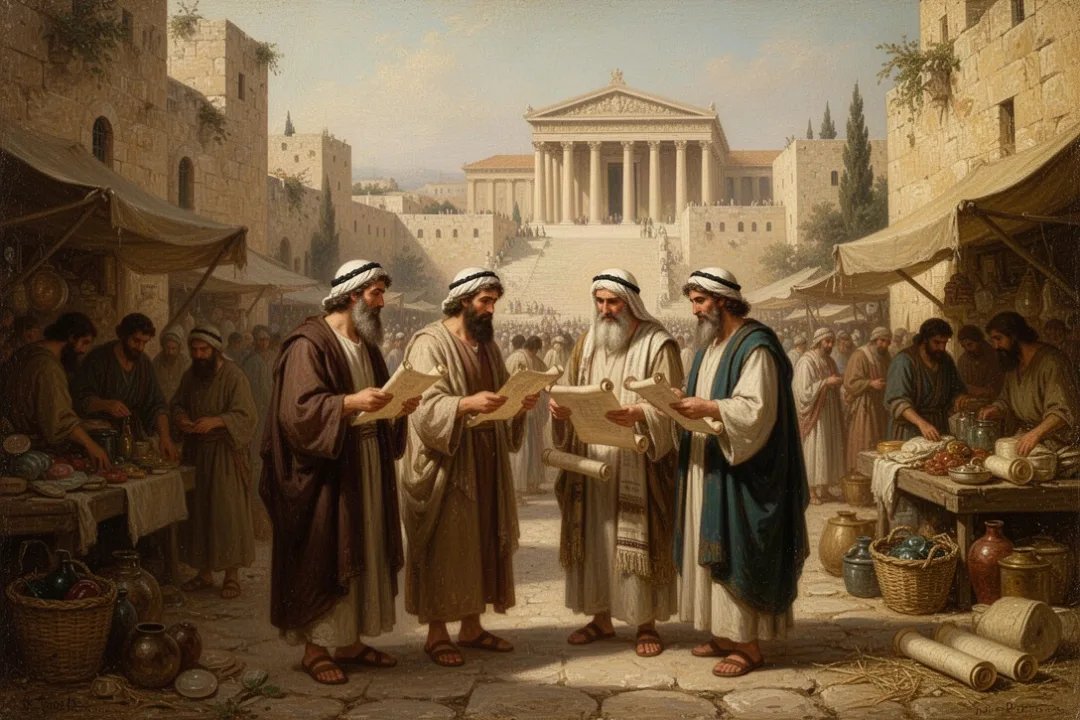
The Pharisees were a Jewish religious movement that emphasized faithful obedience to the Torah, including traditions that applied its commandments to daily life.
They lived during the Second Temple period, especially from the second century BCE through the first century CE, and remained influential in Judea during Jesus’ lifetime. The Gospels often show Jesus arguing with Pharisees, but those disputes should not be used to describe every Pharisee as dishonest or malicious. The historical picture is more complex: Pharisees were <strong interpreters of Jewish law, teachers, community leaders, and religious opponents of other Jewish groups.
The Pharisees emerged in the centuries after the Maccabean revolt, a period when Jewish communities were debating how to remain faithful to God under foreign rule and cultural pressure. Their movement developed within Judaism rather than outside it. They were concerned with the meaning of the Torah, the proper shape of Jewish life, and the responsibilities of ordinary people as well as priests.
Pharisees were active in Judea and Galilee, with connections to Jerusalem and other Jewish communities. Their influence did not come from controlling the Temple priesthood. Instead, they were known for teaching, interpreting Scripture, and shaping religious practice in homes, villages, synagogues, and study circles.
The exact beginning of the Pharisaic movement is difficult to reconstruct. Ancient sources provide only partial information, and the surviving accounts were written from different perspectives. The name may be related to an Aramaic or Hebrew term meaning “separated,” though scholars debate whether this referred to separation from ritual impurity, from non-Pharisaic practices, or from broader political and religious groups.
Historical caution: “Pharisee” describes a particular Jewish movement, not a synonym for “hypocrite.” The negative modern meaning comes largely from selected Gospel disputes and does not represent the whole historical group.
What Pharisees believed about Jewish law
Pharisees treated the Torah as the center of Jewish faith and practice. Their goal was not simply to admire Scripture but to determine how its commandments should be lived in changing circumstances. This required careful interpretation, debate, and the development of practical traditions.
They accepted the authority of the written Torah and also valued interpretive traditions passed down through teachers. These traditions helped address questions that the biblical text did not answer in a direct, detailed way. For example, biblical commandments about Sabbath observance, purity, tithing, and ritual washing raised practical questions for people living ordinary lives outside the Temple.
Later Jewish rabbinic literature preserves many teachings associated with Pharisaic or post-Pharisaic traditions. It is not accurate to treat the Mishnah or Talmud as a simple transcript of Pharisee beliefs, because these writings were compiled later and include many voices. Still, they help show how debates about oral interpretation, legal reasoning, and everyday holiness continued after the destruction of the Temple.
Pharisaic interpretation often extended practices associated with priests and the Temple into ordinary households. Ritual purity, for example, was not treated as a concern limited to the Temple’s inner courts. Some Pharisees sought to make table fellowship and food preparation reflect a heightened level of religious discipline.
This approach could make Jewish faith more visible in daily life. It also created disagreements with other Jewish groups over which traditions were binding, how broadly they should be applied, and who had the authority to interpret them.
How Pharisees differed from Sadducees and other groups
The Pharisees were one of several Jewish movements in the late Second Temple period. The most frequently discussed comparison is with the Sadducees, a group associated with priestly and aristocratic circles and with the Jerusalem Temple. The two groups disagreed about authority, interpretation, and several major beliefs.
Pharisees: They accepted written Scripture together with authoritative interpretive tradition and believed in the resurrection of the dead, angels, and spirits.
Sadducees: Ancient Christian sources portray them as rejecting resurrection and some beliefs about angels or spirits. They are also commonly associated with a narrower approach to scriptural authority, although the evidence is limited.
Essenes: This separatist movement, often connected by scholars with the Dead Sea Scrolls community, pursued strict communal discipline and priestly purity while criticizing the Temple leadership.
Zealot-associated groups: Some Jewish revolutionaries opposed Roman control through resistance, although “Zealot” can refer to several forms of militant opposition rather than one simple organization.
Ordinary Jewish communities: Most Jewish people did not necessarily belong formally to one of these movements, even when they agreed with particular teachings.
The disagreement between Pharisees and Sadducees was not merely a contest between “religious” and “secular” people. Both groups were Jewish and concerned with religious faithfulness, but they differed over who could interpret the law, how tradition functioned, and which beliefs were central.
The New Testament repeatedly places Pharisees and Sadducees in opposition, yet they could also cooperate when they believed a shared concern was at stake. Political interests, Temple authority, and responses to Roman rule did not always divide neatly according to religious labels.
What Pharisees believed about resurrection and the afterlife
According to the New Testament, Pharisees affirmed the resurrection of the dead, while Sadducees denied it. Acts 23 presents this disagreement as a major theological divide. Pharisaic belief in resurrection reflected an expectation that God would ultimately judge evil, vindicate the faithful, and restore life.
The Pharisees also accepted the existence of angels and spirits, beliefs that the Sadducees are described as rejecting in Acts 23. These teachings placed Pharisaic faith within a broader Jewish hope that history was moving toward divine judgment and renewal.
Resurrection was not simply a theory about what happens after death. It shaped how people understood justice. In a world where the righteous could suffer and the powerful could escape earthly judgment, resurrection expressed confidence that God’s justice would not be limited to the present age.
Jesus’ teaching about resurrection sometimes overlaps with Pharisaic expectations, although the Gospels also present disagreements about its meaning and about Jesus’ authority. The shared belief should not erase the serious disputes, but it shows that Jesus and the Pharisees operated within many of the same Jewish theological conversations.
Why the Gospels portray Pharisees arguing with Jesus
The Gospels describe repeated conflicts between Jesus and Pharisees over Sabbath observance, ritual washing, fasting, purity, healing, authority, and the interpretation of commandments. These scenes are part of a larger pattern of intra-Jewish debate. Jesus was not criticizing Judaism from outside; he was making claims within Jewish discussions about how to honor God.
One dispute concerns Sabbath practice. In passages such as Mark 2, Mark 3, and Luke 6, Jesus heals or permits actions that Pharisees question on the Sabbath. The issue is not whether the Sabbath matters. Both sides recognize its importance. The disagreement concerns what faithful Sabbath observance permits, especially when a person is in need.
Another dispute concerns handwashing before meals, described in Mark 7. The Gospel presents a conflict between a Pharisaic tradition and Jesus’ teaching about purity. The passage should not be read as saying that Jewish people were generally dirty or that Jewish law was worthless. It addresses a debate over ritual practice and the relationship between human tradition and divine command.
Matthew 23 contains Jesus’ strongest denunciations of scribes and Pharisees. He criticizes public displays of piety, burdens placed on others, neglect of justice, and a gap between outward appearance and inward character. These criticisms echo the Hebrew prophets, who also condemned religious behavior that ignored mercy and righteousness.
At the same time, Matthew 23 should be handled carefully. The language is polemical, meaning it belongs to a forceful style of public religious dispute. It should not be turned into a blanket accusation against all Pharisees or used to justify hostility toward Jewish people. The chapter criticizes specific behaviors and leaders in a contested religious environment.
Jesus’ disputes with Pharisees focus on the meaning of faithful obedience, not on whether Jewish faith should be discarded.
Were all Pharisees hypocrites?
No. The Gospels criticize some Pharisees for hypocrisy, but they also portray Pharisees in varied ways. Nicodemus, introduced in John 3, meets Jesus privately and later appears in John 7 and John 19 in connection with a fair hearing and burial preparations. His full character is debated, but he is not presented as a simple villain.
Gamaliel, a respected Pharisee mentioned in Acts 5, advises the council to avoid rash action against the apostles. His counsel is not identical to Christian belief, but the passage portrays him as measured and thoughtful. Acts 22 identifies Paul as having been educated in Jerusalem under Gamaliel, demonstrating that Paul’s Pharisaic background was an important part of his Jewish identity.
Paul continues to identify himself as a Pharisee in certain contexts. In Acts 23, he uses the Pharisees’ belief in resurrection to explain the issue under dispute. In Philippians 3, he describes his Pharisaic credentials as part of his former life and contrasts confidence in religious status with faith in Christ.
These examples do not mean that every Pharisee was admirable. They do show why the category should not be reduced to hypocrisy. Some leaders may have been self-righteous; others were serious interpreters, teachers, or fair-minded participants in public debate. A historical movement can contain both genuine devotion and human failure.
What “the leaven of the Pharisees” means
In Matthew 16, Mark 8, and Luke 12, Jesus warns his disciples about “the leaven of the Pharisees.” Because Bible translations vary and the phrase is metaphorical, the surrounding context matters. The Gospels connect the warning with hypocrisy, teaching, spiritual blindness, or a failure to understand what Jesus is doing.
Leaven works as an image because a small amount can spread through a larger batch of dough. The warning suggests that a corrupting attitude can influence an entire religious life. The problem is not careful teaching itself; it is the combination of religious appearance and inward resistance to truth, humility, justice, or genuine trust in God.
Readers should avoid applying the phrase automatically to Jews, Judaism, or anyone who takes religious law seriously. Jesus’ criticism targets a particular misuse of religion. The same Gospel traditions also warn Jesus’ disciples about pride, status, fear, greed, and unbelief. The standard is directed at everyone who claims to represent God.
How the Pharisees influenced Judaism after the Temple fell
The Jerusalem Temple was destroyed by the Romans in 70 CE, a catastrophe that transformed Jewish religious life. The priestly system could no longer operate as before, and Jewish communities had to preserve faith, worship, identity, and learning under new conditions.
Many scholars see a significant connection between the Pharisees and the later rabbinic movement, especially in their shared concern for Torah interpretation and everyday observance. However, the relationship should not be described as a simple institutional handoff in which Pharisees instantly became rabbis. The historical development was gradual, varied by region, and shaped by many Jewish teachers and communities.
Rabbinic Judaism eventually placed strong emphasis on study, prayer, ethical conduct, communal practice, and interpretation of the Torah. Those emphases resemble important Pharisaic concerns, which is why the Pharisees are often considered one of the major ancestors of rabbinic Judaism. Yet later rabbinic tradition was not identical to the Pharisaic movement of the first century.
The Pharisees’ long-term significance therefore lies in more than their arguments with Jesus. They helped establish a model of Judaism in which holiness extended into ordinary life, religious learning was a communal responsibility, and inherited Scripture required active interpretation.
Common mistakes when reading about Pharisees
The word “Pharisee” is often used today as an insult for a person who appears religious but behaves badly. That usage can obscure both the New Testament’s historical setting and the Pharisees’ actual contribution to Jewish life.
Do not equate Pharisees with all Jews. They were one Jewish movement among several, not a name for the entire Jewish population.
Do not assume every Pharisee opposed Jesus in every matter. The sources describe disagreement, curiosity, caution, and occasional cooperation.
Do not treat Jewish law as the problem. Jesus’ debates concern how the law should be interpreted and practiced, not whether obedience to God is valuable.
Do not read “tradition” as automatically bad. The dispute is about which traditions carry authority and whether they preserve or undermine God’s purposes.
Do not ignore the genre of the Gospels. Some passages use sharp polemic, especially in conflicts between religious communities that share Scripture and history.
Do not rely on one passage alone. Compare Gospel accounts with Acts, Paul’s letters, and ancient historical evidence to form a more balanced picture.
Do not apply ancient labels carelessly today. Calling someone a “Pharisee” can promote an unfair stereotype if it is used to condemn an entire religious group.
A useful reading question: Ask what specific practice or claim is being disputed in each passage. “The Pharisees” were not always debating the same issue, and Jesus’ criticisms are not interchangeable.
How to read Pharisee passages in the Bible responsibly
Begin by identifying the setting. Is the passage in Galilee, Jerusalem, a synagogue, a meal, a courtroom, or a private conversation? Location and audience often clarify why a question about purity, Sabbath, fasting, or authority matters at that moment.
Next, separate the religious issue from the narrative conflict. A Sabbath healing story may be asking what mercy requires. A meal dispute may ask whether ritual boundaries have been used to avoid moral responsibility. A question about resurrection may reveal competing views within Judaism rather than a simple contest between belief and unbelief.
Then examine the language used for each person. Matthew, Mark, Luke, John, and Acts have distinct emphases. A passage that describes conflict does not necessarily provide a complete biography. Even when a Gospel presents a group negatively, it may preserve evidence that the group had authority, learning, and substantial public influence.
Finally, keep Jewish historical context in view. Jesus, the apostles, Paul, and the Pharisees shared Scripture, festivals, debates, and hopes. The early Christian movement emerged from Jewish settings, and many of its disagreements were arguments among people who understood themselves through the story of Israel.
Why the Pharisees still matter for understanding the New Testament
Understanding the Pharisees makes the New Testament less like a conflict between Christianity and a vague religious enemy and more like a collection of arguments within first-century Judaism. Questions about law, purity, resurrection, authority, mercy, and the coming kingdom were real debates among Jewish teachers and communities.
The Pharisees also help explain Paul’s background and the shape of later Jewish history. Their emphasis on interpreting Torah for everyday life influenced debates that continued long after the Temple’s destruction. Their disagreements with Jesus show how strongly both sides cared about faithfulness to God, even when they reached different conclusions.
The most accurate picture holds several facts together: Pharisees were influential Jewish teachers; they valued written Scripture and interpretive tradition; they believed in resurrection; they debated other Jewish groups; some Gospel passages sharply criticize them; and not every Pharisee was hypocritical or hostile to Jesus.
Reading them this way replaces a simplistic stereotype with a historically grounded understanding of a movement that shaped the religious world of Jesus and contributed to the development of later Judaism.
Frequently asked questions
Were the Pharisees priests?
Most Pharisees were not priests. The movement included laypeople and teachers and was distinct from the priestly aristocracy commonly associated with the Sadducees. Pharisees could influence religious practice through teaching and interpretation without controlling the Temple priesthood. Their authority was connected more to learning, communal leadership, and legal reasoning than to hereditary priestly status.
Did Pharisees believe in Jesus?
The Gospel accounts describe different reactions among Pharisees, so there was no single response. Some questioned Jesus, some opposed him, and some engaged him seriously. Nicodemus is associated with private conversation and later assistance at Jesus’ burial, while Paul began as a Pharisee and later became an apostle. These examples show varied individual responses.
Are modern rabbis descended from the Pharisees?
Rabbinic Judaism developed after the Second Temple period and shares important concerns with the Pharisees, especially Torah interpretation and everyday religious practice. Many scholars see the Pharisees as a major source of that later tradition, but the transition was gradual and included other Jewish teachers and communities. Modern rabbis should not be treated as identical to first-century Pharisees.
Why did Jesus criticize Pharisees so strongly?
Jesus criticized certain Pharisees and other religious leaders for hypocrisy, status-seeking, burdensome interpretations, and neglect of justice or mercy. These were arguments about how Jewish faith should be lived, not a rejection of Judaism as a whole. The criticism also belongs to the forceful style of public religious debate and should not be used to attack Jews or Judaism.











Leave a Reply