The Sadducees were a powerful Jewish group connected with Jerusalem’s temple who rejected the resurrection of the dead. They appear in the Gospels and Acts as religious authorities who often opposed Jesus and later challenged the apostles.
The New Testament presents them as more than a theological party. They were linked to the chief priests, the temple leadership, and influential families in Judea. Their position gave them religious authority, political influence, and a strong interest in preserving order around the temple.
The Bible does not provide a complete history of the Sadducees, and some details come from ancient Jewish and Roman-era writers. Still, the New Testament clearly identifies several of their beliefs and shows how they interacted with Jesus, the Pharisees, and the early Christian movement.
The Sadducees were a Jewish religious and political group active during the Second Temple period, especially in the centuries before the temple’s destruction in AD 70. Their influence was concentrated in Jerusalem, where the temple stood at the center of Jewish worship, sacrifice, and public life.
Many Sadducees appear to have belonged to wealthy, priestly, or aristocratic families. The New Testament often places them alongside the chief priests, although the two terms are not simply interchangeable. A chief priest held a particular office or position, while “Sadducee” identified a broader religious and social affiliation.
The temple made their influence unusually significant. Priests oversaw sacrifices and other temple responsibilities, while leading families could shape decisions within the Jewish council. Acts describes the high priest and those with him as belonging to the party of the Sadducees when they confronted the apostles.
Their authority existed under foreign rule. Judea was controlled by larger empires during the period when the Sadducees appear in biblical history, including Rome in the first century. As a result, the people who led the temple had to manage a difficult relationship with Roman officials and local rulers.
That political setting helps explain why the Sadducees could be concerned about movements that might provoke public unrest. Jesus attracted large crowds, and his actions in Jerusalem challenged the practices and authority associated with the temple. The apostles’ preaching about Jesus’ resurrection also directly confronted a belief the Sadducees rejected.
Most useful distinction: The Sadducees were not simply “bad Jews” or a synonym for all Jewish leaders. They were a particular influential group with distinctive beliefs, temple connections, and political interests.
What the Sadducees believed about Scripture and spiritual matters
The clearest biblical description of Sadducee beliefs appears in Acts 23:8. That passage says the Sadducees maintain that there is no resurrection, angel, or spirit, while the Pharisees affirm these matters. The statement gives readers the most direct summary of the theological disagreement between the two groups.
The resurrection of the dead was the central point of conflict. The Sadducees denied that the dead would be raised to bodily life, while the Pharisees expected a future resurrection. This dispute became especially important after the apostles began proclaiming that God had raised Jesus from the dead.
The Sadducees’ rejection of resurrection is also recorded in Matthew 22:23, Mark 12:18, and Luke 20:27. In these passages, they approach Jesus with a question designed to make resurrection belief appear unreasonable. Their hypothetical case involves a woman who had been married to several brothers in succession, following the ancient practice of a surviving brother marrying his deceased brother’s widow.
Jesus responds by correcting their understanding of the age to come and by appealing to the writings of Moses. In Matthew 22:31-32, Mark 12:26-27, and Luke 20:37-38, he refers to God’s relationship with Abraham, Isaac, and Jacob. His argument is that God is associated with the living, not with people who have ceased to exist in every meaningful sense.
The Sadducees also denied the existence of angels and spirits, according to Acts 23:8. The wording may refer to rejection of spiritual beings generally or to particular beliefs about them. The passage does not give a long explanation, so it is best not to assume more detail than the text provides.
Ancient sources and later Jewish discussions commonly associate the Sadducees with a more restricted view of religious authority. They are often described as giving special or exclusive weight to the written Law of Moses, especially the first five books of the Bible, rather than accepting the oral interpretations emphasized by the Pharisees.
That distinction should be handled carefully. The New Testament does not say in a single sentence that the Sadducees accepted only the Pentateuch. The association comes from the broader historical evidence about the group and from the way their disputes are described. A safe summary is that they placed strong authority in the written Torah and did not accept all traditions or doctrines supported by the Pharisees.
Sadducee belief: no resurrection of the dead.
Sadducee belief: no angels or spirits, as Acts 23:8 reports.
Scriptural emphasis: strong reliance on the written Law of Moses.
Religious disagreement: rejection of several beliefs and traditions associated with the Pharisees.
The Bible does not present the Sadducees as people who rejected every spiritual belief. They were Jewish leaders who accepted the authority of the Law and were involved in temple worship. Their disagreement concerned specific teachings about resurrection, spiritual beings, tradition, and the future life.
How the Sadducees differed from the Pharisees
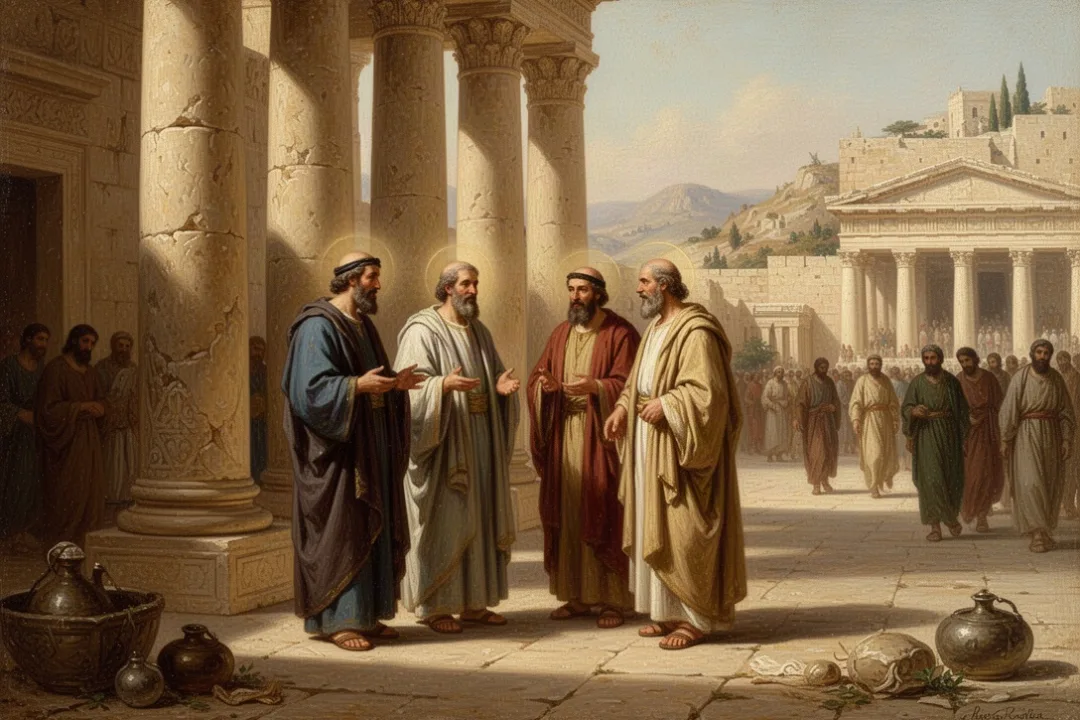
The Sadducees and Pharisees were both Jewish groups, but they were not the same. The New Testament frequently places them side by side because they represented competing approaches to religious authority and because both groups sometimes questioned Jesus.
The most obvious difference was their teaching about resurrection. The Pharisees believed in resurrection, angels, and spirits, while the Sadducees rejected these beliefs. Paul used this disagreement strategically in Acts 23:6-10, when he was being examined by the Jewish council. By identifying himself as a Pharisee on trial because of his hope in the resurrection, he caused a dispute between the two parties.
The groups also differed in their relationship to tradition. The Pharisees developed detailed interpretations of how the Law should be applied in everyday life. These interpretations addressed subjects such as purity, Sabbath observance, food, tithing, and religious practice outside the temple.
The Sadducees appear to have resisted the authority of these Pharisaic traditions. Their approach was more closely tied to the written Law and to temple-centered worship. This does not mean every Sadducee interpreted Scripture identically, but it does explain why disputes between the groups could involve both doctrine and practical religious conduct.
Their social settings were also different. The Pharisees had influence among ordinary Jewish people, teachers, and local religious communities. The Sadducees were more closely associated with the priestly aristocracy, Jerusalem’s leadership, and the institutions connected with the temple.
Neither group can be reduced to a single modern category. The Pharisees were not simply legalistic villains, and the Sadducees were not merely secular politicians. Both were Jewish groups concerned with faithfulness to God, though they disagreed sharply over interpretation, authority, resurrection, and the shape of religious life.
Jesus criticized both groups at different points, but his criticisms were not identical. In Matthew 16:1-12, he warns his disciples about the teaching of the Pharisees and Sadducees. In Matthew 23, his extended criticism is directed primarily at scribes and Pharisees. These passages should not be used to treat every member of either group as equally corrupt or to erase the differences between them.
A helpful comparison looks at their main areas of influence:
Sadducees: closely tied to the temple, chief priests, wealthy families, and Jerusalem’s leadership.
Pharisees: influential among teachers and local communities, with strong emphasis on interpreting the Law for daily life.
Sadducees: rejected resurrection, angels, and spirits according to Acts 23:8.
Pharisees: affirmed resurrection and belief in angels and spirits.
Both groups: could oppose Jesus and question his authority, even though their own beliefs differed.
Where the Sadducees appear in the Bible
The Sadducees challenge Jesus in Jerusalem
The most detailed encounter between Jesus and the Sadducees appears in the final week before his crucifixion. Matthew 22:23-33, Mark 12:18-27, and Luke 20:27-40 describe their question about resurrection.
They present a case involving a widow and seven brothers. Each brother dies after marrying her, and the Sadducees ask whose wife she will be in the resurrection. The question is not a sincere request for a complete explanation of eternal life. It is a challenge based on the assumption that resurrection would create an impossible social situation.
Jesus identifies two errors in their reasoning. First, he says they misunderstand the nature of life in the resurrection. Second, he says they do not understand the power of God. He then uses the writings of Moses to defend the reality of resurrection, showing that the Sadducees’ own preferred authority does not support their conclusion.
This exchange matters because Jesus does not answer by appealing only to later traditions or abstract speculation. He engages the Sadducees on the ground they recognize: the books of Moses. His response shows that belief in resurrection is not presented as a foreign addition to biblical faith.
The Sadducees react to Jesus’ authority
Matthew 3:7 records that Sadducees and Pharisees came to John the Baptist. John confronts them with a demand for genuine repentance rather than confidence based on religious identity. The passage does not explain each group’s motives in detail, so readers should avoid claiming that they came for exactly the same reason.
In Matthew 16:1, Sadducees join Pharisees in asking Jesus for a sign from heaven. Jesus refuses to satisfy their demand on their terms and warns his disciples about the teaching of both groups. Their cooperation in this scene does not mean their beliefs were identical. Groups with major disagreements can still oppose the same person or movement.
The Sadducees oppose the apostles in Acts
After Pentecost, the apostles publicly preach that Jesus has been raised from the dead. Acts 4:1-2 specifically identifies the priests, the captain of the temple guard, and the Sadducees as being disturbed by this teaching. The resurrection message threatened their theological position and could also intensify public tension around the temple.
Peter and John are arrested and questioned by the authorities in Acts 4. The leaders ask by what power or name the apostles have acted. Peter answers that the man who was healed was restored through the authority of Jesus Christ, whom the leaders had rejected but whom God raised from the dead.
Acts 5 again describes the high priest and the Sadducees reacting against the apostles. They arrest them, but the apostles continue teaching in the temple area after being released. The conflict concerns more than a private disagreement. It involves public proclamation, authority, temple space, and the claim that Jesus is God’s appointed Messiah.
Acts 23 provides the clearest explanation of the Sadducees’ theological position. Paul is brought before the Jewish council, and he declares that he is on trial because of the hope of resurrection. The Pharisees and Sadducees then argue, since the Pharisees accept resurrection and spiritual beings while the Sadducees reject them.
Read the Acts passages together: The Sadducees’ opposition to the apostles was both theological and institutional. The resurrection message challenged their doctrine and centered attention on Jesus in a setting where they held major authority.
Why the Sadducees opposed Jesus and the apostles
The Sadducees’ opposition had several connected causes. Their rejection of resurrection made the apostles’ central message unacceptable. If Jesus had truly risen from the dead, the Sadducees would have been forced to reconsider one of their defining beliefs.
The message also challenged their authority. The apostles taught publicly in Jerusalem and presented Jesus as the one through whom God had acted. This teaching could be heard as a direct challenge to the leaders who controlled access to the temple and helped govern religious life.
Jesus himself created tension around the temple. His actions in the temple courts, described in Matthew 21, Mark 11, and Luke 19, challenged the way the sacred space was being used. He also predicted the temple’s destruction in passages such as Mark 13 and Matthew 24. Such claims would have sounded serious to those whose status and responsibilities were tied to the temple.
Political concerns may have reinforced religious opposition. The Jewish leadership operated under Roman power, and public disorder could bring harsh intervention. John 11:47-53 portrays leading priests and Pharisees discussing the danger that Jesus’ growing influence might produce a Roman response. The passage does not say that every person in the discussion had the same motives, but it shows how religious and political concerns could overlap.
It is also necessary to distinguish the Sadducees from the Roman authorities. The Sadducees were not Romans, and the Bible does not portray them as non-Jewish leaders. They were Jewish authorities operating within a Roman-controlled political system. Their cooperation with governing powers should be understood in that context rather than as proof that they had abandoned Jewish faith.
Their opposition to Jesus does not mean that every Sadducee personally hated him or supported every action taken against him. The Gospels describe group-level conflicts, while the historical record rarely allows us to reconstruct the private views of individual members. Treating an entire community as morally identical would go beyond what the biblical texts establish.
Several factors likely worked together:
Doctrinal conflict: Jesus and the apostles proclaimed resurrection, which the Sadducees denied.
Temple authority: Jesus’ teaching and actions challenged institutions connected with Sadducee influence.
Public pressure: Large crowds and signs associated with Jesus could create concern among leaders responsible for order.
Political risk: Any movement that appeared capable of causing unrest could attract Roman intervention.
Competing authority: The apostles claimed that Jesus, rather than the established leaders, carried God-given authority.
What happened to the Sadducees after the temple was destroyed
The Sadducees are closely connected with the Jerusalem temple, so the temple’s destruction by the Romans in AD 70 had major consequences for their position. Once sacrifices stopped and the temple leadership lost its central institution, the social and religious foundation of the Sadducee party was severely weakened.
The New Testament does not provide a narrative explaining the group’s disappearance. Later Jewish and historical sources no longer present the Sadducees as a major surviving movement in the way they describe the Pharisaic tradition. For that reason, historians generally understand the Sadducees to have declined and effectively disappeared after the destruction of the temple.
That development does not mean every person associated with the group vanished immediately. Families, priests, and individuals connected with the former leadership could have continued living, but the Sadducees as an organized force no longer had the same institutional base.
Their decline also helps explain why the New Testament mentions them but later Jewish history gives them less continuing influence. The Pharisees’ interpretive tradition contributed to forms of Judaism that developed after the temple period, while the Sadducees’ temple-centered structure could not be maintained in the same way.
For Christian readers, the Sadducees remain important because their disputes with Jesus illuminate several central biblical themes: the authority of Scripture, the reality of resurrection, the nature of life after death, and the danger of protecting religious power at the expense of truth.
The Bible’s presentation is not an invitation to use “Sadducee” as a casual insult. It is a historical and theological description of a particular group. Understanding who they were makes the Gospel accounts more precise: Jesus was not arguing with all Jews, nor with a vague group of unbelievers, but with specific leaders who held recognizable beliefs and occupied important positions in first-century Judea.
Frequently asked questions
Were the Sadducees priests?
Many Sadducees appear to have come from priestly and aristocratic families, and the group was closely connected with the chief priests and Jerusalem’s temple leadership. However, “Sadducee” and “priest” are not identical terms. Priest described a religious office or lineage, while Sadducee referred to a broader party or affiliation that included people connected with temple authority.
Did the Sadducees believe in God?
Yes. The Sadducees were a Jewish group involved in temple worship and committed to the authority of the Law of Moses. Their disagreement with the Pharisees concerned particular doctrines, especially resurrection and belief in angels or spirits. The Bible does not portray them as atheists; it portrays them as leaders with a distinct interpretation of Jewish faith.
Why did Jesus criticize the Sadducees?
Jesus challenged the Sadducees because they misunderstood both Scripture and the resurrection. In the Gospel accounts, they used a hypothetical marriage problem to argue against resurrection, and Jesus answered by explaining the nature of the future age and appealing to Moses. Their position also represented religious authority that resisted his teaching and the apostles’ message.
Are there Sadducees today?
The Sadducees are generally understood to have disappeared as an organized group after the Jerusalem temple was destroyed in AD 70. Their influence depended heavily on the temple, priestly leadership, and the institutions of that period. Modern Jewish groups are not normally identified as Sadducees, although people may still debate some theological questions that resemble ancient disagreements about resurrection or religious authority.










Leave a Reply