A winepress is a device or prepared place used to crush grapes and collect their juice for winemaking. In its simplest form, workers placed ripe grapes in a shallow basin, crushed them underfoot or with a tool, and directed the juice into a lower container.
Ancient winepresses were usually built from stone or plastered masonry, with a higher crushing floor connected to a lower collecting vat. The word can also refer to the entire grape-crushing operation, including the basin, channels, storage jars, and fermentation vessels.
The basic purpose of a winepress is straightforward: it separates the liquid inside grapes from the skins, seeds, stems, and other solid material. The design varies by period and region, but every press needs a place to crush the grapes and a way to capture the juice.
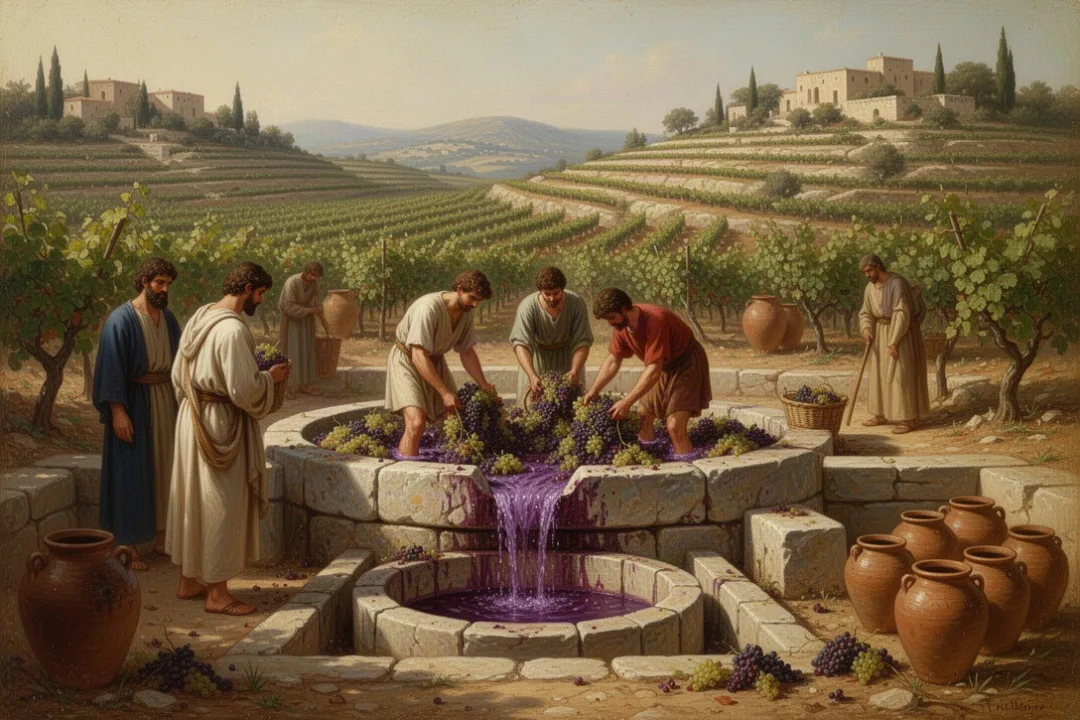
A traditional press often included a crushing vat, sometimes called a treading floor. This was the upper chamber where grapes were placed. Its surface was slightly sloped or connected to a narrow channel, allowing juice to flow toward a lower basin.
The lower basin served as the collection vat. It held the fresh grape juice, which could then be transferred to jars, skins, barrels, or other vessels for fermentation. Some presses had several connected basins so that workers could collect juice, allow sediment to settle, and move the liquid through the next stage of production.
Important parts of a simple winepress may include:
Crushing floor: the upper surface where grapes were trodden or pressed.
Drainage channel: a groove or opening that guided juice away from the grapes.
Collection vat: the lower basin that received the flowing juice.
Pressing mechanism: a beam, weighted stone, screw, or other device used to apply extra pressure.
Storage vessels: containers used to hold juice during settling, fermentation, and later storage.
Not every winepress had a mechanical device. In many small installations, the grapes were crushed by foot. A heavier press was useful when producers wanted to extract more liquid after the first juice had drained naturally, particularly from the remaining skins and pulp.
Plain definition: A winepress is both a grape-crushing installation and the process of extracting juice from grapes. The term does not necessarily mean a modern machine; it can describe an ancient stone vat as well.
How ancient people used a winepress
Winemaking began with harvesting ripe grapes, usually by cutting bunches from the vines and carrying them in baskets. The timing mattered because grapes needed enough sugar and flavor for fermentation, but overripe or damaged fruit could affect the quality of the juice.
Workers placed the harvested grapes into the upper part of the press. In a traditional foot-treading method, several people entered the basin and crushed the grapes with rhythmic steps. They often held onto a rope, pole, or nearby support for balance, especially when the grapes made the floor slippery.
The first liquid released from the grapes was known as free-run juice. It flowed through an opening or channel into the collecting vat without requiring heavy pressure. Once the grapes had been broken down, workers could gather the remaining skins and pulp for additional pressing.
A mechanical press used pressure from above. A beam, lever, weighted object, or later screw mechanism compressed the grape material. This produced additional juice, although it could also extract more tannins, color, and bitter compounds from the skins, seeds, and stems.
A typical ancient winemaking sequence included these stages:
Harvesting: ripe grapes were collected and brought to the press.
Crushing: the grapes were broken open by feet or a pressing tool.
Collection: juice ran into a lower vat or container.
Settling: heavier particles could sink before the liquid was transferred.
Fermentation: naturally occurring yeast changed grape sugars into alcohol.
Storage: the developing wine was kept in suitable vessels and monitored.
Fermentation often began soon after crushing because yeast naturally present on grape skins and in the surrounding environment could start converting sugar into alcohol. Producers might transfer the juice to large ceramic jars, animal skins, or other containers, depending on local materials and customs.
The press therefore played a central role in a community’s agricultural year. It was not merely a tool used for one moment of crushing. A press could be part of a larger production area where people harvested, processed, stored, and monitored grapes over a period of weeks or months.
What ancient winepresses looked like
Many ancient winepresses were permanent installations carved into bedrock or built from fitted stones. A common arrangement had an upper basin for crushing and a lower basin for collecting juice. The two areas were joined by a small opening or channel cut into the wall.
Bedrock presses were especially practical in regions where exposed limestone or other durable stone was available. Builders could shape a shallow basin directly into the rock, smooth the interior, and coat it with plaster to reduce leakage. Nearby spaces might hold jars, tools, or temporary baskets of grapes.
Constructed presses used masonry, plaster, and waterproofing materials. The surfaces needed to be reasonably smooth and resistant to liquid so that juice would not disappear into cracks or become contaminated by loose soil. Repairs could be made when the plaster wore away.
Some installations were small enough for a household or a few families. Others were larger and more carefully engineered, suggesting production for a village, estate, religious center, or commercial market. Size alone does not answer every question about ownership, because a large press might have served several households rather than one wealthy producer.
Archaeologists study winepresses alongside nearby evidence such as storage jars, grape seeds, pruning tools, terraces, and farm buildings. This combination helps show whether a site supported grape cultivation and wine production, rather than merely storing imported wine.
Physical details can also reveal how the press operated:
A deep or broad upper basin may indicate repeated crushing or a larger harvest.
A narrow channel can show the direction in which juice flowed.
A lower vat may have been used for collecting juice before fermentation.
Postholes or supports may suggest that a beam press once stood above the basin.
Plaster layers can provide evidence of maintenance and repeated use.
The presence of a winepress does not always prove that the finished wine was produced at that exact location. Grapes may have been crushed in one place and fermented or stored somewhere else. Archaeological interpretation depends on the entire setting, the condition of the installation, and related finds.
Ancient presses also varied by climate and agricultural practice. In areas with dry summers, a press could be built close to vineyards or on a farm terrace. In cooler or wetter regions, producers might place the facility nearer a settlement or protected building. The essential principle remained the same: break the grapes, collect the juice, and preserve it long enough for fermentation.
How a winepress differs from other grape-processing methods
A winepress is not the same as simply crushing grapes in a bowl or vessel. The defining feature is the organized collection of juice, often through a sloped surface, channel, or separate vat. A press may rely on human feet, but the word refers to the installation or equipment rather than to one specific technique.
Foot treading breaks grapes gently and can release juice while leaving many seeds intact. It is different from using a heavy mechanical press, which applies stronger force to the grape mass. Both methods can occur within the same winepress operation.
A crusher is designed mainly to break grape skins and release juice. A press applies force after or during crushing to extract additional liquid. Modern wineries may use separate machines for destemming, crushing, pressing, and clarification, while an ancient installation often combined several functions.
Presses can also produce different portions of juice. The first juice that drains without strong pressure is generally distinct from juice extracted by pressing the remaining grape solids. Winemakers may keep these portions separate because they can differ in color, acidity, tannin, and flavor.
After pressing, the solid material left behind is called pomace. It contains skins, seeds, pulp, and sometimes stems. Depending on local practice, pomace could be discarded, composted, used for animal feed, processed further, or used to make another alcoholic product.
Modern wine production uses equipment suited to the intended style and the condition of the fruit. A winery may use a bladder press, basket press, pneumatic system, or another design. These machines allow producers to control pressure, speed, oxygen exposure, and the separation of juice from solids.
The most useful distinctions are:
Crushing: opening the grape so juice can escape.
Treading: crushing grapes with human feet, usually in a vat.
Pressing: applying force to extract more juice from grape solids.
Fermentation: allowing yeast to convert sugars into alcohol and other compounds.
Clarification: removing or separating sediment and suspended solids.
These terms describe connected steps, but they are not interchangeable. A winepress may include crushing and pressing, while fermentation normally takes place in another container after the juice leaves the press.
Why the winepress is a powerful biblical image
The winepress appears frequently as an image in the Bible because grape processing was familiar to agricultural communities. People understood the sight of grapes being crushed, juice running out, and the press area becoming stained with deep red liquid. That ordinary scene could carry meanings related to harvest, judgment, suffering, and abundance.
In prophetic writing, a winepress may represent the gathering and processing of a harvest. The harvest can refer to people, nations, or the consequences of human actions. The image communicates that a season of decision has arrived and that what has grown over time is now being brought to its appointed result.
Several passages in the Hebrew Bible connect the winepress with judgment. Isaiah 63 describes a figure who has trodden the winepress alone, using the familiar process as a vivid picture of divine action against wrongdoing. The passage’s imagery is forceful and should be read within its prophetic context rather than treated as a technical description of winemaking.
Joel 3 also uses harvest language that includes the winepress. The message presents nations being brought before divine judgment, with the overflowing press conveying the scale and seriousness of the event. Revelation 14 later uses related harvest and winepress imagery to portray judgment on a large scale.
These references do not all carry exactly the same emphasis. In one setting, the winepress can suggest punishment and wrath; in another, harvest imagery can point to timing, fulfillment, or the gathering of what has matured. The surrounding passage determines whether the image is primarily agricultural, judicial, or both.
The winepress can also suggest pressure and suffering because pressing involves force applied to grapes. In Christian interpretation, that association sometimes appears alongside reflections on Christ’s suffering. Gethsemane itself was not necessarily a winepress, but the name is connected with an olive press, so readers should avoid treating the two terms as identical.
When studying a biblical reference to a winepress, ask these questions:
Is the passage describing a literal agricultural activity or using a metaphor?
Who is doing the pressing, and who or what is represented by the grapes?
Does the surrounding context emphasize judgment, harvest, suffering, or blessing?
Is the image connected to a particular prophecy, vision, parable, or song?
Does the passage refer to grape juice, wine, bloodlike color, or the act of treading?
Judges 9:27 mentions people gathering grapes and celebrating after making wine, showing the winepress in a setting of communal festivity. Isaiah 5 refers to a vineyard and the preparation of a winepress while describing expectations placed on a vineyard’s owner. Matthew 21 uses a vineyard with a winepress in a parable about stewardship and accountability.
The image can therefore move in more than one direction. A winepress may be associated with celebration when the harvest is successful, but it may also become a warning when the harvest represents moral consequences. The concrete process gives the metaphor its emotional force: grapes are gathered, pressure is applied, and the result cannot be hidden.
Reading tip: Biblical winepress imagery should be interpreted from its immediate passage. Do not assume that every reference means anger or punishment; some references focus on harvest, celebration, ownership, or the responsibilities connected with a vineyard.
How to understand a winepress at an archaeological site
If you encounter a stone basin identified as a winepress, look first at its shape and relationship to nearby features. A higher crushing floor paired with a lower collecting vat is stronger evidence than a single shallow depression. Channels, plaster, and a location near agricultural terraces can strengthen the interpretation.
Color alone is not enough. Dark or reddish stains may result from many materials and may have developed long after the press stopped operating. Archaeologists consider residue, sediment, plant remains, construction methods, and the broader site before deciding what a feature was used for.
It is also possible for similar installations to have processed other crops or liquids. An olive press, for example, uses a different process and commonly includes crushing stones, pressing equipment, and collection areas for oil. A simple basin could have served more than one purpose, so identification requires careful comparison.
Visitors should not climb into, scrape, wet, or handle an ancient winepress. These features can be fragile, and modern interference may damage surfaces or remove evidence that researchers need. The safest way to understand a site is to examine its layout, read the local interpretation, and consider how the press fits into the surrounding landscape.
A well-preserved press can reveal more than the existence of wine. It may show the scale of farming, the organization of labor, the availability of water and building materials, the importance of storage, and the relationship between rural producers and nearby settlements.
The most reliable interpretation combines the physical installation with human activity around it. A winepress was a place where agriculture, technology, trade, food preservation, and social life met. That is why even a modest stone basin can provide valuable evidence about the people who built and used it.
Frequently asked questions
What is the difference between a winepress and an olive press?
A winepress extracts juice from grapes, while an olive press crushes olives and separates oil from the solid material and watery liquid. Winepresses commonly use a crushing floor, drainage channel, and collection vat. Olive presses often include heavy crushing stones and a stronger pressing system because olives require a different form of processing.
Did people really crush grapes with their feet?
Yes. Foot treading was a practical method because it broke the grapes without crushing every seed. Workers could stand in a shallow vat and use their weight to release juice. This method required clean equipment and careful handling, but it was common in many traditional winemaking settings before modern mechanical presses became widespread.
Does every biblical winepress reference mean divine judgment?
No. The meaning depends on the passage. A winepress can represent judgment, but it may also appear in descriptions of harvest, celebration, vineyard ownership, or accountability. Prophetic books often use the image dramatically, while historical and parable passages may focus more on farming, community life, or the relationship between a landowner and workers.
Can archaeologists tell how much wine an ancient press produced?
They can make estimates from the size of the crushing floor, collecting vat, storage facilities, and nearby agricultural evidence, but exact production is rarely certain. The condition of the press, the type of grapes, the number of workers, and whether several households shared the installation all affect its capacity and use.












Leave a Reply