If you have ever tried to picture Noah’s Ark as a real vessel, the first question is probably simple: how large was it? Genesis 6:15 gives its dimensions as 300 cubits long, 50 cubits wide, and 30 cubits high. Because a cubit was an ancient unit based roughly on the length of a forearm, the exact modern measurements cannot be known with complete precision.
Using a commonly cited cubit of 18 inches, the Ark would have measured about 450 feet long, 75 feet wide, and 45 feet high. In metric units, that is approximately 137 meters long, 23 meters wide, and 14 meters high. The biblical description also says that the vessel had three decks, although it does not provide detailed plans for the internal layout.
The dimensions appear in Genesis 6:15, where God tells Noah how to make the Ark. The passage gives three measurements in cubits, presented as length, width, and height:
Length: 300 cubits
Width: 50 cubits
Height: 30 cubits
Genesis 6:16 adds several construction details. The Ark is described as having three levels or decks, an opening or window near the top, and a door in its side. The text also says that it was to be made from a type of wood commonly translated as gopher wood, and that it was coated with pitch to make it watertight.
The clearest answer: The biblical dimensions are 300 cubits by 50 cubits by 30 cubits. Modern estimates depend mainly on how long you believe an ancient cubit was.
How large was Noah’s Ark in modern units?
There is no single universally agreed length for the cubit. A practical estimate often used for biblical measurements is 18 inches, or 1.5 feet. Converting Genesis 6:15 with that estimate produces the following figures:
300 cubits: about 450 feet, or 137 meters
50 cubits: about 75 feet, or 23 meters
30 cubits: about 45 feet, or 14 meters
So, under the 18-inch estimate, the Ark would have been a large rectangular vessel measuring approximately 450 feet by 75 feet by 45 feet. Its length-to-width ratio would have been 6 to 1, while its length-to-height ratio would have been 10 to 1.
Those proportions give the Ark a long, relatively narrow shape. The description does not present it as a conventional sailing ship with a pointed bow, curved hull, or tall mast. Instead, many readers understand it as a large barge-like floating structure, designed primarily to remain afloat rather than to travel under its own power.
Why the exact size depends on the cubit
A cubit was not a standardized international unit like the modern foot or meter. It generally referred to the distance from a person’s elbow to the end of the hand or middle finger, so the measurement could vary between cultures and periods. Ancient measuring systems also sometimes used a short cubit and a long or royal cubit.
If the cubit was 18 inches, the Ark was about 450 feet long. If it was closer to 20.4 inches, another commonly discussed ancient estimate, the dimensions would be approximately:
Length: 510 feet, or about 155 meters
Width: 85 feet, or about 26 meters
Height: 51 feet, or about 16 meters
These alternatives do not change the biblical proportions. They simply make the entire vessel larger or smaller by the same scale. The key point is that the Bible gives the dimensions in cubits, not in feet or meters, and the original physical length of that unit cannot be determined with absolute certainty.
How much space would the Ark have contained?
Multiplying the three estimated dimensions gives a rough external volume. At 450 feet long, 75 feet wide, and 45 feet high, the rectangular volume would be about 1.52 million cubic feet, or roughly 43,000 cubic meters.
That number is only a mathematical estimate. It should not be treated as the amount of usable storage space. The vessel would have needed walls, beams, supports, doors, partitions, and space between decks. The shape may also have differed from a perfect rectangular box, especially around the roof, corners, and lower structure.
With three decks, the average deck area would be roughly 33,750 square feet if the full footprint were used on each level. Across all three levels, that would amount to about 101,250 square feet of gross floor area. Actual usable space would have been lower because of construction supports, access passages, animal enclosures, supplies, and other necessities.
Genesis does not give a detailed inventory of the Ark’s contents or a floor plan. As a result, calculations about the number of animals it could hold are based on assumptions about animal categories, enclosure size, food storage, water, ventilation, and the amount of room required for people to work inside the vessel.
What the three decks tell us about the Ark’s design
The mention of three decks is one of the few interior details in the biblical account. If the vessel was about 45 feet high, three levels would not necessarily have been equal in height. The deck arrangement could have allowed room for animals, storage, passageways, and structural framing.
A simple conceptual breakdown might include:
Lower level: heavier supplies, water containers, feed, and animals that needed stable conditions
Middle level: additional animal spaces, storage, and working areas
Upper level: people, lighter supplies, ventilation openings, and access to the door or window
This is not a biblical floor plan. It is only one way to imagine how the available volume might have been organized. Genesis does not say which animals occupied which deck, where Noah’s family lived, or how food and water were distributed.
The height also matters structurally. A 45-foot vessel divided into three decks would have provided substantial internal space, but it would still have required a strong framework. The text mentions rooms or compartments, which suggests that the interior was divided rather than left as one open hall.
What shape did Noah’s Ark have?
The Bible gives measurements but does not provide a full outline of the hull. It does not describe a pointed front, a rounded bottom, a keel, a rudder, or a sail. The Hebrew term commonly translated as ark refers to a box-like vessel, which is also used for the basket in which the infant Moses was placed in Exodus 2.
That does not prove the Ark had perfectly vertical sides or a modern box shape. It does suggest that the biblical focus is on a large protective container that could float, rather than on a ship designed for navigation. The Ark’s purpose in the story was survival during the flood, not exploration or long-distance sailing.
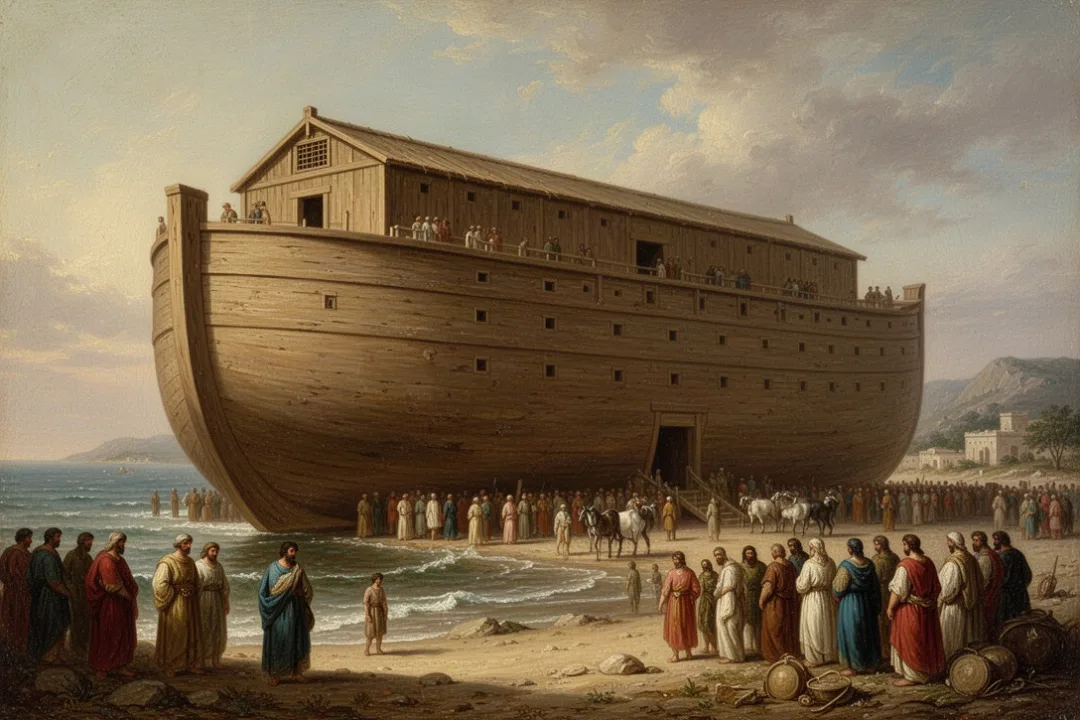
Many artistic reconstructions give the Ark a curved ship’s hull, a raised bow, and a pointed stern. Those details may make an illustration look familiar, but they are not specified in Genesis. Other reconstructions show a long rectangular barge with a flat or gently sloping roof. Both approaches involve interpretation because the ancient text does not supply enough information to establish one exact shape.
How the Ark’s proportions compare with modern vessels
Using the 18-inch cubit, the Ark’s length would have been about 450 feet. That is longer than a typical city block in many parts of the United States and roughly one and a quarter times the length of an American football field including its end zones. It would have been much larger than an ordinary wooden boat.
The comparison has limits. Modern ships are built for particular functions such as carrying containers, transporting fuel, fishing, or moving passengers. They use engineered hulls, propulsion systems, navigation equipment, and carefully calculated stability controls. The Ark is described for a different purpose and in a different technological setting.
The Ark’s 6-to-1 length-to-width ratio is also notable. A long, wide platform can be stable on water, especially when its center of gravity is kept low. However, stability would depend on much more than the outside dimensions, including the shape of the bottom, the weight distribution, the materials, the internal supports, and the conditions of the water.
What Genesis says about the Ark’s construction
Genesis 6:14-16 gives several construction instructions alongside the dimensions. Noah is told to make compartments inside the vessel, apply pitch inside and outside, provide an opening near the top, and place the door in the side. These directions offer a broad design concept but not a complete engineering specification.
The text does not identify the exact species of wood with certainty. The phrase often rendered gopher wood appears only in the Ark account, so its precise botanical meaning remains uncertain. Likewise, translations differ on some details of the opening near the top, including its exact design and dimensions.
The account also does not specify the thickness of the hull, the size of the beams, the number of support columns, or the fastening method. It gives enough information to state the main dimensions, but not enough to create a verified construction blueprint.
Keep the distinction clear: 450 by 75 by 45 feet is a conversion of the stated dimensions using an 18-inch cubit. It is not a measurement recorded in the original biblical text.
Why illustrations of the Ark look different
Pictures and models of Noah’s Ark vary because artists must fill in many details that Genesis leaves open. They may choose different cubit lengths, hull shapes, roof designs, deck heights, window arrangements, and placements for the door.
Common differences include:
Hull shape: rectangular, flat-bottomed, rounded, or ship-like
Roof design: flat, peaked, slightly sloped, or open around a central section
Deck arrangement: three equal levels or three levels with different heights
Window design: one continuous opening, multiple openings, or a narrow ventilation strip
Internal layout: open pens, small compartments, storage rooms, and corridors in different combinations
A model can therefore be useful for showing the scale and proportions of the biblical measurements without proving every visual detail. When examining a reconstruction, check which features come directly from Genesis and which have been added by the designer.
Does the Bible give the Ark’s length, width, and height in that order?
Yes. Genesis 6:15 presents the dimensions as length, breadth, and height. Most English translations therefore report the sequence as 300 cubits long, 50 cubits wide, and 30 cubits high.
The order matters because reversing the figures would create a completely different vessel. A structure that was 50 cubits long and 300 cubits wide would not match the proportions normally understood from the passage. The standard reading produces the long, broad, comparatively low shape associated with most Ark reconstructions.
The passage does not state whether the measurements describe the exterior or interior of the vessel. In ordinary construction language, dimensions of a building or vessel are usually understood as overall dimensions unless the text says otherwise. This is another reason that calculations of storage space should be treated as approximate.
How tall was the Ark compared with its length?
At the 18-inch cubit estimate, the Ark’s height was about 45 feet. That is approximately the height of a four-story building, although a vessel’s decks and internal ceiling heights would not correspond exactly to residential floors.
Its 450-foot length would have been ten times its height. This proportion would produce a relatively low profile compared with many modern ships, especially if the roof was flat or gently sloped. The design may have favored stability by spreading the vessel’s weight across a broad base rather than making it tall and narrow.
Still, the outer measurements alone cannot establish whether the Ark would have survived particular waves or currents. A seaworthiness assessment would require information the biblical account does not provide, such as the hull cross-section, timber properties, joints, ballast, loading pattern, and water conditions.
What can be stated with confidence?
The most secure information comes directly from Genesis: the Ark was 300 cubits long, 50 cubits wide, and 30 cubits high; it had three levels; it included internal compartments; it had an opening near the top; and it had a side door.
The modern conversion is necessarily an estimate. With an 18-inch cubit, the figures are about 450 feet by 75 feet by 45 feet. With a longer cubit, the Ark could have been closer to 510 feet by 85 feet by 51 feet.
Everything beyond those basic measurements—such as the exact wood, the detailed hull shape, the room layout, the number of windows, and the capacity for animals—requires interpretation. The dimensions provide a clear scale, but they do not amount to a complete technical drawing.
Why the measurements matter in the biblical account
The dimensions make the Ark more than a vague symbol of refuge. They present it as a large, carefully specified structure with enough height and floor area to contain people, animals, food, and equipment. The measurements also help readers understand the physical scale of the story.
At the same time, Genesis emphasizes the Ark’s function rather than its engineering details. It is built to preserve life through the flood, and its construction instructions are selective. The text tells readers the principal dimensions and several defining features while leaving much of the design open.
For that reason, the best answer combines precision with caution: Noah’s Ark is described as 300 by 50 by 30 cubits, which is roughly 450 by 75 by 45 feet under a common conversion. The exact modern measurements and appearance remain uncertain because the cubit and many construction details are not fully defined.
Frequently asked questions
How long was Noah’s Ark in feet?
Using an 18-inch cubit, Noah’s Ark would have been about 450 feet long. The biblical measurement is 300 cubits, not 450 feet, so the modern figure is an estimate. If a longer ancient cubit was used, the Ark may have been closer to 510 feet long.
How wide and tall was Noah’s Ark?
Genesis describes the Ark as 50 cubits wide and 30 cubits high. With an 18-inch cubit, those measurements equal approximately 75 feet wide and 45 feet high. The account also says the Ark had three decks, but it does not give the height of each individual deck.
How many decks did Noah’s Ark have?
Genesis 6:16 says the Ark had three levels or decks. The passage does not explain how the decks were divided or what was kept on each one. Ideas about animal pens, storage spaces, work areas, and living quarters come from interpretation rather than a detailed biblical floor plan.
Was Noah’s Ark shaped like a modern ship?
The Bible does not provide enough information to establish a precise hull shape. It describes a large vessel with compartments, a side door, an upper opening, and three levels, but it does not mention a pointed bow, rudder, mast, or sails. Many modern illustrations therefore add details that are not specified in Genesis.










Leave a Reply