2 Chronicles 24 describes the reign of King Joash of Judah, beginning with his effort to repair the temple in Jerusalem and ending with his assassination. The chapter presents a clear pattern: Joash does well while the priest Jehoiada guides him, but after Jehoiada dies, the king abandons faithful worship and refuses correction.
The chapter’s central message is that religious reform requires lasting faithfulness, not merely a strong beginning. Joash restores the temple, yet his later choices reveal that outward repair cannot replace wholehearted loyalty to God.
Joash becomes king of Judah as a child and rules for forty years in Jerusalem. Because he is young, the priest Jehoiada plays a major role in guiding him. During Jehoiada’s lifetime, Joash makes decisions that honor God, including a campaign to restore the temple, which had been neglected and damaged under previous rulers.
The people contribute money for the repairs, and the project eventually moves forward successfully. However, after Jehoiada dies, Judah’s officials persuade Joash to tolerate other forms of worship. God sends prophets to warn the king and the nation, but they refuse to listen.
Jehoiada’s son Zechariah then confronts the people publicly. Instead of responding with repentance, Joash orders Zechariah to be killed in the temple courtyard. Soon afterward, a small Aramean army defeats Judah’s larger force, and Joash is later assassinated by his own servants.
Central idea: 2 Chronicles 24 contrasts a good public reform with a weak inner commitment. Joash can support the right project for a time, but his later rejection of God’s word exposes the difference between borrowed faith and personal faithfulness.
Historical and biblical context for 2 Chronicles 24
Second Chronicles 24 follows a dangerous period in Judah’s history. King Jehoram had led the nation into serious spiritual compromise, and later rulers continued that direction. Athaliah, the mother of King Ahaziah, attempted to destroy the royal family and seize power. Joash survived because his aunt Jehosheba hid him in the temple for six years.
The priest Jehoiada then organized Joash’s public coronation and helped remove Athaliah. This explains why Jehoiada’s influence is so prominent in the chapter. He was not simply a religious adviser; he had protected the surviving royal heir and helped restore the Davidic line.
When Joash begins to reign, the temple has suffered from neglect and misuse. Earlier rulers had allowed objects connected with Baal worship to enter the temple precincts. The restoration project therefore had both a physical and a spiritual dimension: the building needed repair, but Judah also needed to return to proper worship.
The Chronicler emphasizes the temple because worship sits at the center of Judah’s covenant relationship with God. The condition of the temple reflects the nation’s spiritual condition, although the chapter later shows that a repaired building alone cannot guarantee obedience.
A step-by-step breakdown of 2 Chronicles 24
Joash becomes king as a child. His long reign begins under the guidance of Jehoiada, who provides stability and direction.
Joash decides to repair the temple. The king directs attention to the neglected house of God and expects the priests and Levites to organize the work.
The first collection system fails. The Levites do not act quickly enough, so Joash calls for a different arrangement that gives the project clearer accountability.
The people contribute generously. A collection chest is placed near the temple entrance, and the people bring money until the repairs can be completed.
Worship is restored. The remaining funds are used for temple articles and for regular offerings, including burnt offerings.
Jehoiada dies at an advanced age. He is honored with burial among the kings because of the good he had done for Judah and the temple.
Joash changes direction. Judah’s officials come to him, and the king permits them to abandon the temple and serve sacred poles and idols.
Prophets warn the nation. God sends messengers, but neither the leaders nor the king listens.
Zechariah confronts Judah. Jehoiada’s son explains that their unfaithfulness will prevent them from prospering.
Zechariah is murdered. Joash orders his stoning in the temple courtyard, despite the relationship between Zechariah’s father and the king.
Judah is defeated by Aram. A relatively small Aramean force inflicts serious damage because Judah has forsaken God.
Joash is assassinated. His servants kill him while he is weakened, and he is not buried in the tombs of the kings.
Why Joash’s temple repair mattered
Joash’s first major project was not a palace expansion or a military campaign. He focused on the temple, the place where Judah’s priests served and where the nation brought its offerings. That priority shows the influence of Jehoiada and reflects a proper understanding of the king’s responsibility under the covenant.
The temple had been damaged and neglected during years of idolatry. Repairing it required more than construction work. The project represented a decision to remove the effects of previous rebellion and restore the worship God had commanded.
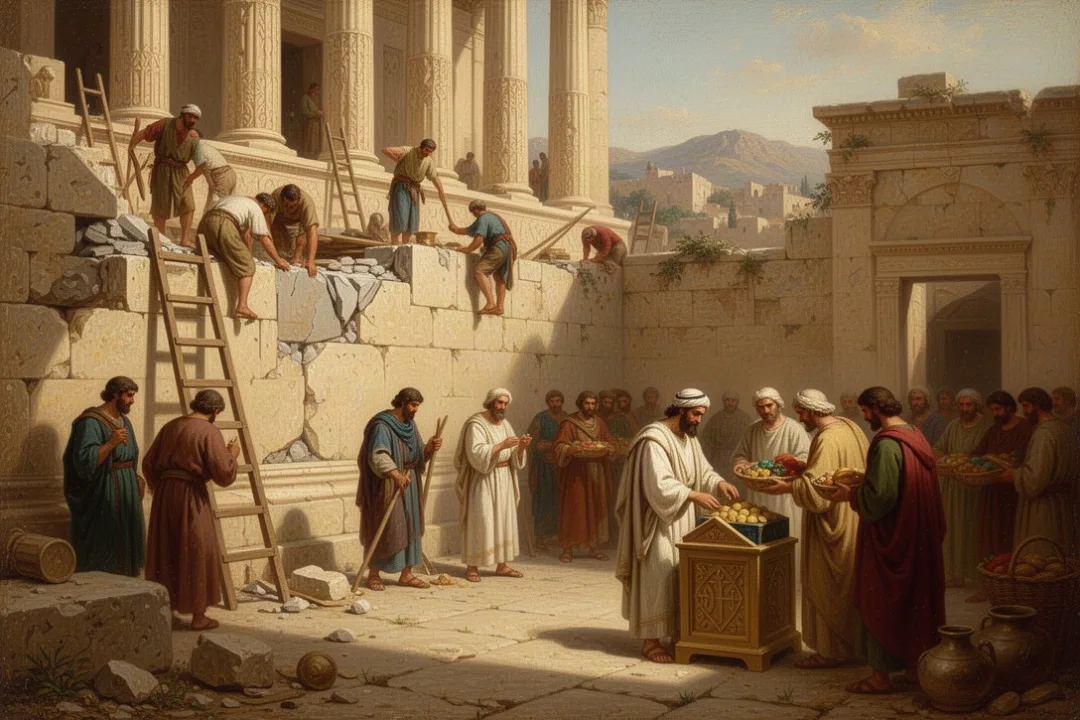
The chapter also shows that good intentions need practical organization. At first, the priests and Levites do not move the project forward as expected. Joash responds by establishing a public collection chest, making the process visible and easier to manage.
As money comes in, the work progresses. Skilled workers repair the structure, and the remaining funds provide for sacred vessels and worship materials. The account presents the people’s giving as a meaningful part of national renewal.
Visible damage required visible action. Joash did not treat the temple’s condition as someone else’s problem.
Shared responsibility made the project possible. The king organized the effort, while the people supplied the resources.
Accountability strengthened trust. The collection chest gave the people a clear way to see how the work was being supported.
Restoration included worship. The goal was not only a sound building but also renewed service at the altar.
How the collection chest changed the temple project
The early collection process is one of the chapter’s most practical details. Joash initially expects the Levites to gather the required money, but the work does not advance. Rather than allowing the repair effort to stall, he creates a more direct method for collecting contributions.
The chest is placed outside the temple entrance, and the king’s officials announce the arrangement. People bring their offerings, and the officials empty the chest when it becomes full. This system connects public giving with a visible need and establishes a repeated process rather than relying on informal promises.
The passage does not present the collection as a technique for manipulating people. Instead, it shows the value of clear stewardship. The purpose is known, the contributions are gathered in an orderly way, and the money is applied to the work that the people were asked to support.
For modern readers, the principle applies to congregations, charities, and other community projects. A worthy goal still needs defined responsibility, transparent handling of funds, and regular attention when the original plan does not work.
What changed after Jehoiada died
Jehoiada’s death marks the sharpest turning point in the chapter. During the priest’s lifetime, Joash follows a faithful pattern. Afterward, Judah’s officials approach the king and persuade him to permit the worship of idols and sacred poles.
The text does not suggest that Joash suddenly became unaware of God. He had already overseen temple restoration and had benefited from Jehoiada’s instruction for decades. His failure is more serious because it follows such close exposure to faithful leadership.
Joash appears to have depended heavily on Jehoiada’s direction without developing the same commitment for himself. Once the priest is gone, the king becomes vulnerable to influential officials who want religious freedom on their own terms. His earlier reform proves to be unstable because it was not rooted deeply enough in personal conviction.
Practical warning: A respected mentor can guide your decisions, but another person’s faith cannot permanently substitute for your own obedience. Healthy spiritual leadership should help people grow in discernment, not leave them dependent on one individual’s presence.
Why God sent prophets after Judah’s idolatry
When Judah turns away, God does not immediately bring judgment without warning. The chapter says that prophets are sent to bring the people back, but the leaders refuse to listen. This shows both God’s patience and the seriousness of the nation’s response.
Prophetic warnings were not merely predictions about future events. They were calls to return. The prophets identified the nation’s unfaithfulness and offered the possibility of repentance, but Joash and the officials rejected the message.
The chapter therefore presents judgment as a consequence of persistent refusal, not as an arbitrary reaction. Judah has been given instruction, opportunity, and warning. Its leaders choose to continue in rebellion.
This pattern appears throughout Chronicles: sin damages worship, leadership, community life, and national security. The spiritual problem is never isolated. When the king and officials reject God, the entire nation suffers.
Who Zechariah was and why his death matters
Zechariah was the son of Jehoiada, the priest who had protected Joash and helped establish him as king. The chapter presents Zechariah as someone empowered by God to speak publicly to the people. His message is direct: because they have abandoned God, God has allowed them to experience the consequences of abandonment.
Zechariah’s position makes Joash’s reaction especially disturbing. Jehoiada had served the king faithfully, yet Joash does not honor that relationship when Zechariah challenges the nation’s behavior. The king chooses silence through violence rather than repentance through listening.
Zechariah is killed in the temple courtyard, the very place Joash had worked to restore. This location creates a powerful contrast. The temple has been repaired physically, but the king’s heart has turned against the message of the God worshiped there.
Jesus refers to the killing of Zechariah in a rebuke recorded in Matthew 23:35 and Luke 11:51. Those passages place Zechariah among the righteous people whose testimony was rejected and connect his death with a broader history of resistance to God’s messengers. The references also make clear that the killing was remembered as a serious act of guilt.
What Zechariah’s final appeal reveals about accountability
Before he dies, Zechariah calls on God to see and judge what has happened. His appeal is not a denial of God’s justice; it is an acknowledgment that human authorities have failed to act rightly. The king may control the immediate situation, but he cannot prevent God from seeing the truth.
This moment addresses a difficult question: what can a faithful person do when powerful leaders reject correction? Zechariah does not have enough political power to protect himself. He remains faithful by speaking the truth, even though the response is hostile.
The account does not encourage reckless confrontation in every circumstance. It does show that faithfulness is measured by truth and obedience, not by whether a warning receives a favorable response. A prophet’s responsibility is to deliver God’s message; the hearer remains responsible for how he responds.
Why a smaller Aramean force defeated Judah
After Zechariah’s death, an Aramean army invades Judah. The Chronicler emphasizes that the invading force is comparatively small, yet it defeats Judah’s larger army and reaches Jerusalem. The point is not that military strength is irrelevant in every situation. The point is that Judah’s numbers cannot protect a nation that has rejected God.
The Arameans inflict heavy losses and take valuable goods back to their ruler. Judah’s leaders had trusted political influence and military resources while abandoning the foundation of their national life. The invasion exposes the weakness hidden behind outward strength.
Joash is left severely wounded. The account links his defeat to his guilt in murdering Zechariah and explains that God delivers judgment because Judah has forsaken him. The military disaster is therefore interpreted spiritually, not merely politically.
Chronicles repeatedly asks readers to see beyond visible circumstances. A large army may look secure, while a smaller force may prevail. The decisive issue is not simply size or strategy but the nation’s relationship with God.
How Joash’s death completes the chapter’s warning
Joash’s servants conspire against him because of the blood of Jehoiada’s son. They kill him while he is lying wounded, then bury him in Jerusalem, but not in the royal tombs. This burial detail contrasts sharply with the honor given to Jehoiada.
Jehoiada is buried among the kings because of the good he did for Judah, the king, and the temple. Joash, although he ruled for forty years and began with a major reform, is denied the same honor. The contrast shows that length of reign and public achievement do not determine the ultimate evaluation of a life.
The ending also demonstrates the instability created by Joash’s choices. He had once benefited from Jehoiada’s protection and guidance. After turning away from that legacy, he loses moral authority, suffers military defeat, and dies through a conspiracy within his own household.
Major themes in 2 Chronicles 24
Good beginnings do not guarantee faithful endings
Joash’s early actions are genuinely good. The temple repairs are not portrayed as a deception or an empty performance. Yet his later apostasy shows that a promising beginning must be followed by continued obedience.
This theme challenges the assumption that past service settles present faithfulness. A person may have made wise decisions, supported important work, or enjoyed a long season of spiritual growth and still need to remain watchful.
Influence can support faith without replacing conviction
Jehoiada’s influence helps Joash make good decisions, but Joash’s later collapse suggests that he never becomes spiritually independent in the right sense. Mature faith does not reject guidance; it receives guidance while developing a direct, enduring commitment to God.
Correction is a mercy before it becomes a judgment
God sends prophets before the nation experiences defeat. The warnings show that judgment is preceded by opportunities to return. Rejecting correction hardens a person’s position and removes the excuse that no warning was given.
Outward restoration must be matched by inward obedience
The temple can be repaired while the king’s heart is turning away. Buildings, ceremonies, budgets, and public reforms all have value, but they cannot replace obedience. The chapter keeps the external and internal aspects of worship together.
God sees wrongs that human power conceals
Joash has the authority to order Zechariah’s death, but authority does not make the act right. The chapter assures readers that public position cannot erase moral responsibility and that hidden or protected wrongdoing remains visible to God.
How to apply 2 Chronicles 24 to personal faith
One application is to examine whether your convictions are personal or merely inherited from a respected leader. Mentors, pastors, parents, and teachers can shape you in valuable ways, but your faith must continue when their direct influence is absent.
A second application concerns response to correction. Joash had access to prophetic truth, yet he treated the messenger as an enemy. A wise response begins by asking whether the criticism exposes a real departure from God’s standards before defending your reputation or position.
Review the foundation beneath your service. Ask whether your work flows from present faithfulness or only from habit and public expectation.
Build accountability into important projects. Clear goals, responsible oversight, and honest reporting protect good work from drifting.
Listen before reacting to uncomfortable truth. A difficult message may be a gift when it exposes a dangerous direction.
Honor faithful influences by continuing their best work. Remembering a mentor well means living out truth, not merely praising the mentor’s past.
Watch for dependence on approval. Joash followed the crowd after influential officials changed direction; spiritual integrity requires discernment even when pressure comes from respected people.
Questions to ask when studying 2 Chronicles 24
Several questions can help you read the chapter carefully rather than reducing it to a simple story about a good king who became bad. What did Jehoiada provide that Joash failed to develop? Why does the writer mention the temple’s physical condition so carefully? How does the collection chest illustrate responsible leadership?
You can also compare the account with 2 Kings 11–12, which gives another record of Joash’s reign. The two accounts share important events but emphasize different details. Chronicles gives particular attention to temple worship, prophetic correction, Zechariah’s murder, and the theological meaning of Judah’s defeat.
Read the chapter in stages and observe the change in leadership:
Read verses 1–3 to identify Joash’s age, length of reign, and relationship with Jehoiada.
Read verses 4–14 to trace the temple restoration and the collection process.
Read verses 15–22 to observe the transition after Jehoiada’s death and Zechariah’s confrontation.
Read verses 23–27 to connect Judah’s military defeat, Joash’s wounds, the conspiracy, and the final evaluation of his reign.
The chapter’s movement is deliberate: guidance, reform, abandonment, warning, judgment. That pattern explains why the account gives so much attention to what happens both before and after Jehoiada’s death.
What 2 Chronicles 24 teaches about leadership
Joash’s story illustrates both the power and limits of leadership. A king can identify a neglected priority, organize resources, and mobilize a nation toward meaningful reform. He can also undo much of that good by allowing pressure from influential advisers to replace obedience to God.
Leaders therefore need more than competence and a successful record. They need the humility to receive correction, the courage to resist unhealthy pressure, and the consistency to keep serving faithfully after a trusted adviser is gone.
The chapter also warns communities not to place their entire spiritual identity in one respected leader. Jehoiada’s death reveals how much depended on him. Strong communities honor faithful leaders while also preparing others to discern, serve, and remain loyal to God when leadership changes.
2 Chronicles 24 leaves the reader with a serious but useful distinction: reform can change conditions, while repentance changes direction. Joash helped improve the temple’s condition, but he did not remain faithful to the God whose worship the temple represented. His story calls for both kinds of renewal—responsible action in public life and enduring obedience in private conviction.
Frequently asked questions
Is Chronicles 24 referring to 1 Chronicles or 2 Chronicles?
The phrase “Chronicles 24” can refer to either chapter 24, but the more commonly discussed passage is 2 Chronicles 24, which tells the story of King Joash, the temple repairs, Zechariah’s death, and Joash’s downfall. First Chronicles 24 focuses on the organization of the priestly divisions during David’s reign.
What is the main lesson of 2 Chronicles 24?
The chapter teaches that a strong beginning does not guarantee a faithful ending. Joash supported temple restoration while Jehoiada guided him, but later rejected God’s commands and prophetic correction. The account stresses the need for personal conviction, continued obedience, and humility when confronted with uncomfortable truth.
Who killed Zechariah in 2 Chronicles 24?
King Joash ordered Zechariah, the son of Jehoiada the priest, to be stoned in the temple courtyard. Zechariah had publicly confronted the king and the people for abandoning God. His death is presented as a serious act of injustice, especially because Jehoiada had previously protected and supported Joash.
How does 2 Chronicles 24 differ from 2 Kings 12?
Both chapters describe Joash’s reign and his efforts to repair the temple, but they emphasize different details. Second Chronicles focuses more strongly on Jehoiada’s influence, the nation’s later idolatry, the prophetic warning, Zechariah’s murder, and the spiritual reason given for Judah’s defeat by Aram.








Leave a Reply